
Bahrain, British protectorate of
Substate | Defunct
1861 CE to 1971 CE
Worlds
The Great Crossroads
View →Related Events
Showing 10 events out of 44 total
The Near and Middle East (1828–1971 CE)
Empires in Decline, Nations in Transition, and Oil in Ascendancy
Geography & Environmental Context
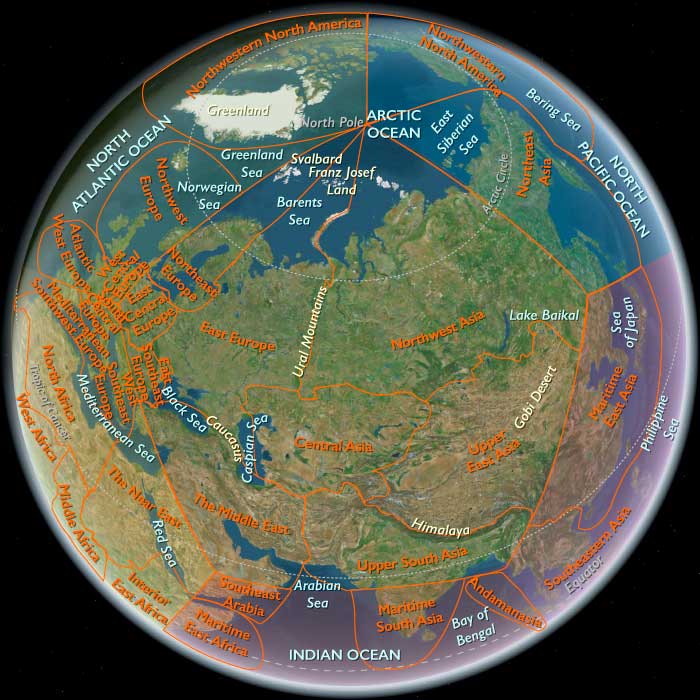
The Near and Middle East includes three fixed subregions:
-
The Near East — Israel, Egypt, Sudan, western Saudi Arabia, Yemen, Jordan, southwestern Turkey, and southwestern Cyprus.
-
The Middle East — Iraq, Iran, Syria, Armenia, Georgia, Azerbaijan, Qatar, Bahrain, the United Arab Emirates, eastern Jordan, eastern Saudi Arabia, and northern Oman.
-
Southeast Arabia — southern Oman, eastern Yemen, and the island of Socotra.
This vast region links the Mediterranean, Red Sea, Persian Gulf, and Caspian Basin, bridging Africa, Europe, and Asia. It is dominated by deserts and highlands, punctuated by fertile river valleys (the Nile, Tigris, and Euphrates) and strategic straits — the Suez Canal, the Bab el-Mandeb, and the Strait of Hormuz — that define global trade and geopolitics.
Climate & Environmental Shifts
Aridity remained the defining condition. The 19th century brought episodes of famine and epidemic following droughts in Egypt, Iran, and the Arabian Peninsula. Irrigation schemes and canal building, such as the Suez Canal (opened 1869) and the Assiut Barrage (1902), transformed riverine agriculture. Petroleum exploration and urban expansion in the 20th century accelerated desertification and water demand. Monsoon moisture sustained oases in Oman and Yemen, while seasonal Nile floods continued until the Aswan High Dam (1960–70) reshaped the river’s ecology.
Subsistence & Settlement
-
Agrarian bases persisted in the Nile Valley, the Fertile Crescent, and the Iranian Plateau, producing wheat, cotton, dates, and fruits.
-
Nomadic and pastoral tribes in Arabia, the Levant, and Sudan maintained camel and sheep herding, adapting to modern markets.
-
Urbanization surged in Cairo, Istanbul, Tehran, Baghdad, Beirut, and Jeddah, intensified by European trade and oil wealth.
-
Port cities—Aden, Basra, Kuwait City, Manama, and Doha—grew into nodes of global commerce.
Technology & Material Culture
European imperial penetration introduced telegraphs, railways (notably the Hejaz Railway, 1908), and modern weaponry. In the 20th century, oil extraction and refining brought pipelines, tankers, and industrial zones. Traditional crafts—carpets, calligraphy, metalwork, and ceramics—remained vital symbols of identity. Concrete architecture and Western education transformed cities, while mosques and bazaars continued as cultural anchors.
Movement & Interaction Corridors
-
Trade routes: The Suez Canal reoriented world shipping; the Persian Gulf became an oil artery.
-
Pilgrimage: The Hajj connected Muslims globally through Mecca and Medina.
-
Migration: Rural–urban drift filled cities; labor migration later linked Yemenis, Egyptians, and Iranians to Gulf oil fields.
-
Military corridors: The Near and Middle East served as theaters of imperial rivalries—British in the Gulf and Egypt, Russians in the Caucasus, Ottomans across Anatolia and Arabia.
Cultural & Symbolic Expressions
-
Religion and reform: Islamic modernists such as Jamal al-Din al-Afghani and Muhammad Abduh sought synthesis of faith and reason; Christian minorities in Lebanon and Armenia fostered education and journalism.
-
Literature and art: The Nahda (Arab Renaissance) revived Arabic prose and poetry; Persian and Turkish writers blended realism with nationalism.
-
Architecture: Cairo’s modern boulevards, Tehran’s avenues, and oil-era Gulf skylines redefined urban form while domed mosques and minarets remained emblems of continuity.
-
Music and media: Radio and cinema from Cairo, Tehran, and Istanbul spread popular culture across linguistic and sectarian boundaries.
Environmental Adaptation & Resilience
Desert agriculture expanded through artesian wells and canals; the introduction of cash crops like cotton in Egypt and tobacco in Iran restructured rural economies. Oases sustained date-palm and grain cultivation, while pastoralists adjusted routes to motor transport and border restrictions. In coastal cities, desalination and modern infrastructure emerged to offset water scarcity.
Political & Military Shocks
-
Imperial decline and reform:
-
The Ottoman Empire weakened, culminating in its dissolution after World War I.
-
Egypt’s Muhammad Ali dynasty modernized administration and industry but fell under British occupation (1882).
-
Iran’s Qajar dynasty faced constitutional revolution (1905–11) and later Pahlavi modernization (from 1925).
-
-
World Wars and mandates: British and French mandates carved up former Ottoman territories; Iraq, Syria, Lebanon, Transjordan, and Palestine emerged under European oversight.
-
Nationalism and revolution:
-
Turkey’s Republic (1923) under Mustafa Kemal Atatürk secularized and industrialized Anatolia.
-
Arab nationalism surged—Nasser’s Egypt championed anti-imperial unity.
-
Iran underwent the 1951 oil nationalization crisis and the White Revolution (1963).
-
The Zionist movement culminated in the creation of Israel (1948) and successive Arab–Israeli wars (1948, 1956, 1967).
-
-
Oil and Cold War: The discovery of major oil fields (Iran 1908; Iraq 1927; Saudi Arabia 1938; Kuwait 1938) made the region central to global power politics. U.S. and Soviet rivalry deepened through alliances and arms races.
Transition
Between 1828 and 1971, the Near and Middle East transformed from imperial provinces and desert sultanates into a mosaic of nation-states, revolutionary republics, and monarchies bound by oil and ideology. The collapse of Ottoman and colonial empires unleashed nationalist movements, while petroleum wealth and Cold War geopolitics redefined economies and alliances. In the deserts of Arabia and the deltas of the Nile and Tigris-Euphrates, modernization coexisted with faith, and cities like Cairo, Tehran, and Riyadh became centers of a region poised between deep tradition and global transformation
The Middle East (1828–1971 CE): Qajar and Ottoman Struggles, Oil Empires, and Cold War Realignments
Geography & Environmental Context
The Middle East includes Iraq, Iran, Syria, Armenia, Georgia, Azerbaijan, Qatar, Bahrain, the United Arab Emirates, most of Turkey (except its European and southwestern parts), eastern Jordan, nearly all of Lebanon, eastern Saudi Arabia, and northern Oman. Anchors include the Tigris–Euphrates basin, the Zagros and Caucasus ranges, the Iranian plateau, the Caspian littoral, the Levantine corridor, and the Persian/Arabian Gulf. This subregion connected Mediterranean, Russian, and Indian Ocean worlds while enduring pressures from empire, revolution, and global energy demand.
Climate & Environmental Shifts
The waning Little Ice Age gave way to modern warming trends, but aridity remained dominant. The Fertile Crescent endured cycles of drought and flood, disrupting agriculture. The Caspian and Persian Gulf coasts supported fisheries and palm groves, while deserts of Iraq, Syria, and Arabia constrained settlement. Earthquakes (notably in Iran and Turkey) punctuated the landscape. After the mid-20th century, dams like the Aswan High Dam’s regional counterparts (e.g., Iran’s Karaj Dam, Turkey’s Keban project) sought to control rivers and support hydroelectricity.
Subsistence & Settlement
-
Agriculture: Wheat, barley, and rice dominated in Mesopotamia and Iran’s plains; date groves thrived in Basra, Khuzestan, and Gulf oases. Tobacco, cotton, and citrus became key cash crops in Syria, Lebanon, and northern Iran.
-
Pastoralism: Nomadic and semi-nomadic tribes (Bedouin, Bakhtiari, Kurdish, Turkmen) persisted, though sedentarization campaigns curtailed mobility in the 20th century.
-
Urbanization: Cities like Baghdad, Damascus, Tehran, Tabriz, Aleppo, and Baku grew as administrative centers. Beirut blossomed as a Levantine port; Gulf towns like Manama, Doha, and Dubai remained small but were transformed by oil after the 1950s.
-
Oil settlements: From the 1900s, Abadan, Kirkuk, Dhahran, and Bahrain became boomtowns linked to Anglo-Iranian and American oil companies.
Technology & Material Culture
-
19th century: Telegraph lines, railways (Berlin–Baghdad, Hejaz, Trans-Iranian), and steam navigation linked the region to Europe.
-
20th century: Oil refineries, pipelines (Kirkuk–Haifa, Abadan–Mediterranean), and dams modernized infrastructure. Cars, radios, and cinemas spread after WWII; by the 1960s, televisions and concrete apartment blocks reshaped urban life.
-
Everyday life: Bazaar craft traditions—carpets, textiles, ceramics—coexisted with imported mass goods. Mosques, churches, and synagogues continued as architectural anchors.
Movement & Interaction Corridors
-
Imperial routes: Russian expansion in the Caucasus (taking Armenia, Georgia, Azerbaijan) and British routes through the Gulf redefined boundaries.
-
Trade: Caravans from Iran and Iraq moved wool, carpets, and livestock; steamships carried oil and pilgrims.
-
Pilgrimage: Shiʿi shrines at Najaf and Karbala attracted millions; Sunni routes to Mecca drew eastern pilgrims via Basra and Gulf ports.
-
Oil corridors: Tankers carried Gulf crude to Europe and Asia; pipelines bound Kirkuk and Abadan to Mediterranean ports.
-
Diaspora & labor: Armenians, Assyrians, and Kurds migrated amid wars; Palestinian refugees after 1948 and 1967 transformed Jordan, Lebanon, and Syria.
Cultural & Symbolic Expressions
-
Religion: Islam predominated (Sunni in Anatolia, Syria, Iraq; Shiʿi in Iran, southern Iraq, eastern Arabia); Christian minorities (Armenian, Assyrian, Maronite, Greek Orthodox) and Jewish communities remained vital until large-scale emigration after 1948.
-
Intellectual life: The Nahda (Arab Renaissance) spread through Beirut, Damascus, and Baghdad; Iranian reformers blended constitutionalism with Shiʿi thought.
-
Arts & media: Persian poetry, Arabic novels, Turkish press, and Levantine theater flourished; postwar Egyptian cinema circulated regionally. Radio speeches—Nasser, Mossadegh, Baʿath leaders—became political rituals.
-
Identity movements: Pan-Arabism, pan-Islamism, and early pan-Turkism shaped discourse. Kurdish nationalism emerged, while Zionist movements abroad affected regional politics through immigration to neighboring Palestine.
Environmental Adaptation & Resilience
-
Irrigation: Canals in Iraq and Iran expanded, though salinization plagued Mesopotamian soils.
-
Oases: Wells, qanats, and date-palm agroforestry sustained Gulf and Iranian plateau communities.
-
Nomadic strategies: Seasonal migration and diversified herds buffered risk; modern states sought to sedentarize tribes, often disrupting resilience.
-
Urban adaptation: Markets, hammams, and communal charities supported survival in famine and flood; post-WWII welfare states extended these functions through subsidies and public works.
Political & Military Shocks
-
Ottoman decline & Russian advance: Russo-Persian wars led to treaties (Turkmenchay 1828) ceding Caucasian lands to Russia. Ottoman Syria and Iraq faced autonomy movements.
-
Iran: The Qajar dynasty (1789–1925) managed concessions to Britain and Russia, sparking nationalist protest; the 1906 Constitutional Revolution curtailed monarchy briefly.
-
Iraq: British occupied Mesopotamia in WWI; mandate rule (1920–32) preceded monarchy and eventual 1958 revolution.
-
Syria & Lebanon: French mandate (1920–46); independence brought coups and eventual Baʿathist ascendancy.
-
Turkey: Atatürk’s republic (1923) reformed Anatolia’s western and central regions, overlapping with this subregion’s borders in Adana and southeastern Turkey.
-
Oil politics: 1901 D’Arcy concession (Iran), 1908 oil discovery at Masjed Soleyman, and formation of Anglo-Iranian Oil Company (later BP). Gulf sheikhdoms signed British treaties, setting the stage for independence in the 1960s–70s.
-
Arab–Israeli conflict: Though Israel itself lies outside this subregion, wars of 1948 and 1967 deeply reshaped its neighbors—Jordan lost East Jerusalem, Syria lost the Golan, Lebanon absorbed refugees.
-
Revolutions & coups: Egypt’s Free Officers inspired Iraq (1958) and Syria (1963); Iran’s Mossadegh nationalized oil (1951) before a 1953 coup restored the Shah.
Transition
Between 1828 and 1971, the Middle East was remade from Ottoman and Qajar borderlands into a set of oil-rich nation-states entangled in global power struggles. Early decades saw imperial encroachment, concessions, and mandates; the 20th century brought oil exploitation, nationalist revolts, and Cold War alignments. The rise of Baʿathism, Arab socialism, and pan-Islamic calls reshaped identity, while Gulf emirates edged toward independence under British withdrawal (1971). By the end of this period, pipelines, refineries, and revolutionary movements had replaced caravan and oasis rhythms, making the Middle East both the strategic heart of the Cold War and the stage for new conflicts over sovereignty, resources, and ideology.
The Al Saud are not the only threat to the Trucial States.
Despite its treaty agreement with Britain, Bahrain on several occasions claims Qatar because of the Al Khalifa involvement on the peninsula.
The Omanis and Iranians have also claimed Bahrain because both have held the island at various times.
Furthermore, the Ottomans claim Bahrain occasionally and try throughout the latter part of the nineteenth century to establish their authority in Kuwait and Qatar.
East-West trade through the Persian Gulf dries up in the nineteenth century after the opening of the Suez Canal, which provides an all-water route to the Mediterranean Sea.
Gulf merchants continue to earn substantial income from the slave trade, but international pressure, mostly from Britain, forces them to abandon this by 1900.
Hereafter, the region continues to profit from the gulf pearl beds, but this industry declines in the 1930s as a result of the world depression, which reduces demand, and as a result of the Japanese development of a cheaper way to "breed" pearls, or make cultured pearls.
The British wish to maintain security on the route from Europe to India so that merchants can safely send goods between India and the gulf.
Britain also seeks to exclude the influence in the area of other powers, such as the Ottoman Empire and France.
On his release, Qaboos bin Said consolidates the sultanate's hold over the interior, then solicits regional rather than British help to put down the rebellion in Dhofar.
Other Arab leaders, as well as the shah of Iran, send troops to Oman in response to Qaboos bin Said's requests; with the help of this coalition, by late 1975 the sultan will end the Dhofar rebellion.
Oil revenues do not change traditional tribal ideas about leadership.
New money, however, increases the influence of area leaders by giving them more resources to distribute.
Because of oil exploration, tribal boundaries become clearer, and areas are defined more precisely.
Distinctions among tribes also became more evident.
A new sense of identity appears in gulf shaykhdoms and arouses a growing expectation that they should rule themselves.
To do this, shaykhs have to cut themselves off from British control and protection.
This voluntary isolation by the sheikhs is something to which the British have little objection by the early 1960s.
India and Pakistan had won their independence in 1947, meaning that Britain no longer has to worry about protecting the western flank of the subcontinent.
Britain is also burdened by the tremendous sacrifices it made during the Second World War and cannot be as globally involved as it had been before the war.
Therefore, Britain yields many of its strategic responsibilities to the United States in the postwar period or gives them up entirely.
However, the British are bound to the gulf by treaties and so remain in the region, but it is clear by the 1960s that they seek to leave the gulf.
Kuwait is the first state to terminate the agreement connecting it with Britain.
Oil production in Kuwait has developed more quickly than in neighboring states; as a result, Kuwaitis are better prepared for independence.
They declare independence in 1961 but run into immediate trouble when Iraq claims their territory.
The Iraqis argue that the British had recognized Ottoman sovereignty over Kuwait before the First World War and, because the Ottomans had claimed to rule Kuwait from what was then the province of Iraq, the territory should belong to Iraq.
The British immediately send troops to Kuwait to deter any Iraqi invasion.
British and Kuwaiti positions are supported by the newly formed League of Arab States (Arab League), which recognizes the new state and sends troops to Kuwait.
The Arab League move leaves the Iraqis isolated.
Accordingly, when a new Iraqi government comse to power in 1963, one of its first steps is to give up its claim and recognize the independence of Kuwait.