
China, People's Republic of
State | Active
1949 CE to 2057 CE
Worlds
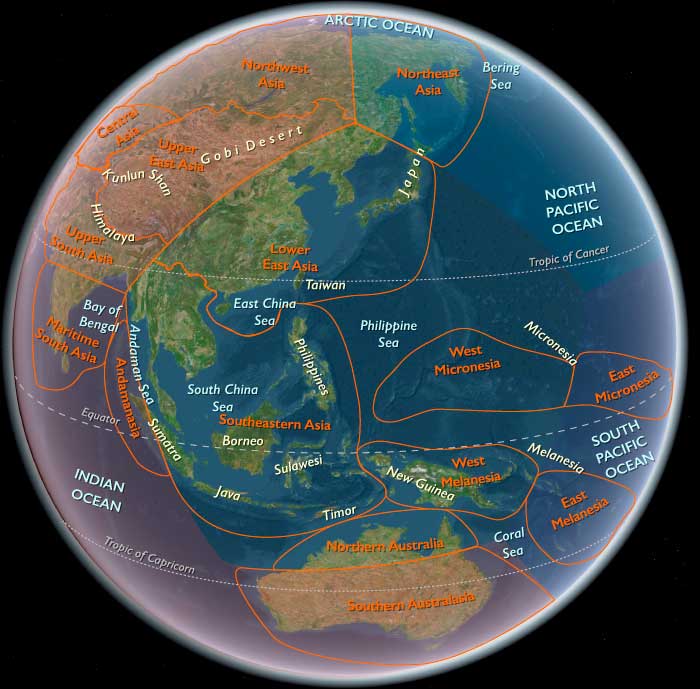
The Far East
View →Related Events
Showing 10 events out of 24 total
Southeast Asia (1828–1971 CE)
Colonial Grids, Island Arcs, and the Long March to Independence
Geography & Environmental Context
Southeast Asia in this framework comprises two fixed subregions:
-
Southeastern Asia: the Indochinese peninsula (Myanmar, Thailand, Laos, Cambodia, Vietnam), the Malay Peninsula, and the great archipelagos of Sumatra–Java–Borneo–Sulawesi and the Philippines.
-
Andamanasia: the Andaman and Nicobar Islands in the Bay of Bengal and the outer-island arc off Sumatra—Aceh, Simeulue, Nias, the Batu and Mentawai Islands (excluding the Mergui Archipelago and Thailand’s west coast).
Volcanic chains, folded highlands, alluvial deltas (Irrawaddy, Chao Phraya, Mekong, Red), mangrove coasts, and reef-fringed islands create one of the world’s most diverse human ecologies.
Climate & Environmental Shifts
Monsoons dictated seasons; ENSO cycles brought episodic droughts and floods. Cyclones battered the Bay of Bengal and South China Sea littorals; great rivers shifted with silt loads from hillside logging and war-time disruption. Along the Sunda trench, earthquakes and tsunamis periodically struck Aceh–Nias–Mentawai; volcanic eruptions (e.g., Krakatoa, 1883) altered coastlines, fisheries, and global climate. Colonial plantations cleared forest belts; 20th-century damming and irrigation reworked paddies and dry fields.
Subsistence & Settlement
-
Rice heartlands in Myanmar, Thailand, Vietnam, and Java intensified wet-rice (irrigated) and rain-fed systems; canals and dikes extended deltas.
-
Plantations & mines reoriented landscapes: rubber and tin in Malaya; coffee, tea, sugar, tobacco in the Dutch archipelago; sugar, hemp in the Philippines; nickel, coal, oil in parts of Indonesia.
-
Andamanasia balanced copra, sago, cloves, and pepper with fishing; the Andaman & Nicobar served the British Raj as a penal settlement (Port Blair), while Aceh’s uplands and coasts supported pepper gardens and Islamic scholarly towns.
-
Urban hubs—Saigon/Ho Chi Minh City, Hanoi, Bangkok, Rangoon/Yangon, Singapore, Batavia/Jakarta, Manila—grew on port and railway grids; Banda Aceh, Padang, Medan, and Port Blair tied Andamanasia into colonial networks.
Technology & Material Culture
Steamships, lighthouses, and telegraph cables stitched coasts to metropoles. The 19th century laid roads, rails, canals, and irrigation schemes (e.g., Cochinchina’s canal grids; Java’s irrigation works). Rubber tapping, tin dredging, and oil rigs transformed work rhythms; mission and vernacular presses fostered literacy. After WWII, airfields and highways expanded; small engines and outboard motors changed coastal livelihoods. Tiled mosques, wats, and churches stood beside longhouses, kampong stilt houses, and shophouse streets.
Movement & Interaction Corridors
-
Diasporas reshaped society: Chinese and Indian migrants fueled plantations, mines, and trade in Malaya, Burma, Thailand, and the Indies; Javanese and Chinese migrated intra-archipelago.
-
Pilgrimage & scholarship flowed through Aceh—the “Verandah of Mecca”—and port cities; Andaman & Nicobar saw convict, guard, and trader circuits of the Raj.
-
War corridors: Japanese occupation (1941–45) militarized ports, rails, and airstrips; Allied return routes cross-cut deltas and hill country; postwar insurgencies made jungles and mountains strategic spaces.
Cultural & Symbolic Expressions
Theravāda Buddhism (Thailand, Burma/Myanmar, Laos, Cambodia), Islam (Malaya, Sumatra/Aceh, parts of Borneo), Catholicism (Philippines, Vietnam enclaves), and Confucian and indigenous traditions intertwined. Reformist presses and schools incubated national literatures: Vietnamese quốc ngữ journalism, Indonesian and Malay novels, Filipino propagandists, Burmese and Thai reformers. In Andamanasia, Acehnese ulama sustained Islamic learning and resistance; Nicobarese and Andamanese kept island cosmologies even as penal and mission regimes pressed in.
Environmental Adaptation & Resilience
Intensive rice ecologies (terraces, bunds, dikes) buffered monsoon swings; swidden–wet rice mosaics in uplands spread risk. Island communities hedged with copra gardens, lagoon fisheries, breadfruit, sago, and inter-island reciprocity. After cyclones or war, kin networks and temple or mosque charities organized rebuilding; post-1960s “Green Revolution” seeds and fertilizers began to alter village agronomy.
Political & Military Shocks
-
Colonial consolidation (19th–early 20th c.):
-
British in Burma and Malaya/Singapore; French in Indochina; Dutch in the East Indies; U.S. in the Philippines; Siam/Thailand remained formally independent but ceded buffer territories.
-
Aceh War (1873–1904): a long anti-Dutch jihad reshaped Sumatra’s northwest; Mentawai and Nias folded into Dutch rule with missionization and pax colonia.
-
Andaman & Nicobar penal settlement entrenched British control in the Bay of Bengal.
-
-
Japanese occupation (1941–45): dismantled colonial rule, mobilized labor, and built military infrastructure; famine and atrocities scarred Indochina and Burma.
-
Independence waves:
-
Indonesia proclaimed 1945 (recognized 1949); Burma 1948; Philippines 1946; Malaya 1957 (Malaysia 1963; Singapore independent 1965); Laos, Cambodia, Vietnam 1953–54 (with Vietnam’s partition).
-
Konfrontasi (1963–66) rattled new Malaysia; Sukarno → Suharto (1965–66) upheaval reordered Indonesia.
-
Vietnam War escalation (1960s), Laotian/Cambodian conflicts, Malayan Emergency (1948–60), and Burmese coups (1962) defined the Cold War map.
-
Transition
Between 1828 and 1971, Southeastern Asia moved from plantation grids and concessionary mines under European flags to a mosaic of independent states and Cold War battlegrounds. Japanese occupation shattered imperial prestige; postwar governments asserted sovereignty but faced insurgency, partition, and economic rebuilding. In Andamanasia, the Aceh War and penal colony years epitomized the arc from coercion to contested autonomy; in the wider region, rice fields, rubber estates, and ports fed a global economy even as revolutions and wars redrew borders. By 1971, Bangkok, Jakarta, Manila, Saigon, Rangoon, Singapore, and Kuala Lumpur anchored a transformed region—its monsoon ecologies and island arcs still the stage on which new nations balanced tradition, development, and geopolitical pressure.
East Asia (1828–1971 CE)
Empires Unraveled, Revolutions Forged, and Economic Miracles Begun
Geography & Environmental Context
East Asia encompasses the great continental and insular arc from the Tibetan Plateau to the Pacific—two subregions held constant in this framework:
-
Upper East Asia: Mongolia and western China (Tibet, Xinjiang, Qinghai, Gansu, Ningxia, and adjoining uplands).
-
Lower East Asia: eastern and southern China, Taiwan, the Korean Peninsula, Japan, and the Ryukyu and Izu island chains.
The region spans deserts, plateaus, and alpine basins in the interior to humid river plains and monsoon coasts in the east. Its great rivers—the Yellow, Yangtze, and Pearl—linked agricultural cores to seaports that became gateways of both commerce and foreign control.
Climate & Environmental Shifts
Monsoon cycles continued to shape harvests. The 19th century saw floods, droughts, and famine in China (notably the North China Famine, 1876–79). Deforestation and siltation worsened flood damage in the Yellow River basin. The 20th century brought dam projects, terracing, and reforestation but also wartime devastation and later industrial pollution. Typhoons and earthquakes periodically struck Japan, Taiwan, and coastal China.
Subsistence & Settlement
-
Rural continuity: Rice, wheat, and millet remained staples; peasants formed the majority until mid-century land reforms.
-
Urban growth: Treaty ports (Shanghai, Tianjin, Yokohama, Nagasaki) became colonial enclaves; later, modern metropolises—Tokyo, Osaka, Seoul, Shanghai, Beijing—drove industrialization.
-
Migration: Millions moved within and beyond China as laborers and merchants; Mongolian and Tibetan pastoralists faced sedentarization under imperial and later socialist regimes.
Technology & Material Culture
Western industrial technology entered through ports and reforms. Railways, telegraphs, and steam navigation spread from the 1870s. After 1945, mechanization, electrification, and mass production reshaped daily life. Traditional crafts—porcelain, silk, lacquer, calligraphy—remained cultural touchstones even amid industrial growth. In the interior, Buddhist monasteries and nomadic tents coexisted with new socialist collectives and mines.
Movement & Interaction Corridors
-
Continental routes: Trans-Siberian and Chinese trunk railways integrated the interior.
-
Maritime networks: The Pacific and South China Sea tied treaty ports to global trade.
-
Diasporas: Chinese merchants, Korean and Japanese migrants, and Tibetan traders extended East Asian networks across Asia and beyond.
-
Military corridors: Repeated wars—the Opium Wars, Sino-Japanese conflicts, Pacific War, and Korean War—turned transport arteries into front lines.
Cultural & Symbolic Expressions
Confucian and Buddhist traditions persisted but were challenged by Christianity, socialism, and nationalism. The Meiji Restoration (1868) in Japan redefined tradition as modernization; Chinese reformers sought to “self-strengthen” through Western science; Mongolian and Tibetan Buddhism adapted to socialist oversight. Literature and art blended realism and modernism: Lu Xun in China, Tanizaki and Kawabata in Japan, Kim Sowol in Korea. Folk and classical forms—from Chinese opera to Japanese kabuki—remained central to identity.
Environmental Adaptation & Resilience
Irrigation and terracing stabilized yields; community granaries and kinship networks mitigated famine. After mid-century, land reform and collectivization in China, North Korea, and Mongolia transformed agrarian systems. Japan’s and South Korea’s reforestation and flood-control programs paralleled rapid industrial pollution control efforts by the late 1960s.
Political & Military Shocks
-
China: Opium Wars (1839–60) opened treaty ports; the Taiping (1850–64) and Boxer (1899–1901) uprisings shattered Qing control. The 1911 Revolution ended dynastic rule; the People’s Republic (1949) followed decades of warlordism, invasion, and civil war.
-
Japan: The Meiji state (1868) industrialized, defeated China (1894–95) and Russia (1904–05), built an empire, and after WWII reconstruction became an economic power.
-
Korea: From late-19th-century reforms through Japanese annexation (1910–45) to division after liberation and the Korean War (1950–53).
-
Mongolia: Gained independence from Qing (1911), became a Soviet-aligned republic (1924).
-
Tibet & Xinjiang: Integrated into the PRC (1950s) through force and reform; revolts in Tibet (1959) and Xinjiang repression marked ongoing contestation.
-
Cold War: East Asia was divided—communist mainland versus capitalist maritime rim—anchoring the global bipolar order.
Transition
Between 1828 and 1971, East Asia was remade through revolution, industrialization, and ideological division. Dynastic empires gave way to republics, colonies to nation-states. Japan and the “Little Tigers” entered early economic miracles; China and its interior pursued socialist transformation; Korea remained split; Mongolia and Tibet navigated life within Soviet and Chinese spheres. Across the region, modernization carried the weight of memory—Confucian ethics, Buddhist cosmology, and ancestral landscapes enduring beneath steel, slogans, and neon.
Maritime East Asia (1828–1971 CE): Dynastic Collapse, Imperial Encounters, and Industrial Revolutions
Geography & Environmental Context
Maritime East Asia encompasses southern and eastern China (Yunnan, Guangxi, Guizhou, Sichuan Basin, Chongqing, Hunan, Hubei, Henan, Shanxi, Hebei, Beijing, Guangdong, Fujian, Zhejiang, Jiangsu, Shandong, Liaoning, Jilin, southern Heilongjiang), Taiwan, the Korean Peninsula, southern Primorsky Krai, and the Japanese islands of Kyushu, Shikoku, Honshu, and southwestern Hokkaidō, plus the Ryukyu and Izu island chains. Anchors include the Yangtze and Yellow River basins, the Sichuan Basin, the Pearl River Delta, the Korean mountains and Han River valley, and the Japanese archipelago stretching into the Pacific.
Climate & Environmental Shifts
The subregion’s monsoonal regime brought alternating floods and droughts. China’s Yellow River repeatedly shifted course (notably floods of 1855, 1931), devastating farmlands. Famines struck northern China and Korea in the 19th century; deforestation in uplands worsened soil erosion. Typhoons regularly battered Taiwan, Fujian, and the Ryukyu chain. Industrial urbanization in Japan, Korea, and later coastal China introduced pollution and new ecological strains by the mid-20th century.
Subsistence & Settlement
-
China: Rice dominated the south (Yangtze, Pearl deltas); wheat, millet, and sorghum fed the north. Tea, silk, and cotton underpinned commerce. Urban hubs like Beijing, Shanghai, Guangzhou, Wuhan, and Chongqing grew rapidly.
-
Korea: Rice paddies in the south, millet and barley in the north; fishing villages dotted the coasts. Seoul (Hanyang) expanded modestly until the late 19th century, then became a colonial capital under Japan.
-
Japan: Rice agriculture was the base, but from the Meiji era (1868), industrialization transformed Osaka, Tokyo, and Yokohama into manufacturing and commercial centers.
-
Taiwan: Rice and sugar cultivation thrived; under Japanese colonial rule (1895–1945), plantations and infrastructure expanded.
-
Primorsky Krai: Fishing, forestry, and Russian settler agriculture integrated this fringe into both East Asian and Siberian networks.
Technology & Material Culture
-
19th century China: Weaving, porcelain, and handicrafts persisted; steamships, telegraphs, and railways entered through treaty ports.
-
Japan: The Meiji era imported Western technology; shipyards, railways, and modern factories reshaped cities. Postwar, Japan pioneered electronics and automobiles.
-
Korea: Under Japanese rule (1910–1945), railways, mines, and ports were developed; after 1945, the peninsula divided—North Korea industrialized under Soviet aid; South Korea struggled with war but began post-1960s export-driven growth.
-
Taiwan: Railways, irrigation, and port works under Japan; post-1949 Nationalist rule built industry with American support.
Movement & Interaction Corridors
-
Maritime hubs: Shanghai, Guangzhou, Nagasaki, and Busan tied the region into global shipping.
-
Railroads: Transcontinental Russian lines reached Primorsky; Japan built dense domestic networks; China’s first railways (1870s onward) expanded in treaty-port regions.
-
Migration: Millions of Chinese emigrated to Southeast Asia and the Americas; Japanese settlers moved into Korea and Taiwan under empire.
-
War corridors: From the Opium Wars (1839–42) to the Sino-Japanese War (1894–95), Russo-Japanese War (1904–05), Pacific War (1941–45), and the Korean War (1950–53), armies moved repeatedly across the subregion.
Cultural & Symbolic Expressions
-
China: The late Qing saw the Taiping and Boxer upheavals; Confucian traditions contended with Christian missions and modern reform. Republican-era intellectuals (May Fourth Movement, 1919) fostered new literature and nationalism.
-
Japan: The Meiji Restoration cultivated Shinto nationalism and Western-style arts; post-1945, pacifist democracy blended tradition with global modernism.
-
Korea: Confucian yangban culture dominated until colonization; Korean nationalism and literature grew under Japanese censorship; division after 1945 entrenched contrasting socialist and capitalist cultures.
-
Taiwan: Indigenous Austronesian traditions persisted alongside Chinese settler practices; Japanese colonial architecture and education left a lasting imprint.
-
Pan-Asian encounters: Buddhism, Confucianism, Shinto, Christianity, and modern ideologies all competed for influence.
Environmental Adaptation & Resilience
-
Flood control: Dikes and canals in China remained vital; 20th-century hydropower projects (Three Gorges precursors, 1950s–60s) began reshaping rivers.
-
Agrarian diversification: Potatoes, maize, and sweet potatoes spread, buffering famine in parts of China and Korea.
-
Urban resilience: Post-1945 reconstruction rebuilt Tokyo, Seoul, and Shanghai after wartime devastation.
-
Industrial adaptation: Japan rebuilt rapidly after 1945 into an export powerhouse, while China’s collectivization and Great Leap Forward (1958–62) caused famine but later stabilized under gradual reforms.
Political & Military Shocks
-
China:
-
Opium Wars (1839–42, 1856–60) opened treaty ports.
-
Taiping (1850–64) and Boxer (1899–1901) Rebellions shook Qing rule.
-
Fall of Qing (1911), Republic of China, and civil war (1920s–1949).
-
PRC founded 1949; Great Leap Forward (1958–62) and Cultural Revolution (1966–76) disrupted society.
-
-
Japan:
-
Meiji Restoration (1868); rapid modernization and empire-building.
-
Wars with China (1894–95), Russia (1904–05), and WWII (1941–45).
-
Defeat in 1945; U.S. occupation (1945–52) imposed democratic reforms.
-
-
Korea:
-
Annexed by Japan (1910–45); liberation after WWII.
-
Division (1945) and Korean War (1950–53) entrenched North/South split.
-
-
Taiwan:
-
Japanese colony (1895–1945).
-
Became base of Republic of China (Kuomintang) after 1949.
-
-
Primorsky Krai: Incorporated into Russian Empire (mid-19th c.); fortified as Soviet Far Eastern frontier in the Cold War.
Transition
Between 1828 and 1971, Maritime East Asia moved from dynastic decline and semi-colonial pressures to industrial revolutions, world wars, and ideological division. Qing China collapsed into republican and then communist rule; Japan transformed into both an empire and then a postwar economic powerhouse; Korea endured colonization, liberation, and Cold War partition; Taiwan became the stronghold of the Kuomintang. By 1971, the subregion was a Cold War flashpoint—with China’s UN seat transferring to the PRC, Japan rising as a global economic power, and the Korean peninsula divided—yet also a region of cultural dynamism and resilience rooted in centuries-old agrarian and urban traditions.
Central Asia (1828–1971 CE): Khanates to Republics: Rails, Cotton, and the Soviet Steppe
Geography & Environmental Context
Central Asia spans the Kazakh steppe (to the Irtysh and Altai forelands), the Karakum and Kyzylkum deserts, and the irrigated oases of the Amu Darya and Syr Darya—notably Bukhara, Samarkand, Khiva, and the Ferghana Valley—along with the Tian Shan–Pamir–Alay ranges and the Caspian east littoral. Anchors include the Aral Sea, Ustyurt Plateau, and passes to Kashgar and Badakhshan. This is a gradient from steppe grasslands to desert basins and snow-fed river oases.
Climate & Environmental Shifts
A continental climate brought droughts and harsh winters. The 19th century saw periodic dzud (ice-crust winters) killing herds; the 20th century added irrigation expansion that shrank the Aral Sea. Dust storms and salinization increased as cotton acreage rose. Mountain glaciers fed oases but were vulnerable to warming and overuse downstream.
Subsistence & Settlement
-
Steppe (Kazakh zhuzes): Transhumant herding of horses, sheep, camels; seasonal camps became kolkhoz/sovkhoz centers under Soviet rule.
-
Oases (Bukhara, Khiva, Samarkand, Ferghana): Wheat, melons, fruit, and especially cotton; bazaars and madrasas structured urban life.
-
Deserts: Karakum and Kyzylkum supported caravan wells and later pipelines and rail.
-
Soviet transformation: Collectivization (1930s) and virgin-lands plowing (1950s) altered settlement; towns like Tashkent, Almaty, Frunze (Bishkek), Dushanbe industrialized.
Technology & Material Culture
-
Rails & roads: The Trans-Caspian Railway (1880s) and later Turkestan–Siberian line integrated oases with Russia; postwar highways and airfields linked republics.
-
Irrigation: Canals (e.g., Great Fergana Canal, 1939) and later the Karakum Canal (1954–1988) massively expanded cotton; pumps, dams, and weirs transformed river regimes.
-
Industry: Textile mills, machine plants, mining (coal, copper, uranium), and oil/gas in western deserts burgeoned.
-
Everyday life: Yurts gave way to brick houses and Soviet apartments; bazaars coexisted with state shops; radios and cinemas spread socialist culture.
Movement & Interaction Corridors
-
Caravan to rail: Old Silk Road paths gave way to rail freight and troop trains; cotton and grain moved north, machinery south.
-
Migration: Tsarist settlement (Russians, Ukrainians, Volga Germans) into steppe; Soviet deportations and wartime evacuations reshaped demography. Virgin Lands recruited millions; oases drew rural labor into industry.
-
Cross-border linkages: Trade and cultural ties with Xinjiang persisted, though tightly controlled after 1949.
Cultural & Symbolic Expressions
-
Islamic learning: Bukhara and Samarkand’s madrasas persisted under repression; Sufi orders survived underground.
-
National formations: Jadid reformers (late 19th–early 20th c.) promoted modern education; the USSR carved Uzbek, Kazakh, Kyrgyz, Tajik, Turkmen republics with codified languages and folklore.
-
Arts: Persianate poetry, Turkic epics, and crafts endured; Soviet theaters and writers (Auezov, Abdulla Qahhor) merged national motifs with socialist realism.
-
Identity politics: Veiling campaigns (hujum), literacy drives, and korenizatsiya (indigenization) recast gender and ethnicity.
Environmental Adaptation & Resilience
-
Pastoral strategies: Herd diversification and winter shelters mitigated dzud; collectivization reduced flexibility.
-
Irrigation risks: Salinization, waterlogging, and Aral desiccation undermined long-term resilience; cotton monoculture made food supplies dependent on imports.
-
Hazard management: Soviet dams moderated floods but displaced communities; steppe shelterbelts fought wind erosion.
Political & Military Shocks
-
Tsarist conquest (1860s–1880s): Khanates subdued; protectorates established.
-
Revolution & Civil War: Basmachi resistance in the 1920s; Red Army consolidation created Soviet republics.
-
Collectivization & purges: Repression, famine, and deportations reshaped society.
-
World War II: Factories evacuated to Tashkent and Alma-Ata; Central Asia as rear base and troop supplier.
-
Postwar: Nuclear tests at Semipalatinsk; space launch support from Tyuratam/Baikonur (Kazakh steppe).
Transition
Between 1828 and 1971, Central Asia traversed a path from khanates and caravan oases to Soviet republics anchored by cotton, rails, and industry. The steppe’s herds were regimented; oases were dammed and piped; cities became hubs of science and production. Yet environmental costs—Aral Sea shrinkage, salinized fields, and dust storms—mounted, while cultural life balanced Islamic memory with Soviet nation-building. By 1971, Central Asia stood as a crucial Soviet hinterland and testing ground, its rivers and deserts harnessed to the ambitions of an industrial superpower.
South Asia (1828–1971 CE)
Colonial Rule, Partition, and the Making of Modern Nations
Geography & Environmental Context
South Asia includes two fixed subregions:
-
Northern South Asia — comprising Afghanistan, Pakistan, Nepal, Bhutan, Bangladesh, and northern India.
-
Southern South Asia — comprising southern India, Sri Lanka, and the Maldives.
Together these lands form the Indian subcontinent, bounded by the Himalayas, Arabian Sea, Bay of Bengal and the equatorial seas of the Indian Ocean. Anchors include the Indus and Ganges river systems, the Deccan Plateau, the Eastern and Western Ghats, and the island worlds of Sri Lanka and the Maldives.
Climate & Environmental Shifts
The monsoon system continued to govern agriculture, alternating between abundance and drought. The 19th century saw cycles of catastrophic famine (notably in Bengal and Deccan) under colonial revenue systems that prioritized exports. Deforestation and canal irrigation transformed landscapes; massive works like the Ganges Canal (1854) reshaped northern plains. In the 20th century, damming, green-revolution agriculture, and deforestation further altered ecological balance. Cyclones and floods remained recurrent threats along the Bay of Bengal.
Subsistence & Settlement
-
Colonial agriculture reoriented production toward cash crops — cotton, indigo, tea, and jute — for export, while subsistence farmers faced land pressure and debt.
-
Industrial centers arose in Calcutta (Kolkata), Bombay (Mumbai), and Madras (Chennai) under British rule; railways connected ports and interiors.
-
Plantations spread in Sri Lanka (tea, coffee, rubber) and the Maldives (coconut, fish).
-
Urban growth accelerated in the 20th century, with Delhi, Karachi, and Dhaka emerging as political and industrial capitals.
-
Indigenous lifeways persisted in highlands and deserts — pastoral nomadism in Afghanistan and Baluchistan, shifting cultivation in the Northeast Frontier, and temple-centered agriculture in peninsular India and Sri Lanka.
Technology & Material Culture
The British Raj introduced railways, telegraphs, postal networks, and canal irrigation, binding South Asia into an imperial economy. Steamships and later motor transport expanded coastal trade. Architecture blended Victorian Gothic with Mughal and Dravidian revival styles. Textile mills in Bombay and jute mills in Bengal industrialized artisanal crafts. In the 20th century, hydroelectric projects, universities, and film industries (especially in Bombay and Madras) symbolized modernization.
Movement & Interaction Corridors
-
Maritime routes linked Calcutta, Bombay, Colombo, and Karachi to global trade networks.
-
Railways and river systems carried grain, coal, and people across the subcontinent.
-
Labor migrations carried Indian and Sri Lankan workers to Southeast Asia, Africa, and the Caribbean as indentured laborers.
-
Pilgrimage routes to Varanasi, Bodh Gaya, and Kataragama endured, joined by new political and labor networks in the 20th century.
Cultural & Symbolic Expressions
-
Religious reform reshaped identity: Brahmo Samaj, Arya Samaj, Aligarh Movement, and Theosophy blended tradition and modernity.
-
Literary renaissances flourished — Rabindranath Tagore in Bengal, Bankim Chandra Chatterjee, and later Premchand, Iqbal, and Faiz voiced nationalist and humanist visions.
-
Nationalism and art fused in the work of Abanindranath Tagore, Nandalal Bose, and the Indian People’s Theatre Association.
-
Cinema emerged as a modern art form, culminating in postwar classics by Satyajit Ray and Raj Kapoor.
-
Music and dance revival movements (Bharatanatyam, Kathak, Hindustani and Carnatic classical) symbolized continuity and reform.
Environmental Adaptation & Resilience
Village and tribal economies adapted through diversified crops, communal water management, and temple or mosque-based charity. Famines prompted new irrigation and rail systems but also resistance to exploitative taxation. In the 20th century, Green Revolution technologies improved yields but widened regional inequalities. Himalayan and desert ecologies remained fragile under new infrastructure and deforestation.
Political & Military Shocks
-
Colonial consolidation: The East India Company extended control through warfare and treaties until the Rebellion of 1857, after which Britain imposed direct Crown rule.
-
Modernization and dissent: Education, print, and reform spurred nationalism; the Indian National Congress (1885) and Muslim League (1906) emerged as political vehicles.
-
Independence and Partition (1947): British withdrawal created India and Pakistan amid mass migration and communal violence.
-
Regional upheavals: Sri Lanka achieved independence (1948); Nepal ended monarchy autocracy (1950); Bhutan retained isolation until modernization under the Wangchuck dynasty; Maldives became independent (1965).
-
Wars and conflicts: Indo-Pakistani wars (1947–48, 1965, 1971), border war with China (1962), and the struggle of Bangladesh (culminating in independence, 1971) defined postcolonial geopolitics.
-
Cold War alignments: India pursued non-alignment under Jawaharlal Nehru, while Pakistan allied with Western blocs; Afghanistan and Nepal balanced Soviet, Chinese, and Indian influence.
Transition
From 1828 to 1971, South Asia journeyed from colonial subjugation to postcolonial nationhood. Railways, plantations, and English education under British rule created both dependency and modern tools for independence. Partition redrew maps and unleashed trauma, while new nations sought industrial growth and democratic governance amid persistent poverty. India and Pakistan emerged as rival powers; Sri Lanka, Nepal, and Bhutan charted divergent paths; the Maldives embraced autonomy. Despite war and inequality, ancient civilizations redefined themselves as modern states — heirs to both empire and enduring cultural continuity.
East Africa (1828–1971 CE)
Caravans, Kingdoms, Empires, and Independence
Geography & Environmental Context
East Africa comprises two fixed subregions:
-
Maritime East Africa — Somalia, eastern Ethiopia, eastern Kenya, eastern Tanzania (including Zanzibar and Pemba), northern Mozambique, southern Malawi, and the island nations of Comoros, Madagascar, Mauritius, and Seychelles.
-
Interior East Africa — Eritrea, Djibouti, Ethiopia, South Sudan, Uganda, Rwanda, Burundi, Zambia’s northwestern margin, northern Zimbabwe, northern Malawi, northwestern Mozambique, inland Tanzania, and inland Kenya.
Anchors include the Great Rift Valley, Lake Victoria, Lake Tanganyika, and Lake Malawi, the Ethiopian Highlands, the Swahili coast, and the Indian Ocean islands. The region stretches from coral coasts and monsoon ports to volcanic highlands and plateau kingdoms.
Climate & Environmental Shifts
Monsoon winds sustained coastal trade, while alternating wet and dry seasons structured inland life. The late 19th century saw famine and rinderpest (1890s) devastate livestock and populations. The 20th century brought ecological engineering—railways, irrigation, and conservation parks—alongside deforestation and soil erosion. Drought cycles recurred in the Horn and interior; locusts and tsetse flies remained persistent threats. Climatic contrasts between humid coasts and arid hinterlands shaped political geography, as highland states and lowland caravan routes competed for control of trade and people.
Subsistence & Settlement
-
Maritime East Africa: Coastal communities combined fishing, coral gardening, and small-scale farming of coconuts, cloves, and grains. On Zanzibar and Pemba, the clove plantations established under Sultan Seyyid Said thrived on enslaved labor. In Madagascar, the Merina Kingdom unified the central highlands and expanded wet-rice farming.
-
Interior East Africa: Highland polities such as Buganda, Bunyoro, and Ethiopia’s Shewa expanded through trade and conquest. Maize and banana cultivation sustained dense populations. After 1890, British, German, and Belgian colonial powers imposed hut taxes and cash-crop systems (cotton, coffee, sisal). Settler estates in Kenya and Tanganyika displaced African farmers; pastoralists adapted by engaging in labor markets or moving into reserves.
Technology & Material Culture
Caravan trade used oxen, donkeys, and later porters to carry ivory and slaves inland to coastal markets. The Uganda Railway (1896–1901) and the Tanga and Central Lines in German East Africa opened the interior to global commerce. Mission presses introduced literacy; railways and telegraphs expanded administration. In the 20th century, imported bicycles, radios, and sewing machines joined local crafts—basketry, textiles, wood carving, and ironwork—forming hybrid material cultures. Coastal stone architecture and carved doors persisted beside new cement towns.
Movement & Interaction Corridors
-
Indian Ocean monsoon routes connected Zanzibar, Mombasa, Lamu, Sofala, Aden, and Bombay; dhows carried people, ivory, slaves, and spices.
-
Caravan routes—notably those of Tippu Tip and Hamed bin Muhammad—linked the interior lakes to the coast.
-
Pilgrimage and diaspora: Muslim scholars traveled to Mecca; Indian, Arab, and Comorian traders settled in coastal cities.
-
Mission and education networks: CMS, White Fathers, and Jesuits spread Christianity, schools, and medical missions inland.
-
War and liberation corridors: WWII troop movements (Abyssinia Campaign, 1940–41), Mau Mau resistance in Kenya (1952–60), and Tanzania’s and Zambia’s postwar support for southern African liberation linked East Africa to wider continental struggles.
Cultural & Symbolic Expressions
The Swahili language and Islamic culture unified coastal societies, while inland oral traditions preserved lineage, cattle, and warrior ideals. Christianity expanded literacy and hymnody; Islam deepened scholarly and mercantile ties. Literature, from Hamitic chronicles to Swahili poetry, blended Arabic script and local forms. In the 20th century, anticolonial writers such as Ngũgĩ wa Thiong’o, Okot p’Bitek, and Julius Nyerere’s political essays articulated new visions of identity. Coastal music (taarab) and inland dances symbolized cultural fusion.
Environmental Adaptation & Resilience
Rotational cultivation and fallowing preserved soil fertility; pastoralists tracked rainfall patterns and rebuilt herds after rinderpest. Irrigation terraces in Ethiopia, banana groves in Buganda, and shifting cultivation in Madagascar reflected ecological diversity. In the 20th century, national parks (e.g., Serengeti, 1951; Tsavo, 1948) institutionalized conservation but often displaced local communities. Rural cooperatives, ujamaa villages, and community irrigation projects (1960s–70s) reflected adaptation to postcolonial development goals.
Political & Military Shocks
-
Colonial conquest: The Scramble for Africa (1880s–90s) divided the region among Britain, Germany, Belgium, France, and Portugal.
-
Ethiopia’s resilience: The Battle of Adwa (1896) preserved Ethiopian independence under Menelik II; Italian invasion (1935–41) under Mussolini was defeated in WWII with Allied support.
-
Resistance and uprisings: The Maji Maji Rebellion (1905–07) in German East Africa, the Hehe resistance, and the Somali Dervish movement (1899–1920) testified to enduring autonomy.
-
World Wars: East Africa was a key front in both conflicts; labor and resources were conscripted for imperial armies.
-
Decolonization:
-
Tanzania (1961), Uganda (1962), Kenya (1963), Malawi (1964), Zambia (1964), and Madagascar (1960) achieved independence.
-
Somalia unified its British and Italian territories (1960); Comoros and Mauritius followed later in the 1970s.
-
Eritrea was federated with Ethiopia (1952) and annexed (1962), sowing seeds of later conflict.
-
Regional federations such as the East African Community (1967) sought economic unity.
-
Transition
Between 1828 and 1971, East Africa transformed from a network of coastal sultanates and caravan kingdoms into a mosaic of colonial states and independent nations. The Swahili coast, once dominated by monsoon commerce and slavery, gave way to global trade in cash crops and labor migration. Inland, Christianity, Islam, and anticolonial nationalism remade political identity. Railways and cash crops reoriented the economy; liberation movements redrew its moral geography. By 1971, East Africa had become a region of independent states—from Ethiopia’s highlands to Madagascar’s forests—poised between the legacies of empire and the aspirations of Pan-African renewal.
Maritime East Africa (1828–1971 CE): Clove Empires, Colonial Partition, and Island Independence
Geographic & Environmental Context
The subregion of Maritime East Africa includes Somalia, eastern Ethiopia, eastern Kenya, eastern Tanzania and its islands, northern Mozambique, the Comoros, Madagascar, Mauritius, and Seychelles. Anchors included the Swahili ports of Zanzibar, Mombasa, and Mogadishu; the clove plantations of Zanzibar and Pemba; the rice terraces of the Merina highlands in Madagascar; and the sugar estates of Mauritius and Seychelles. From coral rag coasts and mangrove estuaries to highland terraces and volcanic islands, this littoral zone became both a hub of global commerce and a theater of European colonization.
Climate & Environmental Shifts
The retreat of the Little Ice Age brought warming trends, though coastal and island regions continued to experience cyclones and drought cycles. Zanzibar endured periodic clove crop failures from pests and storms. Madagascar’s south suffered recurrent drought, while highland rice fields stabilized production. Mauritius and Seychelles faced hurricanes that devastated sugar and coconut crops. Coastal fisheries remained resilient but faced pressure from expanding populations and trade.
Subsistence & Settlement
-
Zanzibar and Pemba: Became global centers of clove cultivation under Omani sultans, relying on enslaved Africans from the mainland. Rice, cassava, and coconuts sustained islanders; fishing and trade supplemented diets.
-
Swahili coast (Kenya–Tanzania–Mozambique): Farmers grew millet, cassava, and maize in coastal hinterlands; fishing and mangrove harvesting persisted. Towns expanded around ports linked to Indian Ocean trade.
-
Somalia and eastern Ethiopia: Pastoralists herded camels, sheep, and goats, supplementing with sorghum and date cultivation in oases.
-
Madagascar: The Merina kingdom centralized power under Radama I and successors, expanding rice terraces and cattle herding; coastal groups (Sakalava, Betsimisaraka) farmed, fished, and engaged in maritime trade.
-
Comoros: Mixed subsistence of rice, cassava, coconuts, and fishing; cloves planted in the 19th century tied islands into world markets.
-
Mauritius and Seychelles: Sugar estates dominated, worked by enslaved laborers until emancipation (1830s–1840s) and later Indian indentured migrants; coconuts and spices diversified production.
Technology & Material Culture
Omani rulers built stone palaces, forts, and clove-processing houses in Zanzibar. Dhows remained central for Indian Ocean trade, carrying cloves, ivory, and slaves. Imported firearms armed coastal elites. In Madagascar, Merina kings constructed fortified hill capitals and expanded irrigation systems. French colonists introduced European-style architecture and mills in Madagascar, Comoros, Mauritius, and Seychelles. Textiles, pottery, and coral-stone mosques continued Swahili traditions; in the Mascarenes, creole architecture and music blended African, European, and Indian influences.
Movement & Interaction Corridors
-
Slave and ivory trade: In the early 19th century, dhows carried enslaved Africans from mainland ports (Bagamoyo, Kilwa, Mozambique Island) to Zanzibar and beyond; ivory caravans reached deep into the interior.
-
Abolition: Britain pressured Zanzibar into anti-slavery treaties (1822, 1873), though clandestine trade persisted into the late 19th century.
-
Colonial partition: Britain took Kenya, Zanzibar (protectorate, 1890), and Somaliland; Germany claimed Tanganyika; France colonized Madagascar (1896) and the Comoros; Portugal retained Mozambique. Mauritius and Seychelles passed to Britain (1810).
-
Labor migrations: Indian indentured workers moved to Mauritius, Seychelles, and coastal East Africa. African porters staffed ivory and rubber caravans inland.
-
20th-century transport: Railways (Uganda Railway to Mombasa, Tanga line) tied coast to interior; steamships and later air links bound islands to global routes.
Cultural & Symbolic Expressions
Swahili Islamic culture thrived in mosques, Qur’anic schools, and poetry; Omani rule reinforced Arabic scholarship. The Zanzibar court became a symbol of coastal Islamic power. In Madagascar, Merina rulers blended traditional rituals with European-style monarchy until French conquest. Catholic and Protestant missions spread across the coast, Madagascar, and the islands, establishing schools and churches. Creole cultures flourished in Mauritius and Seychelles, expressed in séga music, cuisine, and festivals. Oral traditions, ancestor veneration, and ritual feasts persisted across the subregion.
Environmental Adaptation & Resilience
Farmers incorporated cassava, maize, and cloves to buffer crop failures. Pastoralists shifted herds seasonally in Somali and Ethiopian lowlands. Merina highlanders expanded rice terraces, securing resilience against famine. After emancipation, plantation societies adapted through indentured labor systems. Coastal and islanders rebuilt after cyclones, diversifying crops and relying on fishing. Conservation initiatives began mid-20th century, especially in Madagascar’s forests and island ecosystems.
Technology & Power Shifts (Conflict Dynamics)
-
Omani Zanzibar: Under Said bin Sultan, Zanzibar became a clove empire and slave entrepôt; later sultans governed under British oversight.
-
Colonial conquest: France subdued Madagascar (1896); Germany ruled Tanganyika until World War I, when Britain assumed control. Somalia was partitioned between Britain, Italy, and France. Portugal tightened rule in Mozambique.
-
Resistance: Local revolts resisted colonial demands—e.g., Maji Maji Rebellion (1905–1907) in German East Africa. Malagasy uprisings (1947) challenged French rule.
-
Independence movements: Mauritius (1968), Somalia (1960), Madagascar (1960), Comoros (1975, just beyond this span), and Seychelles (1976, also just beyond) emerged from decolonization. Zanzibar’s revolution (1964) overthrew the sultanate, uniting with Tanganyika to form Tanzania.
Transition
By 1971 CE, Maritime East Africa had been transformed from a Swahili–Omani corridor into a mosaic of colonial and postcolonial states. Zanzibar’s clove plantations, Madagascar’s rice highlands, and Mauritius’s sugar estates tied the region to global markets, even as nationalist movements reshaped politics. Swahili culture, Islamic learning, and Malagasy ritual traditions persisted alongside new Christian and creole identities. Maritime East Africa entered the modern era as both a crossroads of global trade and a crucible of independence struggles.
Maritime East Asia (1948–1959 CE): Cold War Divisions, Revolutionary Transformations, and Economic Foundations
Between 1948 and 1959 CE, Maritime East Asia—encompassing lower Primorsky Krai, the Korean Peninsula, the Japanese Archipelago south of northern Hokkaido, Taiwan, and southern, central, and northeastern China—experiences profound transformations driven by Cold War divisions, revolutionary upheaval, ideological consolidation, and rapid economic rebuilding. The period decisively shapes regional identities, creating geopolitical alignments and lasting legacies.
China: Communist Victory and Maoist Reconstruction
In 1949, after years of civil war, Communist forces under Mao Zedong decisively defeat the Nationalist government, establishing the People’s Republic of China (PRC) on October 1. The defeated Nationalist government, led by Chiang Kai-shek, retreats to Taiwan, maintaining a rival government as the Republic of China (ROC).
The PRC initiates radical restructuring under Maoist ideology, including sweeping land reform, collectivization, and centralized economic planning. Campaigns like the Great Leap Forward (1958–1961) aim to rapidly industrialize and collectivize agriculture but result in severe famine and human suffering. Despite these setbacks, the period fundamentally reshapes China’s social, economic, and political landscape.
Korea: Division, Devastating War, and Entrenched Partition
The division of Korea at the 38th parallel solidifies in 1948, with rival states emerging: the Soviet-supported Democratic People’s Republic of Korea (North Korea) under Kim Il-sung, and the U.S.-backed Republic of Korea (South Korea) led by Syngman Rhee. Tensions erupt into open conflict with the outbreak of the Korean War (1950–1953), as North Korea invades the South aiming for reunification by force.
The war devastates the peninsula, involving Chinese intervention on behalf of North Korea and extensive United Nations support for South Korea. A ceasefire in 1953 establishes the heavily fortified Demilitarized Zone (DMZ), leaving the peninsula divided, scarred by immense human and economic costs, and firmly entrenched in Cold War geopolitics.
Japan: Postwar Reconstruction and Economic Miracle Foundations
Under continued American occupation until 1952, Japan undergoes extensive political, economic, and social reforms, including democratization, land redistribution, educational reform, and economic restructuring. The San Francisco Peace Treaty (1951) formally ends the occupation, restoring Japanese sovereignty but maintaining a robust U.S. security presence.
Japan’s recovery accelerates rapidly, driven by industrial innovation, technological advancement, and government-led economic policies focused on export-oriented growth. By the late 1950s, the foundations of Japan’s future economic miracle are firmly laid, positioning the country as a rising global economic power and essential U.S. ally in the region.
Taiwan: Nationalist Refuge and Economic Reorientation
Taiwan becomes the refuge for Chiang Kai-shek’s Nationalist government following its defeat on the mainland in 1949. Initially imposing authoritarian rule and martial law (1949–1987), the ROC government embarks on economic reforms, agricultural modernization, industrialization, and infrastructure expansion.
Taiwan’s economy experiences robust growth, aided by American economic and military support. Rapid industrialization, land reform, and improved education significantly raise living standards, transforming Taiwan into a thriving economic entity. Nevertheless, political tensions and identity debates persist, influenced by complex interactions between mainland refugees and indigenous Taiwanese populations.
Legacy of the Era: New Regional Realities and Lasting Impacts
The years 1948 to 1959 CE decisively reshape Maritime East Asia, embedding Cold War geopolitical realities into the region’s core identity. China embarks on revolutionary transformations with far-reaching consequences. The Korean Peninsula is entrenched in division, its ongoing tensions emblematic of broader ideological conflict. Japan rebuilds, laying the foundations for future economic prosperity and geopolitical significance. Taiwan consolidates economically under authoritarian rule, establishing a distinct identity amid regional complexities. Collectively, these dramatic developments profoundly influence subsequent regional dynamics, with lasting impacts on East Asian and global affairs.
Egyptian participation in the conference, along with other former colonies such as India, symbolizes not only the new postcolonial world order but also Egypt's own independence.
Meanwhile, the Soviet Union is offering aid to Egypt in several forms, including a loan to finance the Aswan High Dam.
The United States withdraws its loan offer on July 19, and Britain and the World Bank follow suit.
Nasser is returning to Cairo from a meeting with President Tito and Prime Minister Nehru when he hears the news.
He is furious and decides to retaliate with an action that shocks the West and makes him the hero of the Arabs.