Palembang, principality of
Substate | Defunct
1350 CE to 1500 CE
Prince Parameswara, the last king of Singapura, had fled from Palembang after being crushed by Javanese forces in 1398.
The city iss then plagued by pirates, notably Chen Zuyi and Liang Daoming.
In 1407, Chen is confronted at Palembang by the returning Imperial treasure fleet under Admiral Zheng He.
Zheng makes the opening gambit, demanding Chen's surrender and the pirate quickly signals agreement while preparing for a surprise pre-emptive strikes,.
but details of his plan have been provided to Zheng by a local Chinese informant, and in the fierce battle that ensues, the Ming soldiers and superior Ming armada finally destroy the pirate fleet and kill five thousand of its men.
Chen is captured and held for public execution in Nanjing in 1407.
Peace is finally restored to the Strait of Malacca as Shi Jinqing is installed as Palembang's new ruler and incorporated into what will become a far-flung system of allies who acknowledge Ming supremacy in return for diplomatic recognition, military protection, and trading rights.
Worlds
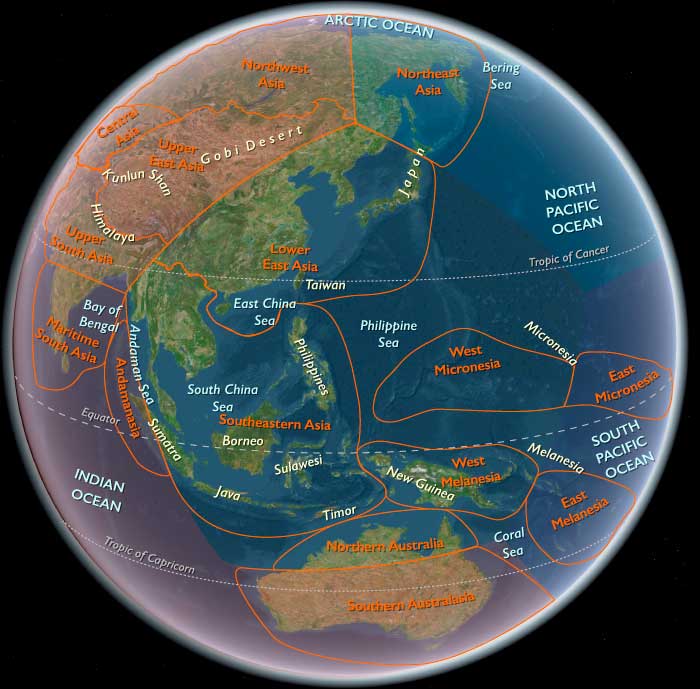
The Far East
View →Related Events
Showing 7 events out of 7 total
Some of the earliest records of this region are the reports of Chinese officials who served as envoys to the seaports and empires of the Nanyang (southern ocean), the Chinese term for Southeast Asia.
The earliest first-hand account of Singapore appears in a geographical handbook written by the Chinese traveler Wang Dayuan in 1349.
Wang noted that Singapore Island, which he called Tan-ma-hsi (Danmaxi), was a haven for several hundred boatloads of pirates who preyed on passing ships.
He also described a settlement of Malay and Chinese living on a terraced hill known in Malay legend as Bukit Larangan (Forbidden Hill), the reported burial place of ancient kings.
The fourteenth-century Javanese chronicle, the Nagarakertagama, also noted a settlement on Singapore Island, calling it Temasek.
A Malay seventeenth-century chronicle, the Sejarah Melayu (Malay Annals), recounts the founding of a great trading city on the island in 1299 by a ruler from Palembang, Sri Tri Buana, who named the city Singapura ("lion city") after sighting a strange beast that he took to be a lion.
The prosperous Singapura, according to the Sejarah Melayu, in the mid-fourteenth century suffered raids by the expanding Javanese Majapahit Empire to the south and the emerging Thai kingdom of Ayutthaya to the north, both at various times claiming the island as a vassal state.
The Sejarah Melayu, as well as contemporaneous Portuguese accounts, note the arrival around 1388 of King Paramesvara from Palembang, who was fleeing Majapahit control.
Although granted asylum by the ruler of Singapura, the king had murdered his host and seized power.
Within a few years, however, Majapahit or Thai forces again drove out Paramesvara, who had fled northward to found eventually the great seaport and kingdom of Malacca.
In 1414 Paramesvara converts to Islam and establishes the Malacca Sultanate, which in time controls most of the Malay Peninsula, eastern Sumatra, and the islands between, including Singapura.
Fighting ships for the sultanate are supplied by a senior Malaccan official based at Singapura.
The city of Malacca servesnot only as the major seaport of the region in the fifteenth century, but also as the focal point for the dissemination of Islam throughout insular Southeast Asia.
Islam enters the region of Indonesia along maritime trade routes in the fifteenth century.
(In less than a century, it will become the predominant religion of the archipelago.)
Zheng He, the famous Chinese mariner, explorer, diplomat and fleet admiral, who had made the six voyages collectively referred to as the travels of "Eunuch Sanbao to the Western Ocean" makes one more voyage under the Xuande Emperor (reigned 1426–1435), but dies at sea in 1433.
On his seven voyages, Zheng had successfully relocated large numbers of Chinese Muslims to Surabaya, …
…Palembang, …
…Malacca, and other places and converted the natives to Islam.
Malacca has become the Southeast Asian center of Islamic learning and also a large international Islamic trade center of the southern seas.
The Ming Dynasty, turning inward, decommissions the Chinese navy in 1434.
This alteration of the balance of power in the Indian Ocean will make it easier for Portugal and other Western naval powers to gain dominance over the Eastern seas.
The reigning sultan when the Portuguese captured Malacca in 1511 had fled to Johore in the southern part of the Malay Peninsula, where he had established a new sultanate.
Singapura has become part of the new Johore Sultanate and is the base for one of its senior officials in the latter sixteenth century.
In 1613, however, the Portuguese report burning down a trading outpost at the mouth of the Temasek (Singapore) River, and Singapura passes into history.
