Ahmed I
Ottoman Sultan and Caliph
Years: 1590 - 1617
Ahmed I Bakhti (April 18, 1590 – November 22, 1617) is the Sultan of the Ottoman Empire from 1603 until his death in 1617.

Related Events
Filter results
Showing 10 events out of 57 total
Abbas gains strong support from the common people.
Sources will report him spending much of his time among them throughout his reign, personally visiting bazaars and other public places in Isfahan.
Abbas can go for long periods without needing to sleep or eat and can ride great distances.
Short in stature, he will remain physically strong until his health declines in his final years.
Abbas shaves off his beard at the age of nineteen, keeping only his mustache, thus setting a fashion in Iran.
The Middle East: 1600–1611 CE
Ottoman Administration and Local Autonomy
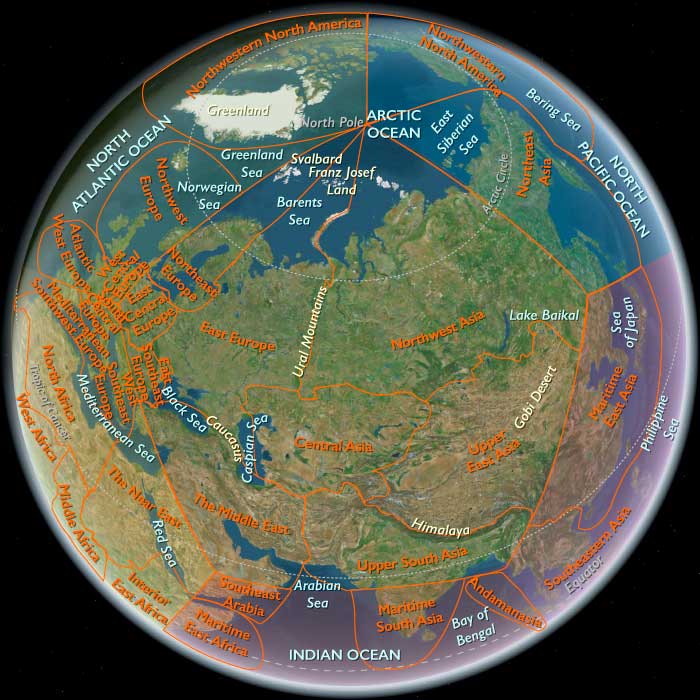
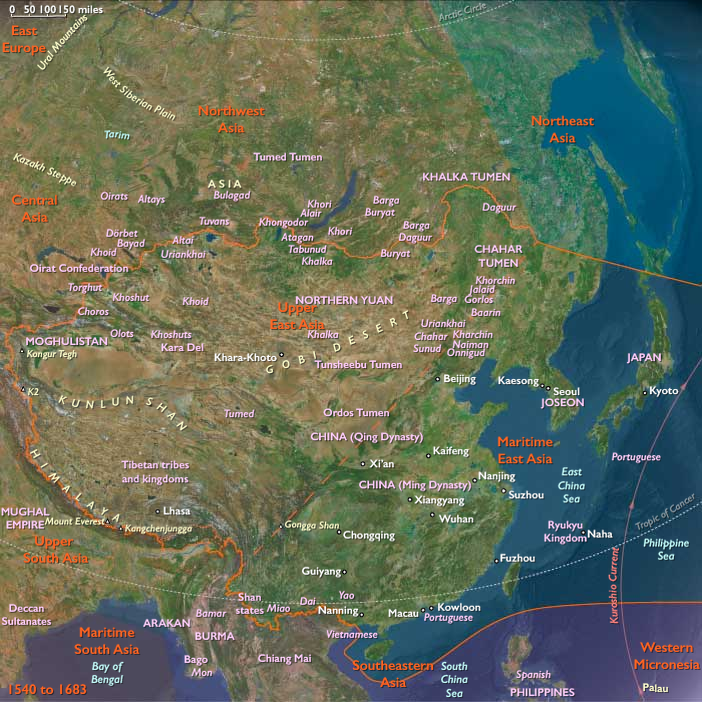
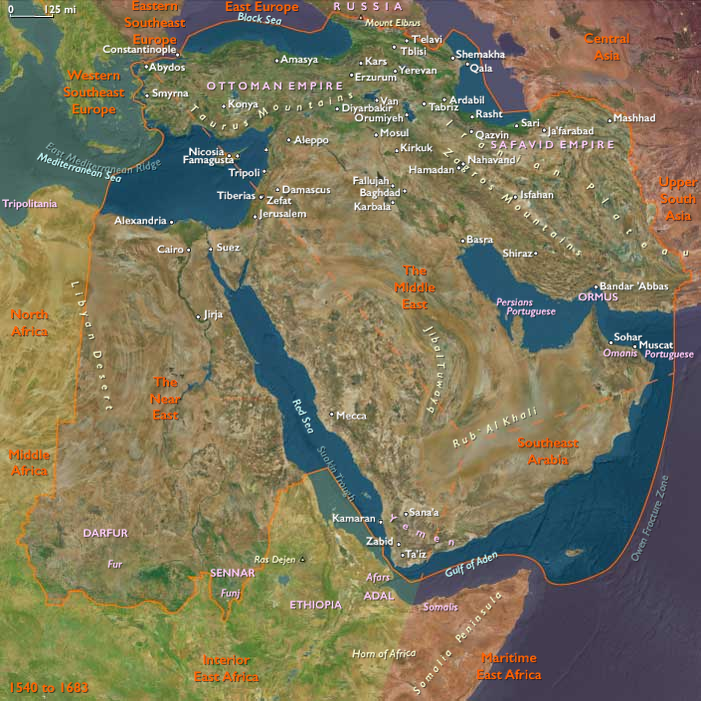
In the opening decade of the seventeenth century, Ottoman administration under Sultan Ahmed I (r. 1603–1617) remains focused on securing the empire’s borders, improving internal governance, and reinforcing Ottoman authority against rival Safavid incursions from Persia. Ahmed I seeks to restore stability and consolidate imperial control across eastern Anatolia, Iraq, and Syria, addressing chronic rebellions and unrest among tribal groups.
Mount Lebanon Under Fakhr al-Din II
In Mount Lebanon, Emir Fakhr al-Din II ibn Maan, a prominent Druze ruler, continues his struggle for dominance after defeating rival factions by 1591. Fakhr al-Din is known for religious tolerance and gains significant support among the region’s Maronite Christian population, who have long resented the oppressive rule of Yusuf Sayfa, the Shi’i leader of Tripoli. Throughout this era, Fakhr al-Din’s political acumen enables him to deftly manage shifting Ottoman allegiances, solidifying his control and enhancing the autonomy and prosperity of Mount Lebanon.
By 1608, Fakhr al-Din further expands Lebanon’s internal cohesion, promoting economic growth through improved agriculture, trade, and infrastructure projects. His leadership establishes Lebanon as an increasingly influential semi-autonomous entity within the Ottoman political framework.
Persian Consolidation Under Shah Abbas I
In Persia, Shah Abbas I (r. 1588–1629) continues his reign of cultural and political renewal, building upon successful military reforms and strengthening Persian authority against external threats. He achieves significant territorial gains against Ottoman forces, notably regaining Azerbaijan and further consolidating Persian control over western territories. Shah Abbas actively fosters diplomatic alliances with European powers to balance Ottoman influence and secure trade advantages.
Under his patronage, the Safavid capital at Isfahan thrives culturally and economically, as Abbas commissions grand architectural works and supports the arts, enhancing the city’s prestige as a vibrant cultural center of the Islamic world.
Portuguese Influence and Local Resistance in the Persian Gulf
During this period, Portuguese power in the Persian Gulf remains contested by sustained local resistance, particularly among indigenous Ibadi factions in Oman. Local Omani forces frequently challenge Portuguese coastal strongholds, progressively eroding Portuguese control over strategic ports. However, the Yarubid dynasty, which will play a decisive role in expelling the Portuguese, has not yet emerged as rulers, and their rise to power remains a future development.
Nonetheless, by 1611, Portuguese dominance in the Gulf is increasingly precarious, reflecting persistent local resentment and ongoing conflict that will set the stage for subsequent shifts in regional power.
Aleppo’s Economic Significance
Aleppo remains the primary commercial hub connecting Europe with the Middle East. Its markets attract European traders seeking spices, textiles, and luxury goods from Persia, India, and beyond. Aleppo’s economic significance bolsters Ottoman revenue and contributes to the broader integration of the Middle East into global trading networks, enhancing diplomatic and cultural exchanges between Europe and the Ottoman Empire.
Legacy of the Era
This era is defined by strategic Ottoman and Persian consolidation, the rise of local autonomy in Mount Lebanon under Fakhr al-Din, and ongoing resistance to Portuguese maritime dominance in the Persian Gulf. These developments significantly shape regional political dynamics and economic prosperity as the Middle East transitions into the mid-seventeenth century.
Shah Abbas had in 1598 moved his capital from Qazvin to the more central and more Persian Isfahan, located along the south bank of the river Zayandeh River.
Like all other Safavid monarchs, Abbas is a Shi'ite Muslim.
He has a particular veneration for Imam Hussein.
He makes a pilgrimage in 1601 on foot from Isfahan to ...
...Mashhad, site of the shrine of Imam Reza, which Abbas restores (it had been despoiled by the Uzbeks).
Since Sunni Islam is the religion of Iran's main rival, the Ottoman Empire, Abbas often treats Sunnis living in western border provinces harshly.
King Alexander II of Kakheti had officially pledged his allegiance to Tsar Feodor I of Russia, but the alliance had never actually been implemented in practice.
Alexander’s son, David, had revolted against the royal authority and in October 1601 seized the crown I, forcing his father to retire to a monastery.
David’s brother, George, had masterminded a plot which quickly collapsed and led to repression; David had George imprisoned while seventeen of his supporters were executed.
David’s foreign policy was a continuation of his father’s line.
He receives a Russian embassy in 1602 and reaffirms his loyalty to the tsar.
He then marches against Nugzar, the defiant lord of the Aragvi river basin, and forces him into submission.
David dies suddenly a year later, on October 2, 1602, and Alexander is able to resume the throne.
Abbas' tolerance towards Christians is part of his policy of establishing diplomatic links with European powers to try to enlist their help in the fight against their common enemy, the Ottoman Empire.
The idea of such an anti-Ottoman alliance is not a new one—over a century before, Uzun Hassan, then ruler of part of Iran, had asked the Venetians for military aid—but none of the previous Safavids had made diplomatic overtures to Europe.
Abbas' attitude is in marked contrast to that of his grandfather, Tahmasp I, who had expelled the English traveler Anthony Jenkinson from his court on hearing he was a Christian.
For his part, Abbas had declared that he "preferred the dust from the shoe soles of the lowest Christian to the highest Ottoman personage."
Abbas had in 1599 sent his first diplomatic mission to Europe.
The group had crossed the Caspian Sea and spent the winter in Moscow, before proceeding through Norway, Germany (where it had been received by Emperor Rudolf II) to Rome where Pope Clement VIII had given the travelers a long audience.
They finally arrive at the court of Philip III of Spain in 1602.
Although the expedition never manages to return to Iran, being shipwrecked on the journey around Africa, it marks an important new step in contacts between Iran and Europe and Europeans begin to be fascinated by the Iranians and their culture.
The number of diplomatic missions to and fro will greatly increase.
Abbas has since the treaty of 1589-90 been regarded as almost an Ottoman vassal.
The Safavids have never beaten their western neighbors in a straight fight.
Abbas had decided in 1602 that he would longer put up with Ottoman insults.
After a particularly arrogant series of demands from the Turkish ambassador, the shah has him seized, has his beard shaved and sends it to his master, the sultan, in Constantinople.
This is a declaration of war.
Abbas first recaptures Nahavand and destroys the fortress in the city, which the Ottomans had planned to use as an advance base for attacks on Iran.
Abbas now pretends he is setting off on a hunting expedition to Mazandaran with his men.
This is merely a ruse to deceive the Ottoman spies in his court—his real target is Azerbaijan.
He changes course for Qazvin where he assembles a large army and sets off to retake Tabriz, which has been in Ottoman hands for decades.
For the first time, the Iranians make great use of their artillery and the town—which has been ruined by Ottoman occupation—soon falls.
Abbas now sets off to besiege Yerevan, the capital of Armenia, and one of the main Turkish strongholds in the Caucasus.
War with Persia breaks out in 1603 while the Ottoman government struggles to suppress these revolts.
Sultan Mehmed, whose reign has seen no major setbacks for the supposedly declining Ottoman Empire, dies on December 22 at Topkapi Palace, Istanbul.
He is succeeded by the thirteen-year-old Ahmed, his eldest son by Valide Sultan Handan Sultan, an ethnic Greek who was originally named Helena.
Ahmed is Mehmed’s fourth-born son; the late Sultan had previously had three sons by a princess from the Byzantine Comnenus or Komnenus dynasty of Trebizond, a branch of the Imperial Family of the same name from Constantinople.
However, the standard Ottoman practice at this time for determining the succession is not birth order of sons; instead the Ottoman laws of succession to the throne state, "during their father's lifetime, all of the adult sons of the reigning sultan would hold provincial governorships.
Accompanied and mentored by their mothers, they would gather supporters and at the death of their father, the sons would fight among themselves until one emerged triumphant."
Mehmed’s two older sons had predeceased him, leaving Jahja, born in 1585.
When Mehmet had become Sultan in 1595, he had followed the custom of executing all of his brothers as potential rival claimants to the Ottoman throne).
Jahja's mother was concerned that this could also eventually happen to him, so he had been smuggled out, first to Greece, and then to present day Bulgaria.
He supposedly was baptized at an Orthodox Christian monastery, where he lived for the next eight years of his life.
Ahmed breaks with the traditional fratricide, however, and sends his brother Mustafa to live at the old palace at Bayezit along with their grandmother Safiye Sultan, a Venetian noblewoman originally named Sofia Baffo.
Jahya believes that as the next oldest son, he, not Ahmed, is next in line to be Ottoman Sultan and feels cheated out of his rightful destiny, thus for the rest of his life Jahja will dedicate himself to gaining the Ottoman Imperial Throne.
Jahja will from this point on make frequent trips to northern and western Europe to gain support.