Al-Kindi
Muslim Arab philosopher, mathematician, physician, and musician
Years: 801 - 879
Abu Yūsuf Yaʻqūb ibn ʼIsḥāq aṣ-Ṣabbāḥ al-Kindī (c. 801–873), known as "the Philosopher of the Arabs", is a Muslim Arab philosopher, mathematician, physician, and musician.
Al-Kindi is the first of the Muslim peripatetic philosophers, and is unanimously hailed as the "father of Islamic or Arabic philosophy" for his synthesis, adaptation and promotion of Greek and Hellenistic philosophy in the Muslim world.
Al-Kindi is a descendant of the Kinda tribe.
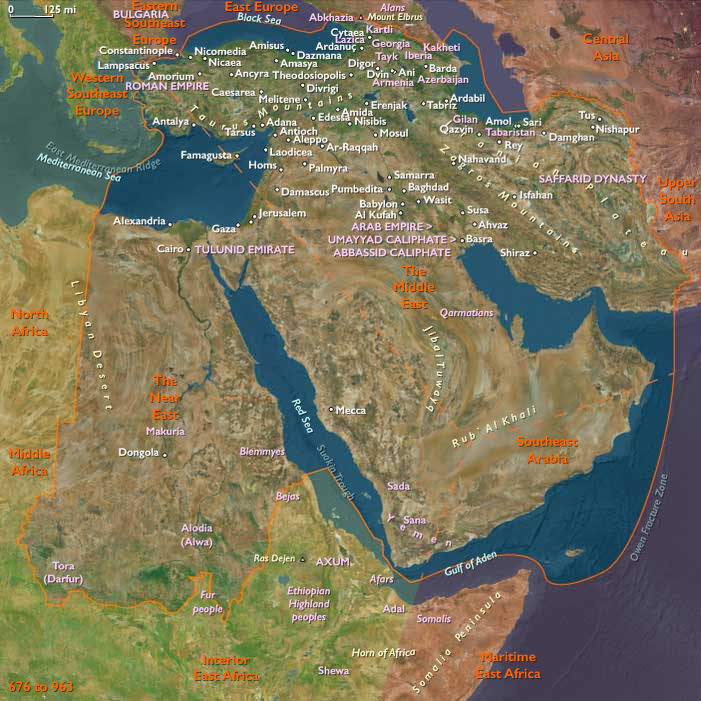
He was born and educated in Kufa, before going to pursue further studies in Baghdad.
Al-Kindi becomes a prominent figure in the House of Wisdom, and a number of Abbasid Caliphs appoint him to oversee the translation of Greek scientific and philosophical texts into the Arabic language.
This contact with "the philosophy of the ancients" (as Greek philosophy is often referred to by Muslim scholars) has a profound effect on his intellectual development, and leads him to write hundreds of original treatises of his own on a range of subjects ranging from metaphysics, ethics, logic and psychology, to medicine, pharmacology, mathematics, astronomy, astrology and optics, and further afield to more practical topics like perfumes, swords, jewels, glass, dyes, zoology, tides, mirrors, meteorology and earthquakes.
In the field of mathematics, al-Kindi plays an important role in introducing Indian numerals to the Islamic and Christian world.
He is a pioneer in cryptanalysis and devises several new methods of breaking ciphers.
Using his mathematical and medical expertise, he is able to develop a scale that would allow doctors to quantify the potency of their medication.
The central theme underpinning al-Kindi's philosophical writings is the compatibility between philosophy and other "orthodox" Islamic sciences, particularly theology.
And many of his works deal with subjects that theology had an immediate interest in.
These include the nature of God, the soul and prophetic knowledge.
Despite the important role he plays in making philosophy accessible to Muslim intellectuals, his own philosophical output is largely overshadowed by that of al-Farabi and very few of his texts are available for modern scholars to examine.