Alcuin of York
English scholar, ecclesiastic, poet and teacher from York
Years: 735 - 804
Alcuin of York (Latin: Alcuinus, c. 735 – 19 May 804), also called Ealhwine, Albinus or Flaccus, is an English scholar, ecclesiastic, poet and teacher from York, Northumbria.
He was born around 735 and became the student of Archbishop Ecgbert at York.
At the invitation of Charlemagne, he becomes a leading scholar and teacher at the Carolingian court, where he remains a figure in the 780s and 790s.
He writes many theological and dogmatic treatises, as well as a few grammatical works and a number of poems.
He is made Abbot of Tours in 796, where he remains until his death.
"The most learned man anywhere to be found", according to Einhard's Life of Charlemagne, he is considered among the most important architects of the Carolingian Renaissance.
Among his pupils are many of the dominant intellectuals of the Carolingian era.




Related Events
Filter results
Showing 10 events out of 16 total
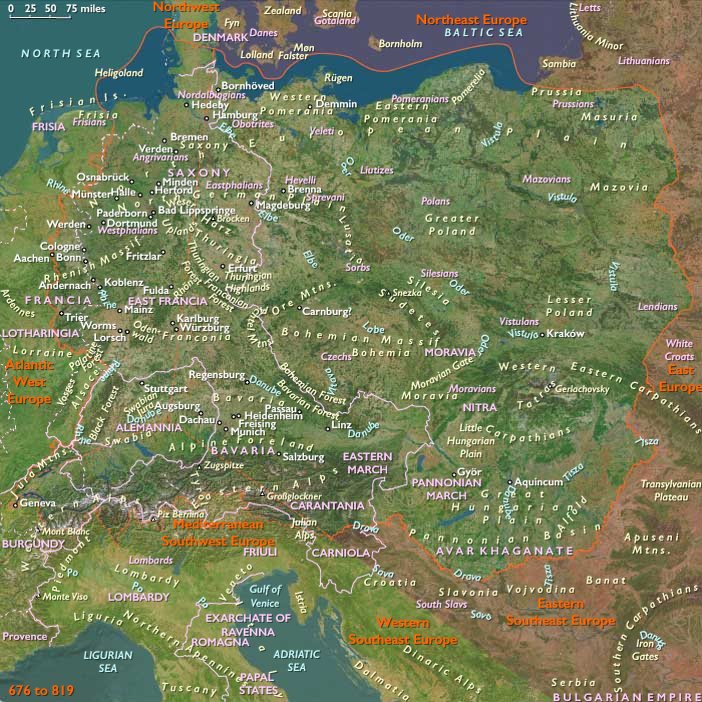
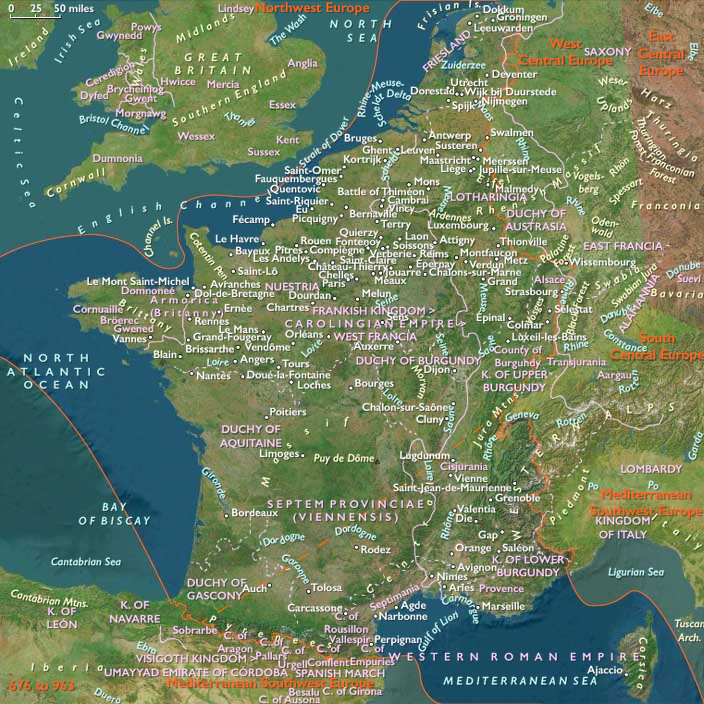
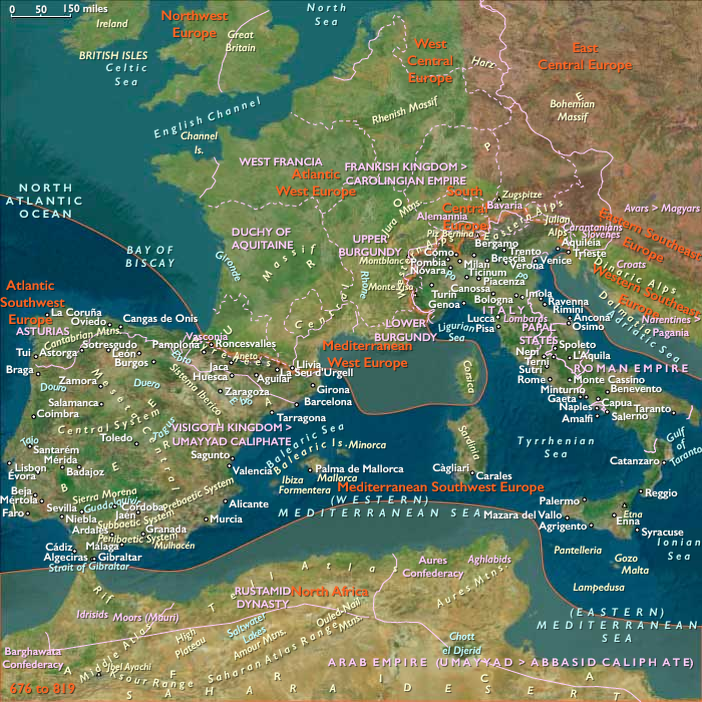
Atlantic West Europe (676–819): From Merovingian Fragmentation to Carolingian Unity
Between 676 and 819, Atlantic West Europe—including regions corresponding to modern-day France (Neustria, Austrasia, Aquitaine, Brittany, Burgundy) and the Low Countries—underwent profound political restructuring, evolving from fragmented Merovingian rule into the unified, culturally vibrant Carolingian Empire. This age witnessed the pivotal transition from declining royal authority to the consolidation of power under influential mayors of the palace, culminating in the ascendance of Charlemagne and the flowering of the Carolingian Renaissance.
Political and Military Developments
Merovingian Fragmentation and Austrasian Dominance (676–714)
- Following the assassination of Childeric II (675), the Frankish kingdoms—Neustria, Austrasia, and Burgundy—descended into rivalry and weakened royal power.
- Pepin of Herstal, Austrasian mayor of the palace, established dominance after the decisive Battle of Tertry (687), consolidating power over Neustria and Burgundy, thereby shifting control away from Merovingian kings to the mayors of the palace.
Carolingian Rise (715–751)
- Charles Martel (r. 718–741), son of Pepin of Herstal, fortified the Carolingian position by defeating Neustrian rivals and asserting authority over Aquitaine, Burgundy, and the Low Countries.
- His victory at Tours-Poitiers (732) halted the northward expansion of Umayyad forces, significantly shaping the future of Atlantic West Europe and earning him legendary status.
Carolingian Consolidation and Expansion (752–819)
- Pepin the Short (r. 751–768), Charles Martel's son, deposed the last Merovingian king (751), becoming king himself with papal sanction. His reign legitimized Carolingian rule, strengthened royal authority, and subdued Aquitaine.
- Charlemagne (r. 768–814) dramatically expanded Frankish territory through wars against Saxons, Lombards, Avars, and Muslim Spain, solidifying control over Aquitaine, Brittany, and parts of Burgundy.
- Charlemagne’s imperial coronation in 800 by Pope Leo III established the Carolingian Empire, a cultural and political unity unprecedented since Rome.
- Louis the Pious (r. 814–840) inherited a vast, culturally vibrant empire, though internal tensions foreshadowed future divisions.
Economic and Social Developments
Agricultural Revival and Feudal Foundations
- Improved stability under the Carolingians spurred agricultural expansion and economic recovery. Monastic estates spearheaded land clearance, technological innovations, and improved farming practices, laying groundwork for medieval manorialism.
- Proto-feudal relationships emerged as local aristocrats and monasteries provided peasants protection in exchange for labor, reinforcing hierarchical rural societies.
Urban Development and Commercial Renewal
- Trade gradually revived as towns such as Paris, Lyon, Nantes, Tours, and Utrecht benefited from increased political stability, becoming regional market centers.
- The Carolingian monetary reforms, especially the introduction of the silver denier, standardized and facilitated trade throughout Atlantic West Europe.
Religious and Cultural Developments
Expansion of Christianity and Ecclesiastical Reforms
- Carolingian rulers promoted Christianity vigorously, supporting missionary work in Saxony and among neighboring peoples.
- St. Boniface (d. 754), supported by Charles Martel and Pepin the Short, reorganized the Frankish church, strengthened papal ties, and founded key bishoprics throughout Atlantic West Europe.
Carolingian Renaissance
- Charlemagne’s court at Aachen became the heart of an intellectual revival, attracting scholars like Alcuin of York, Paul the Deacon, and Einhard.
- The establishment of cathedral and monastic schools, along with manuscript production centers in monasteries such as Corbie, Tours, and Fulda, significantly advanced literacy, education, and classical scholarship.
- Revival and standardization of Latin, script reforms (Caroline minuscule), and illuminated manuscripts marked cultural achievements.
Intellectual and Artistic Developments
Artistic and Architectural Innovations
- The period saw an evolution from Merovingian artistic traditions to Carolingian art, blending Classical Roman, Byzantine, and Germanic elements.
- Notable architectural projects included Charlemagne’s palace chapel at Aachen, Abbey of Saint-Denis, and monasteries throughout the empire.
Legacy and Significance
The era from 676 to 819 in Atlantic West Europe transformed a fragmented post-Roman landscape into a unified, culturally dynamic Carolingian Empire. The rise of the Carolingian dynasty established a powerful political order, revitalized economic life, and fostered a vibrant intellectual and artistic culture, laying the critical foundations for medieval European civilization.
The young Alcuin had come to the cathedral church of York during the golden age of Archbishop Egbert and Northumbrian King Eadberht.
Egbert had been a disciple of the Venerable Bede, who had urged him to raise York to an archbishopric.
King Eadbert and his brother Egbert had overseen the reenergizing and reorganization of the English church, with an emphasis on reforming the clergy and on the tradition of learning that Bede had begun.
Egbert had been devoted to Alcuin, who thrived under his tutelage.
The York school is renowned as a center of learning in the liberal arts, literature, and science, as well as in religious matters.
Alcuin had graduated during the 750s to become a teacher.
His ascendancy to the headship of the York school, the ancestor of St Peter's School, began in 767 after Aelbert became Archbishop of York.
Alcuin around the same time became a deacon in the church.
He was never ordained as a priest and there is no real evidence that he became an actual monk, but he lived his life as one.
King Elfwaldhad had sent Alcuin to Rome in 781 to petition the Pope for official confirmation of York's status as an archbishopric and to confirm the election of the new archbishop, Eanbald I.
At some point he either met or was summoned by Charles I, who seeks to inspire the revival of education in the hope of forming one great Christian empire of all the Germanic peoples.
Alcuin's love of the church and his intellectual curiosity allows him to be reluctantly persuaded to join Charles's court.
He joins an illustrious group of scholars that Charles has gathered around him, the mainsprings of the Carolingian Renaissance: Peter of Pisa, Paulinus of Aquileia, Rado, and Abbot Fulrad.
Alcuin will later write that "the Lord was calling me to the service of King Charles."
Charles is determined to have his children educated, including his daughters, as he himself is not.
His children are taught all the arts, and his daughters are learned in the way of being a woman.
His sons take archery, horsemanship, and other outdoor activities.
Alcuin is welcomed by Charles to the Palace School in Aachen (Urbs Regale) in 782, founded by the king's ancestors as a place for the education of the royal children (mostly in manners and the ways of the court).
However, Charles wants to include the liberal arts and, most importantly, the study of the religion that he holds sacred.
Drawing inspiration from the York school, he revives the Palace School with the trivium and quadrivium disciplines, writing a codex on the trivium, while his student Hraban will write one on the quadrivium.
Returning to Saxony in 782, Charles institutes a code of law and appointed counts, both Saxon and Frank.
The laws are severe on religious issues, namely the native paganism of the Saxons.
This stirs a renewal of the old conflict.
In autumn, Widukind returns and leads a revolt that results in many assaults on the church.
The Saxons invade the area of the Chatti, a Germanic tribe already converted by Boniface and firmly in Charles's empire.
Widukind annihilates a Frankish army at the Süntel while Charles is campaigning against the Sorbs.
It is in response to this setback that Charles, in the Massacre of Verden, orders the beheading of forty-five hundred Saxons who had been caught practicing paganism after converting to Christianity, while Widukind escapes to Denmark again.
Charles’ severe and uncompromising position, which earns him the title "butcher of Saxons", causes his close adviser Alcuin of York to urge leniency, as he believes God's word should be spread not by the sword but by persuasion; but the wars continue.
Beatus of Liébana: Scholar, Theologian, and Symbol of Christian Resistance
Beatus of Liébana is best remembered for his Commentary on the Apocalypse, originally written in 776 CE and later revised in 784 and again in 786. Though not highly original, the work serves as a Christian cultural and religious focal point, compiling long extracts from the Fathers and Doctors of the Church, particularly:
- Augustine of Hippo,
- Ambrose of Milan,
- Tyconius,
- Irenaeus of Lyon, and
- Isidore of Seville.
Additionally, Beatus incorporates Jerome of Stridon’s commentary on the Book of Daniel, further enriching his theological synthesis.
Theological Influence and the Adoptionist Controversy
Beatus corresponds with Alcuin of York and plays a prominent role in the Adoptionist controversy, opposing the views of Felix of Urgel and Elipandus of Toledo, who argue that Christ was the adoptive son of God in his human nature. His staunch Nicene orthodoxy reinforces Asturian resistance to theological influences from Muslim-controlled Toledo.
As confessor to Queen Adosinda, wife of King Silo of Asturias, and as the teacher of Alcuin and Etherius of Osma, Beatus holds considerable influence in the Christian intellectual world.
Beatus’s Legacy and Symbolism
Over time, his Commentary on the Apocalypse becomes a symbol of Christian resistance against the Muslim Arabs who dominate much of Iberia during the early Middle Ages. The Beatus manuscripts, with their illuminated illustrations, will later be reproduced across medieval Europe, preserving and spreading the apocalyptic vision of Christian triumph over Islam and heresy.
The Last Frisian Rebellion and the End of the Frisian–Frankish Wars (793)
In 793, the Frisians rise in rebellion against Charlemagne for the final time, marking the last major revolt in the long history of Frisian resistance to Frankish rule. The immediate cause of the uprising is the forced recruitment of Frisians and Saxons into Charlemagne’s eastern campaign against the Avars, a conflict far removed from their homeland and interests.
The Uprising of Unno and Eilrad
The rebellion begins east of the Lauwers under the leadership of Dukes Unno and Eilrad, quickly spreading across other Frisian territories. The revolt is not merely a political insurrection—it also leads to a temporary return to paganism, with Christian priests forced to flee once again, as had happened during earlier Saxon uprisings.
Frankish Suppression and the End of Frisian Independence
Despite its initial momentum, the rebellion is swiftly and decisively crushed by Frankish forces. With this defeat, the Frisian–Frankish wars come to an end, and the last remnants of Frisian autonomy are extinguished.
From this point forward:
- The Frisians remain firmly under Frankish rule, fully incorporated into the Carolingian realm.
- Paganism in Frisia is gradually eradicated, as Christianization continues without further large-scale resistance.
- The Frisian elite is increasingly absorbed into the Carolingian system, often serving as military and administrative vassals.
Though the Frisian people will continue to maintain their distinct identity, their political independence is permanently lost, marking 793 as the final chapter in the Frisian resistance against the Franks.
Saxon leader Widukind had surrendered himself to the Franks in 785 and was baptized a Christian the following year.
This capitulation does nothing, however, to alter the savage character of Charles’ Saxon War, now grown so ferocious that Alcuin, the preeminent scholar at the Frankish court, lodges a polite complaint with his ruthless king.
Following a major Saxon rebellion in 792, Charles’ troops begin annual invasions of Saxony.
Alcuin had returned in 790 from the court of Charles to England, to which he had remained attached.
He dwelled there for some time, but Charles then invited him back to help in the fight against the Adoptionist heresy that is at this time making great progress in Toledo, the old capital of the Visigoths and still a major city for the Christians under Islamic rule in Spain.
He is believed to have had contacts with Beatus of Liébana, from the Kingdom of Asturias, who fought against Adoptionism.
He was back at Charlemagne's court by at least mid-792, writing a series of letters to Æthelred, to Hygbald, Bishop of Lindisfarne, and to Æthelhard, Archbishop of Canterbury in the succeeding months, dealing with the Viking attack on Lindisfarne in July 793.
These letters and Alcuin's poem on the subject, De clade Lindisfarnensis monasterii, provide the only significant contemporary account of these events.
Alcuin upholds the orthodox doctrine at the Council of Frankfurt in 794 and obtains the condemnation of the heresiarch Felix of Urgel.
Having failed during his stay in Northumbria to influence King Æthelred in the conduct of his reign, Alcuin will never return home to England.
This is the oldest known mention of Frankfurt, as Frankonovurd (in old high German) or Vadum Francorum (in Latin).
Atlantic West Europe, 796–807: Consolidation of Carolingian Power and Imperial Expansion
The years 796–807 represented a decisive period for the Carolingian Empire in Atlantic West Europe, witnessing Charlemagne’s final expansions, the strengthening of centralized imperial authority, and significant cultural developments. This era solidified Frankish dominance, further defined the imperial administration, and saw enhanced cultural and religious activity across the region.
Political and Military Developments
-
Final Stages of Carolingian Expansion
- Charlemagne conducted successful campaigns to secure the empire’s borders, notably against Saxon resistance (defeating rebellious forces conclusively by 804) and consolidating control along the Atlantic coast.
- Brittany experienced increased Carolingian influence, with strengthened fortifications and improved integration, although local autonomy persisted.
-
Administrative and Territorial Consolidation
- Charlemagne reinforced his administrative structure, appointing trusted counts and missi dominici (imperial envoys) throughout Atlantic West Europe to oversee justice, taxation, and military recruitment.
- Key regions, including Aquitaine, Gascony, and Brittany, were brought under more direct imperial oversight, though local traditions and structures remained resilient.
-
Strengthened Frontier Defenses
- Charlemagne bolstered defenses along vulnerable coastal areas from Normandy to Aquitaine, responding proactively to the growing threat of Viking raids and enhancing naval capabilities in the Bay of Biscay and the English Channel.
Economic and Social Developments
-
Agricultural and Commercial Prosperity
- Agricultural productivity increased, supported by imperial encouragement of land cultivation and forest clearance, boosting rural economies.
- Major trade routes across the Loire and Seine valleys and along the Atlantic coast flourished, facilitating commerce between inland towns and coastal settlements such as Nantes, Bordeaux, and Rouen.
-
Urbanization and Regional Integration
- Towns such as Tours, Poitiers, and Orléans thrived as administrative, ecclesiastical, and trade centers, reinforcing regional economic and social integration.
- The stable currency and improved infrastructure under Charlemagne enhanced economic interconnectivity.
Religious and Cultural Developments
-
Advancement of the Carolingian Renaissance
- Charlemagne actively promoted the cultural and intellectual revival throughout Atlantic West Europe. Influential monastic and cathedral schools, notably in Tours, Saint-Martin, and Saint-Benoît-sur-Loire, produced richly illuminated manuscripts and preserved classical texts.
- Alcuin of York continued to play a central role in organizing educational reforms and intellectual discourse, significantly enhancing the literacy and cultural output of the Frankish Empire.
-
Religious Consolidation and Ecclesiastical Reform
- Charlemagne strengthened ecclesiastical structures, ensuring greater uniformity in liturgical practices and improving clerical education and discipline. This created stronger ties between the imperial administration and the Church hierarchy, particularly in western France and the Low Countries.
Intellectual and Artistic Developments
- Cultural Flourishing under Carolingian Patronage
- Manuscript illumination, exemplified by the Ada Gospels (c. 800), set a new artistic standard, characterized by vivid colors, intricate patterns, and classical motifs, becoming a hallmark of Carolingian art.
- Architectural achievements continued, including early expansions of the Palatine Chapel in Aachen and significant ecclesiastical structures in Tours and other cultural hubs of Atlantic West Europe.
Long-Term Significance
The era 796–807 was pivotal in solidifying Carolingian control and cultural identity in Atlantic West Europe. Charlemagne’s military successes, administrative consolidation, and active cultural patronage established enduring patterns of governance, religious authority, and artistic expression, laying firm foundations for subsequent medieval developments.
The Development of Carolingian Minuscule and the Standardization of Literacy
Although Charlemagne never becomes fully literate, he recognizes the importance of literacy, standardized writing, and uniform script for the administration of his vast empire. To achieve this, he invites Alcuin of York, one of the leading scholars of the time, to his palace school and scriptorium at Aachen.
Alcuin’s Role in Script Reform (782–796, 796–804 at Tours)
Efforts to replace regional Merovingian and Germanic scripts were already underway before Alcuin arrived in 782. However, under his direction at Aachen, the Carolingian scribes develop and refine Carolingian minuscule, a highly legible, uniform script designed to be recognized throughout the empire.
After leaving court service in 796, Alcuin continues this work at Marmoutier Abbey in Tours, restructuring its scriptorium, which becomes a major center for disseminating the new script.
Origins and Features of Carolingian Minuscule
Carolingian minuscule emerges from a fusion of earlier scripts:
- Roman half-uncial and its cursive variant, which had influenced many Continental minuscule scripts.
- Insular scripts from Irish and English monasteries, known for their clarity and ornamentation.
The new script is characterized by:
- Uniform, rounded shapes, making letters easy to distinguish.
- Clearly defined capital letters, ensuring readability.
- Spaces between words, a revolutionary change that greatly improves clarity and comprehension.
The Cultural and Political Impact
Carolingian minuscule is not just an aesthetic improvement—it is part of Charlemagne’s broader campaign of cultural standardization, ensuring that official texts, religious manuscripts, and administrative records are legible and consistent across the empire. This reform helps unify the Carolingian world, facilitating governance, education, and the preservation of Classical texts.
Legacy
The script’s clarity and practicality ensure its survival beyond the Carolingian period. It becomes the basis for later medieval book hands and directly influences the development of modern Latin typefaces, shaping Western scriptural tradition for centuries to come.