Alexios III Angelos
Emperor of the Eastern Roman (Byzantine) Empire
Years: 1153 - 1211
Alexios III Angelos (c. 1153–1211) was Byzantine Emperor from 1195 to 1203.
Related Events
Filter results
Showing 10 events out of 30 total
However, Isaac's brother, the second son of Andronikos Angelos, grandson of Alexios I, is proclaimed emperor by the troops, and captures his brother at Stagira in Macedonia; he has him blinded and imprisoned.
The new emperor, crowned Alexios III on April 8, is weak and greedy; he and his deposed brother are among the least competent of all Constantinople’s rulers, and his coup d'état will have disastrous results.
Constantinople and Venice patch up their relations again in 1198, but the Venetians remain embittered.
Theobald III of Champagne and the Origins of the Fourth Crusade (1197–1199 CE)
Theobald III, Count of Champagne, was the younger son of Henry I of Champagne and Marie of France(daughter of Louis VII and Eleanor of Aquitaine). He became Count of Champagne in 1197, following the death of his older brother, Henry II, in Palestine. During his brief rule, Theobald was closely involved in both political and financial dealings with Philip II of France and in the early stages of the Fourth Crusade.
Theobald III and Philip II’s Jewish Charters (1198–1231)
- In September 1198, Theobald and Philip Augustus issued charters dictating the rights of the Jews in their respective lands, particularly in relation to debts.
- These agreements ensured that debts owed to Philip were repaid to Champagne for the use of its Jewish moneylenders.
- These laws were later reinforced in additional charters between 1198 and 1231, shaping the legal framework of Jewish financial interactions in medieval France.
The Tournament at Écry and the Launch of the Fourth Crusade (November 28, 1199)
- Innocent III had called for the Fourth Crusade in 1198, but enthusiasm was initially limited.
- On November 28, 1199, Theobald hosted a grand tournament at his castle in Écry-sur-Aisne, attended by many prominent French nobles.
- The preacher Fulk of Neuilly used the occasion to preach the Crusade, successfully inspiring many nobles to take the cross.
- The crusaders elected Theobald as their leader, marking the formal beginning of the Fourth Crusade.
- Among those present was Geoffrey de Villehardouin, Marshal of Champagne, who would later write one of the principal chronicles of the Crusade.
Legacy of Theobald III
- He would not live to lead the Crusade, as he died in 1201, shortly before its departure.
- His death left the leadership uncertain, leading to the election of Boniface of Montferrat as the new commander.
- The Fourth Crusade would infamously divert its forces to Constantinople, leading to the sack of the Byzantine capital in 1204 rather than a campaign in the Holy Land.
Despite his short rule, Theobald III played a crucial role in the financial and political negotiations of Champagne, and his tournament at Écry was the turning point that officially launched the Fourth Crusade.
Alexios Angelos, the son of the deposed and blinded Emperor Isaac II Angelos, makes his way in 1201 to Germany, where he works to bring about the diversion of the Fourth Crusade to Constantinople in order to restore his father to power.
The brother-in-law of the Hohenstaufen lord Philip of Swabia, Alexios entreats the crusaders to help him remove from the throne his uncle Alexios III in exchange for promises of funds, supplies, and troops to conquer Egypt, the maintenance of five hundred Western knights in the Holy Land, and submission of the Greek church to Rome.
The leadership of the coalescent Fourth Crusade passes after the death of Theobald of Champagne to Boniface of Montferrat, cousin to Philip of Swabia, who, like Philip, has married into the Greek imperial family, and brother to Conrad, the momentarily reigning King of Jerusalem, who had been the brother-in-law of Emperor Isaac.
The Second Bulgarian Empire expands, like the first, at the expense of a preoccupied Constantinople.
In 1202, Tsar Kaloyan concludes a final peace with the Empire that gives Bulgaria full independence.
The Venetian Republic has acquired considerable trading privileges within Constantinople, and the growing number of Venetian merchants has long incurred the hostility of the Greeks.
In 1171, Emperor Manuel I Komnenos had ordered the arrest of Venetians, and eleven years later, an aroused citizenry had massacred a large number of Latins in Constantinople and insulted a papal legate.
Further, following the advice of recently returned crusaders, the new Crusade is to be directed against Egypt, now the center of Muslim power in the Levant but a government with which Venice is closely related commercially.
Venetian policy under the aging and blind but ambitious Doge Enrico Dandolo is therefore potentially at variance with that of the Pope and the crusaders.
Nevertheless, an agreement is made providing for payments to the Venetians for transportation and an equal division of conquests.
Geoffrey of Villehardouin, though one of the lesser nobility, has from the start been accepted as one of the leaders of the Fourth Crusade.
He has helped obtain ships from Venice to transport the Crusaders to the East.
The ten thousand-man crusader army, mostly French and Flemish, that arrives at Venice in the summer of 1202 is somewhat smaller than had been anticipated, since some of the crusaders are traveling directly from France.
Even so, there are not sufficient funds to pay the Venetians.
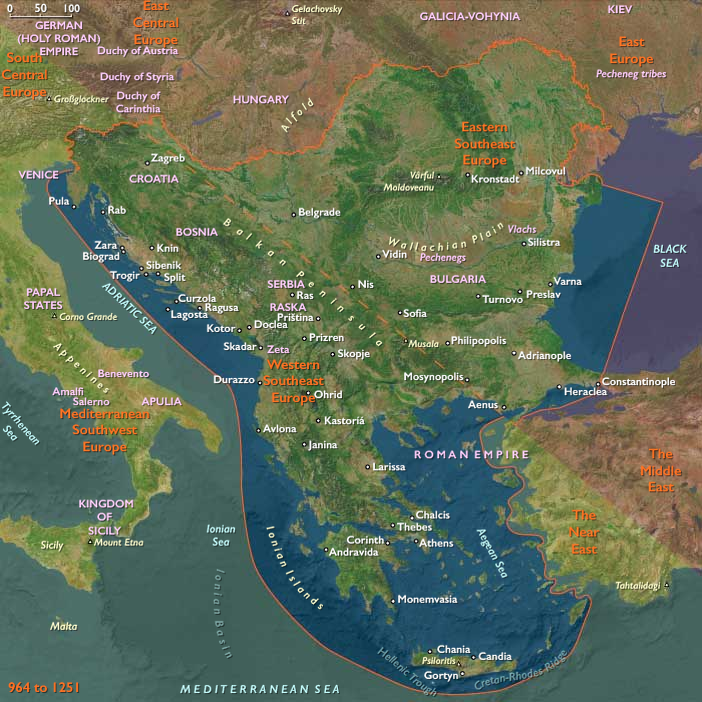
Accordingly, the crusaders accept the suggestion that in lieu of payment they assist the Venetians in the capture of the strategic Hungarian city of Zara in Dalmatia.
This is done despite the opposition of many crusaders both to the diversion of the enterprise and to the attack on a Christian city.
Innocent is informed of the plan, but his veto is disregarded.
Reluctant to jeopardize the Crusade, Innocent gives conditional absolution to the crusaders—not, however, to the Venetians.
To finance the siege of Zara, the Doge grants the benefits of the revenue from the salt tax to a consortium of creditors.
Pledging the income from the Salt Office will become a staple of the city's finance.
Boniface of Montferrat had been chosen in 1201 as the new leader of the Fourth Crusade at the death of the original leader, Count Theobald III of Champagne.
Boniface is an experienced soldier, and the position is an opportunity to reassert his dynasty's reputation after defeat at home.
Boniface's family is well known in the east: his nephew Baldwin and brother Conrad had been Kings of Jerusalem, and his niece Maria is heiress of the kingdom.
Boniface's cousin Philip of Swabia is married to Irene Angelina, a daughter of the deposed emperor Isaac II Angelos and niece of Conrad's second wife Theodora.
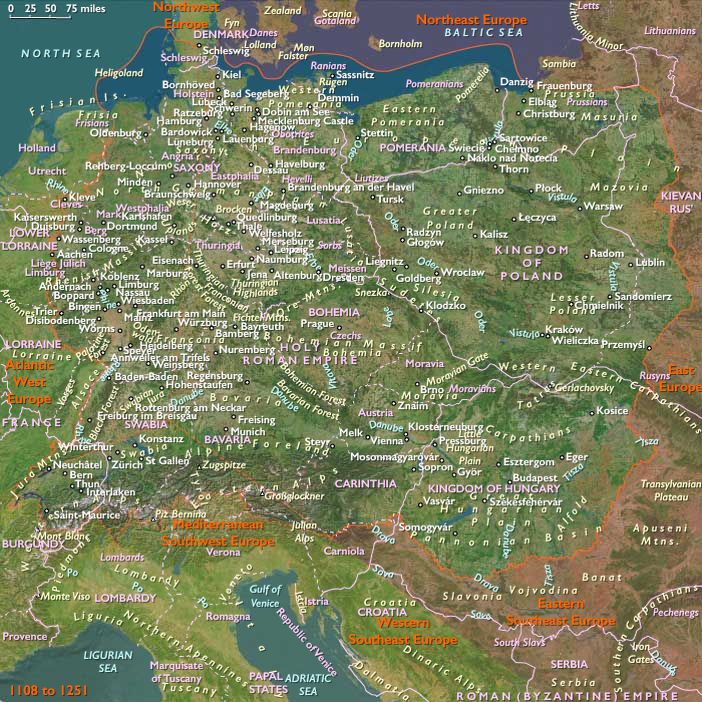
Boniface in the winter of 1201, had spent Christmas with Phillip in Hagenau, and while there also met with Alexios Angelos, Isaac II's son, who had escaped from the custody of his uncle Alexios III Angelos.
The three had discussed the possibility of using the crusading army to restore Alexios' right to the throne.
Alexios entreats the crusaders to help him in exchange for promises of funds, supplies, and troops to conquer Egypt, the maintenance of five hundred Western knights in the Holy Land, and submission of the Constantinopolitan church to Rome.
Both Boniface and Alexios had traveled separately to Rome to ask for Pope Innocent III's blessing for the endeavor; however, Boniface had been specifically told by Innocent not to attack any Christians, including the Imperial Greeks.
The Crusader army is in debt to the Venetian Doge Enrico Dandolo, who had provided their fleet.
He has instructed them to attack the rebellious cities of Trieste, Moglia, and Zara and beat them into submission before sailing for Cairo.
The strategic Dalmatian city of Zara had been repeatedly invaded by Venice between 1111 and 1154, then once more between 1160 and 1183, when it finally rebelled, appealing to the Pope and to the Croato-Hungarian throne for protection.
Emeric, king of Croatia and Hungary, has condemned the crusade, because of an argument about the possible heresy committed by God's army in attacking a Christian city.
Zadar is devastated and captured, nonetheless, with the population—who, like the crusaders, are Roman Catholic Christians—escaping into the surrounding countryside.