Antigonus II Mattathias
Hasmonean king of Judea
Years: 97BCE - 37BCE
Antigonus II Mattathias (known in Hebrew as Matityahu) (died 37 BCE) is the last Hasmonean king of Judea.
He is the son of King Aristobulus II of Judea.
Antigonus is handed over by Herod for execution in 37 BCE, after a reign of three years during which he leads a fierce struggle of the Jews for independence from the Romans.
Related Events
Filter results
Showing 10 events out of 12 total
The Middle East: 45 BCE–CE 99
Roman-Parthian Rivalry and Cultural Transitions
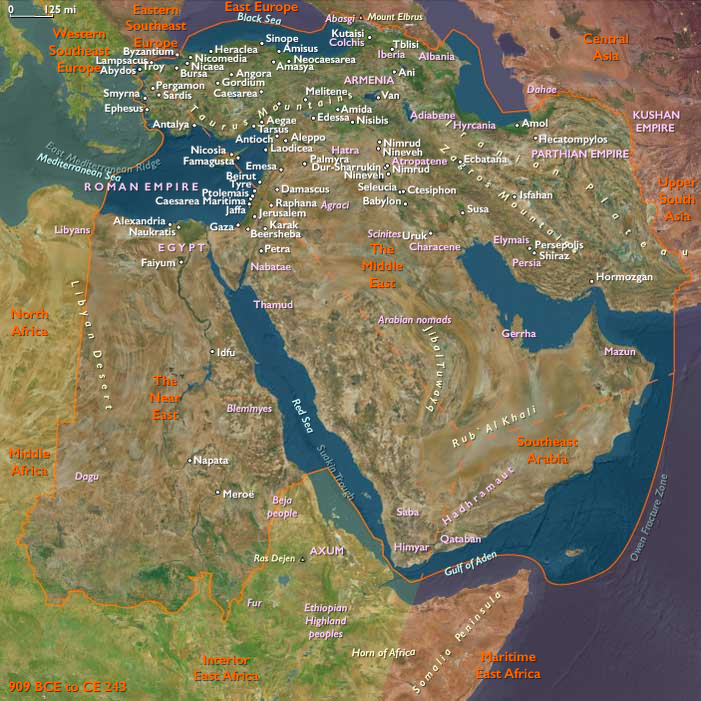
Following Julius Caesar's assassination in 44 BCE, his intended campaign against the Parthian Empire to avenge Rome’s earlier defeat at Carrhae is abandoned. In the ensuing power struggles of the Roman Republic, Parthia seizes the opportunity to attack Roman-controlled territories, capturing Syria and installing Antigonus as king and high priest in Judea. This shift intensifies the Roman-Parthian rivalry in the region. Roman response comes through generals like Publius Ventidius Bassus, who drives the Parthians out of Roman territory, and Mark Antony, whose subsequent campaigns in Atropatene (Iranian Azerbaijan) end disastrously due to logistical failures.
Despite these setbacks, Roman influence remains strong in the region. Under Augustus, a diplomatic settlement is reached with Parthia, stabilizing borders and setting the Euphrates River as a mutual frontier. This diplomatic equilibrium is periodically disrupted by internal Parthian conflicts, notably the civil war beginning around 32 BCE when Tiridates challenges Phraates IV.
In the first century CE, tensions over Armenia, a key strategic buffer state, dominate Roman-Parthian relations. Under Emperor Nero, Rome briefly loses control when the Parthians install Tiridates I on the Armenian throne in CE 53. After years of warfare, Rome concedes to a diplomatic compromise, allowing a Parthian prince on Armenia’s throne, subject to Roman approval—a lasting source of contention between the empires.
Culturally, this era sees the introduction and spread of Christianity in the region, particularly on the island of Cyprus, traditionally credited to the apostles Paul and native Barnabas in CE 45. Roman occupation, aimed primarily at economic exploitation, inadvertently stimulates economic growth and urban development, particularly after Emperor Augustus rebuilds the earthquake-devastated city of Salamis in 15 BCE.
Parthian rulers, notably Vologases I (51–78 CE), actively resist the Hellenization policies of previous eras, promoting indigenous Iranian traditions, religion, and languages. This revival includes founding new cities such as Vologesocerta and commissioning collections of ancient Zoroastrian texts. Simultaneously, the publication of significant works like Pedanius Dioscorides' De Materia Medica around 70 CE highlights the continued intellectual exchange within the broader Hellenistic and Roman-influenced world.
By the end of this period, the Parthian empire under Pacorus II (ruled 78–105 CE) reestablishes stability after intermittent civil conflicts. The continued diplomatic, cultural, and economic interactions between Rome and Parthia profoundly influence the Middle East’s historical trajectory, setting the stage for centuries of dynamic interchange, rivalry, and coexistence.
The Middle East: 45–34 BCE
Caesar’s Ambitions and Antony’s Eastern Campaigns
Following his decisive victory in the Roman civil war, Julius Caesar plans an ambitious campaign against the Parthian Empire in 44 BCE, aiming to avenge the catastrophic defeat suffered by Marcus Licinius Crassus at the Battle of Carrhae. Caesar intends first to pacify Dacia before proceeding eastward into Parthian territory. However, Caesar's assassination halts these plans abruptly, plunging Rome into further turmoil.
Stability returns momentarily when Caesar’s assassins are defeated at the Battle of Philippi, ensuring the dominance of the Second Triumvirate. Yet Roman preoccupation with internal conflicts, notably the revolt of Sextus Pompey in Sicily, provides an opportunity for Parthia to exploit Rome’s vulnerability. In a bold strike, Parthian forces invade Roman-held Syria and the client kingdom of Judea. The Parthians overthrow Hyrcanus II, the Judean high priest and puppet Roman ruler, imprisoning him in Seleucia. In his place, they install the pro-Parthian Hasmonean prince, Antigonus, the last surviving son of former king Aristobulus II, whom Rome had previously deposed. Antigonus ensures Hyrcanus can never reclaim the high priesthood by mutilating him, biting off his ears to permanently disqualify him from office.
Capitalizing on Rome's internal discord, the Parthians forge an alliance with Quintus Labienus, son of Caesar's former general and antagonist Titus Labienus. Together, they penetrate deep into western Anatolia, successfully defeating Roman forces commanded by Decidius Saxa. This triumph proves short-lived, as a seasoned Roman army under Publius Ventidius Bassus decisively drives the invaders from Roman territories.
In 37 BCE, with the direct support of Mark Antony—one of the triumvirs and lover of Egyptian Queen Cleopatra VII—Herod, son-in-law of Hyrcanus, recaptures Jerusalem, reinstating Roman influence over Judea. With the successful suppression of the Sicilian revolt the following year, Antony turns his attention eastward toward the Parthian Empire itself. He advances into Atropatene (modern Iranian Azerbaijan) leading approximately one hundred thousand legionaries, bolstered by contingents from Roman client kingdoms including Armenia, Galatia, Cappadocia, and sovereign Pontus.
Antony's ambitious campaign ends disastrously near the fortress-city of Phraaspa, capital of Atropatene. A tactical blunder leads to severe Roman losses, compounded by harsh winter conditions during the retreat, resulting in the deaths of thousands of Roman soldiers and auxiliary forces. Antony’s army suffers a loss of more than a quarter of its strength.
Undeterred, Antony launches another campaign—funded again by Egyptian resources—successfully invading Armenia. Upon his return in 34 BCE, Antony orchestrates a mock Roman triumph in the streets of Alexandria, a spectacular display that parodies Rome’s traditional military celebrations. During the climactic moment, surrounded by Cleopatra and her children, Antony makes a significant political declaration, publicly ending his alliance with Octavian, thus setting the stage for the impending conflict that will reshape the Roman world.
Caesar, after ensuring victory in his civil war, had planned a campaign into the Parthian Empire in 44 BCE to avenge the earlier defeat of a Roman army led by Marcus Licinius Crassus at the Battle of Carrhae.
Caesar's plan had been, after a brief pacification of Dacia, to continue east into Parthian territory.
Caesarian rule over the Republic had been effectively ensured by the defeat of Caesar's assassins at the Battle of Philippi.
Shortly after, however, with the triumvirs preoccupied with the revolt of Sextus Pompey in Sicily, Parthia attacks Roman-controlled Syria and the client kingdom of Judea.
The Judean high priest and puppet Roman ruler, Hyrcanus II, is overthrown and sent as prisoner to Seleucia, and the pro-Parthian Hasmonean Antigonus is installed in his place.
Antigonus is the only remaining son of former king Aristobulus II, who the Romans had deposed when they installed the weaker Hyrcanus II as high priest (but not king) in 63 BCE.
Antigonus, upon capturing Hyrcanus II, bites off his uncle's ears to disqualify him from ever again serving as high priest.
The Parthians ally with Quintus Labienus, son of Caesar's former general and later antagonist Titus Labienus, penetrating deep into the western Anatolia and defeating a Roman army under Decidius Saxa.
They are, however, defeated in turn by a veteran army led by Publius Ventidius Bassus, who drives the invaders from Roman territory.
Herod, the son-in-law of Hyrcanus, returns in 37 BCE to Judea with the aid of Mark Antony, Triumvir and lover of Egyptian Ptolemaic Queen Cleopatra VII, and recaptures Jerusalem.
The Sicilian revolt ends the following year in a Triumvirate victory.
Antony now goes on to attack the Parthian Empire itself, marching into Atropatene (present-day Iranian Azerbaijan) with some one hundred thousand legionaries, aided by the Roman client kings in Armenia, Galatia, Cappadocia and sovereign Pontus.
The campaign proves a disaster, however, after a Roman slip-up at Phraaspa, capital of Atropatene, and thousands of Romans and auxiliaries die during the retreat due to the cold winter.
Antony’s army loses more than a quarter of its strength in the course of the campaign.
Antony invades Armenia, gain with Egyptian money, this time successfully.
On his return in 34 BCE, a mock Roman Triumph is celebrated in the streets of Alexandria: the parade through the city is a pastiche of Rome's most important military celebration.
The whole city is summoned for the finale to hear a very important political statement by Antony, who, surrounded by Cleopatra and her children, ends his alliance with Octavian.
Near East (45–34 BCE): Roman-Parthian Rivalry and Jewish Turmoil
In 44 BCE, following his victory in the Roman civil war, Julius Caesar planned a campaign against the Parthian Empire to avenge Rome’s earlier defeat at the Battle of Carrhae. However, Caesar’s assassination prevented these ambitions from being realized. In the resulting power vacuum, Parthia took advantage by attacking Roman-controlled territories, notably Syria and the client kingdom of Judea. The Judean high priest and Roman ally, Hyrcanus II, was captured and mutilated by the pro-Parthian Hasmonean claimant Antigonus, effectively ending his ability to serve as high priest.
The Parthians, allied with Quintus Labienus, penetrated deep into western Anatolia, defeating the Roman general Decidius Saxa. The Roman Republic, under the command of Publius Ventidius Bassus, responded decisively, driving the invaders out and stabilizing the region. In 37 BCE, Herod, son-in-law of Hyrcanus, returned to Judea with the backing of Mark Antony, a triumvir and ally of Egyptian queen Cleopatra VII, successfully recapturing Jerusalem and establishing himself as the client king.
Antony then launched an ambitious campaign against Parthia itself, funded by Egyptian resources. His invasion of Atropatene (modern Iranian Azerbaijan) in 36 BCE ended disastrously at Praaspa, resulting in severe Roman losses during the harsh winter retreat. Despite this, Antony successfully invaded and subdued Armenia two years later. On returning to Alexandria in 34 BCE, Antony held a lavish mock triumph, publicly severing his alliance with Octavian, thereby setting the stage for the impending Roman civil war.
Legacy of the Era
The era from 45 to 34 BCE significantly intensified Roman-Parthian rivalry and reshaped the political landscape of the Near East, notably in Judea. The decisive actions of Roman commanders, coupled with the strategic maneuverings of local rulers like Herod, established new power dynamics, laying the groundwork for the lasting Roman dominance and profoundly influencing the cultural and political trajectories of the region.
The unexpected occupation of Palestine in 40 BCE by Parthian troops, the culmination of a Parthian invasion of the Levant under the command of Barzapharnes, alters the situation for the house of Antipater.
Antigonus, the ambitious son of Aristobulus II, the Jewish High Priest and King of Judea from 66 BCE to 63 BCE and therefore a legitimate Hasmonean, wins the favor of the Parthians and is established by them as king and high priest of Jerusalem after the Parthians, at the instigation of Antigonus, cut off the ears of his his uncle Hyrcanus in order to permanently disqualify him for the priesthood.
Hyrcanus is then taken to Babylonia in chains.
Phasael reportedly commits suicide, while his brother Herod escapes to Rome to plead with the Romans to restore him to power.
The Roman general Publius Ventidius Bassus between 39 BCE–38 BCE defeats the Parthian army, sending troops under the command of Poppaedius Silo to await the arrival of Herod, who the Roman Senate, with the approval of Octavian and Mark Antony, had appointed client king of Judaea.
Josephus puts this in the year of the consulship of Calvinus and Pollio (40 BCE), but Appian places it in 39 BCE.
Herod, in any case, returns in 38 BCE to Palestine.
Landing at Ptolemais, …
...Herod begins his campaign against Antigonus with the conquest of the Galilee, ...
…marches down the coast to take Jaffa, then …
…relieves Masada, where his family is still holed up.