Antiochus IV Epiphanes
ruler of the Seleucid Kingdom
Years: 215BCE - 164BCE
Antiochus IV Epiphanes ('God Manifest'; c. 215 BCE – 164 BCE) rules the Seleucid Empire from 175 BCE until his death in 164 BCE.
He is a son of King Antiochus III the Great.
His original name was Mithridates; he assumes the name Antiochus after he ascends the throne.
Notable events during the reign of Antiochus IV include his near-conquest of Egypt, which leads to a confrontation that became an origin of the metaphorical phrase, "line in the sand" , and the rebellion of the Jewish Maccabees.
Antiochus is the first Seleucid king to use divine epithets on coins, perhaps inspired by Bactrian Hellenistic kings who had earlier done so, or else building on the ruler cult that his father Antiochus the Great had codified within the Seleucid Empire.
These epithets include 'manifest god', and, after his defeat of Egypt, 'bringer of victory'.
However, Antiochus also tries to interact with common people, by appearing in the public bath houses and applying for municipal offices, and his often eccentric behavior and capricious actions lead some of his contemporaries to call him Epimanes ("The Mad One"), a word play on his title Epiphanes.





Related Events
Filter results
Showing 10 events out of 47 total
Near East (189–46 BCE): Roman Expansion, Jewish Struggles, and Cultural Flourishing
In 189 BCE, the Near East enters an era marked by the inception of the Greco-Roman world, with the Roman Republic increasingly dominating the eastern Mediterranean Basin. Having defeated the Seleucid king Antiochus III, Rome rewards its allies, particularly Pergamon and Rhodes, with territories, despite previously claiming a policy of "liberation of the Greeks." The Romans, under consul Gnaeus Manlius Vulso, subsequently launch an unauthorized campaign against the Galatian tribes of central Anatolia, decisively defeating them at Mount Olympus and near Ankara in 189 BCE. Although Vulso faces political backlash in Rome for acting without Senate approval, he is eventually cleared and granted a triumph.
Egyptian Instability and Seleucid Decline (177–154 BCE)
Between 177 and 166 BCE, Egypt under young Ptolemy VI Philometor experiences internal turmoil, with regents Eulaeus and Lenaeus provoking the Sixth Syrian War against Seleucid king Antiochus IV Epiphanes. The war briefly places Egypt under Seleucid influence until Roman envoy Gaius Popilius Laenas famously forces Antiochus to withdraw at Eleusis in 168 BCE. Meanwhile, Antiochus IV's aggressive Hellenization policies in Judea ignite the Maccabean Revolt in 165 BCE, led by the priestly Hasmonean family from Modiin. By 164 BCE, Jewish rebels successfully retake Jerusalem, cleanse the Temple, and reestablish traditional worship, initiating Hasmonean autonomy.
From 153 to 140 BCE, the region of modern Jordan thrives under the waning Seleucid and Ptolemaic influence, marked by the rise of the Nabataeans, who extend their kingdom from their capital at Petra, dominating regional trade. Greek influence continues to permeate the region, reflected in city names such as Philadelphia (Amman) and Gerasa (Jarash). Meanwhile, the pharaonic tradition persists among rulers at Meroë, who erect pyramids and stelae to record their achievements, utilizing a new Meroitic script.
Hasmonean Expansion and Hellenistic Influence (141–106 BCE)
By 141 BCE, the Hasmonean rulers secure substantial autonomy for Judea from the declining Seleucid Empire. Under rulers like John Hyrcanus (134–104 BCE), the Hasmoneans expand territorially, notably annexing Edom (Idumea), whose inhabitants adopt Judaism. Hellenistic cultural influence is evident, exemplified by iconic sculptures like the Venus de Milo, attributed to Alexandros of Antioch, created between 130 and 100 BCE.
In southern Arabia, the powerful Himyarite kingdom emerges around 115 BCE, capitalizing on the decline of the inland Sabaean kingdom. The Himyarites establish their center at Zafar, extending their influence from southern Yemen to the Persian Gulf region.
Roman Dominance, Cultural Exchange, and Jewish Population Growth (105–46 BCE)
From 105 BCE onward, Roman political involvement in the Near East intensifies. In 63 BCE, the Roman general Pompey decisively intervenes in Judean affairs, ending Jewish independence. Prominent Jewish figures like Antipater, father of Herod the Great, emerge as pivotal mediators between Judea and Rome. Pompey organizes the Decapolis, a league of ten self-governing Greek cities including Amman, Jarash, and Gadara (modern Umm Qays) to protect Greek interests from Jewish encroachment.
Between 69 and 58 BCE, the Jewish population grows significantly, both in Palestine and throughout the Diaspora. Estimates suggest millions of Jews and proselytes practicing Judaism across the Mediterranean world. Technological advancements, such as glassblowing, likely discovered in Phoenicia around 50 BCE, revolutionize glassware production and trade.
The Wisdom of Solomon, a Greek text by an Alexandrian Jew, emphasizes Jewish religious commitment and showcases extensive Hellenistic influence on Jewish literature, philosophy, and religious thought during this period.
Legacy of the Age
The age from 189 to 46 BCE profoundly reshapes the Near East through the consolidation of Roman dominance, the dynamic rise and territorial expansion of Hasmonean Judea, significant demographic growth among Jewish populations, and notable cultural and technological advancements. These developments lay foundations for further Roman imperial integration, foster dynamic cultural exchanges, and leave enduring legacies influencing subsequent regional histories.
Ptolemy's successors are in turn supplanted in Palestine by the Seleucids, and Antiochus IV seizes power in 175 BCE.
He launches a campaign to crush Judaism, and in 167 BCE he sacks the Temple.
The violation of the Second Temple, which had been built about 520-515 BCE, provokes a successful Jewish rebellion under the generalship of Judas (Judah) Maccabaeus.
The Hasmonean Dynasty begins in 140 BCE under the leadership of Simon Maccabaeus, who serves as ruler, high priest, and commander in chief.
Simon, who is assassinated a few years later, formalizes what Judas had begun, the establishment of a theocracy, something not found in any biblical text.
Seleucid king Antiochus III renounces all claim to his conquests in Europe and in Asia Minor west of the Taurus at the peace treaty of Apamea, signed with Rome in 188.
According to the humiliating terms of the peace agreement, he also is obliged to pay a huge indemnity of fifteen thousand talents over a period of twelve years, surrender his elephants—a great asset in battle— surrender the entire Syrian fleet except ten warships, and furnish hostages, including his son (the future Antiochos IV).
He is also made to give up his coastal territories and leave the whole of Anatolia as a Roman sphere of influence, most of it under the control of Eumenes II of Pergamon.
He can continue his war in the eastern provinces, but his kingdom is now reduced to Mesopotamia, western Iran, and Syria.
Antiochus, faced with rebellion in the east, is without resources to suppress them.
Mounting a fresh expedition in 187 to the east of his kingdom in Luristan, in the upstart kingdom of Elymais, the king, now fifty-four, is murdered in a Baal temple near Susa, where he is exacting tribute in order to obtain much-needed revenue.
The empire inherited in 187 BCE by Antiochus' thirty-year-old son, Seleucus IV Philopater (“Father-loving”), though much reduced after the war with Rome (190-189), is still large, consisting of Syria (including Cilicia and Palestine), Mesopotamia, Babylonia, and nearer Iran (Media and Persia).
The Middle East: 177–166 BCE
The Sixth Syrian War and the Ascendancy of Roman Influence
The era from 177 to 166 BCE is marked by the turbulent events of the Sixth Syrian War, a critical confrontation between the Seleucid Empire under Antiochus IV Epiphanes and Ptolemaic Egypt. The causes of this war are somewhat obscure, but the immediate provocation arises in 170 BCE when the two regents of Egypt's young king Ptolemy VI Philometor, Eulaeus and Lenaeus, declare war against the Seleucids.
Initially successful, Antiochus swiftly captures strategic positions, notably the fortress city of Pelusium. Realizing the disastrous course of their strategy, the Egyptians depose the original regents, replacing them with Comanus and Cineas, who seek peace negotiations. Antiochus exploits the turmoil by taking Ptolemy VI, his nephew, under his guardianship and effectively assumes control over Egypt. The people of Alexandria, however, reject this arrangement and proclaim Ptolemy VIII Physcon as the sole ruler.
Antiochus responds by besieging Alexandria, but unable to sever its supply lines, he withdraws by the end of 169 BCE. In his absence, reconciliation occurs between Ptolemy VI and his brother, undermining Antiochus' position and prompting a renewed Seleucid invasion. Facing imminent conquest, the Egyptians appeal to Rome, marking a critical turning point.
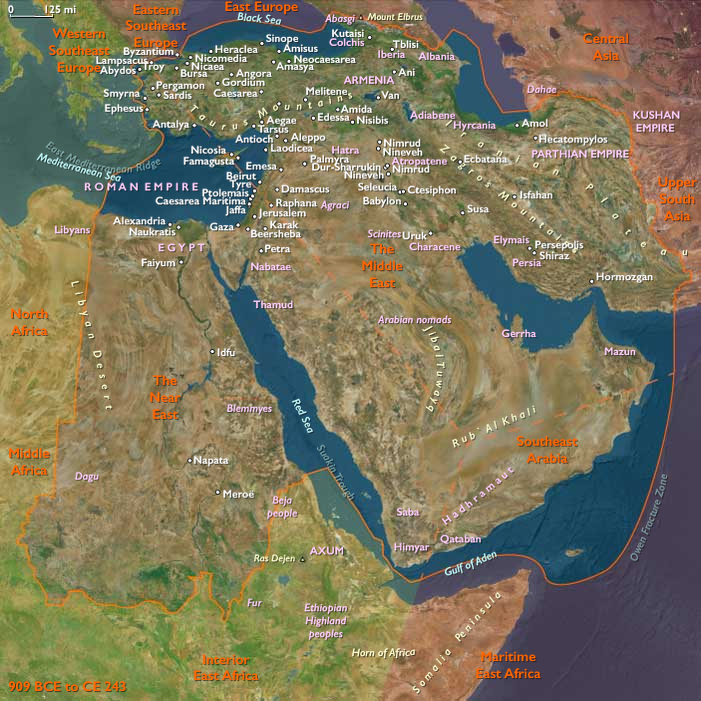
In 168 BCE, Roman envoy Gaius Popilius Laenas confronts Antiochus near Alexandria. In a dramatic scene at Eleusis, Popilius famously draws a circle around Antiochus, demanding a decision on the Roman Senate’s ultimatum—immediate withdrawal from Egypt and Cyprus. Antiochus, cornered by Rome's authority, concedes, marking the event remembered as the "Day of Eleusis," effectively ending Seleucid ambitions in Egypt.
This era also sees the continued consolidation of the Parthian kingdom under Phraates I, who expands Parthian control beyond the Gates of Alexander and captures strategic locations like Apamea Ragiana. The groundwork laid during his reign paves the way for the extensive territorial expansion that will soon be realized by his successor, Mithridates I.
Thus, the era 177–166 BCE signifies the waning of Seleucid power, the consolidation of Roman authority in Mediterranean geopolitics, and the rising prominence of Parthia, reshaping the geopolitical landscape of the Middle East significantly.
The causes of the Sixth Syrian War are obscure.
Eulaeus and Lenaeus, the two regents of the young king of Egypt, Ptolemy VI Philometor, declare war on the Seleucid ruler Antiochus IV Epiphanes in 170.
Ptolemy's younger siblings Ptolemy VIII Physcon and Cleopatra II are in the same year declared co-rulers in order to bolster the unity of Egypt.
Military operations do not begin until 169, when Antiochus quickly gains the upper hand, seizing the important strategic town of Pelusium.
The Egyptians realize their folly in starting the war, Eulaeus and Lenaeus are overthrown and replaced by two new regents, Comanus and Cineas, and envoys are sent to negotiate a peace treaty with Antiochus.
Antiochus takes Ptolemy VI (who is his nephew) under his guardianship, giving him effective control of Egypt.
However, this is unacceptable to the people of Alexandria, who respond by proclaiming Ptolemy Physcon as sole king.
Antiochus besieges Alexandria but he is unable to cut communications to the city so, at the end of 169, he withdraws his army.
In his absence, Ptolemy VI and his brother are reconciled.
Antiochus, angered at his loss of control over the king, invades again.
The Egyptians send to Rome asking for help and the Senate dispatches Gaius Popilius Laenas to Alexandria.
Meanwhile, Antiochus has seized Cyprus and Memphis and is marching on Alexandria.
At Eleusis, on the outskirts of the capital, he meets Popilius Laenas, with whom he had been friends during his stay in Rom, but instead of a friendly welcome, Popilius offers the king an ultimatum from the Senate: he must evacuate Egypt and Cyprus immediately.
Antiochus begs to have time to consider but Popilius draws a circle round him in the sand with his cane and tells him to decide before he steps outside it.
Antiochus chooses to obey the Roman ultimatum.
The "Day of Eleusis" ends the Sixth Syrian War and Antiochus' hopes of conquering Egyptian territory.
Near East (177–166 BCE): The Sixth Syrian War and Roman Intervention
The era from 177 to 166 BCE in the Near East is dominated by the tumultuous events of the Sixth Syrian War, a significant conflict between the Seleucid Empire and Ptolemaic Egypt. The war's origins are obscure but are initiated by the Egyptian regents Eulaeus and Lenaeus in 170 BCE, during the reign of the young king Ptolemy VI Philometor. To fortify Egypt's unity, the king's younger siblings, Ptolemy VIII Physcon and Cleopatra II, are declared co-rulers.
Military operations commence in 169 BCE. The Seleucid king Antiochus IV Epiphanes swiftly gains the advantage, capturing the strategic city of Pelusium and effectively controlling Egypt. Egyptian leaders quickly realize their miscalculation, depose Eulaeus and Lenaeus, and appoint new regents Comanus and Cineas to negotiate peace. Antiochus IV takes Ptolemy VI, his nephew, under his guardianship, effectively asserting dominance over Egypt. This arrangement proves unacceptable to the people of Alexandria, who instead proclaim Ptolemy Physcon sole king.
Antiochus retaliates by laying siege to Alexandria but withdraws at the end of 169 BCE, failing to isolate the city. During Antiochus's absence, reconciliation occurs between the Ptolemaic siblings, frustrating Antiochus, who launches another invasion. The Egyptians appeal to Rome for assistance, prompting the Roman Senate to dispatch envoy Gaius Popilius Laenas.
In a dramatic encounter at Eleusis near Alexandria, Antiochus is confronted by Popilius Laenas in 168 BCE. The Roman envoy delivers a stern ultimatum demanding immediate withdrawal from Egypt and Cyprus. Antiochus hesitates, prompting Popilius to famously draw a circle around him, insisting on an immediate decision before stepping out. Antiochus submits to Rome’s demands, marking the "Day of Eleusis," effectively ending the Sixth Syrian War and Antiochus's ambitions in Egypt.
Legacy of the Era
This era underscores the decisive role Rome begins to play in Near Eastern affairs, curbing Seleucid expansion and reinforcing Roman diplomatic dominance. The resolution of the Sixth Syrian War through Roman intervention signifies a pivotal shift toward Rome’s growing hegemony in the eastern Mediterranean, setting a precedent for future political dynamics in the region.
Egypt’s Hellenistic regent Cleopatra I, although a daughter of a Seleucid king, has not taken sides in Syria and remains friendly with Rome.
Mother and son govern effectively until her death in 176, when ten-year-old Ptolemy VI Philometor (Greek: Loving his Mother), beset by problems of dynastic rivalry, becomes sole ruler of Egypt, and immediately falls under the influence of two ambitious courtiers.
Financial difficulties, created in part by the heavy war indemnity exacted by Rome, have compelled Seleucus IV to pursue a policy devoid of expensive adventures.
His unambitious policy and care are also dictated by the fact that his son and heir, Demetrius, has been sent to Rome as a hostage for his father in exchange for Antiochus, the third son of Antiochus III, who has learned to admire Roman institutions and policies.
Seleucus, having heard that the temple treasury in Jerusalem is wealthy, wonders why some of the tribute is being withheld.
He sends one his chief ministers, Heliodorus, to investigate.
Heliodorus, having possibly found enough wealth to bribe elements in the Seleucid army, returns, assassinates Seleucus, and seizes the throne in 175.
As Seleucus' legitimate heir, Demetrius, is still a hostage in Rome, Antiochus, with the help of King Eumenes II of Pergamon, seizes the throne for himself, proclaiming himself co-regent for another son of Seleucus, an infant named Antiochus (whom he will murder a few years later).
He takes the throne as Antiochus IV Epiphanes (”God Manifest”).
Both economically and socially, Antiochus, a passionate philhellene who pays lip service to the political traditions of both Athens and Rome, makes efforts to strengthen his kingdom—inhabited in the main by Orientals (non-Greeks of Asia Minor and Persia)—by founding and fostering Greek cities.
Even before he had begun his reign, he had contributed to the building of the temple of Zeus in Athens and to the adornment of the theater.
He enlarges Antioch on the Orontes by adding a section to the city (named Epiphania after him).
Here he builds an aqueduct, a council hall, a marketplace, and a temple to Jupiter Capitolinus.