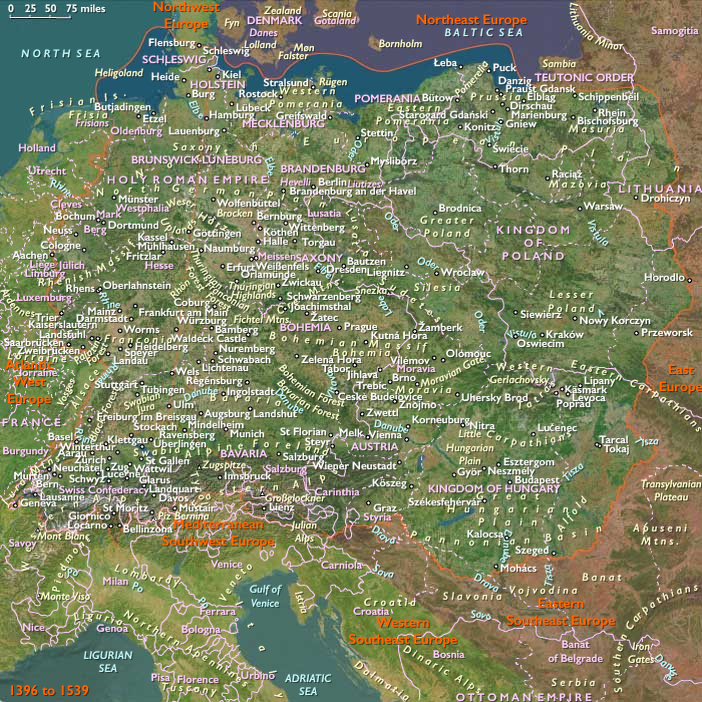
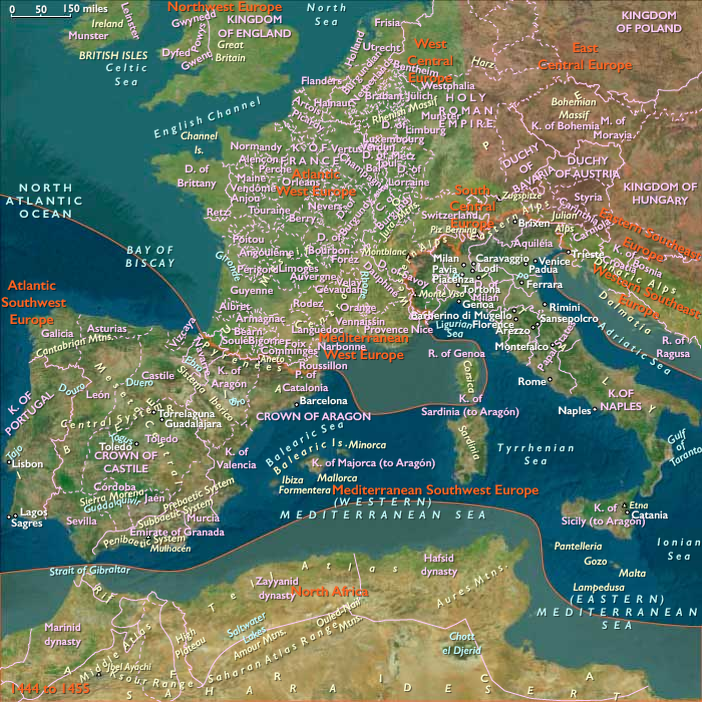
Plague forces the council at Ferrara to move to Florence on January 10, 1439, and is thus known as the Council of Ferrara-Florence.
Here, the Council affirms the so-called Peterine theory, according to which Jesus Christ conferred the position of primacy in the church upon Peter alone, thus grounding his successors' claim to jurisdictional primacy in the church.
After protracted and difficult discussion of their theological differences, the Greeks agree to accept the Filioque and also the Latin statements on purgatory, the Eucharist, and papal primacy.
Isidore of Kiev has attended the council, first in Ferrara, then in Florence, at which he is one of six Greek spokesmen.
Together with the Greek cardinal John Bessarion, he draws up the document of unification, Laetentur Caeli, under which the two churches are formally reunited on July 6, 1439, Constantinople agreeing to submit to the authority of Rome.
The Orthodox leaders will have trouble, however, winning approval from the clergy at home.
The council also negotiates reunion with several smaller eastern churches, such as the Armenian church, Nestorian church, Jacobite church, and Eastern Rite churches, and challenges the conciliar theory enunciated at the councils of Constance and Basel.
Cosimo de' Medici and Pope Eugene IV had requisitioned the decaying convent of San Marco in 1436 and invited the Dominicans to build and decorate a new monastery.
In collaboration with the architect Michelozzo, Fra Angelico and his assistants have frescoed numerous scenes from the life of Christ in the forty-four monks' dormitory cells and connecting corridors.
Angelico has designed each of these clearly drawn frescoes, such as the San Marco “Annunciation,” to enhance the contemplative, religious setting.
In the (now overcleaned) altarpiece for San Marco, painted by Angelico in 1438-39 and entitled “Madonna and Saints in a Sacred Conversation” (he has created the form called “Sacra Conversazione”), the artist employs natural light and Alberti's systematic perspective to produce a remarkable rendering of the human figure.
The versatile Alberti, better known as an architect, publishes a lengthy treatise, “On the Family,” written from 1433 to 1439; its wisdom and rationality mirror the abiding concern of Italian letters with social and ethical topics.
Franco-Flemish composer Guillaume Dufay, highly respected not only for his music but also for his learning, has attained influential appointments in the church, taking part in the Council of Basel as a delegate from Cambrai.
He had remained a member of the papal choir in Rome until 1434 when, because of a crisis in the finances of the papal choir, and to escape the turbulence and uncertainty during the struggle between the papacy and the Council of Basel, he had entered the service of Duke Amadeus VIII of Savoy for a year.
In 1435 he was again in the service of the papal chapel, but this time it was in Florence.
In 1436, Dufay had composed the festive motet Nuper rosarum flores, one of his most famous compositions, which is sung at the dedication of Brunelleschi's dome of the cathedral in Florence, where Eugenius lives in exile.
During this period Dufay also begins his long association with the d'Este family in Ferrara, some of the most important musical patrons of the Renaissance, and with which he probably had become acquainted during the days of his association with the Malatesta family; Rimini and Ferrara are not only geographically close, but the two families are related by marriage, and Dufay composes at least one ballade for Niccolò III, Marquis of Ferrara.
In 1437, Dufay had visited the town.
The struggle between the papacy and the rump Council of Basel has continued: when the rump council had suspended Eugenius, he had excommunicated its members.
The council, with only seven bishops present, had declared Eugenius deposed and in 1439 elects as his successor a layman, Duke Amadeus himself, who takes the name Pope Felix V.