Arnulf of Carinthia
Holy Roman Emperor
Years: 850 - 899
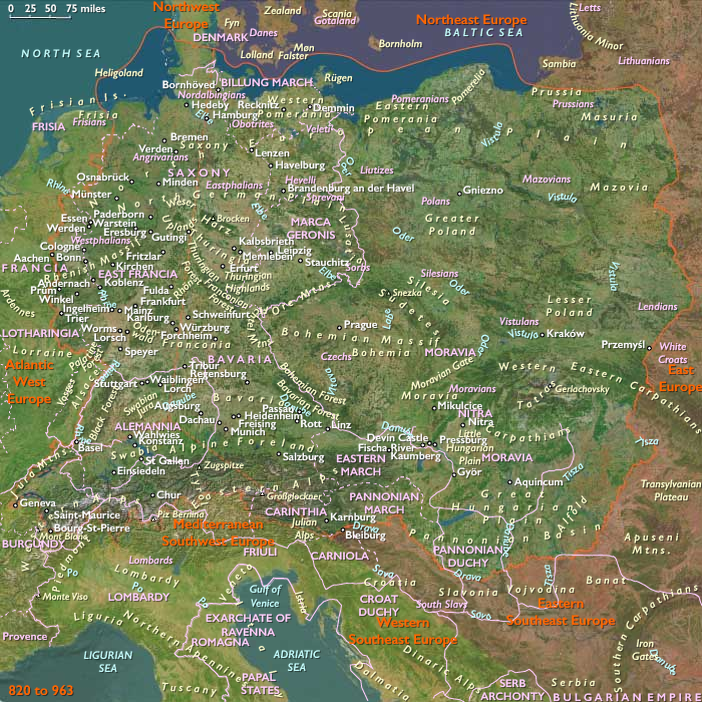
Arnulf of Carinthia (850 – 8 December 899) is the Carolingian King of East Francia from 887, the disputed King of Italy from 894 and the disputed Holy Roman Emperor from 22 February 896 until his death at Regensburg, Bavaria.

Related Events
Filter results
Showing 10 events out of 75 total
Carloman has re-founded the palace and monastery at Ötting in Bavaria, dedicating it to the Virgin Mary and "numerous other saints whose relics we were able to collect with God's help", and appointing his father's friend, the linguistic scholar Baldo, as his chancellor.
He may have been the object in 878 of an assassination attempt.
According to the Annales Iuvavenses, the king "was surrounded by Count Ermenpert and some of his soldiers" at Ergolding, but the had count apparently fled to West Francia, where In a letter of June 7, 879, Pope John, having failed to persuade Louis the Stammerer, Charles the Bald's heir, to come to Italy for its defense, had appealed to Carloman, whom he had previously rejected.
It was too late.
Carloman had in 879 become incapacitated by illness, perhaps a stroke.
His brother Louis came to Bavaria to receive the recognition of the aristocracy as future king.
According to the Annales Fuldenses (879), Carloman lost his voice, but was still able to communicate by writing.
Regino of Prüm, writing for the year 880, recalls that he was "erudite in letters" (litteris eruditus), which indicates he could write Latin.
Most sources place Carloman's death in March 880, but the Annales Iuvavenses place it on September 21.Carloman leaves one illegitimate son, Arnulf, who continues as margrave of Carinthia during the reigns of Carloman's brothers.
In 887, he will become king of East Francia and in 896 emperor.
The Viking Siege of Asselt (882) and the Controversial Treaty of Charles the Fat
In 882, Emperor Charles the Fat gathers a large Frankish army at Worms to confront the Vikings encamped at Asselt on the Meuse in Frisia. This campaign, intended to drive the Norse invaders from Carolingian lands, ultimately results in a controversial treaty with Viking leaders Godfrid and Sigifrid, shaping Charles’ historical reputation.
The Frankish Military Campaign Against the Vikings
- Following his return from Italy and assumption of the East Frankish throne in Regensburg (early May 882), Charles takes immediate action against the Viking threat in Frisia.
- An army is assembled consisting of:
- Franks, Alemanni, Bavarii, Thuringii, Saxons, and Lombards.
- The campaign strategy:
- Lombards, Alemanni, and Franks move up the Rhine on the western bank.
- Bavarians march along the eastern bank and cross the Rhine at Andernach.
- Arnulf of Carinthia (Bavarians) and Henry of Franconia (Franks) are sent ahead to ambush the Norsemen.
The Siege of Asselt and the Unexpected Truce
According to the Mainz continuation of the Annales Fuldenses:
- The Frankish army is on the verge of capturing the Viking camp, but Charles is persuaded by Liutward of Vercelli (allegedly bribed by the Vikings) to accept peace terms instead of pressing the attack.
- Charles meets Viking envoys, leading to negotiations instead of outright battle.
- Godfrid is granted the Kennemerland (formerly ruled by Rorik of Dorestad) as a vassal of Charles.
- Sigifrid is paid Danegeld, with some funds taken from church treasuries.
Alternative Account from the Bavarian Continuation of the Annales Fuldenses
- The ambush fails due to treachery, delaying the Frankish assault.
- The twelve-day siege is broken by disease from rotting corpses and a violent hailstorm.
- Godfrid swears oaths to Charles, promising never again to raid the empire, and is baptized, with Charles serving as his godfather.
Aftermath and Contemporary Reactions
- Charles disperses his army at Koblenz, bringing an end to the campaign.
- The Mainz continuator of the Annales Fuldenses presents the event as a humiliating failure, blaming Charles for weakness and bribery, possibly due to the influence of Liutbert of Mainz, who had been dismissed from court.
- Other sources, including the Bavarian continuation, offer a less critical perspective, portraying the negotiations as a pragmatic response to unforeseen difficulties.
- Contemporaries do not widely view the campaign as a disaster, but later historians emphasize Charles’ diplomatic approach as an example of Carolingian weakness against Viking aggression.
Significance and Legacy
- The treaty of Asselt (882) is part of a larger Carolingian pattern of dealing with Vikings, alternating between military action, payments, and territorial concessions.
- Charles the Fat’s reputation for weakness largely stems from this campaign and its depiction in the Mainz annals, though his diplomatic approach was consistent with previous Frankish rulers.
- The continued Norse presence in Frisia reflects the ongoing fragmentation of Carolingian rule, as Viking leaders are increasingly integrated into the Frankish political system.
Though Charles' campaign at Asselt did not result in a decisive victory, it was not universally seen as a failure at the time. However, the perception of Charles as an ineffective ruler, shaped by contemporary political rivalries and later historical interpretations, has come to define his legacy.
Louis the Younger, having fallen ill in 881, dies in Frankfurt on January 20, 882.
He is buried beside his father in the abbey of Lorsch.
By his wife Luitgard of Saxony, he had had a son called Louis (877–879), who died in a fall from a palace window, and a daughter called Hildegard (878–895).
Louis had also fathered an illegitimate son, Hugh (855/60 – February 880), either with the daughter of Adalard or with an earlier concubine.
Since he leaves no heir, all his territories fall to his brother Charles, who thus can reunite the entire East Frankish kingdom.
Hildegard will later join with the Bavarian magnate Engeldeo in conspiring against King Arnulf and will deprived of her "public honors" in 895, according to the Annals of Fulda.
Louis the Younger had inherited Bavaria, Charles the Fat had been given the Kingdom of Italy and Arnulf had been confirmed in Carinthia by an agreement with Carloman after the latter had been incapacitated by a stroke in 879.
Bavaria, however, is ruled more or less by Arnulf.
Arnulf had in fact ruled Bavaria during the summer and autumn of 879 while his father arranged his succession and he himself had been granted "Pannonia," in the words of the Annales Fuldenses, or "Carantanum," in the words of Regino of Prüm.
The division of the realm had been confirmed in 880 on Carloman’s death.
When, in 882, Engelschalk II rebelled against the Margrave of Pannonia, Aribo, and ignited the so-called Wilhelminer War, Arnulf had supported him and even accepted his and his brother's homage.
This has ruined Arnulf's relationship with his uncle the Emperor and put him at war with Svatopluk of Moravia.
At first, the rebels were successful, until Aribo appeals to not only Moravia, but also the Emperor Charles the Fat, who confirms Aribo in his post, to which he had been appointed by Charles' father, Louis the German, back in 871.
Svatopluk invades Pannonia and, capturing one of the Wilhelminer brothers, mutilates him.
The remaining sons then withdraw from Charles' suzerainty and do homage to Charles' bastard nephew, who thus estranges himself from his uncle.
The war between Arnulf and Svatopluk escalates after the former refuses the latter’s request to to surrender the Wilhelminers.
The Bulgarians, in addition to the Franks and Moravians, also enter the conflict by invading Svatopluk's realm.
According to a record in the Annals of Salzburg, the region of Vienna (Austria) was also invaded in 881 by Hungarians.
They seems to have been hired either by Svatopluk or by Arnulf in order to intervene in their conflict.
The “Willhelminer War" leads to the devastation of Pannonia east of the river Rába.
Finally, Charles the Fat himself turns and receives Svatopluk as his man at Kaumberg, receiving promises of peace and fidelity.
Svatopluk also promises never to invade Charles’s realm with a hostile force as long as he lives, while Charles recognizes him as a prince of his realm.
Arnulf does not make peace with Svatopluk until late 885, by which time the Moravian is a man of the emperor.
Some scholars see this war as destroying Arnulf's hopes at succeeding Charles.
Henry of Franconia: Defender of Neustria Against the Vikings (884–886)
Henry of Franconia was one of Charles the Fat’s most trusted military commanders, assigned to hold the March of Neustria against the Viking invasions following Charles’ accession to the throne of West Francia in 884. His career was marked by his campaigns against the Norse, his role in the political intrigues of Charles' court, and his untimely death in 886.
Role in the March of Neustria
- After Charles became King of West Francia in 884, he appointed Henry as margrave of Neustria, a military frontier region responsible for defending against Viking raids.
- Neustria, situated along the Loire and Seine rivers, was one of the regions most affected by Norse incursions, making Henry’s role critical to Frankish defense.
The Arrest of Hugh of Alsace and Godfrey of Frisia (885)
- In 885, Charles summoned Hugh, Duke of Alsace, and Godfrey, Duke of Frisia, to a court at Lobith.
- It was Henry who carried out their arrest on Charles' orders:
- Godfrey was executed, removing a powerful Viking-allied warlord from Frisia.
- Hugh was blinded and imprisoned at Prüm, eliminating a political rival in Lotharingia.
Campaigns During the Siege of Paris (885–886)
- In early 886, Henry was sent to aid the besieged defenders of Paris, where Vikings under Sigfred and Rollohad been attacking for months.
- However, he did not stay long, likely due to Charles the Fat’s hesitance to fully commit to battle.
- Later in 886, Henry returned to Paris with Charles, but en route, he was killed in a skirmish with the Vikings.
- His death was a serious blow to Carolingian military efforts, as Henry had been one of the few commanders capable of dealing with Viking incursions in Neustria.
Family and Possible Marriages
Though details of Henry’s family are unclear, sources and onomastic studies suggest he was married and had children:
- Wife #1 (Possible): Ingeltrude, daughter of Eberhard of Friuli and Gisela, daughter of Louis the Pious.
- Wife #2 (Possible): A daughter of Berengar I of Neustria, possibly linking Henry to the Conradine family.
- If this is correct, their marriage may have been a strategic alliance, securing Henry’s position in Neustriaand aiding his campaigns against the Vikings.
Children
- Hedwiga → Later marries Otto I, Duke of Saxony, linking Henry’s lineage to the future Ottonian dynasty.
- A possible son:
- Some scholars propose a son named Henry or Berenger, who might be identified with Berengar II of Neustria.
- This theory is based on onomastic evidence (name similarities) and the continuation of Henry’s influence in Neustria.
Legacy of Henry of Franconia
- His military leadership in Neustria was one of the last effective Frankish responses to Viking raids before the Carolingian collapse.
- His daughter Hedwiga’s marriage to Otto I of Saxony helped establish the future Ottonian dynasty, which would rise to power in Germany.
- His death in 886 weakened Carolingian resistance, accelerating the decline of Charles the Fat’s rule and the further decentralization of West Francia.
Henry’s tenure as Margrave of Neustria was short but critical in the ongoing struggle against Viking invasions. His death marked the loss of one of Charles the Fat’s strongest military leaders, further destabilizing West Francia at a time when the Carolingian Empire was already unraveling.
Liutward, Bishop of Vercelli, had in 886 taken the sister of Berengar of Friuli, the chief secular magnate, from the nunnery of San Salvatore at Brescia in order to marry her to a relative of his; whether or not by force or by the consent of the convent and Charles the Fat, her relative, is uncertain.
Berengar and Liutward had had a feud that year, which involved his attack on Vercelli and plundering of the bishop's goods.
Berengar's actions are explicable if his sister was abducted by the bishop, but if the bishop's actions were justified, then Berengar appears as the initiator of the feud.
Whatever the case, bishop and margrave are reconciled by 887, when Charles appears to have succumbed to fits of madness.
During this crisis, Richardis has attempted to rule in her husband's stead, but is unsuccessful.
In an effort to bring down the over-powerful and hated Liutward, Charles' archchancellor, he and Richardis are accused by Charles and his courtiers of adultery.
Charles asserts that their marriage is unconsummated and demands a divorce.
The empress successfully undergoes the ordeal of fire, but Liutward is banished form court.
Richardis, protected by her family, withdraws to Andlau Abbey, which she had founded on her ancestral lands in 880, and where her niece Rotrod is abbess.
(Richardis herself was previously lay abbess of religious houses at Säckingen and Zurich.)
The failure of Emperor Charles III to halt the Viking raids on the East Frankish kingdom results in his overthrow by the East Frankish magnates.
Arnulf takes the leading role in the deposition of his uncle.
With the support of the nobles, Arnulf holds a Diet at Tribur and deposes Charles in November 887, under threat of military action.
Charles peacefully goes into his involuntary retirement, but not without first chastising his nephew for his treachery and asking only for a few royal villas in Swabia, which Arnulf mercifully grants him, on which to live out his final months.
Arnulf, having distinguished himself in the war against the Slavs is elected by the nobles of the realm (only the eastern realm, though Charles had ruled the whole of the Frankish lands) and assumes his title of King of East Francia.
Berengar is the only one of the reguli (petty kings) to crop up in the aftermath of Charles' deposition besides Arnulf of Carinthia, his deposer, who had been made king before the emperor's death in January 888.
Charter evidence begins Berengar's reign at Pavia between December 26, 887 and January 2, 888, though this has been disputed.
Berengar is not the undisputed leading magnate in Italy at this time, but he may have made an agreement with his former rival, Guy of Spoleto, whereby Guy would have West Francia and he Italy on the emperor's death.
Both Guy and Berengar are related to the Carolingians in the female line.
They represent different factions in Italian politics: Berengar the pro-German and Guy the pro-French.