Arthur of Brittany
Duke of Brittany
Years: 1187 - 1203
Arthur I (29 March 1187 – probably 1203) is Duke of Brittany between 1194 and 1202.
He is the posthumous son of Geoffrey II, Duke of Brittany and Constance, Duchess of Brittany.
As Geoffrey's son and heir he also is Earl of Richmond.
Geoffrey is a son of Henry II of England, younger than Richard I but older than John.
In 1190, Arthur is designated heir to the throne of England and its French territory by Richard I, the intent being that Arthur would succeed Richard in preference to Richard's younger brother John.
Nothing is recorded of Arthur after his incarceration in Rouen Castle in 1203, and his precise fate is unknown.

Related Events
Filter results
Showing 7 events out of 7 total
Richard remains in Messina until Tancred finally agrees to sign a treaty on March 4, 1191.
The treaty is signed by Richard, Philip and Tancred.
Its main terms provide for Joan to receive twenty thousand ounces of gold as compensation for her inheritance, which Tancred keeps; moreover, Richard officially proclaims his nephew, Arthur of Brittany, son of Geoffrey, as his heir, and Tancred promises to marry one of his daughters to Arthur when he comes of age, giving a further twenty thousand ounces of gold that will be returned by Richard if Arthur does not marry Tancred's daughter.
Atlantic West Europe (1192–1203): Shifting Alliances, Angevin Decline, and Cultural Flourishing
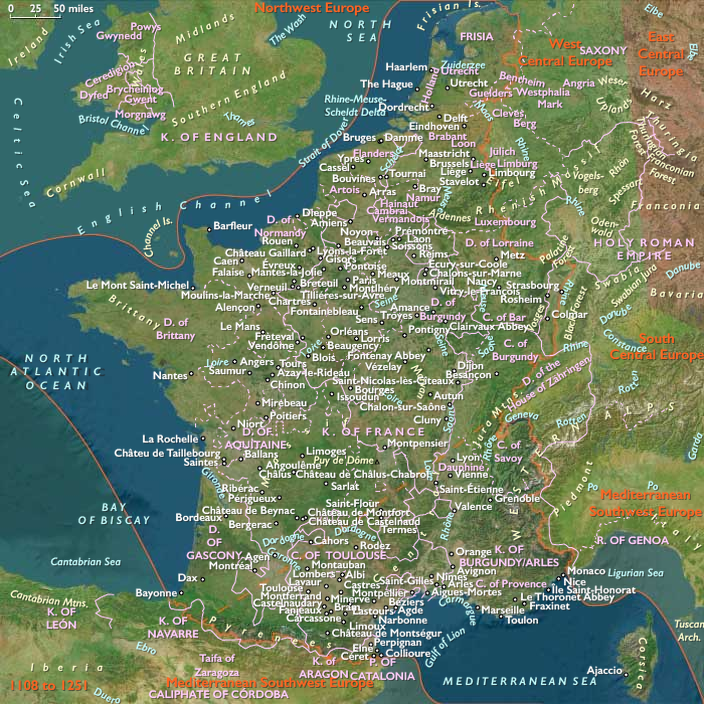
Between 1192 and 1203, Atlantic West Europe—including the Low Countries, Brittany, Normandy, Aquitaine, Burgundy, central France, Alsace, and Franche-Comté—experienced dramatic shifts marked by the decline of Angevin power, a significant expansion of Capetian authority under Philip II Augustus, intensified economic prosperity, and remarkable cultural and intellectual growth.
Political and Military Developments
-
Decline of the Angevin Empire and Rise of Capetian France
- Richard I ("the Lionheart," r. 1189–1199), frequently absent from his continental territories due to crusading and captivity, saw Angevin authority weaken significantly.
- Upon Richard’s death (1199), his brother John Lackland (r. 1199–1216) inherited an empire in turmoil, facing immediate challenges from Philip Augustus of France.
- Philip II Augustus skillfully exploited John's vulnerabilities, gradually undermining Angevin control, particularly in Normandy, Anjou, and parts of Aquitaine.
-
Loss of Normandy and Angevin Territories
- Philip II’s military campaigns culminated in the decisive Siege of Château Gaillard (1203), significantly weakening Angevin defenses in Normandy.
- By 1203, Angevin territories were on the brink of collapse, setting the stage for Normandy’s complete loss (1204).
-
Brittany’s Ambiguous Position
- Brittany, under Duchess Constance and later her young son Arthur of Brittany, became embroiled in the Angevin-Capetian conflict, exacerbating regional instability.
- Arthur’s capture (1202) by King John further destabilized the region, ultimately benefiting Capetian ambitions.
-
Burgundy and the Low Countries: Stability Amid Conflict
- Odo III of Burgundy (r. 1192–1218) maintained stable rule, skillfully navigating alliances between France and the Empire.
- The Low Countries, particularly Flanders, continued to prosper economically and maintained relative political autonomy despite external tensions.
Economic and Social Developments
-
Trade Expansion and Urban Prosperity
- Economic activity in Flanders flourished, particularly in Bruges, Ghent, and Ypres, becoming European centers of textile manufacturing and trade.
- Continued growth of the Champagne fairs integrated markets, strengthening Atlantic West Europe's centrality in European commerce.
-
Rural Productivity and Agricultural Innovation
- Increased agricultural productivity and population growth supported further urbanization, with widespread improvements in agricultural technology and crop rotation.
Cultural and Intellectual Developments
-
Gothic Architecture Reaches New Heights
- Gothic construction reached a high point in this era, particularly at Chartres Cathedral (rebuilt after 1194), which became an influential model across Europe.
-
Courtly Literature and Intellectual Activity
- Courtly literature flourished further, notably in the works of Chrétien de Troyes’ successors, who expanded Arthurian romance and courtly poetry.
- Universities, especially the University of Paris, became dominant intellectual hubs, attracting students and scholars from across Europe.
Religious Developments
-
Crusading Zeal and the Fourth Crusade
- Atlantic West Europe actively supported crusading efforts, culminating in regional participation in preparations for the ill-fated Fourth Crusade (1202–1204).
-
Monasticism and Religious Reform
- Continued expansion of Cistercian monasticism influenced regional religious practice, economy, and education, reinforcing their societal significance.
Legacy and Significance
The era 1192–1203 marked a critical turning point in Atlantic West Europe, characterized by the dramatic weakening of Angevin rule and corresponding rise of Capetian dominance under Philip II Augustus. Combined with robust economic growth, cultural achievements, and intense crusading fervor, this era fundamentally reshaped the political and cultural landscape, establishing a clear foundation for Capetian dominance, regional prosperity, and cultural vitality throughout the thirteenth century.
Richard appears to have started to recognize John as his heir presumptive in the final years before his death, but the matter is not clear-cut and medieval law gives little guidance as to how the competing claims should be decided.
With Norman law favoring John as the only surviving son of Henry II and Angevin law favoring Arthur as the only son of Henry's elder son, the matter rapidly becomes an open conflict.
Arthur is supported by the majority of the Breton, Maine and Anjou nobles and receives the support of Philip II, who remains committed to breaking up the Angevin territories on the continent.
With Arthur's army pressing up the Loire valley towards Angers and Philip's forces moving down the valley towards Tours, John's continental empire is in danger of being cut in two.
The Succession Crisis After Richard I’s Death and the Decline of the Angevin Empire (1199 CE)
With no legitimate heirs and only one acknowledged illegitimate son, Philip of Cognac, Richard I was succeeded as King of England on May 27, 1199, by his youngest and only surviving brother, John. However, Richard’s death without a direct heir marked the first step in the dissolution of the Angevin Empire, as John’s rule was immediately challenged in France.
John’s Inheritance: A Kingdom in Crisis
- John inherited a realm in turmoil, with England in financial bankruptcy due to Richard’s ruinously expensive wars in France and the Third Crusade.
- The war with Philip II of France had weakened Angevin control on the Continent, leaving many of Richard’s conquests vulnerable.
The Succession Dispute: John vs. Arthur of Brittany
- John’s claim to the Angevin lands was disputed by his nephew, Arthur of Brittany, the 12-year-old son of Geoffrey of Brittany (Richard and John’s deceased older brother).
- By modern standards, Arthur’s claim was stronger than John’s:
- Arthur was the son of John’s older brother, meaning he had a direct line of succession.
- The French nobility preferred Arthur, viewing him as a more legitimate heir.
- John, however, had the support of English and Norman barons, as well as the backing of Eleanor of Aquitaine, their formidable mother, who saw John as the best candidate to preserve Plantagenet rule.
The Beginning of the End for the Angevin Empire
- Philip II of France seized the opportunity to exploit the succession crisis, backing Arthur’s claim in an effort to break Angevin power in France.
- This conflict would escalate into the Anglo-French war of succession (1199–1204), ultimately leading to the loss of Normandy and much of Anjou to the Capetians.
- Though English kings would continue to claim lands in France, they would never again command the vast Angevin territories that Richard I had inherited.
Conclusion: The Angevin Empire Begins to Unravel
- Richard I’s lack of an heir led directly to the collapse of Angevin control in France.
- John’s tenuous hold on his French lands led to rebellion and invasion, allowing Philip II to dismantle Angevin power on the continent.
- The dream of a vast Anglo-French Angevin Empire effectively ended with Richard’s death, though English kings would continue to fight for continental possessions for centuries.
The succession crisis of 1199 was the first irreversible step toward the dissolution of Angevin rule in France, marking the beginning of England’s long struggle to maintain a foothold on the Continent.
Arthur of Brittany’s Claim to the Angevin Empire and His Capture by John (1199–1202 CE)
Upon the death of Richard I on April 6, 1199, the Angevin Empire faced a succession crisis. Arthur of Brittany, Richard’s 12-year-old nephew, became a rival claimant to John of England, particularly in the French territories of Anjou, Maine, and Poitou.
Backed by Philip II of France, Arthur declared himself Duke of Brittany, Count of Anjou, and Earl of Richmond on April 18, 1199, and led a force into Anjou and Maine.
However, the Treaty of Le Goulet (May 1200) temporarily settled the matter, with Philip II recognizing John as King of England in exchange for 20,000 marks and John formally accepting Philip as suzerain of the Angevin lands in France.
Arthur’s Changing Loyalties (1200–1202)
- Feeling betrayed by Philip II, Arthur briefly sought John’s favor, but later fled back to France, reaffirming his loyalty to Philip.
- In April 1202, Arthur was reportedly betrothed to Marie of France, the daughter of Philip II and Agnes of Andechs-Merania, strengthening his Capetian ties.
Arthur’s Revolt and Capture (1202 CE)
- With Philip’s support, Arthur launched a campaign in Normandy, triggering a revolt in Poitou against John’s rule.
- In July 1202, Arthur made a strategic mistake by besieging his grandmother, Eleanor of Aquitaine, at Château de Mirebeau.
- John moved swiftly, marching on Mirebeau and catching Arthur’s forces by surprise on July 31, 1202.
- On August 1, Arthur was captured by John’s barons, marking a turning point in the war.
Consequences of Arthur’s Capture
- Arthur’s imprisonment shattered his claim to the Angevin inheritance, giving John a temporary upper handin France.
- However, his fate remains uncertain, as conflicting accounts exist regarding his eventual disappearance or execution at John’s hands.
- His capture intensified opposition to John, particularly among his French vassals, leading to further defections to Philip II.
Arthur’s defeat at Mirebeau in 1202 marked the beginning of the end for Angevin dominance in France, as Philip II would continue dismantling Plantagenet control over Normandy and Anjou in the following years.
The Imprisonment and Disappearance of Arthur of Brittany (1202–1203 CE)
Following his capture at Mirebeau on August 1, 1202, Arthur of Brittany was imprisoned by King John of England at the Château de Falaise in Normandy, under the guard of Hubert de Burgh. His captivity marked the final collapse of his claim to the Angevin inheritance, but his fate remains one of the great historical mysteries of the medieval period.
Arthur’s Imprisonment at Falaise (1202–1203)
- At Château de Falaise, Arthur was closely guarded by Hubert de Burgh, a loyal officer of John.
- According to Ralph of Coggeshall, John ordered two of his servants to mutilate Arthur, likely intending to blind or castrate him, making him unfit to rule.
- Hubert de Burgh refused to carry out the order, sparing Arthur from physical disfigurement.
Arthur’s Transfer to Rouen and His Mysterious Disappearance (April 1203)
- In early 1203, Arthur was transferred from Falaise to Rouen, placed under the charge of William de Braose, another of John’s trusted vassals.
- By April 1203, Arthur vanished from historical records, and his fate remains unknown.
Theories on Arthur’s Death
Since no official record of Arthur’s execution exists, various chroniclers provide conflicting accounts of his demise:
-
Murder by John’s Own Hand
- The most famous account, reported by later chroniclers such as William de Braose’s wife, claims that John personally killed Arthur in a drunken rage, stabbing him and throwing his body into the Seine.
-
Secret Execution at Rouen
- Other sources suggest that John ordered Arthur to be quietly executed in Rouen, possibly by strangulation or starvation.
-
Escape or Long-Term Imprisonment
- Some rumors spread that Arthur escaped or was secretly kept alive, but no credible evidence ever emerged.
Consequences of Arthur’s Disappearance
- Arthur’s death (whether by execution or other means) shocked France, leading Philip II to declare John guilty of murder and confiscate Normandy in 1204.
- William de Braose, who had guarded Arthur in Rouen, later fell out with John, and his wife openly accused John of killing his nephew with his own hands.
- Arthur’s disappearance solidified John’s reputation as a tyrant, further alienating his French and English vassals, contributing to the eventual collapse of Angevin rule in France.
The vanishing of Arthur of Brittany in April 1203 remains one of the most infamous medieval mysteries, marking a turning point in the decline of John’s power and the dissolution of the Angevin Empire.