The Middle East: 765–622 BCE
Imperial Decline and Urartian Expansion
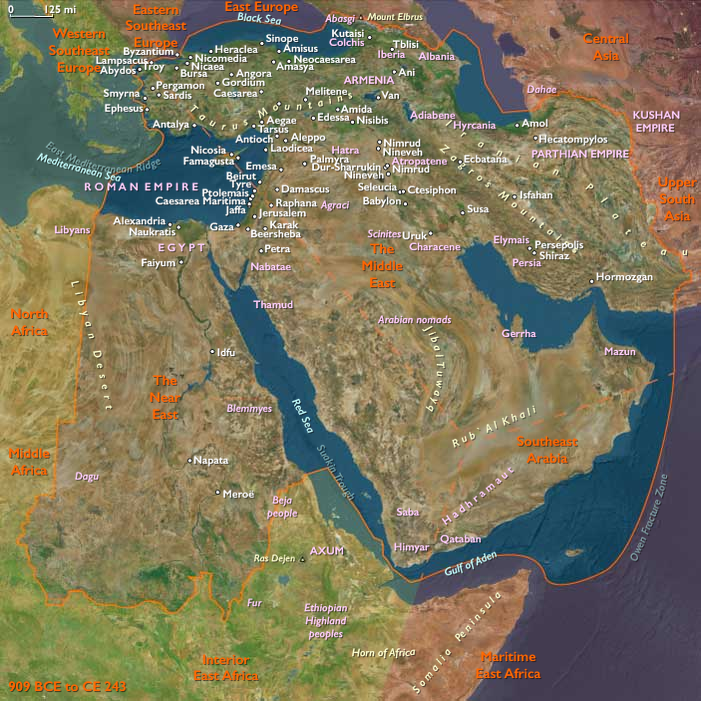
Beginning around 765 BCE, the Assyrian Empire experiences significant decline, marked by ominous events such as the eclipse of 763 BCE, devastating plagues, and internal revolts. This instability severely undermines Assyrian authority, enabling Urartu—a kingdom centered around Lake Van—to ascend as a powerful northern rival. Under King Argishtis I, Urartu expands dramatically, founding cities like Erebouni (modern Yerevan), temporarily dominating northern Syria, and even threatening Babylon. At its height, Urartu controls Armenia, parts of Georgia, and extensive regions of northern Mesopotamia, significantly challenging Assyrian dominance.
Tiglath-Pileser III and Assyrian Resurgence
Tiglath-Pileser III’s accession in 745 BCE dramatically reverses Assyrian fortunes. He quickly stabilizes the empire, implementing crucial military reforms by creating a permanent standing army and an effective bureaucracy. Between 740 and 732 BCE, Tiglath-Pileser leads decisive campaigns, defeating Syrian coalitions, capturing Damascus—the heart of the Aramaean kingdom—and annexing vassal states in eastern Anatolia. His actions involve extensive deportations, notably from northern Israel, integrating these regions firmly into Assyria. He also imposes tribute on Arabian tribes and reasserts control over Babylon, consolidating Assyria’s southern frontier.
Sargon II’s Conquests and Architectural Legacy
Sargon II significantly expands Assyrian domination, capturing strategic cities such as Carchemish in 717 BCE and weakening Urartu with a major campaign in 714 BCE. He commemorates these achievements by building a grand new capital, Dur Sharrukin (modern Khorsabad), featuring monumental gateways guarded by colossal winged bulls, ornate temples, and lavishly decorated royal palaces. Despite his successes, Sargon falls in battle against the Cimmerians in 705 BCE, marking a critical turning point for Assyria.
Sennacherib’s Rule and Babylonian Revolts
Sennacherib relocates the Assyrian capital to Nineveh, transforming it into a monumental city. His reign is dominated by internal rebellions, notably in Babylon, incited by the persistent Chaldean prince Marduk-apla-iddina II. In a brutal act in 689 BCE, Sennacherib razes Babylon, deeply shocking Mesopotamian society and perceived as sacrilegious. This ruthless act contributes to his assassination in 681 BCE, viewed contemporaneously as divine retribution.
Esarhaddon’s Diplomacy and Reconstruction
Ascending amidst turmoil, Esarhaddon quickly stabilizes the empire through diplomatic acumen. He rebuilds Babylon, restoring key religious sites, notably the Esagila temple, thereby regaining Babylonian favor. Esarhaddon adeptly manages threats from Cimmerians and Scythians through strategic alliances, securing Assyrian borders and revitalizing religious and cultural institutions across both Assyria and Babylonia.
Ashurbanipal: Scholar-King and Library Builder
Ashurbanipal rules with scholarly distinction, establishing a renowned library in Nineveh, amassing extensive collections of cuneiform texts from across Mesopotamia. Highly educated, he demonstrates scholarly and mathematical prowess, including the rare ability to interpret ancient Sumerian scripts. However, his reign is also notorious for cruelty towards defeated enemies, vividly depicted in reliefs and inscriptions. Although appearing peaceful later, underlying tensions and succession disputes foreshadow Assyrian fragility.
Fragmentation and Rise of Babylon and Media
Following Ashurbanipal’s death, Assyria plunges into a severe succession crisis involving multiple contenders, including Ashur-etil-ilani, Sinsharishkun, and general Sin-shumu-lishir. This internal chaos critically weakens Assyria. Concurrently, Nabopolassar leads a successful Chaldean rebellion, establishing Babylonian independence by 629 BCE. At the same time, Cyaxares of Media overthrows Scythian dominance, consolidating Media and preparing to confront Assyria. These developments set the stage for a decisive coalition of Babylonians and Medes, poised to end Assyrian dominance.