Mediterranean Southwest Europe (580–591 CE): Byzantine Reorganization, Lombard Consolidation, and Visigothic Expansion
The era 580–591 CE in Mediterranean Southwest Europe is characterized by the formal establishment of the Byzantine Exarchate of Ravenna, ongoing Lombard consolidation throughout Italy, and significant Visigothic territorial and administrative expansion under King Leovigild in Iberia.
Establishment of the Exarchate of Ravenna
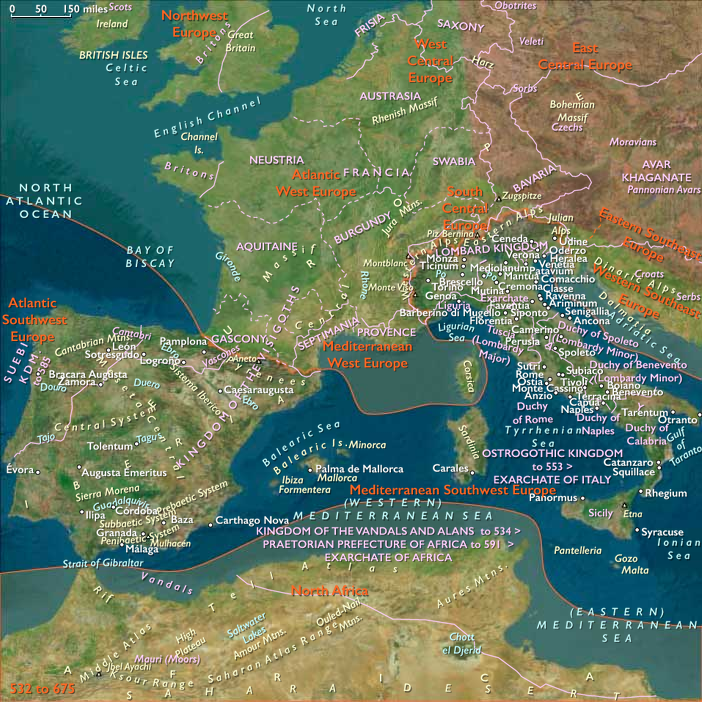
In 584 CE, responding to the persistent Lombard threat and internal fragmentation of its Italian territories, Byzantine Emperor Maurice formally establishes the Exarchate of Ravenna. This administrative reform unites civil and military authority under an exarch based in Ravenna, aiming to strengthen Byzantine governance and improve defense coordination against Lombard incursions. The exarchate’s formation represents a strategic Byzantine adaptation to the challenging political landscape, shaping the governance structure of Byzantine Italy for subsequent generations.
Lombard Consolidation and Expansion
During this era, the Lombards under kings Authari (r. 584–590 CE) and subsequently Agilulf (r. 590–616 CE), solidify their control throughout northern and central Italy, stabilizing their hold on key cities, including their capital, Pavia. The independent Lombard duchies of Benevento and Spoleto also grow increasingly autonomous, further entrenching Lombard political and military dominance across much of the peninsula. Their presence solidifies Italy's fragmented political landscape, limiting Byzantine control primarily to coastal enclaves and fortified urban centers.
Visigothic Expansion and Centralization under Leovigild
In Iberia, King Leovigild (r. 569–586 CE) leads the Visigothic Kingdom through a period of aggressive territorial expansion and centralization. By successfully recapturing territories previously lost to Byzantine incursions, Leovigild significantly reduces Byzantine influence in southern Iberia, strengthening Visigothic dominion. Internally, he implements administrative reforms that centralize royal power, enhance governance, and streamline legal practices across the kingdom.
Religious Policies and Conflict in Visigothic Iberia
Leovigild’s reign is also marked by intensified religious conflict. Initially attempting religious unity through promotion of Arian Christianity, Leovigild eventually faces significant resistance from the predominantly Catholic Hispano-Roman population. His policies lead to internal conflict and heightened tensions, which persist as defining elements of Iberian politics and ecclesiastical relations throughout subsequent decades.
Ecclesiastical Continuity and Cultural Stability
The Christian Church continues to serve as a stabilizing influence across the region, particularly within territories fragmented by political and military strife. Ecclesiastical authorities maintain cultural continuity, providing education and social cohesion amid ongoing geopolitical disruptions. The Papacy further asserts its spiritual and doctrinal leadership, reinforcing orthodox Christianity and shaping the religious landscape.
Legacy of the Era
The era 580–591 CE profoundly influences Mediterranean Southwest Europe’s historical trajectory. Byzantine administrative reforms through the establishment of the Exarchate of Ravenna reshape governance in Italy. Lombard dominance introduces lasting political fragmentation. In Iberia, Visigothic expansion and administrative reforms under Leovigild lay critical foundations for a more unified and distinctly medieval Iberian kingdom.