Bohemond I of Antioch
one of the leaders of the First Crusade
Years: 1058 - 1111
Bohemond I (also spelled Bohemund or Boamund) (c. 1058 – 3 March 1111), Prince of Taranto and Prince of Antioch, is one of the leaders of the First Crusade.
The Crusade has no outright military leader, but instead is ruled by a committee of nobles.
Bohemond is one of the most important of these leaders.

Related Events
Filter results
Showing 10 events out of 161 total
Robert, having become the recognized leader of the Apulian Normans, resumes his campaign in Calabria.
The arrival from Normandy of his younger brother Roger enables him to extend and solidify his conquests in Apulia.
In 1058, Guiscard effects an uneasy reconciliation with Gisulf II, by dissolving his first marriage to Alberada, the mother of his son Bohemond, and marrying Gisulf's sister, Sigelgaita.
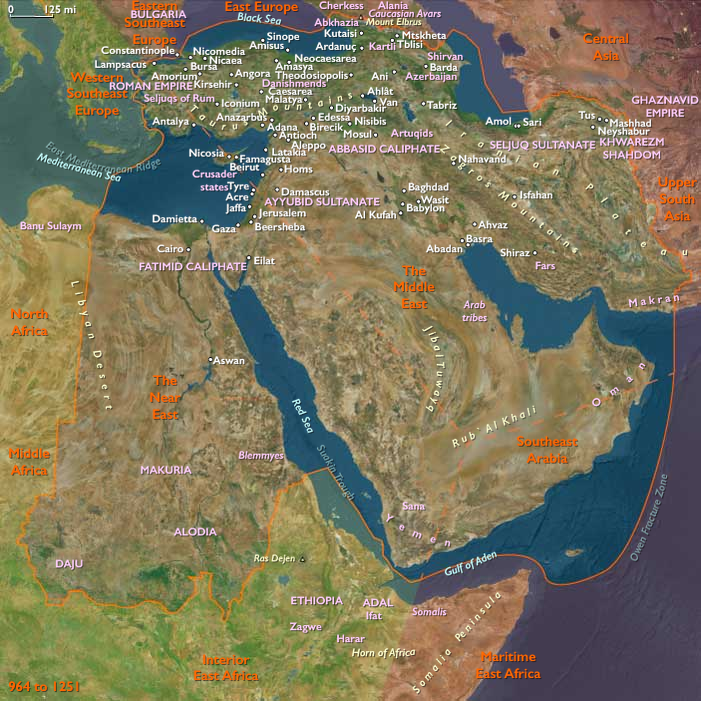
Eastern Southeast Europe (1072–1083 CE): Byzantine Crisis and Shifting Power Dynamics
Settlement and Migration Patterns
Changing Borders and Demographic Stability
Between 1072 and 1083 CE, Eastern Southeast Europe experienced significant political and territorial upheaval, although demographic patterns within existing territories largely remained stable.
Political and Military Developments
Aftermath of the Battle of Manzikert
The devastating defeat of the Byzantine Empire at the Battle of Manzikert in 1071 forced it to drastically redraw its borders at the Bosporus. The Empire lost nearly all of Asia Minor to the Seljuq Turks under Sultan Alp Arslan, significantly altering regional power dynamics and shifting its eastern boundary back toward the Ionian coast of Classical Greece.
Seljuq Turkish Ascendancy
The Battle of Manzikert marked the beginning of Turkish dominance in Anatolia. Despite the continuation of the Byzantine Empire for nearly four centuries afterward, the region’s balance of power decisively shifted toward Seljuq Turks and Sunni Muslims. Turkic migration into Anatolia fundamentally undermined the traditional Byzantine theme system, depriving the Empire of critical military manpower and economic resources.
Byzantine Response and Internal Challenges
In the wake of defeat, internal Byzantine factions sometimes invited Seljuq mercenaries into their cities for protection, paradoxically facilitating further Turkish penetration into imperial territories. In 1078, even the key city of Nicaea was entrusted to Seljuq forces, reflecting deep internal divisions.
Rise of the Komnenian Dynasty
Despite severe territorial and political setbacks, the ascension of Alexios I Komnenos in 1081 marked a turning point. Alexios initiated emergency reforms, including requisitioning Church funds, to stabilize the Empire. His rule initiated a century-long Komnenian dynasty (1081–1185), restoring a measure of stability and continuity to Byzantine governance.
Norman Expansion and Conflict
Meanwhile, the Normans, fresh from their conquest of southern Italy, posed another significant threat. Under the formidable leadership of Robert Guiscard and his son Bohemund, Norman forces successfully captured Dyrrhachium and Corfu, and laid siege to Larissa in Thessaly. Alexios I initially suffered several defeats before eventually repelling the Normans.
Diplomatic Maneuvers
To relieve pressure from the Normans, Alexios strategically bribed German King Henry IV with a substantial sum to attack Norman holdings in Italy, diverting their attention away from Byzantine territories. Additionally, Alexios secured the alliance of Henry, Count of Monte Sant'Angelo, who recognized Alexios' authority, marking the last significant instance of Byzantine political influence on peninsular Italy.
Economic and Technological Developments
Economic Pressures and Military Strain
The extensive military conflicts and territorial losses significantly strained the Byzantine economy. Resources previously drawn from prosperous Anatolian themes were lost, greatly reducing economic stability and fiscal capacity.
Defensive Infrastructure
Byzantine military strategy during this period emphasized fortification improvements along reduced territorial boundaries, especially in areas vulnerable to Norman incursions and further Turkish advances.
Cultural and Artistic Developments
Cultural Resilience Amid Crisis
Despite severe territorial and political crises, Byzantine cultural and intellectual life endured, supported by continued patronage from imperial and ecclesiastical authorities.
Social and Religious Developments
Orthodox Christianity’s Central Role
Orthodox Christianity remained dominant, providing spiritual cohesion and social stability amidst turmoil. Ecclesiastical institutions retained significant influence and continued supporting cultural continuity.
Ongoing Presence of Religious Movements
Alternative religious movements such as Bogomilism continued their presence, particularly in rural areas, reflecting ongoing religious and social diversity.
Long-Term Consequences and Historical Significance
The period from 1072 to 1083 CE represented a critical juncture marked by severe Byzantine territorial losses, internal political crises, and external military threats. The rise of Alexios I Komnenos and his reforms, along with shifting geopolitical dynamics involving Turkish and Norman expansions, significantly influenced the future trajectory of Eastern Southeast Europe and the broader Mediterranean region.
The venturesome Normans, following their successful conquest of southern Italy, see no reason to stop; the crumbling East Roman Empire appears ripe for conquest.
When Alexios I Komnenos ascends to the throne of Constantinople, his early emergency reforms, such as requisitioning Church money—a previously unthinkable move—prove too little to stop the Normans.
Led by the formidable Robert Guiscard and his son Bohemund, the Normans take Dyrrhachium and Corfu, and lay siege to Larissa in Thessaly.
Alexios suffers several defeats before being able to strike back with success.
He enhances this by bribing the German king Henry IV with three hundred and sixty thousand gold pieces to attack the Normans in Italy, which forces the Normans in 1083 and 1084 to concentrate on their defenses at home.
He also secures the alliance of Henry, Count of Monte Sant'Angelo, who controls the Gargano Peninsula and dates his charters by Alexios' reign.
Henry's allegiance is to be the last example of East Roman political control on peninsular Italy.
Robert Guiscard, Duke of Apulia and Calabria, has spent the majority of his reign consolidating Norman power along the heel and toe of Italy by expelling Constantinople’s armies.
Guiscard has been pushing north toward the Papal States (to which the Duchy of Apulia and Calabria is allied) and threatening imperial control of cities along the Ionian and Adriatic seas.
Following the Norman conquest of the Catepanate of Italy and Saracen Sicily, the emperor in Constantinople, Michael VII Doukas, had betrothed his son to Robert Guiscard's daughter.
When Michael is deposed, Robert takes this as an excuse to invade the Empire.
Guiscard leads his army and navy across the sea in May 1081 to lay siege to the port city of Durazzo, as it is one end of the famous Via Egnatia, a direct route to the imperial capital of Constantinople.
At Avlona, south of Durazzo, captured earlier in the year by Bohémond, son of Robert Guiscard and his Norman first wife, Alberada, the Norman fleet is joined by a few Ragusan vessels and …
…moves slowly down the coast to Corfu, where the imperial garrison surrenders at once.
Roger Borsa, the twenty-one year-old son of Guiscard and his Lombard second wife, Sikelgaita, takes part in the capture of Corfu.
At Sikelgaita's instigation, Robert had earlier named Roger Borsa as his heir rather than Bohémond, who no doubt felt early in life that he would have no patrimony because of his half brother and so would have to seek lands and fortune in the weakened condition of the Empire.
Having establishing a bridgehead for reinforcements from Italy, Guiscard's first target is Durazzo, the chief port of Illyria.
Alexios I Komnenos, newly crowned Emperor in Constantinople, dispatches an urgent message to Doge Domenico Selvo asking for the mobilization of the Venetian fleet in defense of Durazzo in return for great rewards.
The Doge wastes no time in setting sail for the besieged city in charge of his fleet of fourteen warships and forty-five other vessels.
Selvo, feeling his polity equally threatened, himself commands the fleet.
Selvo is motivated not only by his familial ties and the promise of reward, but also the realization that Norman control over the Strait of Otranto would be just as great of a threat to Venetian power in the region as it would be to their ally in the east.
Robert's ships are hit by a sudden tempest, and several ships are lost; a Venetian fleet now appears on the northwestern horizon.
The Venetians hoist dinghies to the yardarms from which they shoot arrows and use Greek fire against the inexperienced Norman seamen, who are mostly used to land battle.
The battered fleet led by Guiscard retreats into the harbor after losing many ships.
The defeat, though devastating to Guiscard's fleet, has inflicted little damage to his army as the majority of it has disembarked before the battle in preparation of the siege of Dyrrhachium, which will continue throughout the summer.
Selvo, victorious at sea, leaves the fleet under the command of his son and returns to Venice a hero.
Nikephoros Melissenos, the former pretender to the throne, commands the imperial army's right wing, marches alongside Alexios, who arrives in October with his army.
His Varangian Guard now consists largely of Englishmen, Anglo-Saxons who had left their country in disgust after Hastings (1066) and have taken service with Constantinople.
Many of them have been waiting fifteen years for an opportunity to avenge the Norman Conquest, and they attack with all the vigor of which they are capable.
Swinging their huge two-handed battle-axes around their heads and then slamming them into horses and riders, they inspire terror among the Apulian knights, few of whom have ever come across a line of foot-soldiers that had not immediately broken in the face of a cavalry charge.
The horses begin to panic also, and the Norman right soon turns in confusion, with many galloping into the sea to escape.
Sikelgaita, reputedly a Valkyrie of immense build and Herculean physical strength, rides after the Normans and threatens to impale them with her spear.
Thus rallied, they recover and return to the fray.
The Norman left, under Bohémond's command, wheels to the rescue with a detachment of crossbowmen against whom the Varangians, unable to approach within ax range, find themselves defenseless.
The Varangians retreat to a chapel that the Normans immediately burn down; most perish.
Durazzo manages to hold out until February 1082, when the Normans burst through the gates due to Venetian treachery.
In a few weeks, the whole of Illyria is in Guiscard's hands.
Constantinople, it seems, is within his grasp.
Kastoríá surrenders, despite the fact that its English garrison consists of three hundred fiercely anti-Norman members of Emperor Alexios' Varangian Guard.
Pope Gregory VII, however, suddenly recalls Guiscard to Italy to help him expel the German king Henry, who seeks a military decision in his struggle with the church.
Leaving his forces under the command of his son Bohémond, Guiscard sails for Italy.
Bohémond continues the Norman advance, ravaging parts of Greece, including Thebes and ...
…Corinth.