
Calico Jack
English pirate captain
1682 CE to 1720 CE
John Rackham (21 December 1682 – 18 November 1720), commonly known as Calico Jack, os an English pirate captain operating in the Bahamas during the early 18th century (Rackham is often spelled as Rackam or Rackum in historical documentation).
His nickname is derived from the calico clothing he wears.
Active towards the end (1717–1720) of the "golden age of piracy" (1690–1730) Rackham is most remembered for two things: the design of his Jolly Roger flag, a skull with crossed swords, which contributes to the popularization of the design, and for having two female crew members (Mary Read and Rackham's lover Anne Bonny).
After deposing Charles Vane from his captaincy, Rackham cruises the Leeward Islands, Jamaica Channel and Windward Passage.
He accepts a pardon some time in 1719 and moves to New Providence, where he meets Anne Bonny, who is married to James Bonny.
When Rackham returns to piracy in 1720, by stealing a British sloop, Bonny joins him.
Their new crew includes Mary Read.
After a short run he is captured by pirate hunter Jonathan Barnet in 1720, before being hanged in November of the same year in Spanish Town, Jamaica.
World
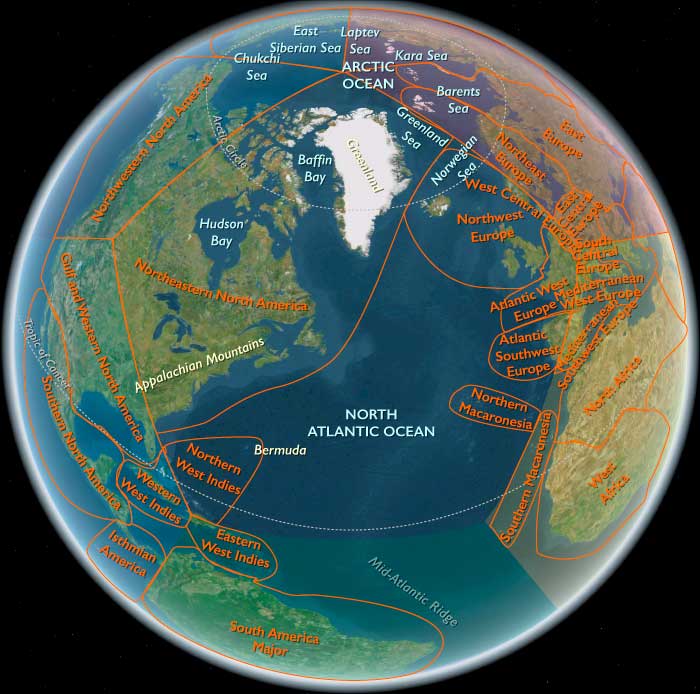
The Atlantic Lands
View →Related Events
Showing 10 events out of 10 total
Woodes Rogers, the new Governor of New Providence, and two men-of-war arrive in Nassau in August 1718 to oversee the pardon, and more importantly for Vane, to capture those who violate it.
While most pirates accepts the enforced pardon, Vane resists it and any who attempt to honestly reform, driving Woodes' men-of-war back with a captured French fireship.
Vane then escapes in his fast six-gun sloop, the Ranger, defiantly firing at the governor as he passes and threatening to return.
He evades the few Royal Navy vessels in the area and sails north.
Ocracoke Inlet, Teach's favorite anchorage, is a perfect vantage point from which to view ships traveling between the various settlements of northeast Carolina, and it is from there that Teach first spots the approaching ship of Charles Vane, another English pirate.
Vane had several months earlier, rejected the pardon brought by Woodes Rogers and escaped the men-of-war that the English captain had brought with him to Nassau.
He had also been pursued by Teach's old commander, Benjamin Hornigold, who is by now a pirate hunter.
Teach and Vane spend several nights on the southern tip of Ocracoke Island, accompanied by such notorious figures as Israel Hands, Robert Deal and Calico Jack.
Charles Vane has continued practicing piracy on the open seas, amassing a large crew and three ships.
He is so successful, in fact, that Governor Rogers has decided to send out Colonel William Rhett to hunt Vane down.
Meanwhile, he has given command of one of his ships to a fellow pirate by the name of Yeats, and the two pillage and loot vessels that are entering and leaving the port at Charleston, looking to emulate Teach's success.
However, Vane creates division among his crew by refusing to capture several promising vessels, leading Yeats to abscond in the night with a large portion of treasure and one of the captured brigs.
Vane meets up with Teach in October 1718 and enjoys a week-long celebration at Ocracoke Island, North Carolina, with their crews.
He then turns north toward New York.
The news of Teach and Vane's impromptu party, as it spreads throughout the neighboring colonies, worries the Governor of Pennsylvania enough to send out two sloops to capture the pirates.
They are unsuccessful.
Governor Spotswood had meanwhile learned that William Howard, the former quartermaster of Queen Anne's Revenge, is in the area.
Believing that he might know of Teach's whereabouts, he has had the pirate and his two slaves arrested.
Spotswood has no legal authority to have pirates tried, and as a result, Howard's attorney, John Holloway, brings charges against Captain Brand of HMS Lyme, where Howard is imprisoned.
He also sues on Howard's behalf for damages of five hundred pounds, claiming wrongful arrest.
Spotswood's council claims that Teach's presence is a crisis and that under a statute of William III, the governor is entitled to try Howard without a jury.
The charges refer to several acts of piracy supposedly committed after the pardon's cutoff date, in "a sloop belonging to ye subjects of the King of Spain", but ignored the fact that they had taken place outside Spotswood's jurisdiction and in a vessel then legally owned.
Another charge cites two attacks, one of which is the capture of a slave ship off Charleston Bar, from which one of Howard's slaves is presumed to have come.
Howard is sent to await trial before a Court of Vice-Admiralty, on the charge of piracy, but Brand and his colleague, Captain Gordon (of HMS Pearl) refuse to serve with Holloway present.
Incensed, Holloway has no option but to stand down, and is replaced by the Attorney General of Virginia, John Clayton, who Spotswood describes as "an honester man [than Holloway]". (Lee, Robert E. (1974), Blackbeard the Pirate (2002 ed.), North Carolina: John F. Blair.)
Howard is found guilty and sentenced to be hanged, but is saved by a commission from London, which directs Spotswood to pardon all acts of piracy committed by surrendering pirates before July 23, 1718.
Spotswood has meanwhile obtained from Howard valuable information on Teach's whereabouts, and he plans to send his forces across the border into North Carolina to capture him.
He gains the support of two men keen to discredit North Carolina's Governor—Edward Moseley and Colonel Maurice Moore.
He also writes to the Lords of Trade, suggesting that the Crown might benefit financially from Teach's capture.
Spotswood personally finances the operation, possibly believing that Teach has fabulous treasures hidden away.
He orders Captains Gordon and Brand of HMS Pearl and HMS Lyme to travel overland to Bath.
Lieutenant Robert Maynard of HMS Pearl is given command of two commandeered sloops, to approach the town from the sea.
An extra incentive for Teach's capture is the offer of a reward from the Assembly of Virginia, over and above any that might be received from the Crown.
Maynard, who takes command of the two armed sloops, has been given fifty-seven men—thirty-three from HMS Pearl and twenty-four from HMS Lyme.
Maynard and the detachment from HMS Pearl take the larger of the two vessels and name her Jane; the rest take Ranger, commanded by one of Maynard's officers, a Mister Hyde.
Some from the two ships' civilian crews remain aboard.
They sail from Kecoughtan, along the James River, on November 17.
The two sloops move slowly, giving Brand's force time to reach Bath.
Vane and his crew, after robbing several ships outside of New York City, encounter a large French man-o-war at least twice as large as Vane's sloop.
The ship goes after them, and Vane commands a retreat from battle, claiming caution as his reason.
Jack Rackham quickly speaks up and contests the decision, suggesting they fight the man-o-war, because it will have plenty of riches.
Not only that, but if they capture it, he argues, it will place a much larger ship at their disposal.
Of the approximately ninety men on the ship, only fifteen support Vane in his decision.
Despite the overwhelming support for Rackham's cry to fight, Vane declares that the captain's decision is considered final and they flee the man-o-war.
Rackham on November 24, 1718, calls a vote in which the men brand Vane a coward and remove him from the captaincy, making Calico Jack the next captain.
Rackham gives Vane and fifteen supporters the other sloop in the fleet, along with a decent supply of ammunition and goods.
Brand, having set out for North Carolina six days after Maynard, had on November 23 arrived within three miles of Bath.
Included in Brand's force are a number of North Carolinians, including Colonel Moore and Captain Jeremiah Vail, sent to put down any local objection to the presence of foreign soldiers.
Moore goes into the town to see if Teach is there, reporting back that he is not, but that the pirate is expected at "every minute."
Brand then goes to Governor Eden's home and informed him of his purpose.
The next day, Brand sends two canoes down Pamlico River to Ocracoke Inlet, to see if Teach could be seen.
They return two days later and report on what had eventually transpired.
John Rackham, an English pirate captain, derives his nickname, Calico Jack, from the colorful calico clothes he wears.
Rackham had served as quartermaster under the command of the notoriously cruel pirate, Charles Vane, until the day Vane refused to engage a French vessel in battle, upsetting the crew grew to the extent that they had mutinied and appointed Rackham as their captain.
Rackham had immediately turned the ship, engaged the French vessel, and defeated it—all, reportedly, while heavily intoxicated from rum.
Vane, cast adrift in a small sloop, had been among the pirate captains who had established a base at New Providence in the Bahamas after the British abandoned the colony in 1713.
He had subsequently set about clawing his way back up the pirate ranks by seizing ever larger ships, but after his ship was wrecked in a storm in February 1719 and he and one other survivor were washed up on an uninhabited island in the Bay of Honduras.
A ship eventually arrived, months later, but Vane had been recognized and both men had been clapped in irons, taken to Jamaica, and at Port Royal tried and hanged on March 29, 1720.
He dies without expressing the least remorse for his crimes.
Rackham had meanwhile decided to take an offer of the King's Pardon and sailed to the shore of New Providence.
Rackham during this time had met and fell in love with a married woman named Anne Bonny.
Infatuated by Anne, Rackham had lavished much of his plunder on her.
He had then joined the crew of Captain Burgess, who was himself a former pirate turned privateer roaming the Caribbean in search of Spanish ships.
When the affair between Rackham and Anne became public, the Governor of New Providence had threatened to have Anne whipped for her adultery.
The pair resolved to assemble a crew and steal a sloop rather than leave Anne behind to be flogged.
Anne, fearing that the crew would refuse to sail alongside a woman, had dressed up as a man and taken the name Adam Bonny.
Becoming a respected member of the crew, she has fought alongside her male counterparts in numerous successful engagements.
After several of the Bahamas merchants send out a heavily armed ship to capture them, Rackham and a few of his crew are forced to flee.
They are subsequently captured by a Spanish ship but manage to escape, sailing around Jamaica and taking possession of several fishing vessels and a sloop.
The governor resolves to capture Rackham and dispatches the pirate-hunter Jonathan Barnet.
It is reputed that Rackham had earlier tried to strike a deal with the governor under which he would surrender himself if clemency was given to Anne and another female pirate called Mary Read.
Barnet in October of 1720 surprises Rackham and his crew of the Revenge, catching them mostly drunk —many of the crew passed out in the ships hull.
Only the two women, Read and Bonny, put up a fight.
Rackham and his crew, brought to trial at St. Jago de la Vega in Jamaica on November 16, 1720, are found guilty of piracy and hanged the next day.
Only Anne Bonny and Mary Read survive, both claiming to be pregnant.
Mary Read will die the following year in prison, either during childbirth or from fever.
Anne Bonny, who disappears from history, is believed to have been ransomed out of prison by her wealthy father.