Catherine I of Russia
Empress of Russia
Years: 1684 - 1727
Catherine I (Russian: Yekaterina I Alekseyevna, born Polish: Marta Helena Skowrońska, Latvian: Marta Elena Skavronska, later Marfa Samuilovna Skavronskaya) (15 April [O.S.
5 April] 1684 – 17 May [O.S.
6 May] 1727), the second wife of Peter I of Russia, reigns as Empress of Russia from 1725 until her death.
Related Events
Filter results
Showing 5 events out of 5 total
Peter's wife seizes the throne as Catherine I after his death, but when she dies in 1727, Peter's grandson, Peter II, is crowned tsar.
In 1730 Peter II succumbs to smallpox, and Anna, a daughter of Ivan V, who had been co-ruler with Peter, ascends the throne.
The clique of nobles that put Anna on the throne attempts to impose various conditions on her.
In her struggle against those restrictions, Anna has the support of other nobles who fear oligarchic rule more than autocracy.
Thus the principle of autocracy continues to receive strong support despite chaotic struggles for the throne.
Peter decrees the establishment of the Saint Petersburg State University on January 28, 1724.
He also establishes in this year the St. Petersburg Mint, which will centralize coinage in Russia and begin to produce different kinds of badges and medals used for decorating.
The campaign along the parched shores of the Caspian had obviously put a great strain on Peter's health, already undermined by enormous exertions and also by the excesses in which he occasionally indulged himself.
Peter, whose overall health has never been never robust, had earlier this winter begun having problems with his urinary tract and bladder.
A team of doctors in the summer of 1724 performs the necessary surgery releasing upwards of four pounds of blocked urine.
Peter remains bedridden until late autumn.
Restless and certain he is cured in the first week of October, he begins a lengthy inspection tour of various projects.
Peter has his second wife, Catherine, crowned as Empress, although he remains Russia's actual ruler.
All of Peter's male children have died—the eldest son, Alexei, had been tortured and killed on Peter's orders in 1718 because he had disobeyed his father and opposed official policies.
Alexei's mother Eudoxia had also been punished; she had been dragged from her home and tried on false charges of adultery.
A similar fate had befallen Peter's beautiful Dutch mistress, Anna Mons, in 1704.
Peter and Catherine have an estrangement over her support of William Mons (the handsome brother of Peter's former mistress and secretary to Catherine) and his sister Matryona Balk, one of Catherine's ladies in waiting.
Peter has fought his entire life a somewhat hopeless battle to clear up corruption in Russia.
Catherine has a great deal of influence on who can gain access to her husband.
Mons is promoted to the rank of imperial chamberlain on Catherine’s crowning, and he and his sister have begun selling their influence to those who want access to Catherine and through her Peter.
Apparently this is overlooked by Catherine, who is fond of them both.
Peter finds out, has Mons apprehended on charges of peculation (embezzlement) and betrayal of trust and, after a brief and brutal inquest by Pyotr Tolstoy, the head of the Secret Chancellery, has him publicly drawn and quartered on November 16.
His sister, who had been publicly flogged during her brother's trial, is exiled.
Peter and Catherine will not speak for several months.
Rumors fly that she and Mons had had an affair, but there is no evidence to support this.
The sea floor just north of the Peterhof site and to the east toward St. Petersburg is too shallow for either commercial ships or warships.
However, to the west of Peterhof, the sea floor drops off to be deep enough for sea vessels.
Accordingly, when Peter the Great had decided to build St. Petersburg at the eastern end of the Gulf of Finland, he had first captured the Kotlin Island, clearly visible from the Peterhof site just to the northeast in the middle of the Gulf.
At Kotlin Island, he has built the commercial harbor for St. Petersburg as well as the Kronstadt fortifications across the twenty kilometers of shallow sea to provision and defend the Navy that he has built.
Peter first mentions the Peterhof site in his journal in 1705, during the Great Northern War, as a good place to construct a landing for use in traveling to and from the island fortress of Kronstadt.
Peter had in 1714 begun construction of the Monplaisir ("my pleasure") Palace based on his own sketches of the palace that he wanted close to the shoreline.
This has become Peter's Summer Palace, which he uses on his way coming and going from Europe through the harbor at Kronstadt.
On the walls of this seacoast palace hang hundreds of paintings that Peter has brought from Europe and allowed to weather Russian winters without heat, together with the dampness of being so close to the sea.
In the seaward corner of his Monplaisir Palace, Peter had made his Maritime Study, from which he can see Kronstadt Island to the left and St. Petersburg to the right.
He had later expanded his plans to include a vaster royal château of palaces and gardens further inland, on the model of Versailles.
Each of the tsars after Peter will expand on the inland palaces and gardens of Peterhof, but the major contributions by Peter the Great are completed by 1725.
A grand residence, it has become known as the "Russian Versailles.” A French architect, Nicolas Pineau, had gone to Russia in 1716 and introduced the Rococo style to the newly founded city of St. Petersburg (e.g., Peter's study in Peterhof, before 1721).
The Rococo in Russia has flourished in St. Petersburg under the protection of Peter I and Elizabeth.
Peter's principal architect, Gaetano Chiaveri, who draws heavily on northern Italian models, is most noted for the library of the Academy of Sciences (1725) and the royal churches of Warsaw and Dresden.
Peter had also entertained plans of a similar palace at Strelna, a short way to the east, but these plans are abandoned when, in early January 1725, Peter is struck once again with uremia.
Legend has it that before lapsing into unconsciousness Peter asked for a paper and pen and scrawled an unfinished note that read: "Leave all to...." and then, exhausted by the effort, asked for his daughter Anna to be summoned.
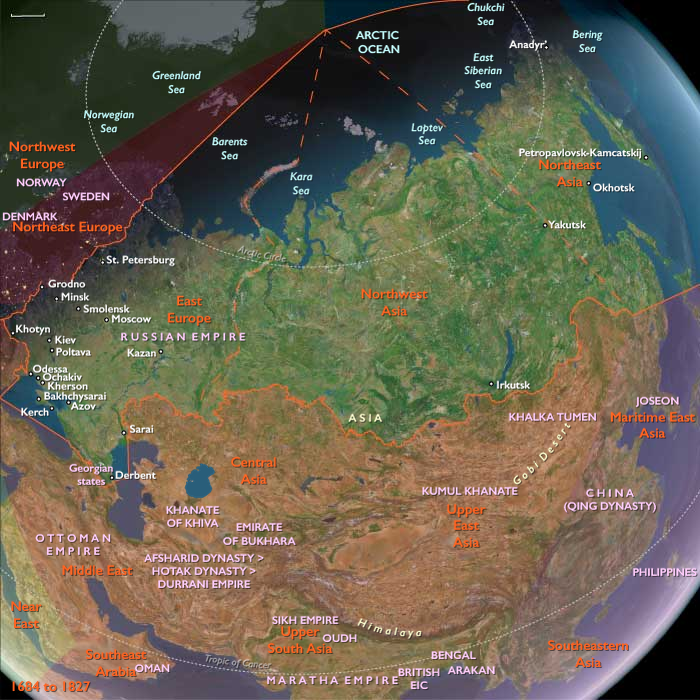
Without having named a successor, Peter dies between four and five in the morning January 28, 1725, leaving an empire that stretches from Arkhangelsk (Archangel) on the White Sea to Mazanderan on the Caspian and from the Baltic Sea to the Pacific Ocean.
He is fifty-two years, seven months old at his death, having reigned forty-two years.
An autopsy reveals his bladder to be infected with gangrene.
Catherine represents the interests of the "new men", commoners who had been brought to positions of great power by Peter based on competence.
A change in government is likely to favor the entrenched aristocrats.
For this reason, during a meeting of a council to decide on a successor a coup is arranged by the late tsar’s best friend, Prince Aleksandr Menshikov, and others in which the guards regiments with whom Catherine is very popular proclaim her the ruler of Russia, giving her the title of Empress.
Menshikov, who is committed to the Petrine system, recognizes that, if this system is to continue, Catherine is the only possible candidate, as her name is a watchword for the progressive faction.
Her placement on the throne means a final victory over ancient prejudices, a vindication of the new ideas of progress, and not least security for Menshikov's person and his ill-gotten fortune.
Supporting evidence is "produced" from Peter's secretary Makarov and the Bishop of Pskov, both "new men" with motivation to see Catherine take over.
The real power, however, lies with Menshikov and with Count Peter Andreyevich Tolstoy, who has materially assisted Menshikov to raise the empress consort to the throne.
The new sovereign makes him a count and one of the six members of the newly instituted Supreme Privy Council.

Catherine is the first woman to rule Imperial Russia, opening the legal path for a century almost entirely dominated by women including her daughter Elizabeth, and Catherine the Great, all of whom are to continue the policies of Peter the Great in modernizing Russia.
She is said to be a just and even-handed ruler.
The Supreme Privy Council concentrates power in the hands of one party, and for this reason is an executive innovation.
In foreign affairs, Russia joins the Austro-Spanish league to reluctantly defend the interests of Catherine's son-in-law Charles Frederick, the Duke of Holstein, against England.
She continues the work of Peter in establishing the Russian Academy of Sciences, gives her name to Catherinehof near St. Petersburg, and builds the first bridges in the new capital.
She is also the first royal owner of the Sarskoje Selo estate, where the Catherine Palace still bears her name.
In general, her policies are reasonable and cautious.
Menshikov’s power has been practically absolute during the short reign of Catherine, who dies just two years after Peter at the age of forty-three, .
He has promoted himself to the unprecedented rank of Generalissimo, and is the only Russian to bear a ducal title.
Upon finishing the construction of a sumptuous palace on the Neva Embankment in St. Petersburg (now assigned to the Hermitage Museum), Menshikov intends to make Oranienbaum a capital of his ephemeral duchy.
Pushkin in one of his poems alludes to Menshikov as "half-tsar".
On the whole he has ruled well, his difficult position serving as some restraint upon his natural inclinations.
He contrives to prolong his power after Catherine's death by means of a forged will and a coup d'etat.
While his colleague Peter Tolstoi would have raised Elizabeth Petrovna to the throne, Menshikov sets up the youthful Peter II, son of the tsarevich Alexius, with himself as dictator during the prince's minority.
During the reign of Catherine, Peter had been quite ignored; but just before her death it had become clear to those in power that the grandson of Peter the Great could not be kept out of his inheritance much longer.
The majority of the nation and three-quarters of the nobility are on his side, while his uncle, Emperor Charles VI, through the imperial ambassador at St. Petersburg, has persistently urged his claims.
The matter is arranged between Menshikov and Count Andrei Osterman; and on May 18, 1727, Peter II, according to the terms of the forged last will of Catherine I, is proclaimed sovereign autocrat.
Menshikov, lodging him in his own palace on the Vasilievsky Island, now aims at establishing himself definitely by marrying his daughter Mary to Peter, but the old nobility, represented by the Dolgorukovs and the Galitzines, unite to overthrow him, and on September 9, 1727, he is deprived of all his dignities and offices and expelled from the capital.
Subsequently he is deprived of his enormous wealth, stripped of the titles, and he and his whole family are banished to Berezov in Siberia, where he will die at fifty-six on November 12, 1729.