Edward, the Black Prince
Duke of Cornwall, the Prince of Wales and the Prince of Aquitaine
Years: 1330 - 1376
Edward of Woodstock KG (15 June 1330 – 8 June 1376), called the Black Prince, is the eldest son of King Edward III and Philippa of Hainault, and the father of King Richard II of England.
He is the first Duke of Cornwall (from 1337), the Prince of Wales (from 1343) and the Prince of Aquitaine (1362–72).
He is called "Edward of Woodstock" in his early life, after his birthplace, and since the sixteenth century has been popularly known as the Black Prince.
He is an exceptional military leader, and his victories over the French at the Battles of Crécy and Poitiers make him very popular during his lifetime.
In 1348 he becomes the first Knight of the Garter, of whose order he is one of the founders.
Edward dies one year before his father, becoming the first English Prince of Wales not to become King of England.
The throne passes instead to his son Richard II, a minor, upon the death of Edward III.

Related Events
Filter results
Showing 10 events out of 41 total
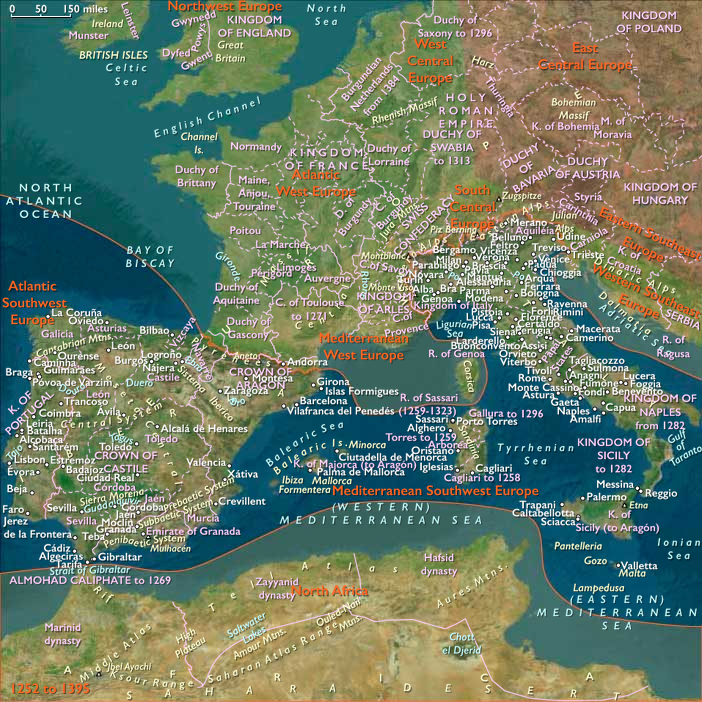
Atlantic West Europe (1108 – 1251 CE): The Angevin Empire, Champagne–Flanders Circuits, and Aquitaine under the English Crown
Geographic and Environmental Context
Atlantic West Europe spans northern France and the Low Countries.
-
Anchors: Paris–Seine–Reims, Upper Loire (Orléans–Blois–Tours), Anjou/Angers–Maine–Le Mans, Poitou/Poitiers–La Rochelle–Saintes, Bordeaux–Gironde–Bayonne, Flanders/Bruges–Ghent–Ypres, Low Countries delta.
Climate and Environmental Shifts
-
High-medieval peak supported population and urbanization; river improvements eased up-country grain and wine traffic.
Societies and Political Developments
-
Eleanor of Aquitaine married Louis VII (1137), annulled (1152), then married Henry II Plantagenet (1152)—creating the Angevin Empire (from Anjou/Normandy to Aquitaine).
-
Capetian–Angevin rivalry dominated: Philip II conquered Normandy (1204), but Aquitaine/Guyenne largely remained under English suzerainty; La Rochelle and Bordeaux became Angevin pillars.
-
Flanders and Champagne fairs integrated Mediterranean–northern circuits; communes of Bruges, Ghent, Ypres asserted charters.
-
Brittany navigated between Plantagenets and Capetians.
Economy and Trade
-
Bordeaux claret exports to England boomed; La Rochelle shipped salt and wine; Nantes handled salt fish and grain.
-
Flanders/Champagne fairs: Italian capital met northern cloth; Bruges emerged as a banking mart.
-
Upper Loire and Anjou–Touraine supplied wine/grain to Paris and ports.
Belief and Symbolism
-
Gothic beginnings in Chartres, Paris; pilgrimage roads of Poitou–Bordeaux remained crowded.
Long-Term Significance
By 1251, Aquitaine was England’s continental anchor; Flanders the cloth workshop; Paris–Loire the Capetian core—poised for 13th–14th-century contests.
Edward III creates the first nonruling duke in England by making his oldest son, Edwar of Woodstock, Duke of Cornwall in 1337.
Edward III’s Invasion of Normandy and March Toward the Somme (July–August 1346)
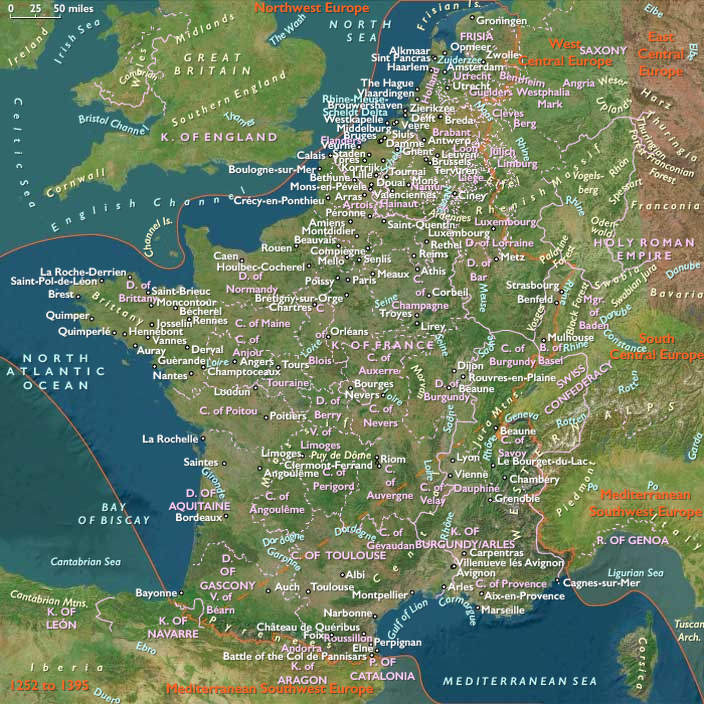
In July 1346, King Edward III, accompanied by his eldest son, Edward of Woodstock (later the Black Prince), launched a major invasion of France, landing with a 20,000-man army at Saint-Vaast-la-Hougue on the Cotentin Peninsula in Normandy. This marked the beginning of the Crécy campaign, one of the most significant offensives of the Hundred Years' War.
The English Capture Caen in a Single Day
- The French were completely unprepared, and Edward’s army quickly overran Normandy.
- On July 26, 1346, the English stormed Caen, one of the largest cities in northern France, in just one day.
- The capture was a major shock to Philip VI, as Caen had been lightly defended despite its importance.
- Thousands of French troops and citizens were massacred, and the city was thoroughly pillaged, yielding immense spoils for the English army.
Philip VI Gathers His Army While Edward Pillages the Countryside
- Rather than attempting to hold territory, Edward III continued his chevauchée strategy, marching northward toward the Low Countries while pillaging towns and villages along the way.
- The French king, Philip VI, began gathering a large army to intercept him.
- As Edward advanced, he found the Seine River crossings destroyed, preventing an easy route northward.
Edward’s Bold Move: Crossing the Seine at Poissy
- Edward moved southward, coming dangerously close to Paris, forcing Philip VI to deploy forces to defend the capital.
- At Poissy, Edward’s troops found the bridge only partially destroyed.
- The carpenters in his army quickly repaired it, allowing the English army to cross safely.
- This clever maneuver enabled Edward to continue his advance toward Flanders, avoiding a direct engagement with the main French army.
The Next Challenge: The Somme River
- After crossing the Seine, Edward continued toward the Low Countries, aiming to link up with his allies in Flanders.
- However, another natural obstacle—the Somme River—stood in his way, and most of its crossings had also been destroyed by the French.
Edward’s brilliant strategic movement through France in July–August 1346 forced Philip VI to react defensively, setting the stage for one of the most significant battles of the Hundred Years’ War—the Battle of Crécy.
The Battle of Crécy (August 26, 1346): A Defining English Victory
The Battle of Crécy (or Cressy in English) was a decisive English victory in the Hundred Years’ War, marking a turning point in medieval warfare. The English army, using innovative tactics and the longbow, devastated the much larger French force, leading many historians to consider this battle as the beginning of the decline of chivalric warfare.
Edward III’s Maneuvers Before the Battle
- After crossing the Somme River at the tidal ford of Blanchetaque, the English army left Philip VI’s forces stranded on the opposite side, gaining a crucial head start.
- Edward III continued his march toward Flanders, aiming to link up with his allies.
- However, Philip VI’s army pursued relentlessly, and Edward, realizing he could not outrun the French, chose to stand and fight on August 26, 1346.
English Battle Formation and Strategy
- Edward III positioned his army on a hill, giving his men a tactical advantage over the approaching French.
- His troops were arranged in a defensive formation:
- Longbowmen were placed on the flanks, ensuring they could fire into the advancing enemy.
- Men-at-arms were stationed in the center, ready to hold the line.
- Reserves were positioned at the top of the hill, prepared to reinforce the front when needed.
- The total combined English and French forces numbered fewer than 60,000, with the English heavily outnumbered.
The Disaster for France: Poor Leadership and Tactical Failures
- Philip VI allowed his army to attack before it was fully prepared, leading to chaotic assaults that played directly into English hands.
- The French vanguard was led by 5,000 Genoese crossbowmen, commanded by Antonio Doria.
- Heavy rain soaked their crossbow strings, making them almost useless, since unlike English longbows, they could not be easily removed or restrung.
- When the crossbowmen failed to make an impact and began retreating, French knights mistook this for cowardice and attacked their own allies, slaughtering many of them.
The Longbow’s Devastating Effect
- The English longbowmen unleashed volleys of arrows, decimating the first three French infantry regiments before they could even engage.
- As French cavalry charged, their horses were targeted and brought down, creating chaos in the ranks.
- Men-at-arms then moved in, cutting down disorganized and trapped French soldiers.
Key Deaths and Casualties
- The battle was a disaster for the French, with many high-ranking nobles killed on the battlefield.
- Among the dead was John of Luxembourg, King of Bohemia, who, despite being blind, fought heroically alongside 500 Bohemian knights.
- His chivalric bravery became legendary, but his death symbolized the fading dominance of mounted knights against new military tactics.
Aftermath and Legacy
- The French suffered enormous losses, while the English held their position and emerged victorious.
- The Battle of Crécy proved that longbowmen and tactical positioning could defeat traditional knightly charges, marking a fundamental shift in medieval warfare.
- The defeat severely weakened the French military, allowing Edward III to continue his campaign, leading to the Siege of Calais (1346–1347).
The Battle of Crécy was a defining moment in the Hundred Years’ War, showcasing English tactical superiority and marking the beginning of the end for the chivalric age.
Brabant Shifts Alliances: The Saint-Quentin Treaty and the Marriage of Margaret (1343–1347)
In 1343, Duke John III of Brabant had sought papal dispensation for the marriage of his daughter Margaret to Prince Edward of Woodstock, the son of Edward III of England. However, as Edward’s finances weakened and his military focus shifted elsewhere, the Brabant-English alliance unraveled, forcing John to seek a new diplomatic arrangement.
Brabant Aligns with France: The Treaty of Saint-Quentin (1347)
- In September 1345, representatives of France and Brabant met at Château de Saint-Germain-en-Laye to negotiate a shift in Brabant’s alliances.
- This led to the Treaty of Saint-Quentin, signed on June 1347, in which:
- Brabant formally aligned with France, abandoning its previous English connections.
- Margaret of Brabant was betrothed to Louis of Male, the newly inherited Count of Flanders.
The Marriage of Margaret and the Strengthening of Brabant-Flanders Relations
- Louis of Male, the new Count of Flanders, had little real power over the independent-minded Flemish communes, which had long resisted comital authority.
- By marrying Margaret of Brabant, the House of Flanders secured an important alliance with Brabant, which had territorial ambitions in the Low Countries.
- A major point of dispute between Brabant and Flanders had been the Lordship of Mechelen, a strategic enclave within Brabant.
- As part of the treaty, it was agreed that Mechelen would now come under full Brabantine control, strengthening Brabant’s territorial claims.
Impact and Legacy
- The Treaty of Saint-Quentin marked a significant shift in Brabant’s foreign policy, as it now firmly aligned with France rather than England.
- The marriage between Margaret and Louis of Male reinforced the Brabant-Flanders connection, influencing regional politics in the Low Countries.
- The transfer of Mechelen to Brabant was a diplomatic victory for John III, securing greater territorial consolidation.
The failure of Brabant’s English alliance and its new alignment with France in 1347 shaped the political balance in the Low Countries, ensuring that Brabant remained a key player in Franco-Flemish relations for years to come.
The Siege of Calais (September 1346 – August 1347): Edward III Secures England’s Foothold in France
Following his victory at the Battle of Crécy (August 26, 1346), Edward III of England advanced north and besieged the city of Calais, an important seaport on the English Channel. This siege, which lasted nearly a year, resulted in one of England’s most significant territorial acquisitions of the Hundred Years’ War, allowing the English to maintain a permanent military presence in northern France for over two centuries.
The Strategic Importance of Calais
- Calais, originally a fishing village, had grown into a prosperous seaport, serving as a major crossing point between England and France.
- Situated on an island surrounded by canals and harbors, the city was strongly fortified and could be supplied by sea, making it difficult to capture by land.
- Edward III recognized its strategic value, as controlling Calais would:
- Secure an English foothold in northern France.
- Provide a base for further invasions.
- Ensure safe passage for English reinforcements and supplies.
The Siege (September 1346 – August 1347)
- Edward III began the siege in September 1346, following his triumph at Crécy.
- The French garrison, led by Jean de Vienne, resisted fiercely, relying on naval resupply to sustain itself.
- However, Edward’s blockade cut off the city’s food and reinforcements, leading to widespread starvation among the defenders.
- By early 1347, the city’s population was exhausted and starving, forcing the leadership to negotiate surrender terms.
The Surrender: The Burghers of Calais
- To avoid mass slaughter, six prominent burghers (citizens) of Calais offered themselves as hostages to Edward III.
- They walked out of the city barefoot and wearing only sackcloth, expecting to be executed as a symbolic act of submission.
- Edward’s wife, Queen Philippa of Hainaut, intervened, pleading for their lives to be spared, which Edward granted.
The Establishment of the Pale of Calais
- With Calais now in English hands, Edward III expelled the city’s French inhabitants and repopulated it with English settlers.
- The English established the Pale of Calais, a fortified English-controlled zone around the city.
- Calais became a critical stronghold for England, allowing them to:
- Station troops safely in northern France.
- Launch further military campaigns into France.
- Control a major trade and naval route in the English Channel.
Calais Under English Control (1347–1558)
- Calais remained an English possession for over 200 years, serving as a military and commercial hub.
- Even after England lost most of its French territories, Calais remained its last continental stronghold.
- It was finally recaptured by the French in 1558 during a successful siege by Francis, Duke of Guise, marking the end of English rule in France.
The Siege of Calais (1346–1347) was one of Edward III’s greatest strategic victories, providing England with a lasting base in France and further cementing English dominance in the early phases of the Hundred Years’ War.
The father of Henry of Grosmont died when his son was in France in 1345, and the younger Henry now became Earl of Lancaster—the wealthiest and most powerful peer of the realm.
After participating in the Siege of Calais in 1347, the king had honored Lancaster in 1348 by including him as a founding knight of the Order of the Garter.
Lancaster is present at the English naval victory at Winchelsea, where he allegedly saves the lives of the Black Prince and John of Gaunt.
Castilian ships have fought against England as the allies or mercenaries of France, and there have been instances of piratical violence between the trading ships of both nations.
A Castilian merchant fleet had been loading cargoes in the Flemish ports to be carried to the Basque coast.
The ships are armed and have warships with them.
They are all under the command of Don Carlos de la Cerda, a soldier of fortune who belongs to a branch of the Castilian royal family.
On its way to Flanders, the Castilian fleet had captured a number of English trading ships, and had thrown the crews overboard.
Piratical violence and massacre of this kind is at this time common on the sea.
The king at Rotherhithe on August 10 announces his intention of attacking the Castilians on their way home.
The rendezvous of his fleet is at Winchelsea: the king travels by land, accompanied by his wife and her ladies, by his sons, the Black Prince and John of Gaunt, as well as by many nobles.
The ladies are placed in a convent and on August 28 the king embarks on his flagship, the Cog Thomas.
The English fleet does not put to sea but remains at anchor, waiting for the appearance of the Castilians.
Its strength is not known with certainty, but Stow puts it at fifty ships and pinnaces.
Don Carlos de la Cerda might easily have avoided the English if he had kept well out in the Channel, but he relies on the size and strength of his forty large ships, and in expectation of an encounter had recruited a body of mercenaries—mostly crossbowmen—in the Flemish ports.
In the afternoon of August 29, he bears down boldly on King Edward's ships at anchor at Winchelsea.
The English steer to board the Castilians.
The king's own ship is run into by one of the enemy with such violence that both are damaged, and she begins to sink.
The Castilian stands on, and the Cog Thomas is laid alongside another, which is carried by boarding.
The king and his following have barely reached the deck of the Castilian before the Cog Thomas goes to the bottom.
Other Castilian ships are taken, but the fight is hot.
La Cerda's crossbowmen do much murder, and the higher-built Castilians are able to drop bars of iron or other weights on the lighter English vessels, by which they are damaged.
The conflict continues until twilight.
King Edward is said to have captured fourteen of the enemy ships of Castille.
What his own loss was is not stated, but as his own vessel, and also the vessel carrying the Black Prince, were sunk, and from the peril of La Salle du Roi, we may conclude that the English fleet suffered heavily.
There is no pursuit, and a truce will be made with the Basque towns the next year.
The battle with the Castilians on the sea is a very typical example of a medieval sea-fight, when the ships are of the size of a small coaster or a fishing smack, are crowded with men, and when the personal prowess of a single knight or squire is an important element of strength.
The only real authority for the battle is Froissart, who is at different times in the service of King Edward or of his wife, Philippa of Hainault, and of the counts of Namur.
He repeated what was told him by men who had been present, and dwells as usual on the chivalry of his patrons.
See his Chroniques, iv. 91.
Edward bestows an even greater honor on Henry of Grosmont in 1351 when he creates him Duke of Lancaster.
The title of duke is of relatively new origin in England; only one other ducal title existed previously (the Duke of Cornwall, a title created for Edward, the Black Prince, in 1337).
In addition to this, Lancaster is given palatinate status for the county of Lancashire, which entails a separate administration independent of the crown.
This grant is quite exceptional in English history; only two other counties palatine exist: Durham, which is an ancient ecclesiastical palatinate, and Chester, which is crown property.
It is a sign of Edward's high regard for Lancaster that he has bestowed such extensive privileges on him.
The two men are second cousins through their great-grandfather Henry III and practically coeval (Edward was born in 1312), so it is natural to assume that a strong sense of camaraderie exists between them.
Another factor that may have influenced the king's decision is the fact that Henry has no male heir, so the grant is made for the Earl's lifetime only, and not intended to be hereditary.
The English resume the offensive against the French with a damaging raid on the Languedoc.
The Great Raid of 1355 cripples southern France economically, and provokes resentment of the French throne among French peasantry.
The raid also 'cushions' the area for conquest, opens up alliances with neighbors in Aquitaine, the one with Charles II of Navarre being the most notable, and causes many regions to move towards autonomy from France, as France is not as united as England.