
Brabant Shifts Alliances: The Saint-Quentin Treaty and…
1347 CE
Brabant Shifts Alliances: The Saint-Quentin Treaty and the Marriage of Margaret (1343–1347)
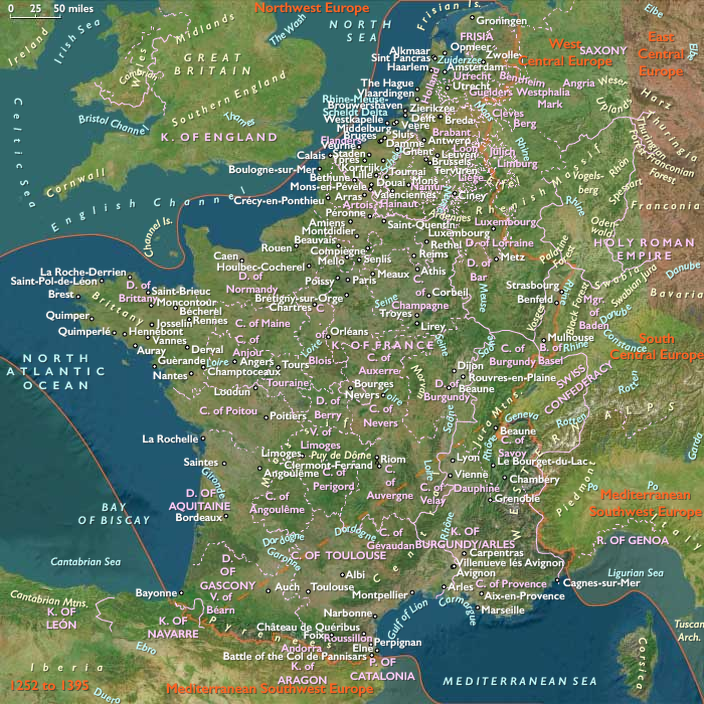
In 1343, Duke John III of Brabant had sought papal dispensation for the marriage of his daughter Margaret to Prince Edward of Woodstock, the son of Edward III of England. However, as Edward’s finances weakened and his military focus shifted elsewhere, the Brabant-English alliance unraveled, forcing John to seek a new diplomatic arrangement.
Brabant Aligns with France: The Treaty of Saint-Quentin (1347)
- In September 1345, representatives of France and Brabant met at Château de Saint-Germain-en-Laye to negotiate a shift in Brabant’s alliances.
- This led to the Treaty of Saint-Quentin, signed on June 1347, in which:
- Brabant formally aligned with France, abandoning its previous English connections.
- Margaret of Brabant was betrothed to Louis of Male, the newly inherited Count of Flanders.
The Marriage of Margaret and the Strengthening of Brabant-Flanders Relations
- Louis of Male, the new Count of Flanders, had little real power over the independent-minded Flemish communes, which had long resisted comital authority.
- By marrying Margaret of Brabant, the House of Flanders secured an important alliance with Brabant, which had territorial ambitions in the Low Countries.
- A major point of dispute between Brabant and Flanders had been the Lordship of Mechelen, a strategic enclave within Brabant.
- As part of the treaty, it was agreed that Mechelen would now come under full Brabantine control, strengthening Brabant’s territorial claims.
Impact and Legacy
- The Treaty of Saint-Quentin marked a significant shift in Brabant’s foreign policy, as it now firmly aligned with France rather than England.
- The marriage between Margaret and Louis of Male reinforced the Brabant-Flanders connection, influencing regional politics in the Low Countries.
- The transfer of Mechelen to Brabant was a diplomatic victory for John III, securing greater territorial consolidation.
The failure of Brabant’s English alliance and its new alignment with France in 1347 shaped the political balance in the Low Countries, ensuring that Brabant remained a key player in Franco-Flemish relations for years to come.
Locations
People
Groups
Topics
Subjects
Regions
West Europe
View →Subregions
Atlantic West Europe
View →Related Events
Showing 10 events out of 104 total
Central Europe (1396–1539 CE): Little Ice Age Worlds—Mines, Markets, and Faith in Revolt
Geographic & Environmental Context
Late-medieval Central Europe was never a single land but a constellation of three natural worlds linked by rivers and passes—and often more closely tied to their external neighbors than to each other.
-
East Central Europe (Poland–Bohemia–Hungary with eastern Austria/Bavaria): open Vistula and Danube basins, Carpathian arcs, Bohemian uplands—grain plains meeting silver–copper districts and Ottoman-facing frontiers.
-
South Central Europe (Swiss–Tyrolean–Styrian Alps and the Swiss Plateau): high passes and valleys that funneled Italy’s goods to German markets; pasture, dairying, and mining under harsh alpine climate.
-
West Central Europe (Rhine–Moselle–Main and the northern Jura): riverine corridors and vineyard slopes, dense towns and bishoprics, and the crucible of printing and Reformation.
This triptych stitched the Baltic, Adriatic, and North Sea worlds together—a region by corridors, not by unity.
Climate & Environmental Shifts (Little Ice Age)
Across all three subregions the Little Ice Age sharpened extremes:
-
Alpine & Carpathian highlands: longer winters, advancing glaciers, destructive spring thaws (floods/landslides).
-
Vistula plain & Hungarian Alföld: oscillation between bumper harvests and shortfalls; drought–flood cycles shaped cattle and grain rhythms.
-
Rhine–Moselle–Main: periodic flooding; tougher vintages but resilient wine culture.
Communities responded with storage, transhumance, and inter-regional grain movements via rivers and fairs.
Subsistence, Settlement & Economies
-
Rural matrices: rye–oats–barley in Poland/Silesia; wheat/millet on the Hungarian plain; vineyards in Moravia, Austria, Bavaria, and the Swiss–Rhine belts; alpine dairy cooperatives (cheese, butter) buffered poor years.
-
Mining & metallurgy: silver/copper at Kutná Hora, Kremnica/Banská Štiavnica, Tyrol–Salzburg; salt at Wieliczka/Hallstatt; ironworks in Bavaria/Styria—cash engines for states and princes.
-
Urban networks: Prague, Kraków, Vienna, Buda; Zurich, Bern, Geneva, Innsbruck; Cologne, Mainz, Strasbourg, Basel, Nuremberg, Augsburg—guilds, universities, fairs (Leipzig/Kraków/Nuremberg) moved surpluses and ideas across subregional borders.
Each subregion’s economy leaned outward: East Central grain and metals into Baltic/Hanse and Danube markets; South Central transit tolls and Tyrolean ore into Italian–German circuits; West Central river towns into the Low Countries’ cloth and finance.
Technology & Material Culture
-
Agrarian & hydraulic: heavy plows, mills, three-field rotations; terraced vineyards; communal granaries.
-
Mining tech: water-powered bellows and stamps; deep timbered shafts; mints financing rulers.
-
Architecture & arts: High Gothic cathedrals and walled towns; Renaissance forms seeped in via Italy and the Upper Rhine; panel painting and courtly polyphony flourished.
-
Printing (after c. 1450): Gutenberg’s Mainz breakthrough spread to Cologne, Strasbourg, Basel, Nuremberg, Vienna, Kraków—an information infrastructure that would carry humanism and, after 1517, Reformation fire.
Movement & Interaction Corridors
-
Vistula moved grain/timber to Gdańsk, into Baltic–Hanse circuits.
-
Danube tied Vienna–Buda–Belgrade, but drew the Ottoman frontier ever closer.
-
Alpine passes (Brenner, St. Gotthard, Arlberg, Simplon) moved Venetian silks/spices north and German silver south.
-
Rhine–Moselle–Main bound Basel to Cologne and the North Sea; pilgrimages and imperial diets layered political traffic atop trade.
These arteries made Central Europe a through-region—its subregions metabolized external flows as much as their own.
Cultural & Symbolic Expressions
-
Catholic Christendom framed civic ritual; monasteries and feast days structured time and charity.
-
Bohemia’s Hussite Reformation (1419–1434)—ignited by Jan Hus’s martyrdom—pioneered vernacular worship (utraquism) and radical lay militias.
-
Humanism spread from Basel, Nuremberg, Vienna, and Kraków (where Copernicus studied).
-
After 1517, Lutheran ideas coursed down the Rhine and over the Alps; pamphlets and woodcuts remapped belief at street level. Zwingli in Zurich (1519) and Calvin in Geneva (late 1530s) recast South Central religious life.
Conflict Dynamics & Power Shifts
-
Hussite Wars: wagon-fort tactics, hand-guns, and disciplined infantry reshaped warfare; utraquism endured within Bohemia’s settlement.
-
Jagiellon Zenith to Shock: c. 1500 the Jagiellons held Poland–Lithuania, Bohemia, and Hungary; Mohács (1526) shattered Hungary—king Louis II fell, splitting the realm into Ottoman pashaliks, Habsburg Royal Hungary, and Transylvania.
-
Habsburg Rise: claimed Bohemia and Hungary after 1526; Vienna became a bulwark against the Porte.
-
Polish–Teutonic Frontier: 1525 secularization created Ducal Prussia as a Polish fief.
-
Swiss Confederation: military prestige (Burgundian Wars) and autonomy (Swabian War, 1499); but Kappel (1531) exposed confessional fracture (Zwingli’s death).
-
Rhine–German lands: Peasants’ War (1524–26) convulsed Swabia/Franconia; princes crushed it, but the social–religious question remained.
Environmental Adaptation & Resilience
-
Peasants rotated cereals, intercropped legumes, pooled risk in commons; highlanders practiced transhumance, stocking cheese and hides for lean years.
-
Mining towns diversified into crafts; imported grain via rivers in crises.
-
Urban councils regulated bread, stockpiled grain, and mobilized confraternities for relief; fairs redistributed regional surpluses when harvests failed.
Subregional Signatures (in one glance)
-
East Central Europe: grain-and-metal powerhouse under Jagiellons, then Ottoman shock; Hussite legacy in Bohemia; Danube as lifeline and threat.
-
South Central Europe: Swiss–Tyrolean confederacies and Habsburg frontiers; alpine dairying/mining; Reformation bifurcation (Zurich/Geneva) amid military autonomy.
-
West Central Europe: Rhine printing belt from Mainz to Basel; humanism → Reformation; wealthy towns, but social fissures (Peasants’ War).
Each subregion often shared more with adjacent external worlds (Baltic, Italian, Low Countries, Balkans) than with its Central European neighbors—precisely the point of The Twelve Worlds: regions are envelopes; subregions are the living units.
Transition by 1539
Central Europe stood at a hinge:
-
Poland–Lithuania prospered as a grain-exporting monarchy;
-
Bohemia remained confessionally mixed under Habsburg suzerainty;
-
Hungary lay partitioned;
-
Austria/Tyrol consolidated mining wealth and fortified the Danube;
-
Swiss cantons were sovereign yet split by faith;
-
Rhine towns pulsed with presses and reform, but rural discontent smoldered.
From 1396 to 1539, the region moved from dynastic zenith to confessional fracture, from medieval corridors to early-modern networks—its destiny now defined by the twin rivalries that would shape the next century: Habsburg–Ottoman war and Reformation–Counter-Reformation at the very center of Europe.
East Central Europe (1396–1539 CE): Dynastic Crossroads, Hussite Fires, and Ottoman Shocks
Geographic & Environmental Context
The subregion of East Central Europe includes modern-day Poland, Czechia, Slovakia, Hungary, and the eastern parts of Germany (including most of Bavaria) and Austria east of 10°E and northeast of Carinthia. Anchors included the Vistula basin (Warsaw, Kraków, Gdańsk), the Danube corridor from Vienna through Pressburg/Bratislava and Buda to Szeged, the Carpathian arc of Slovakia and northern Hungary, the Hungarian Great Plain, the Elbe and Oder headwaters in Bohemia, Saxony, and Silesia, and the Alpine highlands of eastern Austria and Bavaria. These landscapes bound together fertile river basins, upland pastures, alpine valleys, and strategic frontiers bridging the Baltic, Adriatic, and Black Sea worlds.
Climate & Environmental Shifts
The Little Ice Age deepened extremes:
-
Alpine and Carpathian highlands: longer winters, harsher snowpack, late thaws; floods and landslides after spring melt.
-
Vistula basin & Polish plain: variable harvests of rye and wheat; bumper crops alternated with shortfalls.
-
Hungarian plain: droughts and floods shaped cattle herding and grain cycles.
-
Bavarian & Austrian Alps: cooler summers reduced grape yields, but alpine pastures thrived for cattle and sheep.
Subsistence & Settlement
-
Rural economies: Rye, oats, and barley in Poland and Silesia; wheat and millet on the Hungarian plain; vineyards in Moravia, Hungary, Austria, and Bavaria; cattle herding widespread.
-
Mining & metallurgy: Silver and copper mines in Slovakia (Kremnica, Banská Štiavnica), Bohemia (Kutná Hora), and Tyrol–Salzburg; salt at Wieliczka and Hallstatt; ironworks in Bavaria and Styria.
-
Urban centers: Prague, Kraków, Vienna, Buda, Nuremberg, Augsburg, and Regensburg; merchant guilds and universities flourished.
-
Forests & mountains: Logging and charcoal for mines, alpine dairying, and highland pastures tied peasants to both subsistence and trade.
Technology & Material Culture
-
Agriculture: Heavy plows, watermills, three-field rotations; vineyards terraced in Moravia, Hungary, and Bavaria.
-
Mining tech: Water-driven bellows and stamping mills; deep shafts with timbering; new coinages financed states.
-
Architecture: Gothic cathedrals (Prague’s St. Vitus, Kraków’s Wawel), castles, walled towns; Renaissance forms began seeping in.
-
Print: By the early 16th century, Kraków, Vienna, and Nuremberg became major printing centers; humanist texts and Reformation pamphlets circulated.
Movement & Interaction Corridors
-
Vistula river: Grain and timber moved to Gdańsk and into Baltic–Hanseatic circuits.
-
Danube corridor: Vienna–Buda–Belgrade linked German, Hungarian, and Balkan markets, but faced Ottoman pressure.
-
Alpine passes: Bavarian and Austrian routes tied Venice to Augsburg, Regensburg, and Vienna.
-
Carpathian passes: Salt, wine, and cattle moved between Hungary, Poland, and Transylvania.
-
Hanseatic connections: Kraków and Poland linked via Gdańsk into North Sea trade.
Cultural & Symbolic Expressions
-
Catholic Christendom: Monasteries, cathedrals, and feast days structured social life across Poland, Hungary, Austria, and Bavaria.
-
Hussite movement (Bohemia): Sparked after Jan Hus’s execution (1415); Hussite Wars (1419–1434) reshaped Czech religious life; moderate utraquism endured even after defeat.
-
Humanism: Universities in Kraków, Prague, Vienna, and Ingolstadt; Copernicus studied in Kraków; Erasmus’s works circulated from Basel and Nuremberg.
-
Dynastic courts: Jagiellon dynasty ruled Poland–Lithuania, Bohemia, and Hungary; Habsburgs consolidated Austria and eyed Hungary.
-
Music & art: Courtly polyphony, panel painting in Bavaria and Bohemia, illuminated chronicles, and humanist scriptoria.
Environmental Adaptation & Resilience
-
Peasants: Rotated cereals, intercropped legumes; stored grain in communal barns.
-
Highlanders: Practiced transhumance; cheese-making, wool, and hides buffered shortages.
-
Mining towns: Diversified with craft guilds; imported grain when crops failed.
-
Urban networks: Redistributed surpluses through fairs in Leipzig, Kraków, and Nuremberg.
Technology & Power Shifts (Conflict Dynamics)
-
Hussite wars: Wagon forts, hand-guns, and disciplined infantry innovated military tactics; legacies shaped Central European warfare.
-
Jagiellon power: At its height c. 1500, the dynasty united Poland–Lithuania, Bohemia, and Hungary.
-
Ottoman threat: Hungary shattered at Mohács (1526); King Louis II killed, splitting Hungary between Ottoman pashaliks, Habsburg Royal Hungary, and Transylvanian voivodeship.
-
Habsburg rise: Claimed crowns of Bohemia and Hungary after 1526, transforming Vienna into a bulwark of Christendom.
-
Polish–Teutonic frontier: Secularization of the Teutonic Order (1525) created Ducal Prussia as a Polish fief.
-
Bavarian & Austrian Reformation: Lutheran ideas spread in German and Austrian lands; dukes and bishops began suppressing or tolerating reform selectively.
Transition
By 1539 CE, East Central Europe had moved from dynastic zenith to fracture. Poland–Lithuania prospered as a grain-exporting kingdom; Bohemia remained divided between Catholic and utraquist traditions under Habsburg suzerainty; Hungary lay partitioned after Mohács; Austria and Bavaria were absorbing Lutheran ideas amid Catholic pushback; mining and grain surpluses supported urban life but frontiers with the Ottomans seethed. The region’s destiny was shifting toward confessional division and Habsburg–Ottoman rivalry.
Some magnates had resented Hunyadi for his popularity as well as for the taxes he imposed, and they feared that his sons might seize the throne from Laszlo.
They coax the sons to return to Laszlo's court, where Hunyadi 's elder son is beheaded.
His younger son, Matyas, is imprisoned in Bohemia.
However, lesser nobles loyal to Matyas soon expel Laszlo.
After Laszlo' s death abroad, they pay ransom for Matyas, meet him on the frozen Danube River, and proclaim him king.
Known as Matyas Corvinus (1458-90), he is, with one possible exception (Janos Zapolyai), the last Hungarian king to rule the country.
Matyas's reforms do not survive the turbulent decades that follow his reign.
An oligarchy of quarrelsome magnates gains control of Hungary.
They crown a docile king, Vladislav Jagiello (the Jagiellonian king of Bohemia, who is known in Hungary as Ulaszlo II, 1490-1516), only on condition that he abolish the taxes that had supported Matyas's mercenary army.
As a result, the king's army disperses just as the Turks are threatening Hungary.
The magnates also dismantle Matyas's administration and antagonizes the lesser nobles.
In 1492 the Diet limits the serfs' freedom of movement and expands their obligations.
Rural discontent boils over in 1514 when well-armed peasants under Gyorgy Dozsa rise up and attack estates across Hungary.
United by a common threat, the magnates and lesser nobles eventually crush the rebels.
Dozsa and other rebel leaders are executed in a most brutal manner.
Matyas regularly convenes the Diet and expands the lesser nobles' powers in the counties, but he exercises absolute rule over Hungary by means of a secular bureaucracy.
He enlists thirty thousand foreign mercenaries in his standing army and builds a network of fortresses along Hungary's southern frontier, but he does not pursue his father's aggressive anti-Turkish policy.
Instead, Matyas launches unpopular attacks on Bohemia, Poland, and Austria, pursuing an ambition to become Holy Roman Emperor and arguing that he is trying to forge a unified Western alliance strong enough to expel the Turks from Europe.
He eliminates tax exemptions and raises the serfs' obligations to the crown to fund his court and the military.
The magnates complain that these measures reduce their incomes, but despite the stiffer obligations, the serfs consider Matyas a just ruler because he protects them from excessive demands and other abuses by the magnates.
He also reforms Hungary's legal system and promotes the growth of Hungary's towns.
Matyas is a true renaissance man and makes his court a center of humanist culture; under his rule, Hungary's first books are printed and its second university is established.
Matyas's library, the Corvina, is famous throughout Europe.
In his quest for the imperial throne, Matyas eventually moves to Vienna, where he dies in 1490.
East Central Europe (1456–1467 CE): Siege of Belgrade, Ascendancy of Matthias Corvinus, Bohemian Kingship of George of Poděbrady, and the Thirteen Years' War
Between 1456 and 1467 CE, East Central Europe experienced pivotal developments marked by critical Ottoman confrontations, significant shifts in Hungarian leadership under Matthias Corvinus, dynastic consolidation in Bohemia under George of Poděbrady, and crucial transformations resulting from the Thirteen Years' War between the Teutonic Order and the Polish-Lithuanian Union. These events dramatically reshaped regional politics, fortifying defenses against external threats while significantly altering internal power dynamics and political alliances.
Political and Military Developments
Siege of Belgrade and Rise of Matthias Corvinus in Hungary (1456–1458)
-
In 1456, the Ottoman Empire, led by Sultan Mehmed II, launched a massive siege against the strategic Hungarian stronghold of Belgrade. The siege was famously repelled by Hungarian noble John Hunyadi, who died shortly after his remarkable victory, deeply mourned and celebrated as a national hero.
-
Following internal struggles and political maneuvering after Hunyadi’s death, his young son, Matthias Corvinus, was elected King of Hungary in 1458, initiating one of Hungary’s most prosperous and culturally influential reigns. Matthias effectively reorganized military and administrative structures, vigorously defending Hungary’s frontiers while enhancing internal stability.
Bohemian Stability under George of Poděbrady (1458–1471)
-
In 1458, George of Poděbrady ascended peacefully to the Bohemian throne, becoming the first non-dynastic, native Czech king since the Přemyslid dynasty. His reign emphasized political stability, economic recovery, religious moderation (balancing Catholic and moderate Hussite factions), and diplomatic outreach throughout Europe, notably proposing a pan-European league for peace against Ottoman expansion.
Polish-Lithuanian Triumph in the Thirteen Years’ War (1454–1466)
-
The protracted Thirteen Years' War between the Teutonic Order and the Polish-Lithuanian Union reached critical phases during this period. Polish forces steadily gained control, supported by cities and nobility within the Prussian Confederation, an alliance formed by Prussian towns and nobles in opposition to Teutonic domination.
-
This conflict decisively weakened the Teutonic Order, setting the stage for significant territorial realignments and bolstering Polish-Lithuanian influence over vital Baltic territories, notably the crucial trade hubs around Gdańsk (Danzig) and Toruń (Thorn).
Internal and Dynastic Tensions in the Holy Roman Empire Territories
-
Within imperial territories such as Brandenburg, Saxony, and Austria, local and regional dynastic tensions persisted. The Duchies of Saxony, Mecklenburg, Bavaria, and Brandenburg underwent internal consolidation and realignment, managing political competition and negotiating external alliances, significantly influencing East Central Europe’s broader geopolitical balance.
Economic and Technological Developments
Economic Recovery and Urban Prosperity under Matthias Corvinus
-
Under Matthias Corvinus, Hungary experienced substantial economic revitalization, driven by improved agricultural output, commercial trade networks, and increased mining activities, especially silver mining in Upper Hungary (modern Slovakia).
-
Bohemia under George of Poděbrady and Poland under Kazimierz IV experienced similar economic recoveries, significantly improving regional trade networks, infrastructure, and urban prosperity.
Baltic Trade Realignments Following the Thirteen Years' War
-
With Polish-Lithuanian victory and territorial gains, cities like Gdańsk, Toruń, and Elbląg thrived economically, deepening integration into Baltic maritime trade networks and significantly strengthening Poland-Lithuania’s economic foundations.
Cultural and Artistic Developments
Cultural Renaissance under Matthias Corvinus (Hungarian Renaissance)
-
Matthias Corvinus actively patronized arts, science, and scholarship, fostering the Hungarian Renaissance’s cultural flourishing. His royal court in Buda became a vibrant center of Renaissance humanism, attracting notable Italian scholars, artists, and architects.
-
Corvinus’s renowned Bibliotheca Corviniana emerged as one of Europe’s finest Renaissance libraries, significantly enhancing Hungary’s cultural prestige.
Bohemian Cultural Resurgence
-
Under George of Poděbrady, Bohemian culture flourished, blending traditional Czech influences with evolving Renaissance trends. Prague sustained its reputation as a major cultural and intellectual center, marked by architectural projects, literature, and intellectual discourse promoting peace and European unity.
Settlement and Urban Development
Fortifications and Defensive Urbanization
-
Hungary significantly strengthened urban defenses, particularly border cities like Belgrade, Esztergom, and Temesvár, fortifying them against Ottoman threats.
-
Polish-Lithuanian cities, notably Gdańsk and Toruń, expanded rapidly, fortified defenses, and improved civic infrastructure, driven by post-war economic growth.
Social and Religious Developments
Continued Religious Diversity and Moderate Hussitism in Bohemia
-
George of Poděbrady maintained religious tolerance, upholding moderate Hussite traditions alongside traditional Catholic practices. This policy fostered Bohemia’s distinctive cultural and religious pluralism.
Social Strengthening of Nobility and Urban Classes
-
In Hungary, Poland-Lithuania, and Bohemia, aristocratic privileges and noble autonomy strengthened, particularly in territories acquired from the Teutonic Order. Urban elites also gained considerable economic and political influence through expanded commerce and civic development.
Long-Term Consequences and Historical Significance
The era 1456–1467 CE was a critical juncture in East Central Europe, decisively shaping the region’s medieval trajectory. Matthias Corvinus’s reign established a strong Hungarian monarchy, culturally vibrant and militarily resilient, deeply influencing subsequent Hungarian history. The Bohemian kingship of George of Poděbrady solidified internal peace, cultural vitality, and diplomatic innovations, impacting broader European political thought. Polish-Lithuanian triumph in the Thirteen Years' War profoundly reconfigured Baltic geopolitical dynamics, bolstering Polish regional dominance and significantly diminishing Teutonic power. Collectively, these developments transformed East Central Europe’s political landscape, fortifying regional resilience against external threats and laying essential foundations for future stability, cultural flourishing, and political complexity.
Ladislaus’s beheading of the the young László Hunyadi had raised such a storm in Hungary that the king has had to flee to Prague, where he is to spend the last months of his life.
He dies suddenly in Prague on November 23, 1457, while preparing for his marriage to Magdalena of Valois, daughter of Charles VII of France.
It is rumored at the time that his political opponents in Bohemia, including Hussite leader George of Poděbrady, had poisoned him; but in 1985 research will prove that Ladislaus had died of acute leukemia, not a recognized disease in this period.
Ladislaus's cousins Frederick V and Albert VI succeed him in Austria.
Soon.
Hungary will soon elect Matthias Corvinus, the brother of László Hunyadi, as king; and Bohemia will elect George of Poděbrady, fated to be the only Hussite ruler of that kingdom.
The death, amid rumors of poisoning, of the young Habsburg king, Ladislaus Posthumus in November of 1457 had ended the two-year struggle between Hungary's various barons and its king.
George of Poděbrady, governor of Bohemia and friend of the Hunyadis who aims to raise a national king to the Magyar throne, has taken hostage Janos Hunyadi’s younger son Matthias Corvinus.
Knighted at the siege of Belgrade in 1456, Matthias had married Elizabeth of Celje, the only known daughter of Ulrich II of Celje and Catherine Cantakuzina; her maternal grandparents were Đurađ Branković and Eirene Kantakouzene.
But the young Elizabeth had died in 1455, before the marriage was consummated, leaving Matthias a widower at the age of fifteen.
Poděbrady has treated Matthias hospitably and affianced him with his daughter Kunhuta, but still detains him, for safety's sake, in Prague, even after a Magyar deputation has hastened thither to offer the youth the crown.
Matthias takes advantage of the memory left by his father's deed, and by the general population's dislike of foreign candidates; most of the barons, furthermore, consider that the young scholar will be a weak monarch in their hands.
An influential section of the magnates, headed by the palatine Ladislaus Garai and by the voivode of Transylvania, Miklós Újlaki, who had been concerned in the judicial murder of Matthias's brother László, and hates the Hunyadis as semi-foreign upstarts, are fiercely opposed to Matthias's election; however, they are not strong enough to resist against Matthias's uncle Mihály Szilágyi and his fifteen thousand veterans.
Thus, over the elections of Emperor Frederick II, who seeks to retain Habsburg control of Bohemia, Matthias is elected king by the Diet on January 20, 1458.
Poděbrady releases him under the condition of marrying his daughter (later to be known as Catherine).
On January 24, 1458, forty thousand Hungarian noblemen, assembled on the ice of the frozen Danube, unanimously elect Matthias Hunyadi king of Hungary, and on February 14 the new king makes his state entry into Buda.
This is the first time in the medieval Hungarian kingdom that a member of the nobility, without dynastic ancestry and relationship, mounts the royal throne.
The Ottomans and the Venetians threaten Hungary from the south, the emperor Frederick III from the west, and Casimir IV of Poland from the north, both Frederick and Casimir claiming the throne.
The Czech mercenaries under Giszkra hold the northern counties and from thence plunder those in the center.
Meanwhile Matthias's friends have only pacified the hostile dignitaries by engaging to marry the daughter of the palatine Garai to their nominee, whereas Matthias refuses to marry into the family of one of his brother's murderers, and on February 9 confirms his previous nuptial contract with the daughter of Poděbrady, …
…who, chosen unanimously on February 27 by the estates of Bohemia, ascends the throne on March 2, 1458.
The struggle in Bohemia of the Hussites against the papal party has continued without interruption.
Podebrady’s position had become a very difficult one when the young king Ladislaus, who was crowned in 1453, had expressed his pro-Roman sympathies, though he had recognized the compacts and the ancient privileges of Bohemia.
Even the adherents of the papal party had voted for him, however, some in honor of his moderate policies, and some in deference to popular feeling, which had opposed the election of a foreign ruler.
The international situation is becoming increasingly complicated.
The new Prince-Bishop of Ermeland, Cardinal Eneas Silvio Piccolomini, known for his pro-Teutonic sympathies, is in 1458 elected Pope Pius II.
Another complication is the death of Ladislas the Posthumous and the election of the Hussite leader George of Podebrady as the new king of Bohemia, and Matthias Corvinus as king of Hungary.
One positive sign is peace with Denmark.
King Christian I of Denmark has finally conquered Sweden, but the Swedish king Charles VIII has escaped to Poland and started supporting the Polish cause financially.
Danzig and Charles VIII begin hiring more privateers, which seriously damages Baltic trade, and finally Christian I decides to sign a ceasefire in July 1458.
In the spring, Casimir had again called for a levée en masse which included the Masovians.
Ignoring the mediation of John Giskra (Jan Jiskra), a Czech mercenary who hopes for an end to war with Prussia and the start of a new conflict with Hungary, the Polish army has slowly marched into Prussia, crossing the Vistula via a pontoon bridge near Thorn in June.
Again, the army is supported by Tatar auxiliary forces from the Crimea and by the king's own army, commanded by Piotr of Szamotuly, the castellan of Poznań.
The Polish army marches directly to Marienburg, reaching the city on August 10.
This time it is well-equipped with artillery sent by Danzig and Elbing.
The siege, however, is another fiasco, due partly to lengthy negotiations, and partly to Piotr's lack of aggression on the battlefield.
His inept leadership allows Fritz Raweneck to take yet another castle.
The nobles demand the storming of the castle, and when this does not happen, they start deserting and returning to Poland.