
Élisée Reclus
French geographer, writer and anarchist
1830 CE to 1905 CE
Jacques Élisée Reclus (March 15, 1830 – July 4, 1905) is a renowned French geographer, writer and anarchist.
He produces his nineteen-volume masterwork, La Nouvelle Géographie universelle, la terre et les hommes ("Universal Geography"), over a period of nearly twenty years (1875–1894)
In 1892 he is awarded the Gold Medal of the Paris Geographical Society for this work, despite having been banished from France because of his political activism.
World
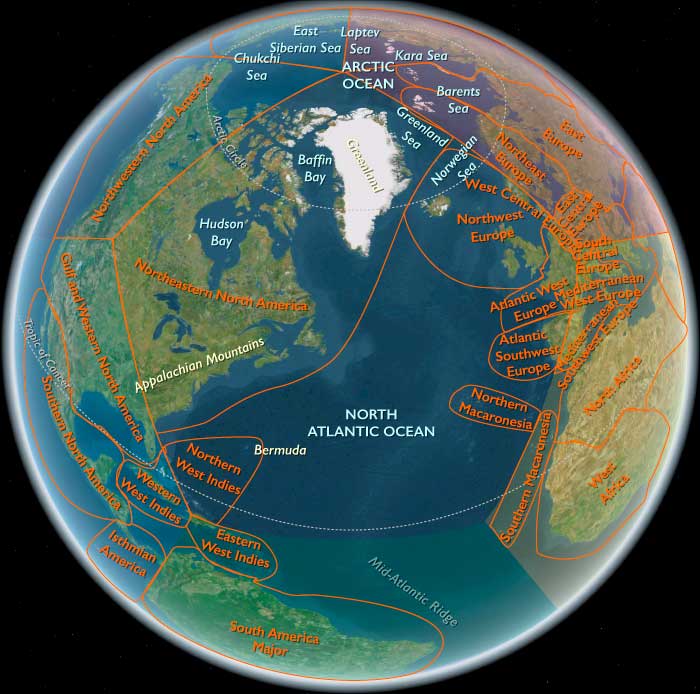
The Atlantic Lands
View →Related Events
Showing 2 events out of 2 total
Mikhail Bakunin plays a prominent role in the Inaugural Congress of the League of Peace and Freedom in Geneva in September 1867, and joins the Central Committee.
The founding conference is attended by six thousand people.
By July 1866, Bakunin had been informing the Russian exiles Aleksandr Herzen and Nikolay Ogarev about the fruits of his work over the previous two years.
His secret society by that date had members in Sweden, Norway, Denmark, Belgium, England, France, Spain, and Italy, as well as Polish and Russian members.
In his Revolutionary Catechism of 1866, he had opposed religion and the state, advocating the "absolute rejection of every authority including that which sacrifices freedom for the convenience of the state." (Revolutionary Catechism, Mikhail Bakunin, 1866, Bakunin on Anarchy, translated and edited by Sam Dolgoff, 1971.)
During the 1867–1868 period, Bakunin has responded to Emile Acollas's call for the conference and become involved in the League of Peace and Freedom (LPF), for which he writes a lengthy essay, Federalism, Socialism, and Anti-Theologism.
Acollas's call for the conference had gained ten thousand adherents from across Europe who had signed petitions in support of the congress, including Victor Hugo, John Stuart Mill, Elisée Reclus, Edgar Quinet, Jules Favre, Giuseppe Garibaldi, Louis Blanc and Bakunin.
They also count on the participation of the newly formed International Workingmen's Association (IWMA), inviting the sections of the IWMA and its leaders, including Karl Marx, to attend the Congress.
They had decided to postpone the opening of the Congress until September 9, so as to enable delegates of the Lausanne Congress of the IWMA (to be held on September 2–8) to take part.
Marx is dismissive and urges the IWMA to have no official involvement.
Acollas had insisted that the first Conference, held in Geneva, should be called a "revolutionary conference".
Here, Bakunin advocates a federalist socialism, drawing on the work of Proudhon.
He supports freedom of association and the right of secession for each unit of the federation, but emphasizes that this freedom must be joined with socialism for: "Liberty without socialism is privilege, injustice; socialism without liberty is slavery and brutality."
Mikhail Bakunin and other socialists (Élisée Reclus, Aristide Rey, Jaclard, Giuseppe Fanelli, N. Joukovsky, V. Mratchkovsky and others) at the Bern Congress of the League of Peace and Freedom in 1868, find themselves in a minority and secede from the League, establishing their own International Alliance of Socialist Democracy, which adopts a revolutionary socialist program.