Eric III of Denmark
King of Denmark
Years: 1120 - 1146
Eric III Lamb (Danish: Erik III Lam) (c. 1120 – 27 August 1146) is the King of Denmark from 1137 until 1146.
He is the grandson of Eric I of Denmark and the nephew of Eric II of Denmark, whom he succeeds on the throne.
He abdicates in 1146, as the first and only Danish monarch to do so.
His succession leads to a period of civil war between Sweyn III, Canute V, and Valdemar I.



Related Events
Filter results
Showing 8 events out of 8 total
The death of Eric II, as told by Arild Huitfeldt, a seventeenth century Danish historian and state official, known for his vernacular Chronicle of Denmark:
A harsh and unpopular ruler, Eric died at Urnehoved landsting in 1137.
King Eric was struck down by a local nobleman, Sorte Plov.
According to legend, Sorte Plov asked permission to approach the king, carrying a spear in his hand with a block of wood protecting the tip.
Having deemed that King Eric wore no mail underneath his tunic, Sorte Plov kicked off the protection, and drove his spear right through the king.
King Eric's nephew Erik Håkonssøn stepped forward with sword in hand, but the nobleman told him to calm down, seeing as how he—Erik —was next in line for the throne, being the only adult male in the royal family: "Put away thine mace, young Erik.
A juicy piece of meat hath fallen in thine bowl!"
According to legend, Sorte Plov escaped with his life.
Eric, killed on July 18, 1137, is buried at Ribe Cathedral.
His son Erik Håkonssøn is now crowned Eric III of Denmark.
Sometime before 1130, Eric had married Malmfred of Kiev, the daughter of Grand Duke Mstislav I of Kiev and Christina Ingesdotter of Sweden.
Malmfrid was the former wife of King Sigurd I of Norway.
With his concubine Thunna, Eric has an illegitimate son Sweyn, who will later become king as Sweyn III of Denmark.
Olaf Haraldsen, after trying in vain to regain his heritage, proclaims himself king in Scania in 1139, fighting his cousin King Eric III of Denmark.
The civil war mostly consists of alternating raids, during which Olaf kills Bishop Rike of Roskilde, an act that sees him excommunicated by the Pope.
Olaf Haraldsen is at last defeated by Eric III and around 1143 is killed in a battle in Middle Scania.
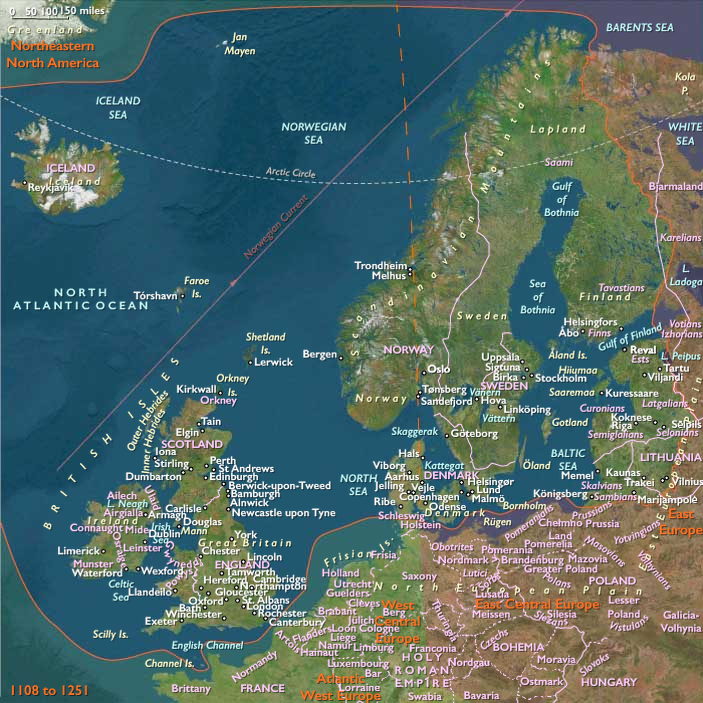
Northwest Europe (1144–1155 CE): Intensified Conflict and Emerging Stability
England: Height of the Anarchy
The period 1144–1155 saw the peak of turmoil during The Anarchy (1135–1153), the ongoing civil conflict between King Stephen of Blois and Matilda, daughter of Henry I. England suffered from continuous warfare, exacerbated by shifting loyalties among barons who constructed numerous castles to assert their autonomy. In 1147, Matilda departed England permanently, leaving her son, Henry Plantagenet, to continue the struggle. The prolonged stalemate prompted fatigue among the nobility, leading to the eventual Treaty of Wallingford in 1153, under which Stephen agreed to name Henry Plantagenet as his successor.
Scotland: Continued Growth and Influence
David I (r. 1124–1153) continued his transformative rule until his death in 1153, further developing Scotland's feudal framework and urban infrastructure. His administration saw the establishment of additional monasteries and burghs, enhancing trade and economic stability. David supported his niece, Empress Matilda, in the English succession conflicts, frequently campaigning in Northern England, which consolidated Scotland’s territorial claims and bolstered its influence beyond the border. Upon David’s death, his grandson, Malcolm IV (r. 1153–1165), inherited a relatively stable kingdom.
Ireland: Increased Norman Influence
Ireland remained fragmented politically, yet Norman influence gradually increased. The coastal cities, particularly Dublin and Waterford, prospered through trade and served as gateways for Norman customs and commercial practices. While Ireland was still politically divided, these urban centers became focal points for greater economic and cultural integration with continental Europe and England.
Denmark: Internal Discord and Leadership Changes
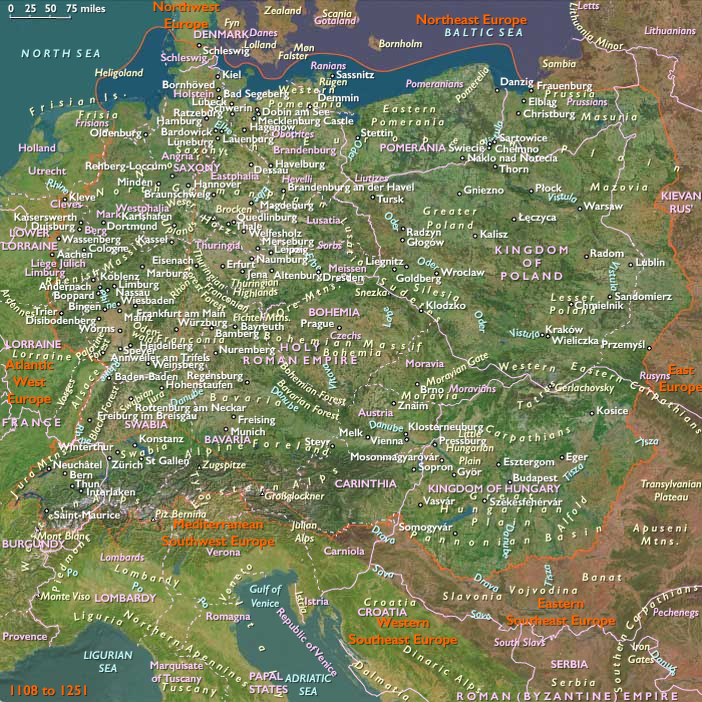
Denmark continued to endure internal strife throughout this era. The instability following Eric II Emune's assassination in 1137 extended through successive reigns. Eric III Lamb assumed power in 1137 but struggled to maintain control amid powerful aristocratic factions and eventually abdicated in 1146, paving the way for yet another succession conflict between Sweyn III Grathe, Canute V, and Valdemar the Great, plunging Denmark further into civil war.
Norway: Continued Civil Wars
Norway remained embroiled in civil conflict. The strife initiated by the death of Sigurd I Jorsalfar continued with shifting allegiances and intermittent violence. Battles for the throne between rival claimants marked the decade, reinforcing regional factionalism. Norway’s internal strife weakened central authority and prolonged instability throughout the period.
Iceland and the North Atlantic: Cultural Continuity
Iceland remained largely insulated from mainland conflicts, preserving political stability through its traditional assembly, the Althing. Icelandic culture continued to flourish, as literary and historical works, such as sagas and skaldic poetry, were increasingly documented, thereby enriching cultural heritage and historical preservation.
Religious Expansion and Consolidation
Monastic expansion continued across Northwest Europe, significantly shaping cultural and economic landscapes. The Cistercian order established additional abbeys, playing a critical role in the religious and agricultural development of Scotland and northern England. The influence of monastic institutions reinforced ecclesiastical authority and helped stabilize regions ravaged by warfare.
Legacy of the Era
By 1155 CE, Northwest Europe began transitioning from intense conflict toward emerging stability. England approached the end of its civil war, with Henry Plantagenet poised to ascend the throne, promising restoration of royal authority. Scotland’s political reforms under David I left a stable foundation for his successors. Denmark and Norway, however, continued grappling with internal divisions, delaying lasting peace and unity. Ireland saw steady cultural and economic advancement, facilitated by Norman influence, and Iceland maintained its cultural integrity, largely unaffected by the continental upheaval.
Denmark seems to have been a stable country during the kingship of Eric III Håkønssøn Lam, ruling from 1137, and some contemporary sources speak very highly of him.
The first Danish king who seems to have been strongly influenced by German culture, he had spent his early youth among German knights whose ideals have marked most of his later life.
Also his queen, Lutgard of Salzwedel, is a German.
The reasons for his abdication (the only one by a Danish king) are unknown; he enters a convent in 1146 and dies this same year, and the illness that has killed him may well have been the main reason.
At the abdication of Eric, Sweyn Grathe, the illegitimate son of Erik II Emune and a mistress, has been elected a king on the large island of Zealand (Sjaelland) but for the next years he will have to fight against his rival …
…Canute (Knud Magnussen), son of Prince Magnus who was the son of King Niels, who rules in Jutland.
A third claimant is …
…Valdemar, the son of Canute Lavard, a chivalrous and popular Danish prince, who had been the eldest son of Eric I of Denmark.
Valdemar’s father had been murdered days before his birth; his mother, Ingeborg, daughter of Mstislav I of Kiev, had named him after her grandfather, Vladimir Monomakh of Kiev.
(Vladimir's father-in-law had been King Harold Godwinson of England; Vladimir 's grandfather had been Emperor Constantine Monomachus of Constantinople.)
As an heir to the throne, and with his rivals quickly gaining power, Valdemar has been raised in the court of Asser Rig of Fjenneslev, together with Asser's sons, Absalon and Esbern Snare, who are to become his trusted friends and ministers.
Valdemar holds southern Jutland as his possession.
The ensuing civil war will last the better part of ten years.
Northwest Europe (1156–1157 CE): Brief Consolidation Amidst Lingering Uncertainty
England: Restoration Under Henry II
Following the resolution of The Anarchy, Henry II (r. 1154–1189) embarked on a swift consolidation of royal authority. By 1156, Henry had significantly reduced the number of unauthorized castles built during the civil conflict, reasserting centralized control. He reformed legal institutions and initiated measures to restore economic stability, marking a clear shift away from the turbulence of previous decades.
Scotland: Early Reign of Malcolm IV
Malcolm IV (r. 1153–1165) faced immediate challenges following the stable reign of his grandfather, David I. Young and inexperienced, Malcolm struggled to maintain the expansive territorial holdings secured by David, particularly those south of the border. Nonetheless, his initial reign focused on consolidating royal authority within Scotland and preserving the internal stability fostered during David’s rule.
Ireland: Continued Norman Influence and Fragmentation
Ireland remained politically fragmented but economically vibrant, particularly within Norse-Gaelic coastal settlements such as Dublin and Waterford. These towns continued to integrate Norman customs and economic practices, serving as key points of cultural and economic exchange with England and the continent. However, the island’s broader political unity remained elusive.
Denmark: Unstable Truce and Violent Power Struggle
The Danish civil war saw a brief lull in 1157, when a temporary peace agreement was forged among Sweyn III Grathe, Canute V, and Valdemar the Great, dividing the kingdom between them. However, during a celebration marking this accord, Sweyn treacherously ordered the assassination of his co-rulers. Canute was killed, but Valdemar managed to escape. Valdemar subsequently conducted a successful campaign against Sweyn, defeating and killing him near Viborg. This victory allowed Valdemar to consolidate his rule and become the sole king of the Danes, temporarily restoring some stability to Denmark.
Norway: Persistent Factionalism
Norway continued to endure civil unrest and rivalry among claimants to the throne. These internal struggles further fragmented royal authority, perpetuating regional instability and ongoing conflict as competing factions persisted in their attempts to dominate the kingdom.
Iceland and the North Atlantic: Stability and Cultural Flourishing
Iceland and surrounding North Atlantic communities maintained their stability and cultural continuity, insulated from the wider political upheavals. The traditional Althing continued to function effectively, while the literary and historical traditions flourished, capturing and preserving regional narratives and cultural identity.
Religious Influence and Cultural Expansion
Monastic institutions continued their expansion across Northwest Europe, further solidifying ecclesiastical and cultural networks. Cistercian monasteries proliferated, enhancing agricultural production and reinforcing economic stability, particularly in Scotland and Northern England.
Legacy of the Era
By the close of 1157 CE, Northwest Europe presented a mixed picture of recovery and uncertainty. England under Henry II exhibited clear signs of restored stability, while Scotland sought to preserve its recent gains. In contrast, Denmark and Norway grappled with ongoing internal conflicts, and Ireland continued its fragmented yet economically dynamic existence. Iceland remained a culturally rich enclave of stability amidst broader regional volatility.