Eric IX of Sweden
King of Sweden
Years: 1115 - 1160
Eric "IX" of Sweden, (Swedish: Erik Jedvardsson; Erik den helige), also called Eric the Lawgiver, Erik the Saint, Eric the Holy and in Sweden Sankt Erik meaning Saint Eric (died 18 May 1160) was a Swedish king c.1155 – 1160.
No historical records of Eric have survived, and all information about him is based on later legends that were aimed at having him established as a saint.

Related Events
Filter results
Showing 9 events out of 9 total
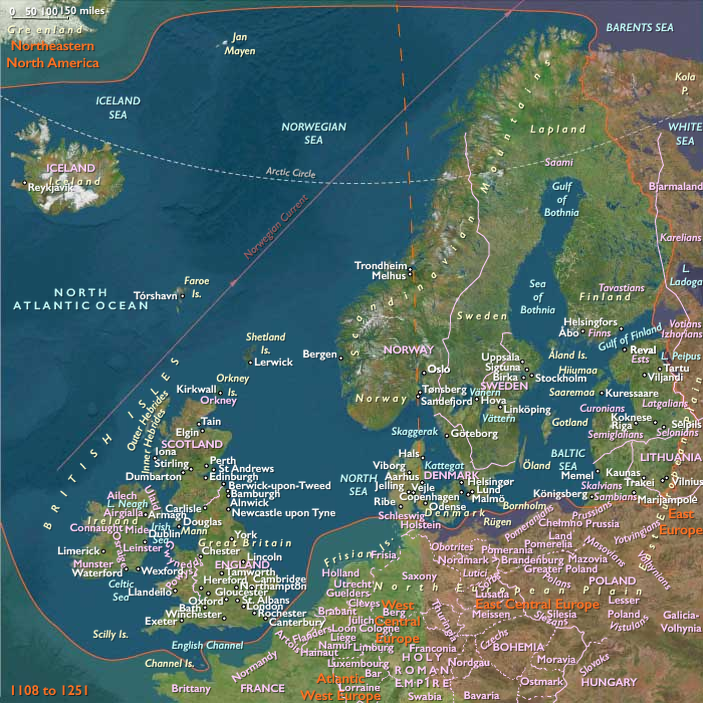
A quasi-historical legend maintains that in 1157 a crusade was led against the polytheistic Finns by the Swedish King Erik IX and the English monk Henry, who had been appointed archbishop of Uppsala.
According to tradition, Henry was martyred in Finland and was subsequently recognized as the country's patron saint.
The success of the crusade was supposed to have given Sweden and Latin Christianity a solid foothold in Finland.
There is no evidence of the crusade and Henry's role in it, however, and there are indications that Christian communities existed in Finland at an earlier date.
They have been converted to Eastern Orthodox Christianity and subsequently try to convert the Finns to this religion.
Finnic peoples in eastern Karelia are converted to Orthodoxy and are thereby drawn into a different religious and cultural orbit from Swedish-ruled, Roman Catholic Finns in the west.
Northeast Europe (1144–1155 CE): Royal Power, Early Northern Crusades, and Emerging Conflict
Introduction
Between 1144 and 1155 CE, Northeast Europe was shaped by intensified crusading zeal, consolidation of royal power, and growing conflict between Christian kingdoms and neighboring pagan tribes. This era witnessed the formal beginnings of the Northern Crusades, aimed at forcibly converting Baltic peoples to Christianity, significantly influencing future regional dynamics.
Strengthening of Royal Authority
In Denmark, following the turbulent reign and death of King Erik Emune (r. 1134–1137), his successor King Sweyn III Grathe (r. 1146–1157) struggled to maintain central authority amid persistent dynastic rivalry. Noble factions competed fiercely, weakening Denmark internally and diverting resources toward political conflict rather than external expansion.
In Sweden, King Sverker I (r. ca. 1130–1156) strengthened royal governance by consolidating control over previously fragmented territories. Sverker's reign stabilized internal politics, providing conditions conducive to early crusading missions and territorial consolidation.
Commencement of the Northern Crusades
This era marked the formal onset of the Northern Crusades, beginning around 1147, driven primarily by German crusaders and Scandinavian monarchs. These crusades targeted the forcibly conversion of pagan tribes including the Slavs, Balts, Estonians, and Finns to Christianity. The military and religious campaigns initiated in this era continued for centuries, profoundly shaping the political and cultural landscape of the Baltic region.
Notably, the legendary First Swedish Crusade around 1155, led by King Erik IX ("Saint Erik") and Bishop Henry of Uppsala, focused on Finland. Although historical specifics are limited and steeped in later tradition, this expedition symbolized Sweden's burgeoning ambitions for territorial and religious expansion eastward.
Economic Expansion and Urban Growth
Urbanization advanced notably during this period. The strategic trading center of Visby on Gotland enhanced its prominence as a key node in Baltic commerce. Additionally, Danish cities such as Roskilde and Lund saw incremental growth driven by thriving trade networks and merchant activities, foreshadowing their later centrality in regional economic life.
Baltic Resistance and Fortifications
Baltic tribes—including ancestors of modern Estonians, Latvians, and Lithuanians—resisted fiercely against incursions from crusaders. Fortified settlements expanded considerably, and local populations demonstrated a readiness to repel external threats. This active resistance laid the foundations for enduring regional conflicts, as Baltic tribes sought to preserve their autonomy and traditional beliefs against mounting external pressures.
Ecclesiastical Influence and Cultural Expansion
Ecclesiastical institutions, particularly monastic foundations such as the Cistercians, gained further prominence, fostering education, literacy, and religious reforms. The Church significantly shaped regional cultural norms, legal systems, and political institutions, reinforcing Christian influence in local governance.
Legacy of the Era
The era 1144–1155 CE critically impacted Northeast Europe's historical trajectory through intensified royal ambitions, the onset of the Northern Crusades, and persistent Baltic resistance. These developments initiated enduring patterns of religious conflict, territorial expansion, and cultural interaction that profoundly influenced Northeast Europe for generations to follow.
The beginning of Finland's nearly seven hundred-year association with the Kingdom of Sweden is traditionally connected with the year 1154 and the hypothesized introduction of Christianity by Sweden's King Erik.
However, archaeological evidence points to prior Christian influences in southwestern and southeastern Finland and include both western and eastern Christian artifacts.
For example, Finland had been mentioned together with Estonia in a list of Swedish provinces drawn up for the pope in 1120, apparently as a Swedish missionary area.
Northeast Europe (1156–1167 CE): Dynastic Conflicts, Crusading Intensification, and Baltic Resistance
Introduction
Between 1156 and 1167 CE, Northeast Europe witnessed heightened dynastic rivalry, the intensification of crusading campaigns, and increased tension between Christian kingdoms and pagan Baltic populations. The period saw crucial developments, including the consolidation of royal authority in Sweden and Denmark, and further advances of the Northern Crusades, reshaping regional political dynamics.
Dynastic Conflicts and Monarchical Consolidation
In Denmark, internal dynastic struggles continued to plague royal stability following the reign of Sweyn III Grathe (r. 1146–1157). A critical turning point came with the rise of Valdemar I the Great (r. 1157–1182), who emerged victorious from civil wars in 1157, restoring order and consolidating royal authority. Valdemar's reign marked the beginning of a period of Danish strength and centralized power.
In Sweden, the reign of King Eric IX ("Saint Erik," r. ca. 1156–1160) was brief but impactful, strongly associated with early crusading efforts. After Erik’s death, likely around 1160, dynastic tensions resurged, involving the Sverker and Erik families in recurring conflicts for control over the throne. Despite these tensions, efforts to centralize royal power gradually progressed, setting foundations for a stronger monarchy.
Expansion and Intensification of the Northern Crusades
The crusading fervor that began in earlier decades significantly intensified during this era. The Northern Crusades, now firmly underway, continued their aggressive targeting of pagan Baltic tribes, including the Estonians, Latvians, Lithuanians, and Finnic peoples. Crusaders, notably from German territories, increased their incursions and fortified their presence along the Baltic shores.
Following the legendary First Swedish Crusade to Finland around 1155, missionary and military campaigns continued in earnest. These expeditions aimed to convert local pagan populations forcibly, initiating centuries-long religious and cultural transformation throughout the region.
Urban and Economic Development
Economic activity and urbanization steadily progressed, especially in key trade centers. The strategic city of Visby on Gotland further solidified its role as a principal node in Baltic maritime commerce, connecting Scandinavia with continental Europe. Urban growth also continued in Danish and Swedish towns such as Roskilde, Lund, and the emerging settlement of Stockholm, reflecting increased economic activity and expanding trade networks.
Baltic Resistance and Fortifications
Throughout this period, Baltic populations maintained staunch resistance against crusading incursions. Tribes across modern-day Estonia, Latvia, and Lithuania fortified their settlements and engaged in active resistance, forming strategic alliances against foreign aggression. Their steadfast defense, marked by frequent raids and battles, highlighted the enduring determination of these communities to maintain their autonomy and cultural identity.
Ecclesiastical Influence and Cultural Foundations
Ecclesiastical institutions grew increasingly influential, further embedding Christianity into regional governance and cultural life. Monastic foundations, especially the expanding presence of Cistercian monasteries, provided essential centers for education, religious instruction, and Latin scholarship. The church's strengthening presence significantly influenced societal norms, legal codes, and political structures throughout Northeast Europe.
Legacy of the Era
The years 1156 to 1167 CE left a significant imprint on Northeast Europe's subsequent history. Consolidation of royal authority, intensification of the Northern Crusades, sustained Baltic resistance, and steady urban expansion profoundly shaped regional dynamics. These developments laid critical groundwork for future centuries, defining patterns of religious, cultural, and political interaction that would continue to influence Northeast Europe's historical trajectory.
Sverker I, before becoming King of Sweden, had been a powerful landowner from Östergötland.
According to the Westrogothic law (1240), his father's name was Cornube, but according to Skáldatal, his father's name was Kol.
He was acknowledged as king at the beginning of 1130s, and conquered Västergötland from its ruler Magnus the Strong.
Sverker rules for about 26 years, but in spite of the long reign not much is known about him, other than that the convents and monasteries of Alvastra, Nydala and Varnhem are founded during this time.
According to a Russian chronicle, the newly founded Republic of Novgorod had its first confrontation with Sweden during Sverker's reign in 1142, thus breaking a centurylong peace that had been guaranteed by marriages between the earlier ruling families.
Sverker is murdered near his own coach at the Alebäck bridge near Alvastra priory, going to the early service on Christmas day, in 1156.
This is considered a shocking crime, even by medieval standards.
The pretender Magnus Henriksson is suspected of the crime.
Eric, a rival king, is subsequently recognized in most or all provinces.
Eric is murdered as he leaves the church in Uppsala on May 18, 1160.
He is said to have been murdered by Emund Ulvbane, an assassin who was hired by people working for the Sverker dynasty, in order for them to regain the control of the kingdom, or alternatively by Magnus Henriksson, another claimant, who is said in some sources to have succeeded him briefly as king.
Swedes believe a miracle occurred at Eric's death: a fountain is said to have sprung from the earth where the king's head fell after being chopped off.
Eric is soon worshiped as a saint, becoming known as Eric the Saint or Eric the Holy.
Though never formally canonized by the pope, he will eventually become the patron saint of Sweden.
Northeast Europe (1168–1179 CE): Royal Ascendancy, Crusading Momentum, and Baltic Resilience
Introduction
From 1168 to 1179 CE, Northeast Europe experienced a significant consolidation of royal authority, the growing momentum of crusading efforts, and ongoing resistance from the Baltic populations. This era notably marked Denmark's assertive expansion under King Valdemar I the Great, intensified missionary activities, and increasingly organized resistance among Baltic tribes against Christian encroachment.
Consolidation of Royal Power
In Denmark, the reign of Valdemar I the Great (r. 1157–1182) represented a period of pronounced royal consolidation and territorial expansion. Valdemar's leadership effectively ended decades of internal strife, establishing centralized authority through decisive victories against rival claimants. His reign notably included aggressive campaigns into pagan Baltic territories, significantly extending Danish influence and paving the way for a strengthened monarchy.
In Sweden, internal dynastic conflicts persisted between the Sverker and Erik families. Following the assassination of King Charles VII Sverkersson in 1167, political instability intensified. Nevertheless, emerging leaders continued attempts to centralize royal power, balancing internal feuds with territorial and missionary ambitions in the east.
Crusading Momentum and Expansion
The momentum of the Northern Crusades notably increased during this era. In 1168, under the leadership of King Valdemar I and Bishop Absalon of Roskilde, Danish forces decisively captured the strategic pagan stronghold at Arkona on the island of Rügen, dramatically expanding Christian influence in the southern Baltic. This event represented a major milestone in the northern expansion of Christianity, significantly emboldening crusaders' ambitions and serving as a springboard for further campaigns into the Baltic interior.
Missionary activities also continued in Finland and the eastern Baltic regions. Despite the earlier legendary First Swedish Crusade, persistent missionary incursions and military campaigns gradually reinforced Christian influence among resistant pagan populations.
Urban and Economic Development
Economic vitality and urbanization continued to flourish during this era. Visby on Gotland remained central to Baltic commerce, facilitating extensive trade exchanges with Scandinavia, northern Germany, and beyond. Danish towns, particularly Roskilde and Lund, grew notably, benefiting from increased economic activity, royal patronage, and the expanding influence of merchant guilds.
Baltic Resistance and Defensive Strategies
Baltic tribes, including the ancestors of modern Estonians, Latvians, and Lithuanians, responded to intensified Christian incursions by fortifying settlements, strengthening alliances, and launching coordinated counterattacks. The fall of Arkona in 1168 significantly alarmed these communities, prompting them to increase defensive measures and collaborative efforts to resist further crusading incursions effectively.
Ecclesiastical Influence and Cultural Expansion
The influence of ecclesiastical institutions continued to grow. The expansion of Cistercian monasteries significantly shaped regional cultural and educational life, spreading Latin literacy and ecclesiastical law. Bishop Absalon of Roskilde emerged as a prominent ecclesiastical and political figure, instrumental in promoting crusading ideology, bolstering royal authority, and advancing ecclesiastical structures throughout Denmark and newly conquered Baltic territories.
Legacy of the Era
The era 1168–1179 CE was pivotal in shaping Northeast Europe's historical trajectory. Enhanced royal authority in Denmark under Valdemar I, heightened momentum of the Northern Crusades, and resolute Baltic resistance collectively defined this transformative period. These developments laid crucial foundations for the continuing integration of Northeast Europe into broader European religious, cultural, and political spheres.
Northeast Europe (1180–1191 CE): Expansion, Crusader Fortresses, and Baltic Defiance
Introduction
From 1180 to 1191 CE, Northeast Europe experienced heightened crusading activity, the strengthening of royal power, and persistent Baltic resistance. This era witnessed strategic territorial expansions by Denmark and Sweden, increased fortifications by crusaders, and growing determination among Baltic peoples to preserve their independence and cultural identity.
Strengthening Royal Authority
In Denmark, under King Valdemar I the Great (r. 1157–1182) and subsequently his successor King Canute VI (r. 1182–1202), royal authority was firmly consolidated. Canute VI built upon his father's successes, reinforcing centralized governance, fortifying Denmark's influence in the southern Baltic, and securing control over previously pagan territories, especially on the island of Rügen and along the Pomeranian coast.
In Sweden, dynastic rivalries persisted, yet central authority strengthened gradually, allowing continued colonization efforts in southern Finland and greater engagement in crusading missions. Swedish kings increasingly projected power across the Baltic Sea, setting foundations for long-term Swedish presence in the eastern Baltic region.
Expansion and Consolidation of the Northern Crusades
This era marked intensified crusading efforts by German, Danish, and Swedish forces. Denmark expanded aggressively southward and eastward, fortifying strategic points and establishing Christian rule over local populations. Notably, Danish authorities continued consolidating control around recently conquered regions, particularly on the Baltic coast near Pomerania.
In Finland, Swedish settlement and missionary activity advanced significantly. Colonization accelerated, leading to deeper integration of southern Finland into the Swedish sphere of influence. This process intensified the cultural and political estrangement between Finnic communities north of the Gulf of Finland and their Baltic kin, especially the Estonians to the south.
Emergence of Crusader Fortresses
To secure territorial gains and protect expanding Christian domains, crusaders constructed numerous fortified strongholds throughout newly conquered territories. Key locations, such as the fortress towns emerging in Estonia and the recently secured regions of Rügen and southern Finland, served as bases for continued missionary and military operations, significantly bolstering Christian control.
Urban and Economic Growth
Economic vitality increased markedly during this period. Major trading hubs, particularly Visby on Gotland, solidified their central role in regional commerce, connecting Scandinavian merchants with Baltic and European markets. Danish towns such as Roskilde and Lund continued to flourish under royal patronage, driven by expanding trade and increased urbanization facilitated by merchant guilds.
Baltic Resistance and Defensive Alliances
Pagan populations of the Baltic region—particularly ancestors of the modern Estonians, Latvians, and Lithuanians—continued vigorous resistance against crusading incursions. Tribes intensified their defensive measures, strengthened alliances, and launched frequent counterattacks against encroaching crusader forces, demonstrating resilience and determination to maintain autonomy.
Ecclesiastical Influence and Cultural Foundations
Ecclesiastical institutions significantly expanded their influence during this era. Monastic establishments, particularly those of the Cistercian Order, grew more numerous and influential, promoting literacy, education, and the spread of ecclesiastical law. Bishops and clergy played pivotal roles in governance and cultural transformation, strengthening Christian influence throughout Northeast Europe.
Legacy of the Era
The years 1180 to 1191 CE significantly shaped the future trajectory of Northeast Europe. The strengthening of Danish and Swedish royal authority, establishment of strategic crusader fortresses, heightened cultural divisions among Baltic peoples, and sustained resistance to Christian incursions laid enduring foundations. This period's developments influenced subsequent centuries, profoundly affecting political alliances, territorial control, and cultural dynamics across the region.