Filippo Brunelleschi
Italian architect and engineer
Years: 1377 - 1446
Filippo Brunelleschi (1377 – April 15, 1446) was one of the foremost architects and engineers of the Italian Renaissance.
He is perhaps most famous for his discovery of perspective and for engineering the dome of the Florence Cathedral, but his accomplishments also include other architectural works, sculpture, mathematics, engineering and even ship design.
His principal surviving works are to be found in Florence, Italy.
Related Events
Filter results
Showing 10 events out of 14 total
Southwest Europe (1396–1539 CE)
Aragonese Sea Lanes, Italian Renaissance, and Habsburg–Valois Wars
Geography & Environmental Context
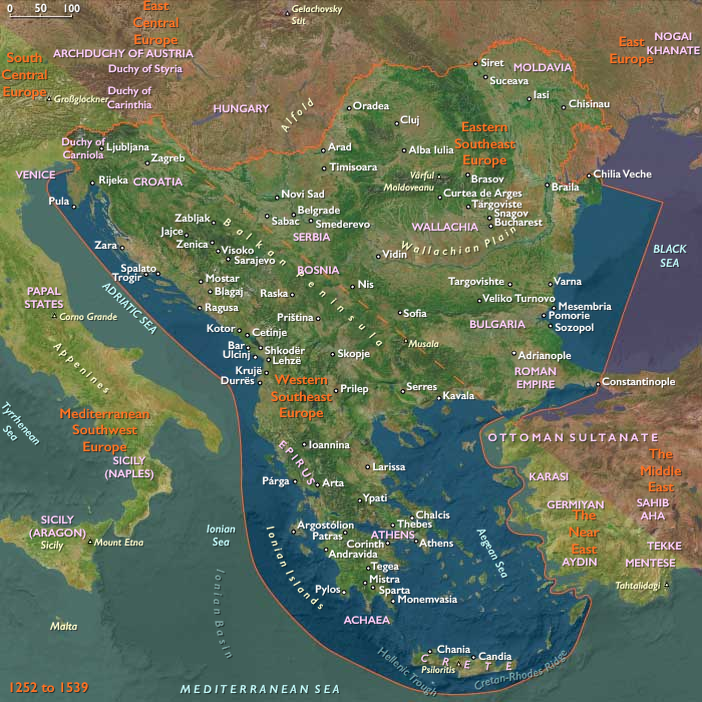
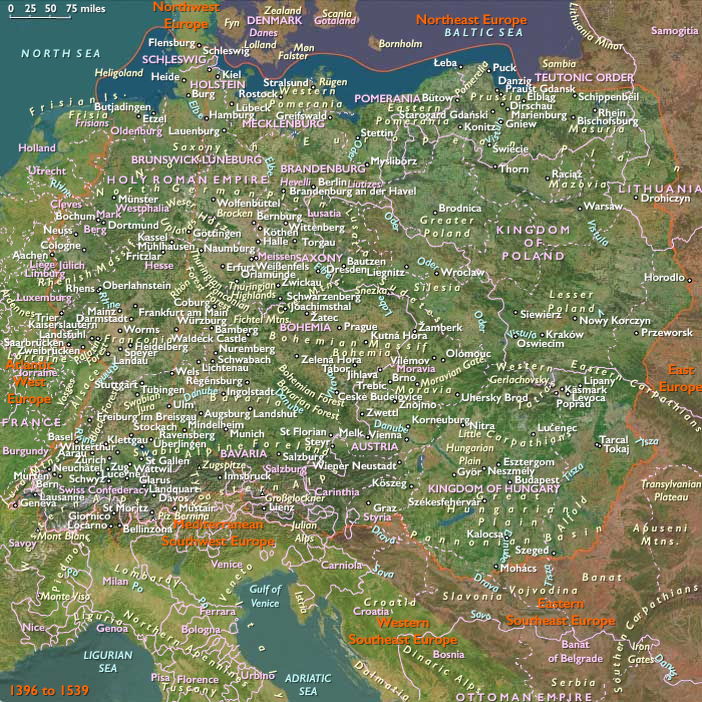
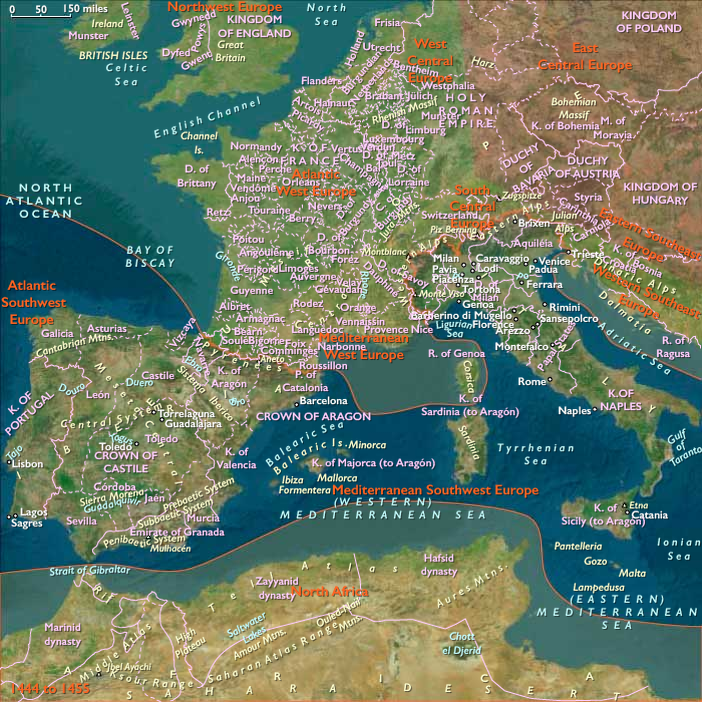
Southwest Europe encompassed Italy (including Sardinia and Sicily), Malta, southern and eastern Spain (Andalusia, Murcia, Valencia, Catalonia), and the Balearic Islands. Anchors spanned the Po Valley and Venetian–Adriatic gateways, the Apennine spine with Tyrrhenian and Adriatic littorals, the grain and volcanic uplands of Sicily, the rugged Sardinian interior, Malta’s limestone plateau astride central sea-lanes, and Spain’s irrigated huertas and ports from Seville–Cádiz (Atlantic–Mediterranean hinge) through Valencia–Barcelona to the Balearics.
Together these corridors provisioned, armed, and cultured Europe’s busiest inland sea.
Climate & Environmental Shifts
Under the Little Ice Age, winters cooled and variability intensified:
-
Po Valley & Lombardy: alternating droughts and Po floods unsettled rice and wheat rotations.
-
Sicily, Sardinia, southern Spain: recurrent droughts reduced grain and olive yields; citrus and pastoralism buffered loss.
-
Valencia–Murcia huertas: Acequia irrigation offset dry years, but torrential riadas periodically destroyed terraces.
-
Balearics & Malta: thin soils and rainfall swings required cisterns, terracing, and imported grain.
Subsistence & Settlement
-
Italy: Wheat, barley, vines, olives, and, in Lombardy, irrigated rice; urban gardens surrounded the city-states.
-
Sicily & Sardinia: Grain, olives, vines, citrus, and livestock; granaries provisioned Italian and Iberian ports.
-
Southern & eastern Spain: Andalusian cereals, olives, and vines; Valencian and Murcian sugarcane and mulberry–silk; Catalan wool flocks.
-
Islands: Grain, olives, vines, goats, and fisheries sustained mixed economies; harbors provisioned passing fleets.
Major ports—Venice, Genoa, Naples, Palermo, Barcelona, Valencia, Seville, Palma, Cagliari—served as collection hubs for Mediterranean and emerging Atlantic commerce.
Technology & Material Culture
-
Irrigation & terracing: Acequias, qanat-derived galleries, pozzos and cisterns, and stone-bench terraces stabilized yields on coasts and islands.
-
Maritime innovation: Galleys remained indispensable; Italian and Iberian shipyards developed round-hulled naos and early caravels; bronze cannon revolutionized siege and naval warfare.
-
Manufactures: Florentine wool and silk, Venetian glass and books (the Aldine Press), Valencian silk and sugar, Catalan and Neapolitan shipbuilding.
-
Architecture & arts: Gothic–Renaissance transitions—Brunelleschi’s dome, Alberti’s façades, Venetian palazzi; Spanish Mudéjar and early Plateresque; island watchtowers and coastal walls.
Movement & Interaction Corridors
-
Aragonese thalassocracy: The Barcelona–Valencia–Balearics–Sardinia–Sicily–Naples chain formed a western Mediterranean empire later absorbed by Habsburg Spain.
-
Italian sea-lanes: Venice and Genoa dominated Levantine and North African trade; Apennine passes linked inland production to ports.
-
Iberian hinge: Seville–Cádiz bridged Atlantic and Mediterranean routes after 1492, prefiguring global circuits of silver and spice.
-
Islands: Malta, Sardinia, and the Balearics provisioned convoys and guarded corsair-prone straits.
Cultural & Symbolic Expressions
-
Renaissance humanism: Florence, Rome, and Venice led Europe’s artistic renewal; courts of Naples, Ferrara, and Urbino radiated taste into Iberia and the islands.
-
Catholic Christendom: Rome remained pilgrimage center and patron of arts; confraternities and mendicant orders structured devotion.
-
Iberian transformations: The Fall of Granada (1492) ended Nasrid rule; the Inquisition and expulsions reshaped Andalusian society; Valencian and Catalan towns mixed mercantile realism with reformist thought.
-
Islands: Malta, blending Sicilian, Catalan, and Arabic legacies, was granted in 1530 to the Knights Hospitaller as a new crusading bastion.
Environmental Adaptation & Resilience
Cereal–legume rotations, vine–olive intercropping, chestnut economies in uplands, and rice paddies in irrigated lowlands spread risk.
Huerta canals and terrace systems were continuously maintained; state granaries and charitable confraternities mitigated dearth; fisheries and salted staples balanced harvest failures.
Technology & Power Shifts (Conflict Dynamics)
-
Aragonese expansion: Alfonso V (1442) united Naples with Aragon’s sea empire.
-
Italian Wars (1494–1559): France, Spain, and the Empire contested Italy—Fornovo (1495), Cerignola (1503), Agnadello (1509), Pavia (1525), and the Sack of Rome (1527) redefined European warfare and diplomacy.
-
Corsair & Ottoman pressure: Raids struck Sicily, Sardinia, Valencia, and the Balearics; Preveza (1538) confirmed Ottoman naval mastery in the east.
-
Iberian union: The crowns of Aragon and Castile (1479) created a Spanish monarchy projecting power across the peninsula and into the Mediterranean.
Transition
By 1539 CE, Southwest Europe was a crucible of power and culture. Habsburg Spain controlled Naples, Sicily, and Sardinia; Venice and Genoa mediated East–West trades under Ottoman pressure; Malta under the Knights became a bulwark; Valencia–Barcelona and Italian ports thrived on commerce and shipbuilding. Terracing, irrigation, and maritime provisioning sustained populations amid climatic volatility. Renaissance brilliance endured even as corsairs and cannon ushered in a new Mediterranean order.
Mediterranean Southwest Europe (1396–1539 CE): Aragonese Sea Lanes, Italian Renaissance, and Habsburg–Valois Wars
Geographic & Environmental Context
The subregion of Mediterranean Southwest Europe includes Italy (including Sardinia and Sicily), Malta, southern and eastern Spain (Andalusia, Murcia, Valencia, Catalonia), and the Balearic Islands. Anchors span the Po Valley and Venetian–Adriatic gateways, the Apennine spine with Tyrrhenian and Adriatic littorals, the grain and volcanic uplands of Sicily, the rugged Sardinian interior, Malta’s limestone plateau astride central sea-lanes, and Spain’s irrigated huertas and ports from Seville–Cádiz (Atlantic–Mediterranean hinge) through Valencia–Barcelonato the Balearics. Together, these corridors fed and armed Europe’s busiest inland sea.
Climate & Environmental Shifts
Under the Little Ice Age, winters were cooler and variability sharper:
-
Po Valley & northern Italy: alternating droughts and Po floods unsettled wheat/rice rotations; foggy winters extended.
-
Sicily, Sardinia, southern Spain: periodic droughts dented wheat and olive yields; citrus and pastoralism buffered shortfalls.
-
Valencian/Murcian huertas: canal and acequia irrigation moderated dry spells; occasional torrential floods (riadas) damaged terraces.
-
Balearics & Malta: thin soils and rainfall swings drove reliance on cisterns, terracing, and imported grain in lean years.
Subsistence & Settlement
-
Italy: Wheat, barley, vines, and olives dominated; rice spread in Lombardy; urban gardens ringed city-states.
-
Sicily & Sardinia: Grain, olives, vines, citrus, pastoral flocks; granaries supplied Italian and Iberian ports.
-
Southern & eastern Spain: Andalusian cereals, olives, vines; Valencia/Murcia grew rice, sugarcane, mulberry–silk; Catalan uplands raised sheep for wool.
-
Balearics & Malta: Mixed grain, olives, vines, goats; fisheries vital; harbors provisioned passing fleets.
Port cities—Venice, Genoa, Naples, Palermo, Barcelona, Valencia, Seville, Palma, Cagliari—functioned as collection and redistribution hubs for Mediterranean and, increasingly, Atlantic trade.
Technology & Material Culture
-
Irrigation & terracing: acequias, qanat-derived galleries, pozzos/cisterns, stone-walled benches stabilized yields on coasts and islands.
-
Maritime technology: galleys remained the workhorse; Italian and Iberian yards developed round-hulled naos and early caravels; bronze cannon transformed siege and naval warfare.
-
Manufactures: Florentine wool and silk; Venetian glass and print (Aldine press); Valencian silk and sugar; Catalan and Neapolitan shipyards.
-
Architecture & arts: Gothic to Renaissance transitions—Brunelleschi’s dome, Alberti’s façades, Venetian palazzi; Spanish Mudéjar and early Plateresque; island watchtowers and coastal walls.
Movement & Interaction Corridors
-
Aragonese thalassocracy: Barcelona–Valencia–Balearics–Sardinia–Sicily–Naples stitched a western Mediterranean network later inherited by Habsburg Spain.
-
Italian sea-lanes: Venice and Genoa collected Levantine and North African wares; peninsular roads (Via Emilia, Apennine passes) bound inland cities to ports.
-
Iberian hinge: Seville–Cádiz bridged Atlantic and Mediterranean circuits after 1492; Atlantic silver would later amplify these flows.
-
Island waypoints: Malta, Sardinia, and the Balearics provisioned convoys and guarded straits against corsairs.
Cultural & Symbolic Expressions
-
Renaissance humanism: Florence, Rome, and Venice fostered painting, sculpture, architecture, philology; courts of Naples, Ferrara, and Urbino radiated styles into Iberia and the islands.
-
Catholic Christendom: Papal Rome remained a pilgrimage and patronage center; confraternities, processions, and mendicant orders structured urban piety.
-
Iberian transformations: The Fall of Granada (1492) ended Nasrid rule; the Inquisition and expulsion/forced conversion reshaped Andalusian society; Valencian and Catalan towns mixed mercantile pragmatism with reforming currents.
-
Island identities: Genoese, Aragonese, and local elites fused on Corsica/Sardinia; Malta blended Sicilian, Catalan, and Arabic legacies—until 1530, when it became the fief of the Knights Hospitaller.
Environmental Adaptation & Resilience
-
Risk-spreading agriculture: cereal–legume rotations, vine–olive intercropping, and chestnut economies in uplands; rice paddies where water allowed.
-
Water management: canal dredging (Po/Adige), huerta maintenance (Valencia), terrace/cistern upkeep (Malta, Balearics, Ligurian and Amalfi coasts).
-
Urban buffers: state granaries, grain imports, and charitable confraternities mitigated dearth; fisheries and salted staples bridged bad harvests.
Technology & Power Shifts (Conflict Dynamics)
-
Hundred Years’ War (to 1453): peripheral raids reached Languedoc and Catalonia, nudging Aragonese naval policy.
-
Conquest of Naples (1442): Alfonso V of Aragon knit Naples to the Crown of Aragon’s sea empire.
-
Italian Wars (1494–1559): France, Spain, and the Empire fought over Italian hegemony—
-
Battle of Fornovo (1495) checked Charles VIII’s withdrawal;
-
Battle of Cerignola (1503) (Apulia) showcased gunpowder infantry, securing Spanish control in southern Italy;
-
Battle of Agnadello (1509) humbled Venice on the terraferma;
-
Battle of Pavia (1525) delivered a decisive Habsburg victory and Francis I’s capture;
-
the Sack of Rome (1527) shattered papal prestige and artists’ security.
-
-
Western Mediterranean contest: Barbary and Ottoman corsairs raided Sicily, Sardinia, Balearics, and Valencia; Rhodes (1522) fell to the Ottomans, redirecting the Hospitallers to Malta (1530); Preveza (1538) cemented Ottoman naval dominance in the eastern basin with echoes westward.
-
Iberian unification: The crowns of Aragon and Castile united (1479), projecting Spanish power across the peninsula, Italy, and the sea.
Transition
By 1539 CE, Mediterranean Southwest Europe was a crucible of power and culture. Habsburg Spain controlled Naples, Sicily, and Sardinia; Venice and Genoa mediated eastern and western trades under growing Habsburg and Ottoman pressure; Malta stood newly under the Knights as a central bastion; Valencia–Barcelona and Italian ports thrummed with commerce and shipbuilding. Despite climatic swings, terracing, irrigation, and maritime provisioning sustained populations. Renaissance patronage glowed even as Italian Wars and corsair/Ottoman threats remade the political seascape—setting up a long sixteenth century of Spanish predominance and Mediterranean contest.
Greatest artists like Leonardo da Vinci, Brunelleschi, Botticelli, Michelangelo, Giotto, Donatello, Titian and Raphael produce inspired works—their paintwork is more realistic-looking than had been created by Medieval artists and their marble statues rival and sometimes surpass those of Classical Antiquity.
Humanist historian Leonardo Bruni also splits the history in the antiquity, Middle Ages and modern period.
The ideas and ideals of the Renaissance soon spread into Northern Europe, France, England and much of Europe.
In the meantime, the discovery of the Americas, the new routes to Asia discovered by the Portuguese and the rise of the Ottoman Empire, all factors that erode the traditional Italian dominance in trade with the East, cause a long economic decline in the peninsula.
Donatello, born in Florence, most likely in the year 1386, as the son of Niccolò di Betto Bardi, a member of the Florentine Wool Combers Guild, and had been educated in the house of the Martelli family.
He had apparently received his early artistic training in a goldsmith's workshop, then worked briefly in the studio of Lorenzo Ghiberti.
While undertaking study and excavations with Filippo Brunelleschi in Rome (1404–1407), work that had gained the two men the reputation of treasure seekers, Donatello had made a living by working at goldsmiths' shops.
Their Roman sojourn will prove decisive for the entire development of Italian art in the fifteenth century, for it was during this period that Brunelleschi had undertaken his measurements of the Pantheon dome and of other Roman buildings.
Brunelleschi's buildings and Donatello's sculptures are both considered supreme expressions of the spirit of this era in architecture and sculpture, and they will exercise a potent influence upon the artists of the age.
In Florence, Donatello had assisted Ghiberti with the statues of prophets for the north door of the Florence Baptistery, for which he had received payment in November 1406 and early 1408.
He had in 1409–1411, executed the colossal seated figure of Saint John the Evangelist (which until 1588 will occupy a niche of the old cathedral façade, and is now placed in the Museo dell'Opera del Duomo).
This work marks a decisive step forward from late Gothic Mannerism in the search for naturalism and the rendering of human feelings.
The face, the shoulders and the bust are still idealized, while the hands and the fold of cloth over the legs are more realistic.
Donatello has worked from 1411 to 1413 on a marble statue of St. Mark for the guild church of Orsanmichele, adapting the drapery to the body's movement to produce a figure of tremendous organic vitality and unity, and in the process rediscovering contrapposto.
Donatello now seeks to portray his figures as individual personalities rather than as types.
Work on the Florence Cathedral, begun in the gothic style and halted due to the Black Death in 1348, had resumed in 1349 under a series of architects, commencing with Francesco Talenti, who had finished the campanile and enlarged the overall project to include the apse and the side chapels.
In 1359, Talenti had been succeeded by Giovanni di Lapo Ghini (1360–1369) who had divided the center nave in four square bays.
Other architects were Alberto Arnoldi, Giovanni d'Ambrogio, Neri di Fioravante and Andrea Orcagna.
By 1375, the old church, Santa Reparata, had been pulled down.
The nave was finished by 1380, and the huge masonry octagon intended to support the dome had been completed in 1414.
By 1418 only the dome itself remains incomplete.
The Arte della Lana on August 18, 1418, announces a structural design competition for erecting Neri's dome.
The two main competitors are the two master goldsmiths Lorenzo Ghiberti and Filippo Brunelleschi, the latter supported by Cosimo de Medici.
Ghiberti had been winner of a competition for a pair of bronze doors for the Baptistery in 1401 and lifelong competition between the two remains acute.
Brunelleschi wins and receives the commission.
Filippo Brunelleschi, the well-educated son of a lawyer, engages first in goldsmith work and sculpture but soon turns to architecture.
Sometime between 1417 and 1420, Brunelleschi, in his early forties, paints two panels demonstrating new schemes of perspective, techniques he may have discovered in his painstaking architectural studies of actual buildings. (These schemes establish the form of all subsequent perspective painting in the Renaissance.)
He receives a major commission in 1419 for the “Ospedale degli Innocenti” (Foundling Hospital).
Filippo Brunelleschi had designed the massive octagonal dome of Florence’s Gothic cathedral of Santa Maria del Fiore in about 1420.
The Florentine architect intends the vast dome, left unfinished in the fourteenth century because of seemingly insoluble structural problems, to be a self-supporting double shell using new and lighter masonry, and devises new scaffolding and hoists to accomplish this.
The first Italian patent is awarded by the Republic of Florence in 1421, when Brunelleschi receives a three-year patent for a barge with hoisting gear, that carries marble along the Arno River.
He astonishes his contemporaries by completing the soaring structure—one hundred and thirty feet (thirty-nine meters) in diameter and three hundred feet (ninety-one meters) high, with a fifty-two-foot (sixteen-meter) lantern crowning it—without centering (supporting scaffolding).
Brunelleschi begins work in 1421 on the church of San Lorenzo, created, like his Ospedale degli Innocenti, in a new style, employing the details of classical architecture—columns, arches, and pilasters—with a fresh approach, each element being distinctly and visibly in proportion with all other elements.
Brunelleschi designs the church as a three-aisled, Latin cross plan with transept; the unifying elements in it are the square module on which all of the church is designed and the consistent application of the classical orders.
Tommaso di Ser Giovanni di Mone, nicknamed Masaccio ("Slovenly Tom") because he cares so little for his appearance and personal affairs and so much more for his art, is the first artist to employ the principles of Brunelleschi's linear perspective in a major painting when he executes his Trinity fresco, an astonishing visual tour-de-force painted around 1425-27 for the church of Santa Maria Novella in Florence.
In this monumental and rationally ordered work, Masaccio creates the three-dimensional illusion of a chapel receding beyond the wall on which it is painted.
He reinforces this perspective effect by the placement of the figures of the donors, who are portrayed kneeling on a shelf that appears to project forward.
He constructs the entire composition so as to direct the spectator's eye inexorably toward the focal point of the work, the pyramidal group composed of the Virgin and Saint John at the bases and God the Father and the crucified Christ at the apex, further heightening the sculptural appearance of the figures by his innovative use of chiaroscuro, or modeling in light and dark.
Mediterranean Southwest Europe (1432–1443 CE): Artistic Achievements, Maritime Expansion, and Political Dynamics
The era 1432–1443 CE in Mediterranean Southwest Europe witnesses continued artistic innovation, significant maritime and commercial expansions, and evolving political dynamics across Italy and the Iberian Peninsula.
Artistic Developments: Florentine Masters
During this period, the city of Florence remains at the forefront of Renaissance artistic achievement. Filippo Brunelleschi continues work on the monumental dome of the Florence Cathedral (Santa Maria del Fiore), an unprecedented engineering accomplishment symbolic of Renaissance ingenuity. The dome, completed structurally in 1436, serves as a defining landmark of Renaissance Florence.
In parallel, Donatello continues to influence sculpture profoundly, undertaking various notable commissions, including the strikingly emotional and realistic marble reliefs for the pulpits of the Basilica of San Lorenzo, which display remarkable depth and psychological complexity.
Maritime and Commercial Expansion
This era sees significant maritime and economic activity throughout the region. Italian city-states such as Genoa, Venice, and Florence actively expand their Mediterranean and Atlantic trade networks, leveraging their merchant fleets and banking prowess to dominate international commerce. Their economic success supports further cultural patronage, fueling artistic and intellectual growth.
In Iberia, Portugal under Prince Henry the Navigator accelerates maritime exploration along the West African coast, significantly influencing future trade and exploration patterns. These expeditions expand European geographical knowledge and economic horizons, laying critical groundwork for the forthcoming Age of Exploration.
Political Developments and Regional Stability
Political landscapes shift as various powers consolidate their territories and influence. The Republic of Venice continues its territorial expansion, notably on the mainland (terraferma), fortifying its economic base. In contrast, the Kingdom of Naples faces internal and external pressures, experiencing political turbulence and dynastic disputes that destabilize southern Italy.
On the Iberian Peninsula, Castile and Aragon strengthen internal administrative structures and reaffirm their political cohesion. The Crown of Aragon, under Alfonso V, further deepens involvement in Italian politics, notably intensifying control over territories like Sicily and Naples, thereby reinforcing the interconnectedness of Mediterranean political affairs.
Cultural and Intellectual Flourishing
The intellectual environment remains vibrant, with Humanism continuing to thrive through the works of scholars who revisit and reinterpret classical texts. Literary and philosophical output flourishes, influencing not only artistic developments but also governance and education throughout the region.
Legacy of the Era
The era 1432–1443 CE is characterized by ongoing artistic innovation, significant maritime exploration and commercial growth, evolving political dynamics, and vibrant intellectual activity. These developments collectively shape Mediterranean Southwest Europe’s cultural identity, economic prosperity, and political structures, leaving a lasting legacy for future generations
Paolo Uccello, commissioned in 1436 to paint a posthumous equestrian monument of the famous English mercenary soldier Sir John Hawkwood for Florence Cathedral, creates an extraordinary fresco portraying a monumental stone statue; the pedestal is seen from below, but the horse and rider are seen from the side.
Florence’s Gothic cathedral of Santa Maria del Fiore is consecrated in 1436.
The ideal church type of the age is based on the centralized plan, admired by architects and theoreticians for its geometrical purity and clarity (and thus to heavenly order), and directly exemplified by Florentine sculptor-architect Filippo Brunelleschi's remarkable 1434 design for the first centrally planned church of the Renaissance, Florence’s vast (and still unfinished) Santa Maria degli Angeli (also called the Duomo of Florence): a domed octagon with eight radiating chapels.
His centralized plan, formed by a ring of eight piers, becomes the ideal among his Florentine contemporaries and his followers in Rome.
In 1436, he begins the church of Santo Spirito, using such traditional Italian Romanesque elements as a basilican plan, round arches, and a flat ceiling, but combines these with a new sense of proportion, the use of Corinthian columns, and a dome over the crossing of nave and transepts.
Italian polymath Leone Battista Alberti had moved in 1434 to Florence, becoming a member of the inner circle of humanists in Tuscany, among them the sculptor Donatello, and has gained recognition as an authority on art and classical literature.
He has become especially interested in the work of Brunelleschi, to whom he dedicates the Italian edition of Della pittura (On Painting), a treatise on the theory and technique of painting published in 1436, in which the author sets forth all that is currently known on the subject.
(Alberti had dedicated the 1435 Latin edition to Gian Francesco Gonzaga of Milan.)