Frederick Augustus I of Saxony
Elector of Saxony and King of Saxony
Years: 1750 - 1827
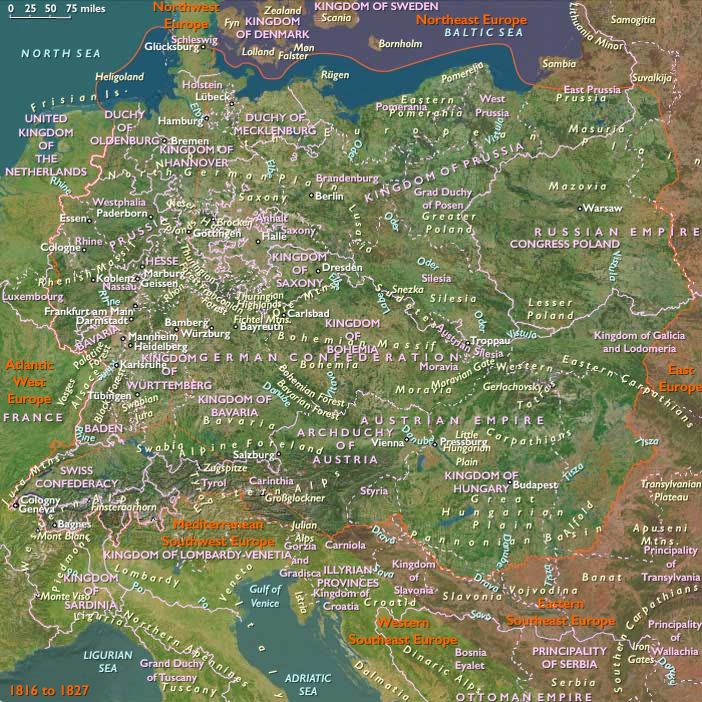
Frederick Augustus I (full name: Frederick Augustus Joseph Maria Anthony John Nepomuk Aloysius Xavier; December 23, 1750 – May 5, 1827) is a member of the House of Wettin who reigns as Elector of Saxony from 1763 to 1806 (as Frederick Augustus III) and as King of Saxony from 1806 to 1827.
He also serves as Duke of Warsaw from 1807 to 1813.
Succeeding his father in 1763 as the elector Frederick Augustus III, he brings order and efficiency to his country's finances and administration.
In foreign policy, he is neutralist but drifts towards Prussia, whose side he takes in the Bavarian succession dispute (1778–79), when it prevents Bavaria's cession to Austria.
For his cooperation he receives substantial financial compensation from Prussia.
In 1785, Frederick Augustus joins the Prussian-sponsored Fürstenbund (League of Princes), but remains neutral during the Austro-Prussian dispute in 1790.
Offered the Polish crown in 1791, he declines as he fears that his "risky" politics may cause further damage to the Polish state, which is already weak and eventually stops existing in 1795.
The next year Saxony reluctantly joins the coalition against Revolutionary France but is defeated by 1796.
Again entering the struggle on Prussia's side in 1806, after the decisive defeat at Jena in the same year, Frederick Augustus makes peace with Napoleon, which secures the title of king of Saxony for him.
A year later, Napoleon secures the Grand Duchy of Warsaw for him.
Frederick Augustus remains a loyal ally to France even after the disastrous Russian campaign (1812–13).
Although he had started halfhearted negotiations with Austria, he breaks them off after the French victory at Lützen (May 1813).
In the Battle of Leipzig (October 1813), however, his troops go over to Prussia and he wis taken as prisoner to Berlin.
At the Congress of Vienna in 1815, Frederick Augustus loses three-fifths of his territory to Prussia.
He spends the rest of his life attempting to rehabilitate his truncated state.
Throughout his political career Frederick Augustus tries to rehabilitate and recreate the Polish state that had been torn apart and stopped existing after the final partition of Poland in 1795; however he does not succeed—or this he will blame himself for the rest of his life.
The Augustusplatz in Leipzig is named after him.