Fyodor Dostoyevsky
Russian writer of novels, short stories and essays
Years: 1821 - 1881
Fyodor Mikhailovich Dostoyevsky (11 November 1821 – 9 February 1881) sometimes transliterated Dostoevsky, is a Russian writer of novels, short stories and essays.
Dostoyevsky's literary works explore human psychology in the troubled political, social and spiritual context of 19th-century Russia.
Although Dostoyevsky begins writing books in the mid-1850s, his most remembered work is from his last years, including Crime and Punishment, The Idiot and The Brothers Karamazov.
He writes eleven novels, three novellas, seventeen short novels and three essays, and is often acknowledged by critics as one of the greatest and most prominent psychologists in world literature.
Dostoyevsky was born and raised on the grounds of the Mariinsky hospital in Moscow, Russia.
At an early age he is introduced to English, French, German and Russian literature, as well as to fairy tales and legends.
His mother's sudden death devastateshim and, around the same time, he leaves private school for a military academy.
After his graduation, he wors as an engineer and briefly enjoys a liberal lifestyle.
He soon begins translating books to earn extra money.
Around the mid-1840s, he writes his first novel, Poor Folk, through which he enters into the literary mainstream.
In 1849, he is arrested for his involvement with the Petrashevsky Circle, a progressive discussion group.
He and other members are condemned to death for their participation in this group, but the penalty proves to be a mock execution at the last moment, and Dostoyevsky's sentence is commuted to four years of imprisonment in Siberia.
After his release, he is forced to serve as a soldier but is discharged from the military due to ill health and allowed to continue with his writing.
In the following years, Dostoyevsky works as a journalist.
He publishes and edits several magazines of his own and later a serial, A Writer's Diary.
Beginning with his travels to Europe he struggles with money issues because of his gambling addiction, resulting in the humiliation of begging for money.
He suffers from epilepsy throughout his adult life, but through the sheer energy and volume of his work he eventually becomes one of the most widely read and renowned writers in Russia.
His books have been translated into more than 170 languages and have sold around 15 million copies.
Dostoyevsky leaves a lasting legacy that has influenced many other writers, ranging from James Joyce to Ernest Hemingway, Jean-Paul Sartre and Ayn Rand, to name but a few.
Related Events
Filter results
Showing 10 events out of 14 total
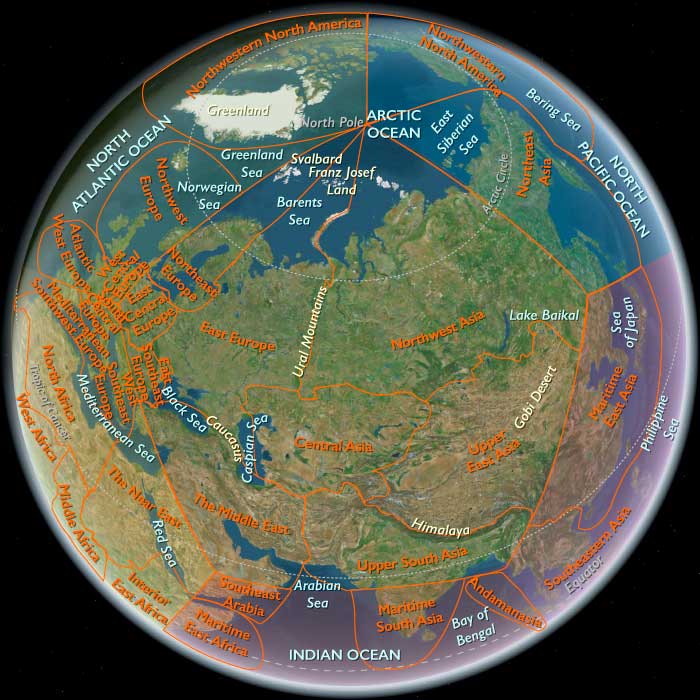
Northeastern Eurasia (1828–1971 CE)
From Tsarist Frontiers to Soviet Heartlands and Cold War Rimlands
Geography & Environmental Context
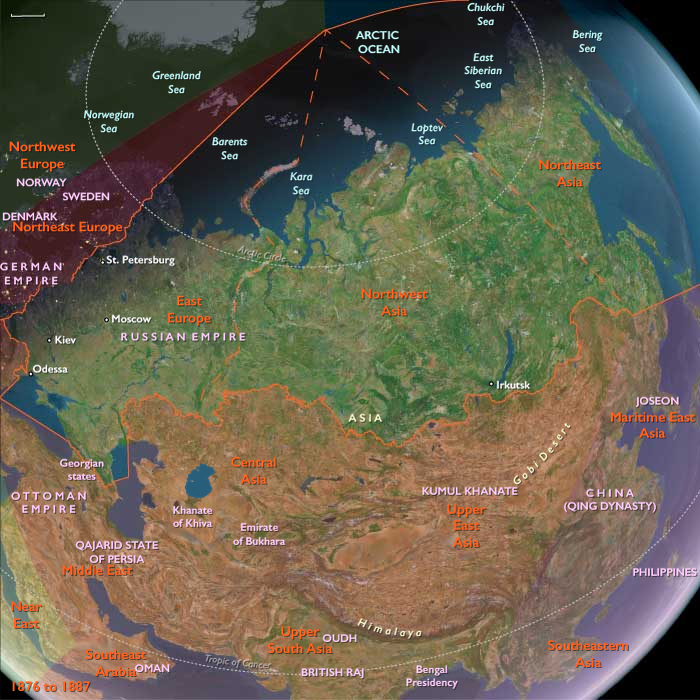
Northeastern Eurasia consists of three fixed subregions:
-
Northeast Asia — eastern Siberia (including Primorsky Krai), Sakhalin, the Chukchi Peninsula, Wrangel Island, Kuril Islands, and Hokkaidō (except its extreme southwest).
-
Northwest Asia — western and central Siberia from the Urals to roughly 130°E, including the West Siberian Plain, Altai, and the Central Siberian Plateau.
-
East Europe — the European portion of Russia, Belarus, and Ukraine, together with the Russian republics west of the Urals.
Anchors include the Arctic Ocean littoral (Kara, Laptev, and Okhotsk seas), the great river systems of the Ob–Irtysh, Yenisei, Lena, Amur–Ussuri, Dnieper, Don, and Volga, and the industrial–urban nodes of Leningrad (St. Petersburg), Moscow, Kyiv, Novosibirsk, Krasnoyarsk, Irkutsk, Vladivostok, and Sapporo. From tundra and taiga to loess plains and monsoon coasts, the region spans half the Northern Hemisphere’s climates and biomes.
Climate & Environmental Shifts
A sharply continental regime dominated interiors: long, frigid winters and short summers. The tail of the Little Ice Age persisted into the 19th century, then gave way to gradual warming, earlier river thaws, and glacier retreat in the Altai and Kamchatka by the mid-20th century. Periodic dzud winters devastated herds; drought pulses struck the Ukrainian steppe and Lower Volga (famines in the 1890s and early 1920s, and the Holodomor, 1932–33). In the Far East, typhoons and sea-ice shifts shaped fisheries; permafrost constrained construction across Siberia.
Subsistence & Settlement
-
Indigenous lifeways: Evenki, Nenets, Khanty, Chukchi, Koryak, Nivkh, Yupik, and Ainu sustained reindeer herding, sea-mammal hunting, fishing, trapping, and foraging—progressively curtailed by colonization, collectivization, and settlement policies.
-
Tsarist and Soviet expansion: Villages and penal settlements pushed east along the Trans-Siberian and river corridors; after 1917, collectivized agriculture and kolkhoz/sovkhoz systems reorganized the countryside of East Europe and southern Siberia.
-
Urbanization and industry: European Russia’s cities ( Moscow, Leningrad, Kyiv, Kharkiv, Donbas ) became heavy-industry cores; Siberia’s hubs ( Novosibirsk, Kemerovo, Krasnoyarsk, Irkutsk ) rose on coal, metals, and hydro, while Vladivostok, Khabarovsk, and Sapporo anchored the Pacific rim.
Technology & Material Culture
Railways (Trans-Siberian, 1891–1916; later Turk-Sib, branch lines) integrated steppe, taiga, and ports. Hydropower (e.g., Krasnoyarsk and Bratsk dams) and mining complexes transformed landscapes. In East Europe, steel, machine-building, and chemicals defined mass industrialization; in Northeast Asia, shipyards, ports, and fisheries expanded, while Hokkaidō underwent Meiji-to-postwar colonization and industrial growth. Everyday material culture shifted from log izbas and yurts to khrushchyovka apartments; radios, then TVs, entered homes by the 1960s.
Movement & Interaction Corridors
-
River highways: Seasonal shipping on the Ob, Yenisei, Lena, and Amur pre-dated and then fed rail hubs.
-
Trans-continental rails: Funneled grain, coal, ore, and people between European Russia and the Pacific; wartime evacuations (1941–42) relocated factories east.
-
Maritime arcs: The Okhotsk and Japan seas, Sakhalin–Hokkaidō–Kurils chain, and the Northern Sea Route(seasonal) tied fisheries, timber, and defense installations into Pacific networks.
-
Forced mobility: Tsarist exile and the Soviet Gulag (Kolyma, Norilsk, Vorkuta) drove coerced resettlement and resource extraction at massive human cost.
Cultural & Symbolic Expressions
Orthodox Christianity, Islam (in the Volga–Ural and North Caucasus margins of East Europe), Buddhism (Buryat and Mongol spheres), shamanic traditions, and—on Hokkaidō—suppressed Ainu culture framed identity against the rise of secular ideologies. Russian literature, music, and film radiated from Moscow and Leningrad; Soviet monumentalism and avant-gardes coexisted uneasily. Indigenous carving, song, and festival cycles persisted in Siberia and the Arctic, often underground, reviving visibly in the later 20th century.
Environmental Adaptation & Resilience
-
Permafrost engineering (pile foundations, winter roads) and taiga architecture enabled Siberian settlement.
-
Pastoral strategies: Herd diversification and seasonal migrations buffered dzud risk; state reindeer farms mixed traditional practice with planned quotas.
-
Agrarian adaptations: Shelterbelts, canals, and later the Virgin Lands campaigns extended cereal belts—often with soil erosion and dust storms by the 1960s.
-
Conservation beginnings: Zapovednik nature reserves (from 1916) protected representative biomes, even as industrial pollution rose in the Donbas, Upper Volga, and Kuzbass.
Political & Military Shocks
-
Tsarist consolidation and reform: The Emancipation of the Serfs (1861); Siberian penal colonization; the founding of Vladivostok (1860); Sakhalin as penal colony.
-
Revolution and Civil War (1917–22): Collapse of empire; shifting fronts across East Europe; creation of the USSR (1922).
-
Collectivization and terror: The Holodomor (1932–33) in Ukraine; purges; mass deportations to the Gulag and internal exiles in Siberia and the Far North.
-
Russo-Japanese War (1904–05) and Sakhalin/Kurils disputes; Hokkaidō settler colonialism and Ainu dispossession.
-
World War II: The Eastern Front ( Moscow, Stalingrad, Kursk, Leningrad ); devastation and liberation; Soviet seizure of southern Sakhalin and the Kurils (1945).
-
Cold War: East Europe as Soviet core; Northeast Asia militarized on both sides—the Pacific Fleet at Vladivostok; closed cities; the DEW Line/radar arcs in the Arctic; border incidents along the Amur by the late 1960s.
Transition
Between 1828 and 1971, Northeastern Eurasia was remade from a mosaic of imperial frontiers and Indigenous homelands into the industrial heartlands and strategic rimlands of two modern states: the USSR and Japan. Railways, mines, and dams bound taiga and tundra to Moscow; Hokkaidō’s Meiji-to-postwar transformation integrated it into Japan’s national economy. The costs were immense—famines, repression, deportations, cultural suppression—yet the region also generated vast material output and scientific achievement. By 1971, Northeastern Eurasia stood as a Cold War fulcrum: East Europe anchoring Soviet power, Northwest Asia supplying raw materials and hydro-electricity, and Northeast Asia bristling with fleets, airbases, and fisheries—its peoples negotiating survival and renewal between permafrost, ports, and power blocs.
East Europe (1828–1971 CE): Tsarist Expansion, Socialist Transformation, and Cold War Frontiers
Geography & Environmental Context
East Europe includes Belarus, Ukraine, the European portion of Russia, and the sixteen Russian republics west of the Urals. Anchors span the Baltic–Black Sea watershed, the Dnieper, Don, and Volga basins, the Carpathian fringe in western Ukraine, and the vast Russian Plain stretching toward the Urals. Major cities include Moscow, Leningrad (St. Petersburg), Kyiv, Minsk, Smolensk, Kharkiv, Odessa, and Novgorod.
Climate & Environmental Shifts
A continental climate produced harsh winters and hot summers. Crop failures punctuated the 19th century (famines in 1840s, 1891–92). Deforestation and soil exhaustion pressed peasants; steppe droughts recurred, notably in the 1920s and 1940s. The Virgin Lands campaign (1950s) extended cultivation into steppe margins, often unsustainably. River control projects (Dnieper Hydroelectric Station, Volga–Don Canal) and massive reforestation campaigns altered landscapes, while industrial pollution intensified after WWII.
Subsistence & Settlement
-
Agriculture: Wheat, rye, barley, oats, and later maize and sugar beet dominated. The black earth (chernozem) zone in Ukraine and southern Russia remained the empire’s and USSR’s breadbasket. Dairy, potatoes, and flax sustained Belarus and northern Russia.
-
Rural settlement: Villages of wooden cottages (izbas) under communal landholding (mir or obshchina) persisted until reforms. After collectivization (1930s), collective and state farms reorganized the countryside.
-
Urbanization: By the late 19th century, cities like Moscow, Kyiv, and Odessa swelled with factories. Soviet industrialization (1930s onward) created new cities in the Urals’ western fringe and magnified Donbas, Kharkiv, and Moscow. By the 1960s, Minsk, Kyiv, and Moscow were industrial and cultural hubs.
Technology & Material Culture
-
19th century: Railways (Moscow–St. Petersburg, Odessa–Kyiv) integrated markets. Peasants used iron plows, scythes, and horse-drawn wagons.
-
Industrialization: Steelworks in Donbas, textile mills in Moscow, machine building in Kharkiv, and shipyards in Odessa expanded. Hydroelectric stations on the Dnieper and Volga symbolized Soviet modernization.
-
Everyday life: Peasant households centered on icon corners, ovens, and handmade tools until collectivization introduced standardized housing. Soviet urban apartments, radios, and later televisions spread by mid-20th century.
Movement & Interaction Corridors
-
River highways: Dnieper and Volga carried grain, timber, and coal.
-
Railways: By the late 19th century, St. Petersburg–Warsaw, Kyiv–Moscow, and Odessa–Donbas lines integrated the empire.
-
Ports: Odessa and Sevastopol tied Ukraine to Black Sea trade. Murmansk and Leningrad were naval and commercial gates.
-
Migration: Serfs freed in 1861 moved to new lands; Soviet deportations and wartime evacuations displaced millions. After WWII, labor mobilization filled Siberian and Ural industries with migrants from Ukraine and Belarus.
Cultural & Symbolic Expressions
-
Religion: Orthodoxy remained central under tsars; Catholic enclaves persisted in Belarus and Ukraine; Judaism flourished in the Pale of Settlement until pogroms and emigration. Soviet atheism after 1917 repressed churches, though folk religiosity endured underground.
-
Literature & arts: 19th-century classics (Gogol, Tolstoy, Dostoevsky, Shevchenko) defined world literature. Soviet culture emphasized socialist realism (Gorky, Sholokhov, Ehrenburg). Ukrainian and Belarusian revivals flourished briefly in the 1920s before Stalinist repression.
-
Music & folklore: Russian ballets, Ukrainian folk songs, Belarusian epics, and Soviet mass songs coexisted. After 1945, film and radio disseminated propaganda alongside cultural achievements.
Environmental Adaptation & Resilience
-
Peasant strategies: Crop rotation, communal redistribution, and grain storage buffered famine but often failed under poor harvests.
-
Soviet collectivization: Mechanization, state seed reserves, and irrigation projects aimed at stability but caused dislocation and famine (notably Holodomor, 1932–33).
-
Postwar: Massive rebuilding campaigns restored cities and farms after Nazi devastation; dams and canals mitigated drought but caused salinization and ecological strain.
Political & Military Shocks
-
Tsarist reforms: Emancipation of serfs (1861); industrialization drives under Alexander III and Nicholas II.
-
Revolutions: 1905 unrest; 1917 February and October revolutions toppled tsarism and established Bolshevik rule.
-
Civil War (1918–21): Ukraine, Belarus, and western Russia ravaged by conflict and shifting borders.
-
Stalinist era: Collectivization, purges, forced deportations, famines, and rapid industrialization.
-
World War II: Nazi invasion (1941) devastated Belarus, Ukraine, and western Russia. Battles of Kyiv, Stalingrad, Kursk, and the siege of Leningrad defined the Eastern Front. Soviet victory in 1945 left East Europe under Moscow’s control.
-
Cold War: The subregion formed the USSR’s European core, with Moscow and Leningrad as global Cold War capitals. Eastern Europe beyond was drawn into Warsaw Pact (1955), cementing the frontier with NATO.
Transition
Between 1828 and 1971, East Europe was transformed from a Tsarist agrarian empire into the industrial, military, and political heartland of the Soviet Union. Grain surpluses, railways, and industrial cities arose in the 19th century; revolutions and civil war destroyed imperial order; collectivization, purges, and world war remade society. By the 1960s, Moscow, Kyiv, and Minsk were modern socialist cities, commanding an empire stretching from Berlin to the Urals. Yet the costs were immense—famine, repression, war, and environmental degradation—leaving a legacy of resilience shaped by both survival and control.
Anton Chekhov, the major literary figure in the last decade of the nineteenth century, contributes in two genres: short story and drama.
Chekhov, a realist who examines not society as a whole but the foibles of individuals, produces a large volume of sometimes tragic, sometimes comic short stories and several outstanding plays, including The Cherry Orchard, a dramatic chronicling of the decay of a Russian aristocratic family.
The greatest talents of the age, their realistic style transcends immediate social issues and explores universal issues such as morality and the nature of life itself.
Although Dostoevsky is sometimes drawn into polemical satire, both writers keep the main body of their work above the dominant social and political preoccupations of the 1860s and 1870s.
Tolstoy's War and Peace and Anna Karenina and Dostoevsky's Crime and Punishment and The Brothers Karamazov have endured as genuine classics because they draw the best from the Russian realistic heritage while focusing on broad human questions.
Although Tolstoy continues to write into the twentieth century, he rejects his earlier style and never again reaches the level of his greatest works.
The romantic drama Hernani, penned by twenty-eight-year-old Victor Hugo, debuts on the stage of the Comedie Francaise, formerly a bastion of classicalism, on February 25, 1830.
Ongoing strife between the conservative neoclassicalists and the romantics culminates in a riot over the work’s metrical irregularities, violation of Aristotelian unities, and calculated disregard of conventions.
Hugo's first mature work of fiction, Le Dernier jour d'un condamné (The Last Day of a Condemned Man), had appeared in 1829, and reflects the acute social conscience that is to infuse his later work.
The novel, which recounts the thoughts of a man condemned to die, will have a profound influence on later writers such as Albert Camus, Charles Dickens, and Fyodor Dostoevsky.
East Europe (1840–1851 CE): Reforms, Nationalism, and Geopolitical Challenges
Political and Military Developments
Autocratic Consolidation under Nicholas I
During this period, Tsar Nicholas I continued to strengthen autocratic control through centralized administrative reforms and expanded censorship. His regime emphasized stability and order, increasingly repressing nationalist movements and liberal ideologies throughout Eastern Europe.
Revolutions of 1848
The revolutionary wave of 1848 significantly impacted Eastern Europe, with nationalist uprisings erupting in Hungary, Poland, and various Slavic territories. While initial momentum posed considerable threats, Nicholas I's forces intervened decisively, particularly in Hungary, to restore monarchical authority, effectively reinforcing Russian dominance in regional affairs.
Crimean War Prelude
Tensions increased between Russia and the Ottoman Empire due to disputes over protection rights for Orthodox Christians in Ottoman territories. Diplomatic and military preparations during this era foreshadowed the forthcoming Crimean War (1853–1856).
Economic and Technological Developments
Steady Industrial Progress
Russia experienced sustained industrial growth, especially in iron and textile production. Urban centers like Saint Petersburg and Moscow continued to expand industrially, reflecting broader European technological influences and economic integration.
Transportation and Communication Advances
Significant advancements were made in transportation, notably the expansion of railway networks. The Moscow–Saint Petersburg Railway opened in 1851, markedly enhancing trade, communication, and military logistics.
Cultural and Artistic Developments
Literary and Intellectual Flourishing
Russian literature entered a vibrant era, highlighted by prominent literary figures such as Fyodor Dostoevsky and Ivan Turgenev, whose works reflected profound societal tensions and evolving national consciousness.
Expansion of Educational Institutions
Educational reforms under Nicholas I promoted scientific and technical studies, although intellectual life remained constrained by state censorship. Nonetheless, universities expanded, significantly enhancing Russia’s educational infrastructure.
Settlement Patterns and Urban Development
Continued Urban Expansion
Major urban areas experienced ongoing growth and modernization, with urban planning improving living conditions, sanitation, and infrastructure. Strategic enhancements to administrative centers strengthened economic resilience and governance effectiveness.
Strengthened Border Fortifications
Investments in fortifications along Russia’s western borders continued, aimed at bolstering defenses against potential military threats from Europe and the Ottoman territories.
Social and Religious Developments
Increased Social Regulation
Nicholas I's administration heightened control over social structures, emphasizing obedience, discipline, and loyalty to the state. Social reforms often prioritized stability and integration, though with limited concessions to broader demands for liberalization.
Church-State Alignment
The alignment between the state and the Russian Orthodox Church further solidified, reinforcing the church's role in promoting state interests and social cohesion, particularly in suppressing dissent and nationalist agitation.
Long-Term Consequences and Historical Significance
The period from 1840 to 1851 CE was marked by significant geopolitical and internal challenges, highlighted by revolutionary uprisings and growing international tensions. Nicholas I's autocratic consolidation and decisive responses to the Revolutions of 1848 preserved Russia’s dominant geopolitical status while setting the stage for major conflicts, notably the Crimean War. The era's developments shaped the trajectory of Eastern Europe, profoundly influencing subsequent social, political, and military dynamics.
A Russian court had sentenced Fyodor Dostoyevsky to death, for anti-government activities linked to a radical intellectual group, the Petrashevsky Circle, on November 16, 849.
Facing a firing squad on December 23, the group members are reprieved at the last moment, and exiled to the katorga prison camps in Siberia.
The publication of Zhitie (Life) in 1860, the autobiography of martyred Old Believer archpriest Avvakum, a Russian protopope of Kazan Cathedral on Red Square who led the opposition to Patriarch Nikon's reforms of the Russian Orthodox Church, will influence such later Russian novelists as Fyodor Dostoevsky, Ivan Turgenev and Alexander Solzhenitsyn.
East Europe (1864–1875 CE): Modernization, Reform Consolidation, and Rising Tensions
Political and Military Developments
Expansion and Consolidation under Alexander II
During this era, Tsar Alexander II continued extensive reforms to modernize and centralize Russia. The administration further consolidated judicial reforms, military reorganization, and bureaucratic efficiency, enhancing state governance and regional stability.
Russo-Turkish Tensions and Balkan Nationalism
Tensions escalated again between Russia and the Ottoman Empire, exacerbated by rising nationalist movements within the Balkans. Russia actively supported Slavic nationalism, positioning itself as a protector of Orthodox Christians and deepening geopolitical friction.
Military Reforms
Significant military reforms, including universal conscription introduced in 1874, strengthened the Russian military structure and improved its defensive readiness, preparing the nation for future conflicts.
Economic and Technological Developments
Sustained Industrial Growth
Economic modernization continued vigorously, notably in heavy industry, coal mining, and metallurgy. Industrial growth supported increasing domestic demands and military enhancements, further integrating Russia into the European economy.
Infrastructure Advancements
The expansion of rail networks proceeded, significantly enhancing economic efficiency and strategic military mobility. Notable projects included railway links connecting Russia’s interior regions with key ports, facilitating trade and economic integration.
Cultural and Artistic Developments
Realist Literature and Cultural Discourse
Russian literature flourished, entering a period defined by realism and profound social critique. Prominent authors such as Fyodor Dostoevsky and Leo Tolstoy continued producing major works that critically examined societal issues and moral dilemmas.
Educational Growth
Education underwent further expansion, supported by ongoing state reforms. Despite persistent censorship, increased accessibility to higher education and the growth of technical schools significantly enhanced Russia’s intellectual capacity.
Settlement Patterns and Urban Development
Continued Urban Modernization
Urban growth persisted robustly, with cities such as Moscow, Saint Petersburg, and emerging industrial towns expanding infrastructure, public utilities, and urban amenities. Strategic urban planning efforts improved public health, sanitation, and civic administration.
Strategic Fortification Projects
Investments in defensive fortifications continued, notably in strategic border regions and key coastal cities, reflecting growing geopolitical concerns. These projects strengthened regional defenses and increased national security.
Social and Religious Developments
Social Reforms and Rural Transformation
The post-emancipation period brought ongoing challenges and reforms in rural communities, including land redistribution policies and adjustments to agricultural practices. These reforms aimed at stabilizing rural societies and improving peasants' economic conditions, despite ongoing social unrest.
Church's Role in Social Stability
The Russian Orthodox Church maintained its crucial role in stabilizing society, particularly through involvement in educational initiatives and social programs. Church-state cooperation reinforced public order, particularly in rural and recently emancipated communities.
Long-Term Consequences and Historical Significance
From 1864 to 1875 CE, Eastern Europe witnessed continued modernization, extensive administrative reforms, and rising nationalist tensions. The advancements achieved during this period, combined with underlying geopolitical and social pressures, positioned Russia as a major European power, preparing the ground for subsequent pivotal conflicts and transformations in the region.
The Russian realist novel finds additional exponents in Count Leo Tolstoy’s War and Peace (1865—69) and in Fyodor Dostoyevsky’s Crime and Punishment (1866) and The Idiot (1871).