Galen
Roman (of Greek ethnicity) physician, surgeon and philosopher
Years: 129 - 200
Aelius Galenus or Claudius Galenus (b.
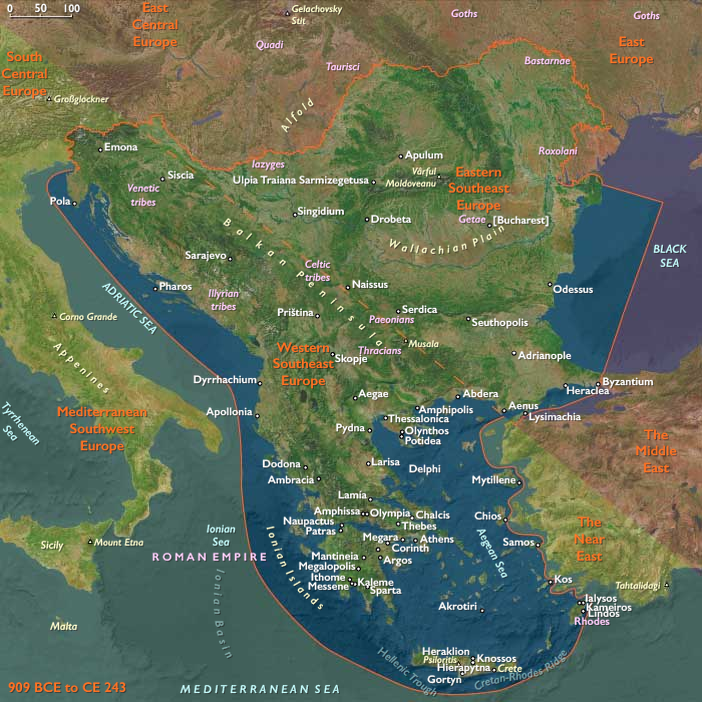
129 CE, d. circa 200 CE), better known as Galen of Pergamon (modern-day Bergama, Turkey), is a prominent Roman (of Greek ethnicity) physician, surgeon and philosopher.
Arguably the most accomplished of all medical researchers of antiquity, Galen contributes greatly to the understanding of numerous scientific disciplines, including anatomy, physiology, pathology, pharmacology, and neurology, as well as philosophy and logic.
The son of Aelius Nicon, a wealthy architect with scholarly interests, Galen receives a comprehensive education that prepares him for a successful career as a physician and philosopher.
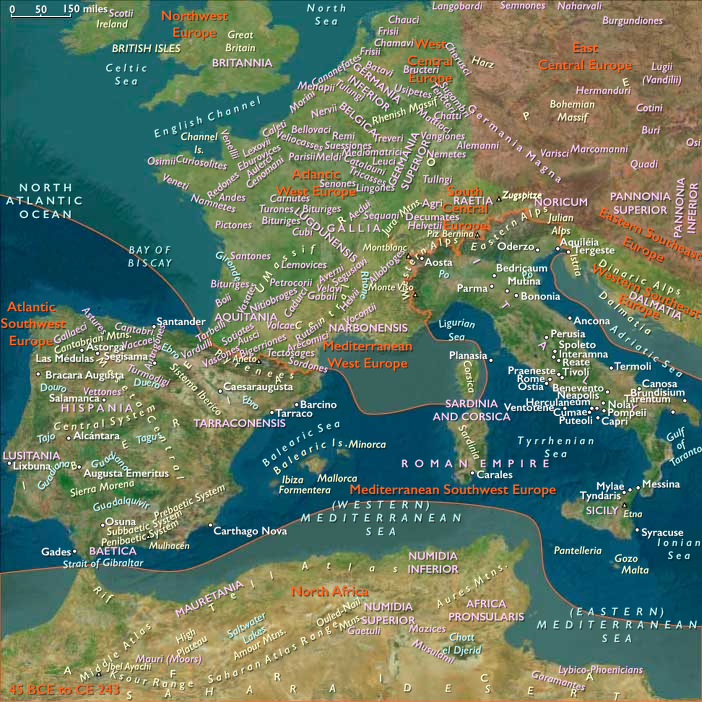
He travels extensively, exposing himself to a wide variety of medical theories and discoveries before settling in Rome, where he serves prominent members of Roman society and eventually is given the position of personal physician to several emperors.
Galen's understanding of anatomy and medicine is principally influenced by the then-current theory of humorism, as advanced by many ancient Greek physicians such as Hippocrates.
His theories dominate and influence Western medical science for nearly two millennia.
His anatomical reports, based mainly on dissection of monkeys and pigs, remain uncontested until 1543, when printed descriptions and illustrations of human dissections are published in the seminal work De humani corporis fabrica by Andreas Vesalius[ where Galen's physiological theory is accommodated to these new observations.
Galen's theory of the physiology of the circulatory system endures until 1628, when William Harvey publishes his treatise entitled De motu cordis, in which he establishes that blood circulates, with the heart acting as a pump.
Medical students continue to study Galen's writings until well into the 19th century.
Galen conducts many nerve ligation experiments that support the theory, which is still believed today, that the brain controls all the motions of the muscles by means of the cranial and peripheral nervous systems.
Galen sees himself as both a physician and a philosopher, as he writes in his treatise entitled That the Best Physician is also a Philosopher.
Galen is very interested in the debate between the rationalist and empiricist medical sects, and his use of direct observation, dissection and vivisection represents a complex middle ground between the extremes of those two viewpoints.
Many of his works have been preserved and/or translated from the original Greek, although many were destroyed and some credited to him are believed to be spurious.
Although there is some debate over the date of his death, he was no younger than seventy when he died.