
George W. Bush
Forty-third President of the United States
1946 CE to 2215 CE
George Walker Bush (born July 6, 1946) is an American politician and businessman who serves as the 43rd president of the United States from 2001 to 2009.
A member of the Republican Party, he had previously served as the 46th governor of Texas from 1995 to 2000.
Born into the Bush family, his father, George H. W. Bush, serves as the 41st president of the United States from 1989 to 1993.
Bush is the eldest son of Barbara and George H. W. Bush, and the second son to become the American president after his father, the first being John Quincy Adams.
After graduating from Yale University in 1968 and Harvard Business School in 1975, he works in the oil industry.
Bush marries Laura Welch in 1977 and unsuccessfully runs for the U.S. House of Representatives shortly thereafter.
He later co-owns the Texas Rangers baseball team before defeating Ann Richards in the 1994 Texas gubernatorial election.
Bush is elected president of the United States in 2000 when he defeated Democratic incumbent Vice President Al Gore after a narrow and contested win that involves a Supreme Court decision to stop a recount in Florida.
He becomes the fourth person to be elected president without a popular vote victory.
In response to the September 11 terrorist attacks, Bush creates the United States Department of Homeland Security and launches a "War on Terror" that begins with the war in Afghanistan in 2001.
He also launches the Iraq War in 2003, with the administration arguing that the Saddam Hussein regime possesses an active weapons of mass destruction (WMD) program, and that the Iraqi government poses a threat to the United States.
Some administration officials falsely claim that Hussein had an operational relationship with Al-Qaeda, the perpetrators of the 9/11 attack.
No stockpiles of WMDs or an active WMD program are ever found in Iraq.
Signature legislation passed during his presidency includes broad tax cuts, the Patriot Act, the No Child Left Behind Act, the Partial-Birth Abortion Ban Act, the Medicare Modernization Act, and funding for the AIDS relief program known as PEPFAR.
In the 2004 presidential race, Bush defeats Democratic Senator John Kerry in a close election.
After his re-election, Bush receives criticism from across the political spectrum for his handling of the Iraq War, Hurricane Katrina, and other challenges.
Amid this criticism, the Democratic Party regains control of Congress in the 2006 elections.
In December 2007, the United States enters its longest post-Second World War recession, often referred to as the "Great Recession", prompting the Bush administration to obtain congressional approval for multiple economic programs intended to preserve the country's financial system.
Bush is among the most popular, as well as unpopular, U.S. presidents in history; he receives the highest recorded approval ratings in the wake of the 9/11 attacks, but one of the lowest such ratings during the 2008 financial crisis.
Bush finishes his second term in office in 2009 and returns to Texas.
In 2010, he publishes his memoir, Decision Points.
His presidential library opens in 2013.
His presidency will be rated as below-average in historical rankings of U.S. presidents, although his public favorability ratings have improved since leaving office.
World
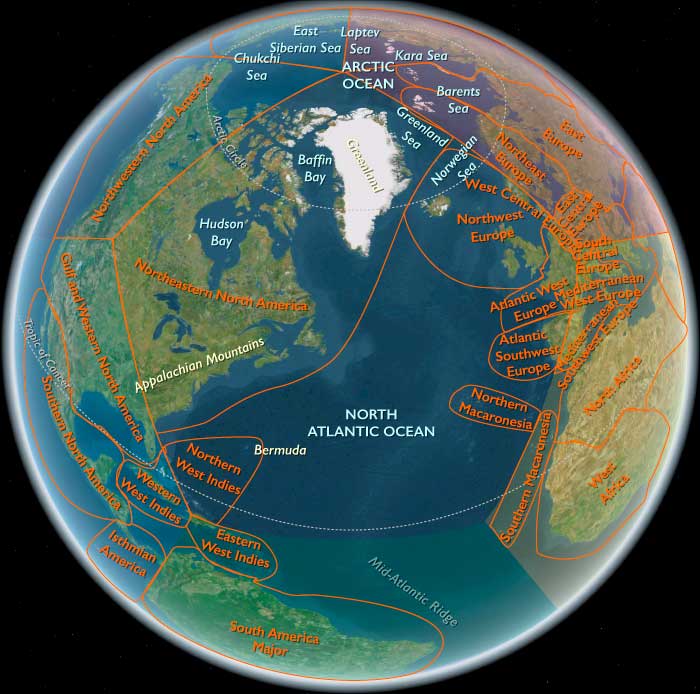
The Atlantic Lands
View →Related Events
No related events match the current filters.