Gerard Sagredo
Italian Benedictine monk from Venice, who serves in the Kingdom of Hungary
Years: 980 - 1046
Gerard Sagredo, O.S.B.
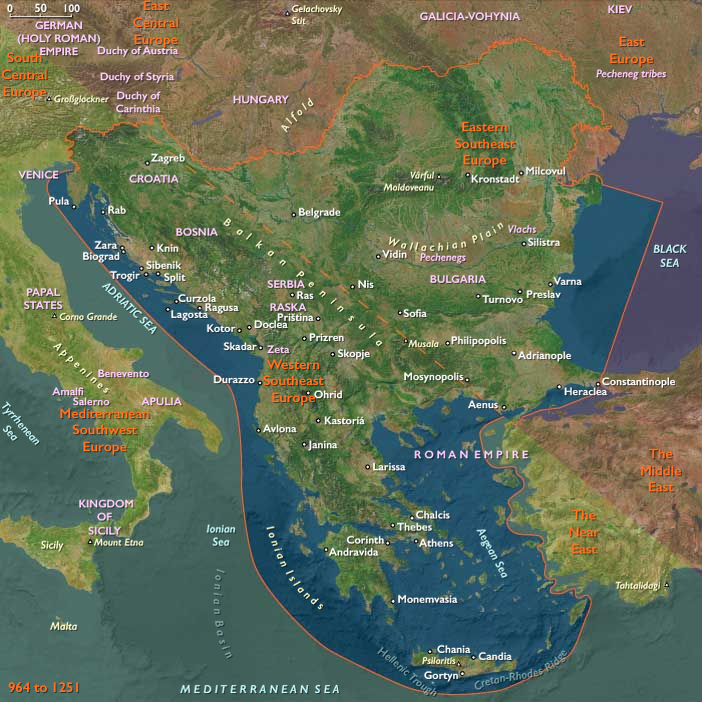
(April 23, 980 – September 24, 1046), is an Italian Benedictine monk from Venice, who serves in the Kingdom of Hungary (specifically in Buda) and in Cenad, where he educates Emeric of Hungary, the son of King Stephen of Hungary, using an interpreter.
He plays a major role in converting Hungary to Christianity as the Bishop of Csanád, today Cenad, in Romania.
Related Events
Filter results
Showing 10 events out of 11 total
A series of events in the Kingdom of Poland in the 1030s culminate in a popular uprising or rebellion, or series of these, which for a time destabilizes the kingdom.
In Hungary, the Vata pagan uprising of 1046 brings about the overthrow of King Peter Urseolo, the martyrdom of St. Gellért and the reinstatement of the Árpád dynasty on the Hungarian throne.
The audacious King Peter Urseolo of Hungary confiscates Queen Giselle's property and takes her into custody.
She seeks help from Hungarian lords, who blame one of Peter's favorites (Budo) for the monarch's misdeeds and demand that Budo be put on trial.
When the king refuses, the lords seize and murder his unpopular advisor and depose the monarch in 1041.
They elect a new king, Samuel Aba, who is a brother-in-law or another nephew of King Stephen I. Samuel had held important offices during the reign of King Stephen; he was a member of the royal council and became the first palatine of Hungary.
Samuel's family, according to the anonymous author of the Gesta Hungarorum, descends from two "Cuman" chieftains, Ed and Edemen, who had received "a great land in the forest of Mátra" from Árpád, Grand Prince of the Hungarians.
In contrast, the fourteenth-century Hungarian chronicles describe Ed and Edemen as the sons of Csaba —himself a son of Attila the Hun—by a lady from Khwarezm.
Since all Hungarian chronicles emphasize the Oriental—either "Cuman" or "Khwarezmian"—origin of Ed and Edemen, the historians Gyula Kristó, László Szegfű and others propose that the Aba clan descending from them ruled the Kabars, a people of Khazar origin who had joined the Hungarians before their arrival in the Carpathian Basin.
Kristó argues that both Samuel's Khazar origin and his first name suggest that he was born to a family that adhered to Judaism.
Despite the uncertainty over the clan's origins, Samuel undoubtedly descends from a distinguished family, since an unnamed sister of Stephen I, the first King of Hungary, had been given in marriage to a member of the Aba clan around 1009.
However, historians still debate whether Samuel himself or Samuel's father married the royal princess.
If Samuel was her husband, he must have been born before 990 and converted—either from Judaism or paganism—to Christianity when he married Stephen I's sister.
This is further evidenced by Samuel's establishment of an abbey at Abasár, which was recorded by Hungarian chronicles.
According to Gyula Kristó and other historians, Samuel's conversion coincided with the creation of the Roman Catholic Diocese of Eger, encompassing the Mátra region.
As king, Samuel abolishes all laws introduced by Peter the Venetian and has many of his predecessor's supporters killed or tortured.
Hungarian chronicles sharply criticize him for socializing with the peasants instead of the nobles.
Samuel even abolishes some levies payable by the commoners.

The deposed Peter Orseolo had first fled to Austria, whose ruler (Margrave Adalbert) had married his sister Frowila, and approaches Emperor Henry III for help against Samuel Aba.
The new Hungarian monarch invades Austria in February 1042, but Adalbert routs Aba's troops.
Henry III launches his first expedition against Hungary in early 1042.
His forces advance north of the Danube to the river Garam (Hron, Slovakia).
The emperor plans to restore Peter, but the locals are strongly opposed.
Accordingly, the emperor appoints another (unnamed) member of the Hungarian royal family, living in exile in Bohemia, to administer the territories.
Samuel is forced by Emperor Henry to renounce all Hungarian territories to the west of the rivers Leitha and Morava as well as agree to the payment of a tribute.
Henry forces Aba to recognize the Danubian territory donated to Germany by Stephen I of Hungary pro causa amicitiae (for friendship's sake); these territories had been ceded to Hungary after the defeat of Conrad II in 1030.
This border will remain the border between Hungary and Austria until 1920.
The funding of the tribute payment is through new taxes on the prelates and seizure of Church estates.
This policy causes discontent even among the members of his own council, resulting in the murder of a number of them during Lent.
In order to punish the king, Bishop Gerard of Csanád refuses to perform his coronation at Easter.
The emperor returns to Hungary in the early summer of 1044, and is joined in his advance by many Hungarian lords.
The decisive battle is fought on June 5 at Ménfő (near Győr), where Samuel Aba's forces are defeated.
Peter is reinstalled as king at Székesfehérvár, a vassal of the Empire, and Henry can return home triumphant, the Hungarian people having readily submitted to his rule.
Tribute is to be paid, and Aba, who had escaped from the battlefield, is soon captured and killed by Peter's supporters.
Hungary appears to have entered the German fold fully and with ease.
Emperor Henry enters Székesfehérvár following Samuel Aba's death.
He restores Peter, who introduces Bavarian law in his realm, which suggests that Hungary became an imperial fief.
He accepts the emperor's suzerainty on Whitsun 1045, giving his royal lance to his overlord (who returns to Hungary).
A number of plots to overthrow Peter indicate that he remains unpopular.
Two of King Stephen I's maternal cousins (Bolya and Bonyha) conspire against Peter in 1045, but the king has them arrested, tortured and executed; Bishop Gerard of Csanád invites the late Vazul's exiled sons to the country.
The two members of Hungary’s exiled Árpád dynasty, András and Levente, only set out after the agents they had sent to Hungary confirmed that the Hungarians were ripe for an uprising against the king.
Fearing ambush and accompanied by Russian troops from Kiev, they enter the still-pagan portion of Hungary.
In Újvár (today Abaújvár, after the Aba family), they immediately gain the support of the pagan and other factions opposed to Peter’s rule, despite the fact that András is Christian (Levente had remained pagan).
On their return, a rebellion begins that András and Levente initially support.
During this rebellion, a pagan noble named Vata (or Vatha) gains power over a group of rebels who wish to abolish Christian rule and revert to paganism.
According to legend.
Vata shaved his head in the pagan fashion, leaving three braids remaining, and declared war on the Christians.
King Peter plans to flee again to the Holy Roman Empire, but András invites him to a meeting at Székesfehérvár.
Soon realizing that András's envoys actually want to arrest him, the deposed king flees to a fortified manor at Zámoly, but his opponent's supporters seize it and capture him three days later.
All fourteenth-century Hungarian chronicles attest that Peter was blinded, which caused his death.
However, the near-contemporary Cosmas of Prague relates that Judith of Schweinfurt, widow of Duke Bretislaus I of Bohemia who was expelled by her son, fled to Hungary and married Peter about 1055 "as an insult to" her son "and all the Czechs".
If the latter report is reliable, Peter survived his mutilation and died during the late 1050s.
He is in any case buried in the cathedral of Pécs.
András, as the oldest brother, pronounces himself king.
The bishops Gellért (Italian: Gerard), Besztrik, Buldi, and Beneta gather to greet them András and Levente's men as they move towards Pest.
The bishops are attacked in Pest on on September 24 by Vata's mob, who begin stoning the bishops; Buldi is stoned to death.
Gellért repeatedly makes the sign of the cross as the pagans throw rocks at him, which further infuriates the pagans.
Gellért is allegedly taken up Kelenhegy hill, where he is put into a cart and pushed off a cliff, onto the banks of the Danube; then, found still alive at the bottom, he is beaten to death.
Other unverified tales report him as being put in a spiked barrel and rolled down the hill during a mass revolt of pagans.
Besztrik and Beneta manage to flee across the river, where Besztrik is injured by pagans before the pair can be rescued by András and Levente; only Beneta survives.
Gellért will later be canonized for his martyrdom and the hill from which he had been thrown will be renamed Gellért Hill.
The hill, in modern central Budapest, has a monument on the cliff where Gellért, today a patron saint of Hungary, was killed.