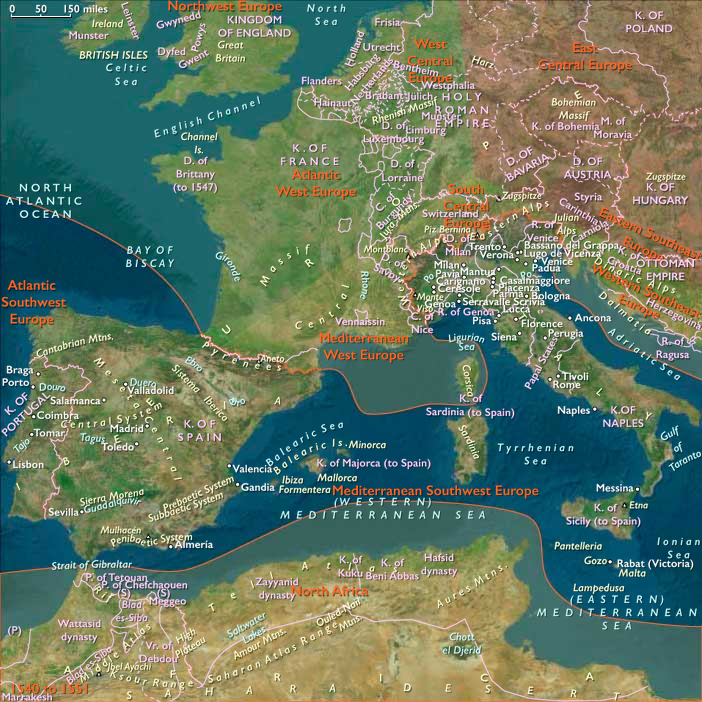
Gian Giorgio Trissino, born of a patrician family in Vicenza, had been exiled from Venice for political reasons, and traveled to Germany and Lombardy.
He has the advantages of a good humanistic training, having studied Greek under Demetrius Chalcondylas at Milan and philosophy under Niccolò Leoniceno at Ferrara.
His culture had recommended him to the humanist Pope Leo X, who in 1515 had sent him to Germany as his nuncio; later on Pope Clement VII has showed him special favor, and employed him as ambassador.
In spite of the banishment from Vicenza pronounced upon him in 1509 because his family had favored the plans of Maximilian, he is held in high esteem throughout Italy.
Wherever he makes his home, it is a center for gatherings of scholars, littérateurs, and the most cultured men of the time.
His family life is far from happy, apparently through little fault of his own.
Trissino occupies a prominent place in the history of modern European literature because of his tragedy Sophonisba, written in about 1515 and published in 1524.
Based on the life of the Carthaginian lady Sophonisba and inspired by ancient tragedies, it is perhaps the first tragedy in early modern times to show deference to the classic rules.
It will serve as an example for European tragedies throughout the sixteenth century.
It will be translated into French by Mellin de Saint-Gelais, and performed with great acclaim in 1556 at the Château de Blois.