Henry II, Duke of Bavaria
Years: 951 - 995
Henry II (951–995), called the Wrangler or the Quarrelsome, in German Heinrich der Zänker, is the son of Henry I and Judith of Bavaria.
Related Events
Filter results
Showing 10 events out of 14 total
Otto II will spent his reign continuing his father's policy of strengthening imperial rule in Germany and extending it deeper into Italy.
Difficulties arise for Otto in southern Germany, probably owing to his refusal to grant the duchy of Swabia to his cousin Henry II of Bavaria, who had succeeded his father at the age of four, under the guardianship of his mother Judith, and eventually married Gisela of Burgundy, a niece of the empress Adelaide, who is perhaps the most prominent European woman of the tenth century.
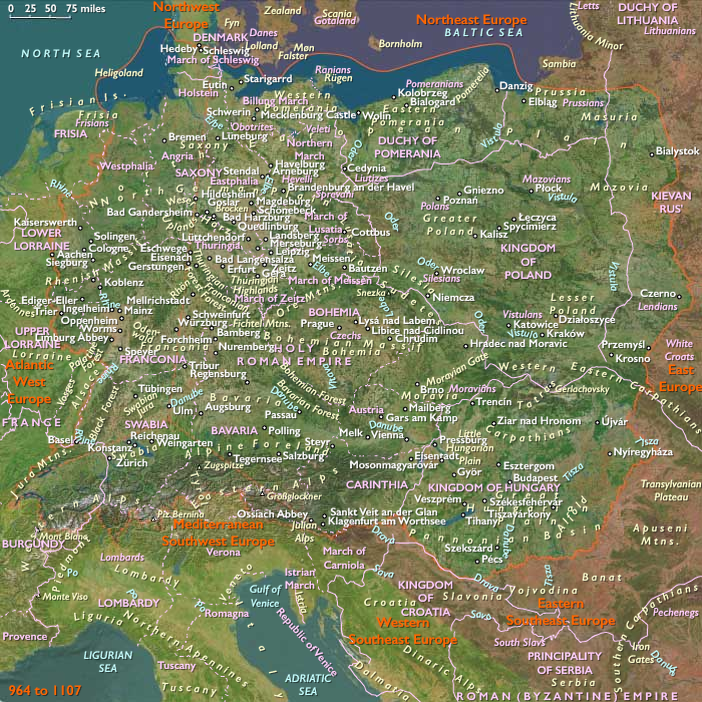
In 974, Judith sets up a conspiracy against the emperor, which includes Henry, Bishop Abraham of Freising, the dukes of Bohemia and Poland, and several members of the clergy and the nobility who are discontented by the previous emperor's policies.
The plan is discovered and easily suppressed, however.
Henry, known as the Wrangler, is taken captive in Ingelheim, but escapes and instigates a revolt in Bavaria.
The energetic Boleslaus the Cruel, the Czech Przemysl dynasty’s prince of Bohemia from 929 or 935, is notorious for the murder of his brother (Saint) Wenceslas, through which he had become prince of Bohemia.
Boleslaus may never have become a vassal of the German king, but it is known that he led a Czech force in alliance with Otto at the great victory over the Magyars at the Lech river on August 10, 955.
He had also helped Otto to crush an uprising of Slavs on the Lower Elbe in 953.
Seeing the growth of Polish strength to the north of his borders, he had accordingly arranged for his daughter Dubrawka to marry the Piast prince Mieszko I in 965.
Dying two years later, he is succeeded by his son, Boleslaus II, whose reign is most notable for founding of the diocese of Prague in 973, which has been placed within the jurisdiction of the Archbishop of Mainz.
Called ”The Pious”, Boleslaus maintains good relations with the Ottonian German kings, and in 975 supports Otto II during his civil war against Henry II, Duke of Bavaria.
Three German leaders, all called Henry, stage a brief rebellion against the Holy Roman Emperor Otto II in 977.
The conflict is called The War of the Three Henries.
Most Polabian Slavs see Jesus as a "German god" and remain pagan, despite the efforts of Christian missionaries.
In the Great Slav Rising in 983, the pagan Slavs revolt against their subjugation to the Kingdom of the Eastern Franks, aka East Francia.
The Slavic Lutici and Obotrite people, who live to the east of the Elbe in modern northeast Germany, defeat Emperor Otto II in at the Battle of Stilo in 982, then rebel against the Germans the following year.
The Hevelli and Lutici destroy the Bishoprics of Havelberg and Brandenburg., and some Slavs advance across the Elbe into Saxon territory, but retreat when the Christian Duke of the Polans, Mieszko I, attacks them from the East.
The Holy Roman Empire retains only nominal control over the Slavic territories between the Elbe and the Oder.
Austria comes under the rule of the Babenberg Margraves from 976, initially under Leopold of Babenberg, known as Leopold the Illustrious.
The Babenbergs will rule Austria until 1246.
The origins of Leopold the Illustrious are not known.
According to early traditions, documented by Bishop Otto of Freising in the twelfth century, he is descended from Count Adalbert of Bamberg (died 906) and the Franconian Babenberg family whose genealogy is documented in Franconia Nobility.
According to some sources, his father Berthold was count of the Nordgau, the region north of Ratisbon in Bavaria A more recent theory identifies Leopold as the son of Arnulf, Duke of Bavaria.
While his ancestry is disputed, some affiliation with the ducal Luitpoldings dynasty is probable.
Leopold is first mentioned in a document from 962 as count of the Bavarian Donaugau region by Ratisbon,count of the Traungau region and a faithful follower of Emperor Otto I.
After Otto I had defeated the Magyars in 955, he had reestablished the marchia in the conquered territories, placing them under the command of Burkhard, a brother-in-law of Duchess Judith of Bavaria.
When Burkhard joined the uprising of Henry the Wrangler against Emperor Otto II, he is deposed at the Imperial Diet of Regensburg in 976.
According to a charter dated July 21, 976, Leopold is appointed margrave of the East Mark, the core territory of the later Archduchy of Austria.

Boleslaus II, the son of Boleslaus I and Biagota, had become Duke (or Prince) of Bohemia on his father's death.
Boleslaus has maintained good relations with the Ottonian German kings, and from 975 supports Otto II during the civil war against Henry II, Duke of Bavaria.
Called Henry the Wrangler, he is defeated in 976 and stripped of his Duchy.
Bavaria has lost her first southeastern marches, including Austria, as a consequence of Duke Henry’s revolt.
Boleslaus again attacks Bavaria in 977, but on this occasion is barred from annexing any lands by Otto II.
A conspiracy has meanwhile arisen in Bavaria.
The conspirators—Henry I, Bishop of Augsburg; the recently deposed Duke Henry II; and Henry I, Duke of Carinthia—even have the support of the Church.
Otto, allied with Otto I, Duke of Swabia and Bavaria, marches first on Passau, held by the rebels.
The town surrenders in September due to his siege tactics, which include a bridge of boats.
Otto II, in 978, finally suppresses the five-year revolt led by his cousin Duke Henry II of Bavaria.
At the Easter court of 978, at Magdeburg, the three insurrectionists had been punished.
Both dukes are banished and Henry of Carinthia loses his duchy to Otto, son of Conrad the Red, Duke of Lorraine.
The bishop is imprisoned until July.
The chief result of the conflict is the complete subjection of Bavaria: henceforth it will no longer be the indisputably greatest of the stem duchies.
Henry II, released from captivity after Otto's death, tries once again to usurp the German throne, abducting the infant Otto III.
Although he fails in his attempt to gain control of Germany, he does regain Bavaria.
The Lutici federation of West Slavic Polabian tribes had remained quiet during the early years of Otto III's reign, even during Henry II's failed rebellion.
In 983, following Otto II's defeat at the battle of Stilo, the Slavs had revolted against Imperial control, forcing the Empire to abandon its territories east of the Elbe Rivier in the Northern March and the Billung March.
With the process of Christianization halted, the Slavs had left the Empire in peace, and with Henry II's rebellion put down, Theophanu had launched multiple campaigns to reconquer the lost eastern territories, beginning in 985.
Even though he was only six at the time, Otto III had personally participated in these campaigns.
During the expedition of 986 against the Slavs, Otto III had received the homage of Duke Meiszko I of Poland, who had provided the Imperial army with military assistance and had given Otto III a camel.
Although the Lutici were subdued for a time in 987, they have continued to occupy the young king’s attention.
When Otto III is eleven, Slavic raiders capture the city of Brandenburg in September 991.