Herod the Great
Roman client king of Judea
Years: 73BCE - 4BCE
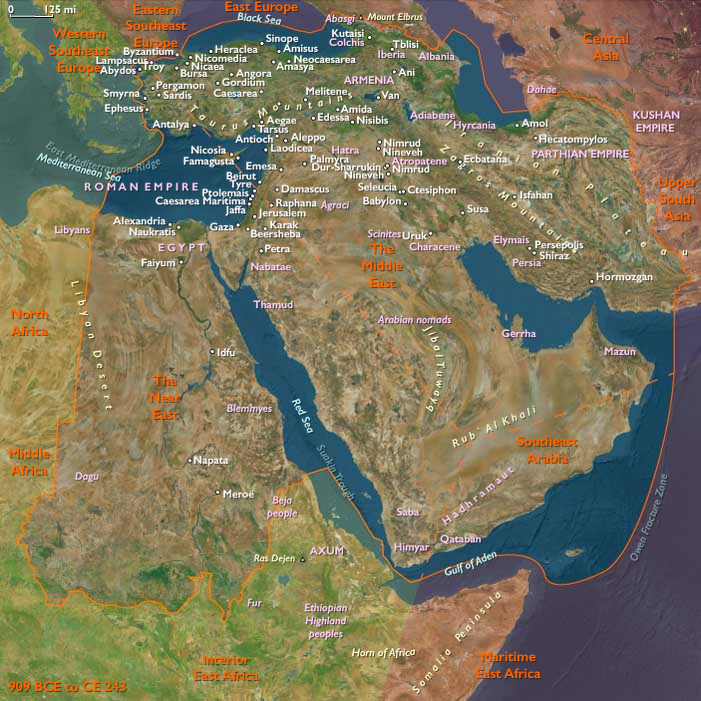
Herod, also known as Herod the Great (born 73 or 74 BCE, died 4 BCE in Jericho, is a Roman client king of Judea.
He is also known for his colossal building projects in Jerusalem and elsewhere, including his expansion of the Second Temple in Jerusalem (sometimes referred to as Herod's Temple) and the construction of the port at Caesarea Maritima.
Important details of his biography are gleaned from the works of the 1st century CE Roman-Jewish historian Josephus Flavius.
The Romans make Herod's son Herod Archelaus ethnarch of Judea, Samaria, and Idumea (biblical Edom) from 4 BCE to 6 CE, referred to as the tetrarchy of Judea.
Archelaus is judged incompetent by the Roman emperor Augustus who then combinei Samaria, Judea proper and Idumea into Iudaea province under rule of a prefect until 41.
Herod's other son Herod Antipas is tetrarch of Galilee from 4 BCE – 39 CE.


Related Events
Filter results
Showing 10 events out of 63 total
Near East (189–46 BCE): Roman Expansion, Jewish Struggles, and Cultural Flourishing
In 189 BCE, the Near East enters an era marked by the inception of the Greco-Roman world, with the Roman Republic increasingly dominating the eastern Mediterranean Basin. Having defeated the Seleucid king Antiochus III, Rome rewards its allies, particularly Pergamon and Rhodes, with territories, despite previously claiming a policy of "liberation of the Greeks." The Romans, under consul Gnaeus Manlius Vulso, subsequently launch an unauthorized campaign against the Galatian tribes of central Anatolia, decisively defeating them at Mount Olympus and near Ankara in 189 BCE. Although Vulso faces political backlash in Rome for acting without Senate approval, he is eventually cleared and granted a triumph.
Egyptian Instability and Seleucid Decline (177–154 BCE)
Between 177 and 166 BCE, Egypt under young Ptolemy VI Philometor experiences internal turmoil, with regents Eulaeus and Lenaeus provoking the Sixth Syrian War against Seleucid king Antiochus IV Epiphanes. The war briefly places Egypt under Seleucid influence until Roman envoy Gaius Popilius Laenas famously forces Antiochus to withdraw at Eleusis in 168 BCE. Meanwhile, Antiochus IV's aggressive Hellenization policies in Judea ignite the Maccabean Revolt in 165 BCE, led by the priestly Hasmonean family from Modiin. By 164 BCE, Jewish rebels successfully retake Jerusalem, cleanse the Temple, and reestablish traditional worship, initiating Hasmonean autonomy.
From 153 to 140 BCE, the region of modern Jordan thrives under the waning Seleucid and Ptolemaic influence, marked by the rise of the Nabataeans, who extend their kingdom from their capital at Petra, dominating regional trade. Greek influence continues to permeate the region, reflected in city names such as Philadelphia (Amman) and Gerasa (Jarash). Meanwhile, the pharaonic tradition persists among rulers at Meroë, who erect pyramids and stelae to record their achievements, utilizing a new Meroitic script.
Hasmonean Expansion and Hellenistic Influence (141–106 BCE)
By 141 BCE, the Hasmonean rulers secure substantial autonomy for Judea from the declining Seleucid Empire. Under rulers like John Hyrcanus (134–104 BCE), the Hasmoneans expand territorially, notably annexing Edom (Idumea), whose inhabitants adopt Judaism. Hellenistic cultural influence is evident, exemplified by iconic sculptures like the Venus de Milo, attributed to Alexandros of Antioch, created between 130 and 100 BCE.
In southern Arabia, the powerful Himyarite kingdom emerges around 115 BCE, capitalizing on the decline of the inland Sabaean kingdom. The Himyarites establish their center at Zafar, extending their influence from southern Yemen to the Persian Gulf region.
Roman Dominance, Cultural Exchange, and Jewish Population Growth (105–46 BCE)
From 105 BCE onward, Roman political involvement in the Near East intensifies. In 63 BCE, the Roman general Pompey decisively intervenes in Judean affairs, ending Jewish independence. Prominent Jewish figures like Antipater, father of Herod the Great, emerge as pivotal mediators between Judea and Rome. Pompey organizes the Decapolis, a league of ten self-governing Greek cities including Amman, Jarash, and Gadara (modern Umm Qays) to protect Greek interests from Jewish encroachment.
Between 69 and 58 BCE, the Jewish population grows significantly, both in Palestine and throughout the Diaspora. Estimates suggest millions of Jews and proselytes practicing Judaism across the Mediterranean world. Technological advancements, such as glassblowing, likely discovered in Phoenicia around 50 BCE, revolutionize glassware production and trade.
The Wisdom of Solomon, a Greek text by an Alexandrian Jew, emphasizes Jewish religious commitment and showcases extensive Hellenistic influence on Jewish literature, philosophy, and religious thought during this period.
Legacy of the Age
The age from 189 to 46 BCE profoundly reshapes the Near East through the consolidation of Roman dominance, the dynamic rise and territorial expansion of Hasmonean Judea, significant demographic growth among Jewish populations, and notable cultural and technological advancements. These developments lay foundations for further Roman imperial integration, foster dynamic cultural exchanges, and leave enduring legacies influencing subsequent regional histories.
Near East (45 BCE–99 CE): Transition and Turmoil under Roman Dominance
This era in the Near East witnesses dramatic shifts in political control, religious movements, and cultural integration under increasing Roman influence. Following Julius Caesar’s assassination in 44 BCE, Mark Antony and Octavian (later Augustus) emerge victorious in the subsequent Liberators' civil war against Caesar’s assassins, reasserting Roman dominance over eastern territories. Antony’s campaigns, notably his ill-fated Parthian expedition, significantly shape local power dynamics.
Antony allies with Egypt’s Cleopatra VII, ultimately challenging Roman authority. Their defeat by Octavian at the Battle of Actium (31 BCE) leads to Egypt’s annexation into the Roman Empire, concluding Cleopatra’s independent reign. Cleopatra’s suicide symbolizes the definitive end of Egypt’s Hellenistic era and initiates over six centuries of direct Roman control. Egypt, a vital grain supplier to Rome, becomes a strategically crucial province governed directly by the emperor.
Herod the Great, appointed by Rome as king of Judah in 37 BCE, stabilizes Roman rule in Palestine. Upon Herod’s death in 4 BCE, his kingdom fragments among heirs, eventually absorbed by Rome as Syria Palestina. Though under Roman sovereignty, the Jews retain religious autonomy via the Sanhedrin, the authoritative Jewish council overseeing religious, legal, and political matters.
Tensions culminate in the First Jewish-Roman War (66–73 CE), ignited by religious disputes, oppressive taxation, and Roman insensitivity to Jewish traditions. Roman generals Vespasian and Titus decisively destroy Jerusalem and the Second Temple in 70 CE, ending independent Jewish statehood and intensifying the Jewish Diaspora. The final tragic stand occurs at Masada in 73 CE.
Rabbinic leadership significantly shifts post-Jerusalem's fall. Rabbi Johanan ben Zakkai establishes an academic and religious center at Yavneh (Jabneh), creating a new focal point for Judaism recognized throughout the Diaspora. His successors, notably Gamaliel of Jabneh, formalize Jewish religious practices, standardize the calendar, and mediate with Roman authorities, exemplified by Gamaliel’s appeal to Emperor Domitian in 95 CE to rescind Jewish expulsions.
Meanwhile, Christianity prominently emerges, marked by doctrinal debates, notably the rise of Docetism, a Gnostic-influenced teaching claiming Christ only appeared physically, challenging foundational Christian doctrines. Early Christian texts, especially the Johannine Epistles (95–110 CE) from western Anatolia, counter these beliefs by emphasizing the incarnation and communal orthodoxy.
Relations between Meroë and Egypt fluctuate, notably with a Roman punitive expedition in 23 BCE responding to incursions into Upper Egypt. Despite this conflict, continued interactions with Mediterranean, Arab, and Indian traders enrich Meroë’s society, leaving significant architectural and linguistic legacies. Meroë maintains cultural vibrancy, even as northern Kush faces pressure from nomadic Blemmyes, but continues its prominence through trade and cultural integration.
In Cyprus, the missionary activities of Paul and Barnabas lead to the conversion of the Roman proconsul Sergius Paulus, marking Cyprus as the first Roman territory governed by a Christian. Elsewhere, the Lydian language persists among descendants of Lydian colonists at Kibyra in southwest Anatolia, despite becoming extinct in Lydia proper around this period.
Legacy of the Era
From 45 BCE to 99 CE, the Near East experiences profound transformations under Roman hegemony. The definitive incorporation of Egypt into Rome, the violent suppression and subsequent restructuring of Jewish society, and the theological crystallization within early Christianity define this critical juncture. These events lay lasting foundations for regional identities, religious developments, and socio-political dynamics in subsequent centuries.
Rome makes Herod king of Judah when the last member of the Hasmonean Dynasty dies in 37 BCE.
With Roman backing, Herod (37-4 BCE) rules on both sides of the Jordan River.
The Jewish kingdom is divided among his heirs after his death and is gradually absorbed into the Roman Empire.
Herod, confirmed by the Roman Senate as king of Judah in 37 BCE in the period of wars subsequent to the Roman occupation of the country, reigns until his death in 4 BCE.
Nominally independent, Judah is actually in bondage to Rome, and the land is formally annexed in 6 BCE as part of the province of Syria Palestina.
Rome does, however, grant the Jews religious autonomy and some judicial and legislative rights through the Sanhedrin.
The Sanhedrin, which traces its origins to a council of elders established under Persian rule (333 BCE to 165 BCE) is the highest Jewish legal and religious body under Rome.
The Great Sanhedrin, located on the Temple Mount in Jerusalem, supervises smaller local Sanhedrins and is the final authority on many important religious, political, and legal issues, such as declaring war, trying a high priest, and supervising certain rituals.
Scholars have sharply debated the structure and composition of the Sanhedrin.
The Jewish historian Josephus and the New Testament present the Sanhedrin as a political and judicial council whereas the Talmud describes it as a religious, legislative body headed by a court of seventy-one sages.
Another view holds that there were two separate Sanhedrins.
The political Sanhedrin was composed primarily of the priestly Sadducee aristocracy and was charged by the Roman procurator with responsibility for civil order, specifically in matters involving imperial directives.
The religious Sanhedrin of the Pharisees was concerned with religious law and doctrine, which the Romans disregarded as long as civil order was not threatened.
Foremost among the Pharisee leaders of the time are the noted teachers, Hillel and Shammai.
The Middle East: 45–34 BCE
Caesar’s Ambitions and Antony’s Eastern Campaigns
Following his decisive victory in the Roman civil war, Julius Caesar plans an ambitious campaign against the Parthian Empire in 44 BCE, aiming to avenge the catastrophic defeat suffered by Marcus Licinius Crassus at the Battle of Carrhae. Caesar intends first to pacify Dacia before proceeding eastward into Parthian territory. However, Caesar's assassination halts these plans abruptly, plunging Rome into further turmoil.
Stability returns momentarily when Caesar’s assassins are defeated at the Battle of Philippi, ensuring the dominance of the Second Triumvirate. Yet Roman preoccupation with internal conflicts, notably the revolt of Sextus Pompey in Sicily, provides an opportunity for Parthia to exploit Rome’s vulnerability. In a bold strike, Parthian forces invade Roman-held Syria and the client kingdom of Judea. The Parthians overthrow Hyrcanus II, the Judean high priest and puppet Roman ruler, imprisoning him in Seleucia. In his place, they install the pro-Parthian Hasmonean prince, Antigonus, the last surviving son of former king Aristobulus II, whom Rome had previously deposed. Antigonus ensures Hyrcanus can never reclaim the high priesthood by mutilating him, biting off his ears to permanently disqualify him from office.
Capitalizing on Rome's internal discord, the Parthians forge an alliance with Quintus Labienus, son of Caesar's former general and antagonist Titus Labienus. Together, they penetrate deep into western Anatolia, successfully defeating Roman forces commanded by Decidius Saxa. This triumph proves short-lived, as a seasoned Roman army under Publius Ventidius Bassus decisively drives the invaders from Roman territories.
In 37 BCE, with the direct support of Mark Antony—one of the triumvirs and lover of Egyptian Queen Cleopatra VII—Herod, son-in-law of Hyrcanus, recaptures Jerusalem, reinstating Roman influence over Judea. With the successful suppression of the Sicilian revolt the following year, Antony turns his attention eastward toward the Parthian Empire itself. He advances into Atropatene (modern Iranian Azerbaijan) leading approximately one hundred thousand legionaries, bolstered by contingents from Roman client kingdoms including Armenia, Galatia, Cappadocia, and sovereign Pontus.
Antony's ambitious campaign ends disastrously near the fortress-city of Phraaspa, capital of Atropatene. A tactical blunder leads to severe Roman losses, compounded by harsh winter conditions during the retreat, resulting in the deaths of thousands of Roman soldiers and auxiliary forces. Antony’s army suffers a loss of more than a quarter of its strength.
Undeterred, Antony launches another campaign—funded again by Egyptian resources—successfully invading Armenia. Upon his return in 34 BCE, Antony orchestrates a mock Roman triumph in the streets of Alexandria, a spectacular display that parodies Rome’s traditional military celebrations. During the climactic moment, surrounded by Cleopatra and her children, Antony makes a significant political declaration, publicly ending his alliance with Octavian, thus setting the stage for the impending conflict that will reshape the Roman world.
Caesar, after ensuring victory in his civil war, had planned a campaign into the Parthian Empire in 44 BCE to avenge the earlier defeat of a Roman army led by Marcus Licinius Crassus at the Battle of Carrhae.
Caesar's plan had been, after a brief pacification of Dacia, to continue east into Parthian territory.
Caesarian rule over the Republic had been effectively ensured by the defeat of Caesar's assassins at the Battle of Philippi.
Shortly after, however, with the triumvirs preoccupied with the revolt of Sextus Pompey in Sicily, Parthia attacks Roman-controlled Syria and the client kingdom of Judea.
The Judean high priest and puppet Roman ruler, Hyrcanus II, is overthrown and sent as prisoner to Seleucia, and the pro-Parthian Hasmonean Antigonus is installed in his place.
Antigonus is the only remaining son of former king Aristobulus II, who the Romans had deposed when they installed the weaker Hyrcanus II as high priest (but not king) in 63 BCE.
Antigonus, upon capturing Hyrcanus II, bites off his uncle's ears to disqualify him from ever again serving as high priest.
The Parthians ally with Quintus Labienus, son of Caesar's former general and later antagonist Titus Labienus, penetrating deep into the western Anatolia and defeating a Roman army under Decidius Saxa.
They are, however, defeated in turn by a veteran army led by Publius Ventidius Bassus, who drives the invaders from Roman territory.
Herod, the son-in-law of Hyrcanus, returns in 37 BCE to Judea with the aid of Mark Antony, Triumvir and lover of Egyptian Ptolemaic Queen Cleopatra VII, and recaptures Jerusalem.
The Sicilian revolt ends the following year in a Triumvirate victory.
Antony now goes on to attack the Parthian Empire itself, marching into Atropatene (present-day Iranian Azerbaijan) with some one hundred thousand legionaries, aided by the Roman client kings in Armenia, Galatia, Cappadocia and sovereign Pontus.
The campaign proves a disaster, however, after a Roman slip-up at Phraaspa, capital of Atropatene, and thousands of Romans and auxiliaries die during the retreat due to the cold winter.
Antony’s army loses more than a quarter of its strength in the course of the campaign.
Antony invades Armenia, gain with Egyptian money, this time successfully.
On his return in 34 BCE, a mock Roman Triumph is celebrated in the streets of Alexandria: the parade through the city is a pastiche of Rome's most important military celebration.
The whole city is summoned for the finale to hear a very important political statement by Antony, who, surrounded by Cleopatra and her children, ends his alliance with Octavian.
Near East (45–34 BCE): Roman-Parthian Rivalry and Jewish Turmoil
In 44 BCE, following his victory in the Roman civil war, Julius Caesar planned a campaign against the Parthian Empire to avenge Rome’s earlier defeat at the Battle of Carrhae. However, Caesar’s assassination prevented these ambitions from being realized. In the resulting power vacuum, Parthia took advantage by attacking Roman-controlled territories, notably Syria and the client kingdom of Judea. The Judean high priest and Roman ally, Hyrcanus II, was captured and mutilated by the pro-Parthian Hasmonean claimant Antigonus, effectively ending his ability to serve as high priest.
The Parthians, allied with Quintus Labienus, penetrated deep into western Anatolia, defeating the Roman general Decidius Saxa. The Roman Republic, under the command of Publius Ventidius Bassus, responded decisively, driving the invaders out and stabilizing the region. In 37 BCE, Herod, son-in-law of Hyrcanus, returned to Judea with the backing of Mark Antony, a triumvir and ally of Egyptian queen Cleopatra VII, successfully recapturing Jerusalem and establishing himself as the client king.
Antony then launched an ambitious campaign against Parthia itself, funded by Egyptian resources. His invasion of Atropatene (modern Iranian Azerbaijan) in 36 BCE ended disastrously at Praaspa, resulting in severe Roman losses during the harsh winter retreat. Despite this, Antony successfully invaded and subdued Armenia two years later. On returning to Alexandria in 34 BCE, Antony held a lavish mock triumph, publicly severing his alliance with Octavian, thereby setting the stage for the impending Roman civil war.
Legacy of the Era
The era from 45 to 34 BCE significantly intensified Roman-Parthian rivalry and reshaped the political landscape of the Near East, notably in Judea. The decisive actions of Roman commanders, coupled with the strategic maneuverings of local rulers like Herod, established new power dynamics, laying the groundwork for the lasting Roman dominance and profoundly influencing the cultural and political trajectories of the region.
Antipater the Idumaean had been a high ranked official of Judea under the later Hasmonean kings and subsequently became a client of Pompey the Great when the Roman general conquered Judea in the name of Roman Republic.
The power of Antipater and his family had greatly increased after the death of Pompey.
Hyrcanus II had become a figurehead of no importance, and Antipater himself, in return for services to Julius Caesar, had received Roman citizenship and been awarded the title of “procurator of Judaea.” Hyrcanus, who is to be the last of the Hasmonean kings, had been restored to his position as High Priest but not to the Kingship.
Political authority rests with the Romans whose interests are represented by Antipater, who primarily promoted the interests of his own house.
Julius Caesar in 47 BCE had restored some political authority to Hyrcanus by appointing him ethnarch.
This however has had little practical effect, since Hyrcanus yields to Antipater in everything.
Antipater had appointed Phasael and Herod, his two sons by Cypros, a Nabatean princess, as governors, respectively, of Jerusalem and Galilee.
Herod has enjoyed the backing of Rome but his excessive brutality has been condemned by the Sanhedrin, the assembly of Jewish judges who constitute the supreme court and legislative body.
When summoned to be tried by the Sanhedrin, Herod meant to come to Jerusalem with an army and make war; however, Antipater and Phasael had managed to persuade him to be satisfied with making threats of force.
Antipater after the assassination of Caesar had been forced to side with Gaius Cassius Longinus against Mark Antony.
Antipater's pro-Roman politics lead to his increasing unpopularity among the devout, non-Hellenized Jews, and he is poisoned.
Herod, backed by the Roman Army, executes his father's murderer.
Herod persuades Mark Antony and Octavian in 42 BCE that his father had been forced to help Caesar's murderers.
In consequence, the Romans name Phasael tetrarch of Jerusalem and Herod tetrarch of Galilee, rendering Hyrcanus powerless.
Many of the Jews are very upset by this, however, since most Jews do not consider Herod to be a true Jew.
The Idumaeans, successors to the Edomites of the Hebrew Bible, had settled in Idumea, formerly known as Edom, in southern Judea.
When in 140–130 BCE the Maccabean John Hyrcanus conquered Idumea, he had required all Idumaeans to obey Jewish law or to leave; most Idumaeans thus converted to Judaism.
Herod publicly identifies himself as a Jew and is considered as such by some, but this religious identification notwithstanding, the Herodians’ Hellenistic cultural affinity has earned them the antipathy of observant Jews.
Antony’s affair with Cleopatra will result in three children, Alexander Helios, Cleopatra Selene II and Ptolemy Philadelphus.
Antony early in 40 receives two pieces of bad news: that his brother Lucius Antonius and his third wife, Fulvia, on their own initiative and without success, have revolted against Octavian, thus setting off the Perusine War (after the central point of the rising, Perusia, the modern Perugia); and that the Parthians, the eastern neighbors of Rome’s republican empire, have invaded Roman Syria.
In spite of the latter information, Antony, aware of his deteriorating relationship with Octavian, leaves Cleopatra in Egypt and first proceeds to Italy with a large force to oppose Octavian.
Herod and Antony are old friends; but after Antony's departure, Cleopatra had tried unsuccessfully to seduce Herod on his way through Egypt.
Cleopatra will never forgive him for the rebuff.
Her twins by Antony, named Cleopatra Selene and Alexander Helios, are born on December 25 of this year.