Herodian
Roman civil servant and historian
Years: 170 - 240
Herodian or Herodianus of Syria (ca.
170–240) is a minor Roman civil servant who writes a colorful history in Greek titled History of the Empire from the Death of Marcus in eight books covering the years 180 to 238.
His work is not entirely reliable, although his relatively unbiased account of Elagabalus is more useful than that of Cassius Dio.
He is a Greek (perhaps from Antioch) who appears to have lived for a considerable period of time in Rome, but possibly without holding any public office.
From his extant work, we gather that he was still living at an advanced age during the reign of Gordianus III, who ascended the throne in 238.
Beyond this, nothing is known of his life.
Herodian writes (i.1.§ 3, ii.15.§ 7) that the events described in his history occurred during his lifetime.
Photius (Codex 99) gives an outline of the contents of this work and passes a flattering encomium on the style of Herodian, which he describes as clear, vigorous, agreeable, and preserving a happy medium between an utter disregard of art and elegance and a profuse employment of the artifices and prettinesses that are known under the name of Atticism, as well as between boldness and bombast.
He appears to have used Thucydides as a model to some extent, both for style and for the general composition of his work, often introducing speeches wholly or in part imaginary.
He shows a partiality for Pertinax.

Related Events
Filter results
Showing 10 events out of 25 total
Severus’s policy of an expanded and better-rewarded army is criticized by his contemporary Dio Cassius and Herodianus: in particular, they pointed out the increasing burden (in the form of taxes and services) the civilian population had to bear to maintain the new army.
In order to maintain his enlarged military he has debased the Roman currency drastically.
Upon his accession he had decreased the silver purity of the denarius from 81.5% to 78.5%, but the silver weight had actually increased, rising from 2.40 grams to 2.46 grams.
Nevertheless the following year he debased the denarius substantially because of rising military expenditures.
The silver purity decreased from 78.5% to 64.5%—the silver weight dropping from 2.46 grams to 1.98 grams.
In 196 he reduces the purity and silver weight of the denarius again, to 54% and 1.82 grams respectively.
Severus' currency debasement is the largest since the reign of Nero, compromising the long-term strength of the economy.
However, Severus mints a much higher volume of denarii than his predecessors, alleviating some of the negative effects of debasement.
Artabanus IV of Parthia had rebelled against his brother Vologases VI of Parthia soon after the latter's succession to the throne around 212 and gained control over a greater part of the empire.
Vologases VI maintains himself in a part of Babylonia.
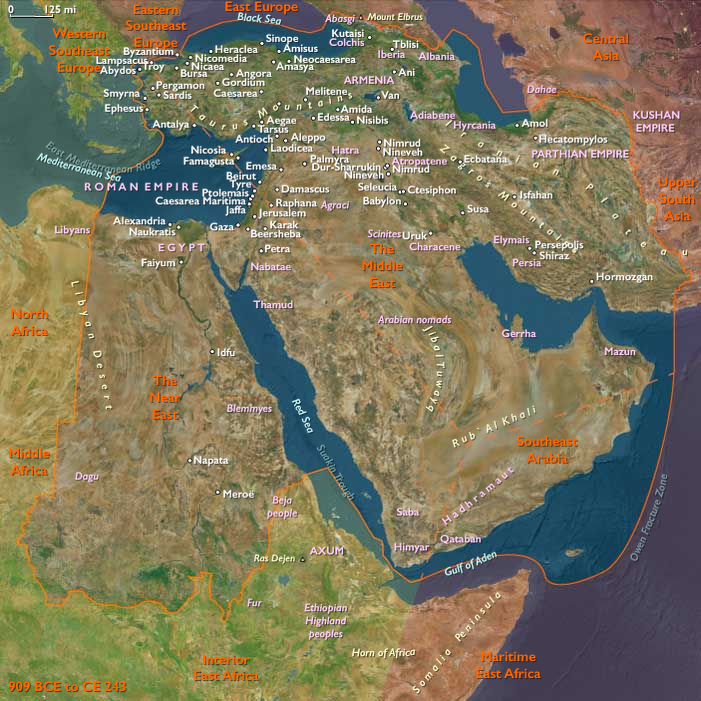
The Roman emperor Caracalla, wishing to make use of this civil war for a conquest of the East in imitation of his idol, Alexander the Great, marches into Mesopotamia under the pretext of marrying one of Artabanus' daughters.
Caracalla, according to the historian Herodian, tricked the Parthians in 216 into believing that he accepted a marriage and peace proposal, but then had the bride and guests slaughtered after the wedding celebrations.
The thereafter ongoing conflict and skirmishes become known as the Parthian war of Caracalla.
After deposing the kings of Osroene and Armenia to make them Roman provinces once more, he crosses the Tigris, destroys the towns, and spoils the tombs of Arbela, but when Artabanus advances at the head of an army, …
…Caracalla retires to Edessa.
The Praetorian prefect Macrinus is among Caracalla’s staff, as are other members of the praetorian guard.
Born in Caesarea (modern Cherchell, Algeria) in the Roman province of Mauretania to an equestrian family, Macrinus had received an education which allowed him to ascend to the Roman political class.
Over the years he had earned a reputation as a skilled lawyer.
Under the emperor Septimius Severus he became an important bureaucrat, and Caracalla in 212 had appointed him prefect of the Praetorian guard after the murder of Papianus.
While Macrinus likely enjoys the trust of Caracalla, this may have changed when, according to tradition, he was prophesied to depose and succeed the Emperor.
Rumors spread regarding Macrinus' alleged desire to take the throne for himself.
Given Caracalla's tendency towards murdering political opponents, Macrinus probably fears for his own safety should the Emperor become aware of this prophecy.
According to Dio, Caracalla had already taken the step of re-assigning members of Macrinus' staff.
Macrinus is confirmed in his new role by the Senate despite his equestrian background.
According to S.N.
Miller, this may have been due to both his background as an accomplished jurist and his deferential treatment of the senatorial class.
(Miller, S.N., "The Army and the Imperial House," The Cambridge Ancient History, Volume XII: The Imperial Crisis and Recovery (A.D. 193–324), S.A. Cook et al.
eds, Cambridge University Press, 1965, pp 50–2.)
He finds it necessary, however, to replace several provincial governors with men of his own choosing.
Caracalla's mother Julia Domna is initially left in peace, but when she starts to conspire with the military he orders her to leave Antioch.
Being at this time in an advanced stage of breast cancer (Cassius Dio) she chooses instead to starve herself to death.
In urgent matters of foreign policy, Macrinus displays a tendency towards conciliation and a reluctance to engage in military conflict.
He averts trouble in the province of Dacia by returning hostages that had been held by Caracalla, and he ends troubles in Armenia by granting that country's throne to Tiridates, whose father had also been imprisoned under Caracalla.
Less easily managed is the problem of Mesopotamia, which has been invaded by the Parthians in the wake of Caracalla's demise.
Monuments are built to revere Macrinus at a high point of his popularity.
The grand tetrastyle Capitoline Temple in Volubilis is erected to honor him in 217.
Meeting the Parthians in battle during the summer of this year, Macrinus achieves a costly draw near the town of Nisibis and as a result is forced to enter negotiations through which Rome is obliged to pay the enormous indemnity of two hundred million sesterces to the Parthian ruler Artabanus IV in return for peace.
However, Macrinus displays some financial farsightedness when he revalues the Roman currency.
He increases the silver purity of the denarius from 51.5% to 58%—the actual silver weight increasing from 1.66 grams to 1.82 grams.
Nevertheless, Macrinus' reluctance to engage in warfare, and his failure to gain victory over even a historically inferior enemy such as the Parthians causes considerable resentment among the soldiers.
This is compounded by him curtailing the privileges they had enjoyed under Caracalla and the introduction of a pay system by which recruits receive less than veterans.
After only a short while, the legions are searching for a rival emperor.
His popularity also suffered in Rome.
Not only has the new emperor failed to visit the city after taking power but a late-summer thunderstorm causes widespread fires and flooding.
Macrinus' appointee as urban prefect proves unable to repair the damage to the satisfaction of the populace and has to be replaced.
Caracalla, while traveling from Edessa to continue the war with Parthia, goes to visit a temple of Luna near the spot of the battle of Carrhae on April 8, 217, accompanied only by his personal bodyguard, which includes Macrinus.
The emperor’s escort gives him privacy to relieve himself at a roadside near Carrhae.
Events are not clear, but it is certain that Caracalla is assassinated, reportedly while urinating.
Caracalla's body is brought back from the temple by his bodyguards, along with the corpse of a fellow bodyguard.
The story as told by Macrinus is that the dead guard—Julius Martialis—had killed Caracalla with a single sword stroke.
Herodian says that Martialis' brother had been executed a few days earlier by Caracalla on an unproven charge; Cassius Dio, on the other hand, says that Martialis was resentful at not being promoted to the rank of centurion.
Macrinus, who (according to Herodian) was most probably responsible for having the emperor assassinated, has proclaimed himself emperor by April 11.
Macrinus also nominates his son Diadumenianus Caesar and successor and confers upon him the name "Antoninus", thus connecting him with the relatively stable reigns of the Antonine emperors of the second century.
The surviving members of the Severan dynasty, headed by Julia Maesa (Caracalla's aunt) and her daughters, foster this discontent.
When Macrinus came to power, he suppressed the threat against his reign by the family of his assassinated predecessor by exiling them—Julia Maesa, her two daughters, and her eldest grandson Elagabalus—to their estate near Emesa in Syria, where the Severan women plot, with Julia Maesa’s eunuch advisor and Elagabalus' tutor Gannys, to place another Severan on the imperial throne.
They use their hereditary influence over the cult of sun-deity Elagabalus (the Latinized form of El-Gabal) to proclaim Soaemias' son Elagabalus (named for his family's patron deity) as the true successor to Caracalla.
The false rumor is spread by Elagabalus, with the assistance of the Severan women, that he is Caracalla's illegitimate son and thus the child of a union between first cousins.
He is therefore due the loyalties of Roman soldiers and senators who had sworn allegiance to Caracalla.
Born around the year 203, as Varius Avitus Bassianus to the family of Sextus Varius Marcellus and Julia Soaemias Bassiana, his father had initially been a member of the equestrian class, but had later been elevated to the rank of senator.
His grandmother Julia Maesa is the widow of the Consul Julius Avitus, the sister of Julia Domna, and the sister-in-law of emperor Septimius Severus.
Her daughter Julia Soaemias is a cousin of Caracalla.
Other relatives include his aunt Julia Avita Mamaea and uncle Marcus Julius Gessius Marcianus and their son Alexander Severus.
Elagabalus's family holds hereditary rights to the priesthood of the sun god El-Gabal, of whom Elagabalus is the high priest at Emesa (modern Homs) in Syria.
Elagabalus was initially venerated at Emesa.
The name is the Latinized form of the Syrian Ilāh hag-Gabal, which derives from Ilāh ("god") and gabal ("mountain"), resulting in "the God of the Mountain" the Emesene manifestation of the deity.
The cult of the deity had spread to other parts of the Roman Empire in the second century.
For example, a dedication has been found as far away as Woerden (Netherlands).
The god is later imported and assimilated with the Roman sun god, who was known as Sol Indiges in republican times and as Sol Invictus during the second and third centuries.
Sun worship has increased throughout the Empire since the reign of Septimius Severus.
Elagabalus, in his dual role as Roman Emperor and hereditary priest of the god El-Gabal at his hometown, Emesa, sees this as an opportunity to install El-Gabal as the chief deity of the Roman Pantheon.
The god is renamed Deus Sol Invictus, meaning God the Undefeated Sun, and placed over Jupiter.
As a sign of the union with the Roman religion, Elagabalus gives either Astarte, Minerva, Urania, or some combination of the three, to El-Gabal as a wife.
He provokes further outrage when he takes as his second wife the Vestal Virgin Aquilia Severa, claiming the marriage will produce "god-like children".
This is a flagrant breach of Roman law and tradition, which holds that any Vestal found to have engaged in sexual intercourse before her thirty-year vow of celibacy has been fulfilled is to be buried alive.
A lavish temple called the Elagabalium is built on the east face of the Palatine Hill to house El-Gabal, who is represented by a black conical meteorite from Emesa.
Herodian wrote "this stone is worshipped as though it were sent from heaven; on it there are some small projecting pieces and markings that are pointed out, which the people would like to believe are a rough picture of the sun, because this is how they see them".
(Herodian, Roman History V.3) In order to become the high priest of his new religion, Elagabalus has himself circumcised.
(Cassius Dio, Roman History LXXX.11) He forces senators to watch while he dances around the altar of Deus Sol Invictus to the sound of drums and cymbals, and each summer solstice he holds a festival dedicated to the god, which becomes popular with the masses because of the free food widely distributed there.
During this festival, Elagabalus places the Emesa stone on a chariot adorned with gold and jewels, which he parades through the city.
The most sacred relics from the Roman religion are transferred from their respective shrines to the Elagabalium, including the Great Mother, the fire of Vesta, the Shields of the Salii and the Palladium, so that no other god except El-Gabal will be worshipped.
Elagabalus' eccentricities, particularly his relationship with Hierocles, have by 221 increasingly infuriated the soldiers of the Praetorian Guard, a significant portion of whom are Illyrians, having distinguished themselves as warriors in the Roman legions.
When Elagabalus’s grandmother, Julia Maesa, perceives that popular support for the emperor is quickly wavering, she decides that he and his mother, who had encouraged his religious practices, have to be replaced.
As alternatives, she turns to her other daughter Julia Avita Mamaea and her son, the thirteen-year-old Severus Alexander.
Persuading Elagabalus to appoint his cousin as his heir, Alexander is bestowed with the title of Caesar and shares the consulship with the emperor this year.
However, Elagabalus reconsiders this arrangement when he begins to suspect that the Praetorian Guard favors his cousin over himself.
Elagabalus' sexual orientation and gender identity are the source of much controversy and debate.
All told, Elagabalus will marry and divorce five women, three of whom are known.
His first wife was Julia Cornelia Paula; the second is the Vestal Virgin Julia Aquilia Severa, but within a year, he abandons her and marries Annia Aurelia Faustina, a descendant of Marcus Aurelius.
It is her beauty and her high prominent imperial ancestry that have attracted Elagabalus to her.
In order to marry her, he orders the execution of her husband, Pomponius Bassus.
After the death of the latter, Elagabalus forbids her to mourn Bassus.
In July 221, Elagabalus takes Faustina as his third wife.
Roman society is more accepting of his marriage to her than of his second marriage to the Vestal Virgin Julia Aquilia Severa.
Through her marriage to Elagabalus, she becomes Empress of Rome.
When she marries Elagabalus, it seems for a time that the Nerva–Antonine dynasty rule has returned to Rome.
He gives her the title of Annia Faustina Augusta and adds the Latin name Julia to her name.
Numismatic and other evidence that have survived of her date from her second, brief marriage, to Elagabalus.
Elagabalus has hoped she will bear him an heir, so that his maternal cousin will not inherit the throne; however, she bears him no children and, towards the end of 221, Elagabalus divorces her; it is not known why.
There are no surviving sources stating how Annia Aurelia Faustina ruled when she was a Roman Empress.
Elagabalus returns to Julia Aquilia Severa, claiming that the original divorce was invalid, and remarries her, as his fourth wife.
Although Elagabalus returns to Severa by the end of the year, according to Cassius Dio, his most stable relationship seems to have been with his chariot driver, a blond slave from Caria named Hierocles, whom he refers to as his husband.
The Augustan History claims that he also married a man named Zoticus, an athlete from Smyrna, in a public ceremony at Rome.
Cassius Dio reported Elagabalus would paint his eyes, epilate his hair and wear wigs before prostituting himself in taverns and brothels, (Cassius Dio, Roman History LXXX.14) and even the imperial palace: Finally, he set aside a room in the palace and there committed his indecencies, always standing nude at the door of the room, as the harlots do, and shaking the curtain which hung from gold rings, while in a soft and melting voice he solicited the passers-by. (Cassius Dio, Roman History LXXX.13)
Herodian commented that Elagabalus pampered his natural good looks by wearing too much make-up.
He was described as having been "delighted to be called the mistress, the wife, the Queen of Hierocles" and was said to have offered vast sums of money to the physician who could equip him with female genitalia. (Cassius Dio, Roman History LXXX.16)
Subsequently, Elagabalus has often been characterized by modern writers as transgender, most likely transsexual.
Elagabalus, to see how the Praetorians would react following the failure of various attempts at Alexander's life, strips his cousin of his titles, revokes his consulship, and circulates the news that Alexander is near death.
A riot ensues, and the guard demands to see Elagabalus and Alexander in the Praetorian camp.
The emperor complies and on March 11, 222, he presents his cousin, along with his mother Julia Soaemias.
Upon arrival the soldiers start cheering Alexander, while ignoring Elagabalus, who orders the summary arrest and execution of anyone who had taken part in this revolt.
In response, the Praetorians attack Elagabalus and his mother:
So he made an attempt to flee, and would have got away somewhere by being placed in a chest, had he not been discovered and slain, at the age of 18. His mother, who embraced him and clung tightly to him, perished with him; their heads were cut off and their bodies, after being stripped naked, were first dragged all over the city, and then the mother's body was cast aside somewhere or other, while his was thrown into the river. (Cassius Dio, Roman History LXXX.20)
Following his demise, many associates of Elagabalus are killed or deposed, including Hierocles and Comazon.
His religious edicts are reversed and El-Gabal is returned to Emesa.
Women are barred from ever attending meetings of the Senate, and damnatio memoriae—erasing a person from all public records—is decreed upon him.
The source of many of these stories of Elagabalus's debauchery is the Augustan History (Historia Augusta), which scholarly consensus now feels to be unreliable in its details.
The Historia Augusta was most likely written near the end of the fourth century during the reign of emperor Theodosius I, drawing as much upon the invention of its author as actual historical sources.
The life of Elagabalus as described in the Augustan History is believed to be largely a work of historical fiction.
Only the sections 13 to 17, relating to the fall of Elagabalus, are considered to hold any historical value.
Sources more credible than the Augustan History include the contemporary historians Cassius Dio and Herodian.
Cassius Dio's account of his reign is generally considered more reliable than the Augustan History, although it should be noted that Dio, although he was a contemporary of Elagabalus, spent the larger part of this period outside of Rome and had to rely on secondhand accounts when composing his Roman History.
Furthermore, the political climate in the aftermath of Elagabalus' reign, as well as his own position within the government of Alexander, likely imposed restrictions on the extent to which his writing on this period is truthful.
Herodian is considered the most important source on the religious reforms which took place during the reign of Elagabalus, which have been confirmed by modern numismatical and archaeological evidence.
While Herodian is deemed not as reliable as Cassius Dio, his lack of literary and scholarly pretensions make him less biased than senatorial historians.