Hisham II al-Hakam
3rd Caliph of Cordoba
Years: 976 - 1013
Hisham II is the third Caliph of Cordoba, of the Umayyad dynasty.
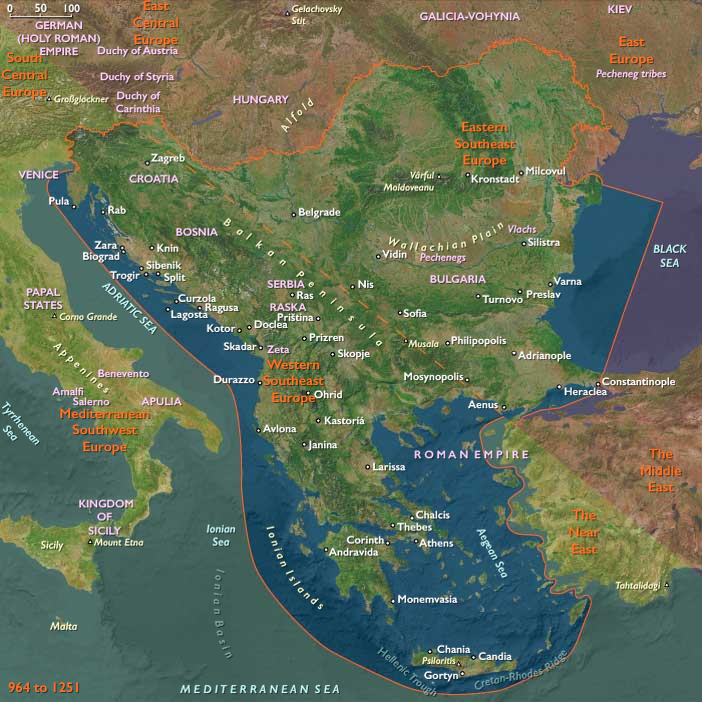
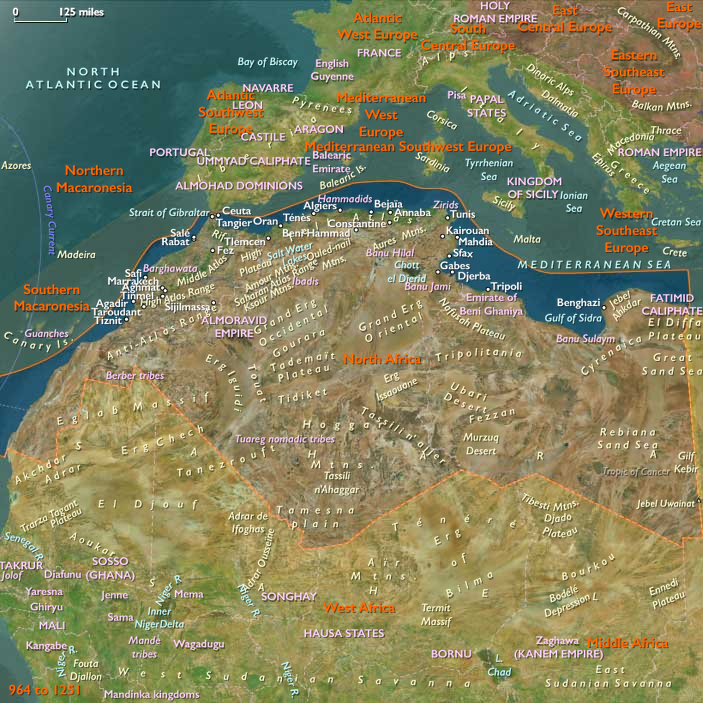
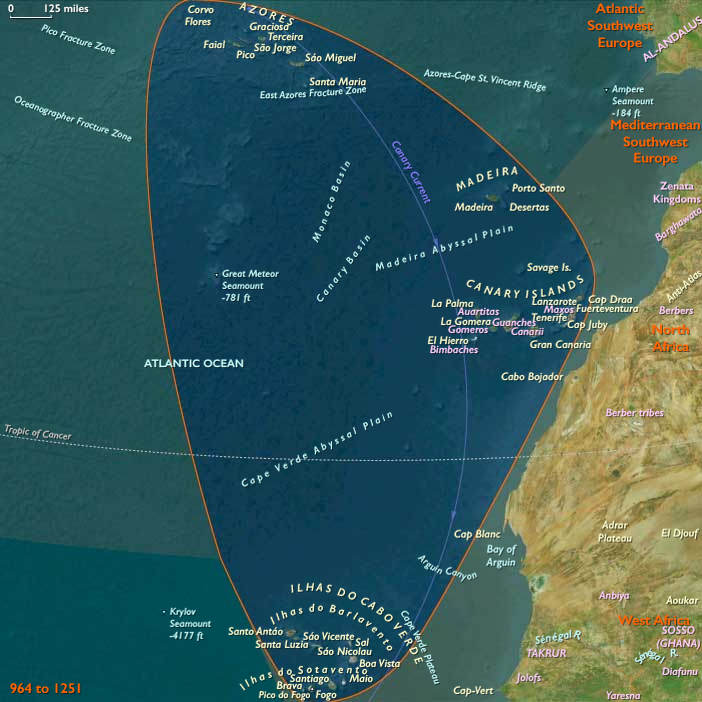
He rules 976–1009, and 1010–1013 in the Al-Andalus (Moorish Iberia, which becomes part of modern Spain).




Related Events
Filter results
Showing 10 events out of 15 total
Ibn Abi Amir (known as Almanzor, or Al Mansur), the royal vizier, becomes regent (981-1002) and establishes himself as virtual dictator when Hisham II, grandson of Abd al Rahman III, inherits the throne in 976 at age twelve.
The caliph is no more than a figurehead for the next twenty-six years, and Al Mansur is the actual ruler.
Al Mansur wants the caliphate to symbolize the ideal of religious and political unity as insurance against any renewal of civil strife.
Notwithstanding his employment of Christian mercenaries, Al Mansur preaches jihad, or holy war, against the Christian states on the frontier, undertaking annual summer campaigns against them, which serves not only to unite Spanish Muslims in a common cause but also to extend temporary Muslim control in the north.
Abu Aamir Muhammad ibn Abdullah ibn Abi Aamir, born in the area of Algeciras and descended from a noble member of the Arab army that conquered Spain, had arrived at the Umayyad Court of Cordoba as a student studying law and literature.
He began his career as a professional letter writer, becoming the protégé; (and supposedly the lover) of the mother of the young Hisham II, becoming manager of the infant prince’s estates.
In the space of a few years, he had schemed his way from this humble position to considerable heights of influence, eliminating his political rivals in the process.
When Caliph Al-Hakam died in 976, Ibn Abi Amir had been instrumental in securing the succession of the young Hisham II, aged twelve, to the throne.
With the aid of his father-in-law, General Galib ibn Abd al-Rahman, he overthrows and succeeds the Hajib (a title similar to that of Grand Vizier in the Muslim East), or Chancellor in 978.
By giving African territories local independence under Umayyad suzerainty, Abu Aamir Muhammad reduces the drain on government resources.
Abu Aamir Muhammad has during the ensuing three years consolidated his power with the building of his new palace on the outskirts of Córdoba, al-Madina az-Zahira, while at the same time completely isolating the young Caliph, who has become a virtual prisoner in Medina Azahara.
General Galib, grown fearful of his son-in-law’s power, has allied himself with the Christian kings of León, Castile, and Navarre.
Abu Aamir Muhammad, having strengthened his Moorish army, had invaded León in 977 and, after four years of fighting, defeats and kills Galib in battle.
A triumphant Abu Aamir Muhammad returns in 981 from his victories in the north to Córdoba, having earned the honorific title al-Mansur bi-Allah (“victorious through Allah), and rules al-Andalus as regent for Hisham II.
He becomes known to the European Christians as Almanzor.
His grip over Al-Andalus now absolute, Al-Mansur dedicates himself to military campaigns against the Christian states of the peninsula.
All told, he will organize and take part in fifty-seven campaigns, and will be victorious in all of them.
To wage these campaigns against the Christian states, he brings in many Berber mercenaries, which will upset the political order over time.
Al-Mansur adopts the title of al-Malik al-Karim, or Noble King, in 994, while the ineffectual caliph continues as nominal chief of state.
Mediterranean Southwest Europe (1000–1011 CE): Fitna of al-Andalus, Prelude to Collapse, and Cultural Traditions
The era 1000–1011 CE in Mediterranean Southwest Europe is characterized by the outbreak of severe internal strife in Al-Andalus known as the Fitna, marking a critical prelude to the caliphate’s ultimate collapse, as well as the continuity and revival of deeply rooted cultural traditions such as bullfighting.
Fitna of al-Andalus and Political Fragmentation
The period sees the onset of the Fitna of al-Andalus (1009–1031 CE), a severe internal crisis marked by instability and civil war. Initiated by a violent coup d'état in 1009 CE, this conflict leads to the assassination of Abd al-Rahman Sanchuelo, the son and successor of Al-Mansur, and the deposition of Caliph Hisham II al-Hakam. Muhammad II, the great-grandson of Abd-ar-Rahman III, ascends briefly to power amid growing chaos. This turbulent era significantly weakens the central authority of Córdoba, setting the stage for the eventual dissolution of the Caliphate into numerous small, independent kingdoms known as taifas.
Almanzor's Purges and Authoritarian Rule
The Fitna’s turmoil is amplified by earlier authoritarian measures taken by Almanzor (Al-Mansur), the de facto ruler until his death in 1002, who conducted extensive political and social purges throughout Muslim Al-Andalus. These harsh actions contributed significantly to the growing tensions and fragmentation that erupt dramatically in 1009.
Historical and Cultural Roots of Bullfighting
During this period, cultural practices rooted deeply in Mediterranean history, such as bullfighting, gain renewed prominence. Tracing its origins to ancient bull worship and sacrificial rites in Mesopotamia and the broader Mediterranean region, bullfighting evolved from practices depicted in Minoan Crete’s bull-leaping traditions and Roman Venationes—animal hunts held for entertainment. Evidence of early bullfighting appears in Iberian artifacts such as the Celtiberian tombstone from Clunia and the cave painting known as El toro de hachos.
Moorish Influence on Bullfighting Tradition
Notably, the Moors of Al-Andalus restore and popularize bullfighting practices involving skilled riders confronting bulls on horseback. This revival of mounted bullfighting—previously suppressed by Christian authorities—exemplifies cultural continuity and exchange within the Iberian Peninsula, highlighting the enduring Moorish influence on Iberian traditions.
Persistent Intellectual and Cultural Vitality
Despite the ongoing political turmoil, intellectual life, especially within Jewish and Mozarab communities, continues to thrive. Lucena maintains its prominence as a center of Jewish scholarship, while Mozarab communities continue to bridge Christian and Muslim cultures, preserving and fostering intellectual and cultural resilience.
Economic Stability and Technological Continuation
Technological innovations, particularly the sustained use of the Catalan forge, underpin continued economic stability and growth. Enhanced iron production continues supporting agricultural productivity, urban development, and military capabilities across the region.
Legacy of the Era
The era 1000–1011 CE marks a critical juncture in Al-Andalus, defined by the Fitna’s onset and the imminent collapse of centralized caliphal power. Simultaneously, the revival and continuation of ancient cultural traditions such as bullfighting illustrate the region’s enduring cultural complexity and resilience, significantly influencing the historical trajectory of Mediterranean Southwest Europe.
The Fitna of al-Andalus, a period of instability and civil war, precedes the ultimate collapse of the Caliphate of Córdoba in 1031.
In addition to the political turmoil, large purges are also carried out throughout Muslim al-Andalus by Almanzor, its de facto ruler.
It begins in the year 1009 with a coup d'état that leads to the assassination of Abd al-Rahman Sanchuelo, the son of Almanzor, the deposition of the Caliph Hisham II al-Hakam, and the rise to power of Muhammad II of Córdoba, great-grandson of Abd-ar-Rahman III.
The conflict will eventually divide all of Al-Andalus into a series of small kingdoms, or statelets; called taifas.
A truce between Castile and Córdoba had existed since the succession of Sancho García of Castile, but in 999 it had been broken when the count refused to pay the annual tribute and came to the aid of his Christian neighbor, García Sánchez II of Pamplona, when Almanzor attacked him.
On June 21, 1000, an army leaves Córdoba under Almanzor for a punitive expedition against Castile.
The subsequent campaign is the most well-recorded of Almanzor's many wars after his Compostela campaign of 997.
The primary historian is Ibn al-Khatib, who derived his Arabic account partially from Ibn Hayyan, himself relying on the eyewitness testimony of his father, Jalaf ibn Husayn ibn Hayyan, one of the combatants on the Muslim side and a secretary to Almanzor.
Ibn al-Khatib records that the campaign was the most intense and difficult Almanzor ever waged, that preparations took an especially long time, and that all the rulers of Christian Spain were allied against him, with troops from all the Christian realms assembled together.
Almanzor crosses the Duero and invades Castile near Madinat Selim, where he sights an army under Sancho García and the "Galician kings", consisting of troops from as far as Pamplona and Astorga (that count Sancho leads the group is thought to reflect the decline of García).
Almanzor passes by the fortresses of Osma, San Esteban de Gormaz, and Clunia, which had been in Muslim hands for several years at that point.
Just north of Clunia, he is surprised to find a large Christian army.
Sancho, who had been elected leader of the entire army by the assembled troops, is encamped at the rock of Yarbayra (Peña de Cervera), a central location, well situated for supplies, and inaccessible due to its geography.
The implication of these events is that Sancho's planning and communications had been superior to those of Almanzor.
The roads from Clunia, the northernmost Muslims garrison, lead to Tordómar, Lara, and Salas de los Infantes through the narrow pass of the Yecla, which passes through the Peña de Cervera before widening into the basin of the river Arlanza.
Almanzor is aware of his disadvantaged position—the Christians have a stronger camp and better sightlines, with a large open field before them—but his viziers cannot agree on how to proceed.
Then, without planning and without strategy, the Christian host descends on the unsuspecting Muslims and the battle soon evolves into a general mêlée.
Almanzor's right and left columns are attacked simultaneously and soon fall back, which inspires the Christians to press their advantage even more boldly.
The majority of the Muslim rear, disoriented by the unorganized attack and disheartened by the result, flee.
According to the eyewitness Jalaf ibn Husayn, Almanzor, with his escort, observed the action from atop a short hill near the field.
While he was debating whether to throw his retinue into the fight the right wing broke, which furthered the confusion.
One of Almanzor's secretaries, Abd al-Malik ibn Idris al-Yaziri, said to Said Ibn Yusuf, as reported by Ibn al-Qalina, "Come to say goodbye, oh martyr, because surely today you must die."
By the end of the day Said Ibn Yusuf was dead.
Jalaf also related how, when Almanzor asked him how many of his own retinue remained, Jalaf counted them off for him one by one and arrived at twenty.
Almanzor eventually dismounted and returned to his couch in order to strengthen the confidence of those around him.
It was there that Jalaf says he hit upon the idea of transferring the camp from the shallow depression in which he had first pitched it to the hill from which he had been observing the battle.
The sight of the large tent of Almanzor now propped on the hill demoralized the Christians and inspired the Muslims.
In their ten-mile flight, many Christians are captured and many more killed, while more than seven hundred Muslims die this day.
The Christian camp is captured and pillaged.
Ibn al-Khatib notes that the most outstanding fighter on the Muslim side was Abd al-Malik, Almanzor's son, stressing that this was "by unanimous opinion" without any favoritism and that he excelled even the famous Berber cavalry.
Among these, Kayaddayr al-Dammari al-Abra (the Leper), a prince of the north African tribe of the Banu Dammari, is most famous.
At Cervera he reputedly decapitated one of the counts of the Banu Gumis and carried his head about with him.
Ibn al-Khatib also praises Almanzor's second son by another woman, Abd al-Rahman, who follows his half-brother into battle.
Both brothers watch the battle with their father until he finally permits them, tearfully, to join it.
Though the battle is a Muslim victory, the Christians do succeed in preventing further inroads by Almanzor in Castile.
Al-Mansur dies in 1002; his older son, Abdulmalik al-Muzaffar, succeeds him as regent in Córdoba for Umayyad caliph Hisham II.
Ermengol I, Count of Urgell, is a man of culture, open to influences from wider Europe.
He has made two voyages to Rome, in 998 and 1001, and has stimulated his nobles to make pilgrimages to Santiago de Compostela or Le Puy.
He has also reformed the judiciary of his county to make justice more universally available.
Moreover, he has begun to reassert his authority over the outlying castles of his realm, whose lords are acting independent of his power.
He also maintains an intense war against the Caliphate of Córdoba.
In 1003, Urgell is invaded by Abd al-Malik al-Muzaffar.
Aided by Raymond Borrel of Barcelona, Bernard I of Besalú, and Wifred II of Cerdagne, Ermengol defeats them at the Battle of Torà, followed by …