Isabella I of Castile
Queen of Castile and León
Years: 1451 - 1504
Isabella I (Spanish: Isabel I, Old Spanish: Ysabel I; Madrigal de las Altas Torres, April 22, 1451–Medina del Campo, November 26, 1504) is Queen of Castille.
She is married to Ferdinand II of Aragon.
Their marriage becomse the basis for the political unification of Spain under their grandson, Holy Roman Emperor Charles V. After a struggle to claim her right to the throne, she reorganizes the governmental system, brings the crime rate to the lowest it has been in years, and unburdens the kingdom of the enormous debt her brother had left behind.
Her reforms and those she makes with her husband have an influence that extends well beyond the borders of their united kingdoms.
Isabella and Ferdinand are known for completing the Reconquista, ordering conversion or exile of their Muslim and Jewish subjects in the Spanish Inquisition, and for supporting and financing Christopher Columbus's 1492 voyage that leads to the opening of the New World and to the establishment of Spain as the first global power, which will dominate Europe and much of the world for more than a century.
Isabella is granted the title Servant of God by the Catholic Church in 1974.
Related Events
Filter results
Showing 10 events out of 229 total
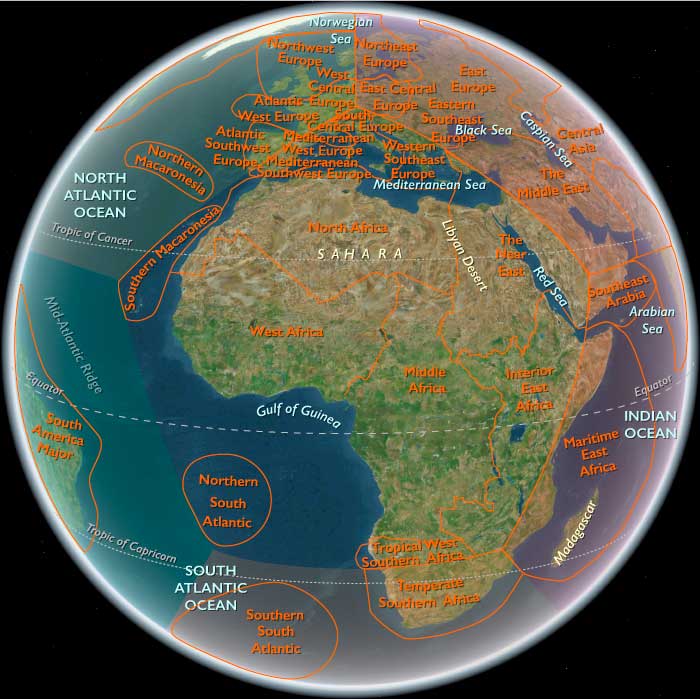
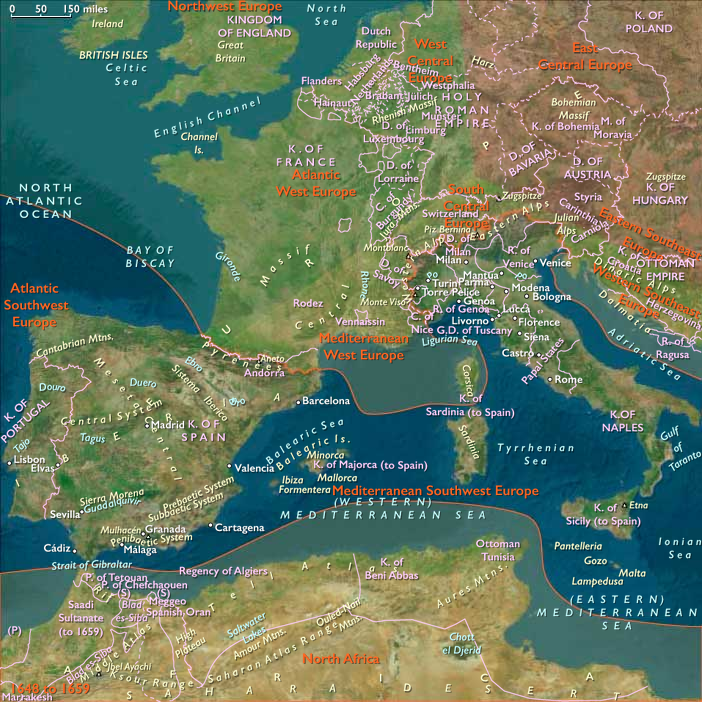
Southwest Europe (1396–1539 CE)
Aragonese Sea Lanes, Italian Renaissance, and Habsburg–Valois Wars
Geography & Environmental Context
Southwest Europe encompassed Italy (including Sardinia and Sicily), Malta, southern and eastern Spain (Andalusia, Murcia, Valencia, Catalonia), and the Balearic Islands. Anchors spanned the Po Valley and Venetian–Adriatic gateways, the Apennine spine with Tyrrhenian and Adriatic littorals, the grain and volcanic uplands of Sicily, the rugged Sardinian interior, Malta’s limestone plateau astride central sea-lanes, and Spain’s irrigated huertas and ports from Seville–Cádiz (Atlantic–Mediterranean hinge) through Valencia–Barcelona to the Balearics.
Together these corridors provisioned, armed, and cultured Europe’s busiest inland sea.
Climate & Environmental Shifts
Under the Little Ice Age, winters cooled and variability intensified:
-
Po Valley & Lombardy: alternating droughts and Po floods unsettled rice and wheat rotations.
-
Sicily, Sardinia, southern Spain: recurrent droughts reduced grain and olive yields; citrus and pastoralism buffered loss.
-
Valencia–Murcia huertas: Acequia irrigation offset dry years, but torrential riadas periodically destroyed terraces.
-
Balearics & Malta: thin soils and rainfall swings required cisterns, terracing, and imported grain.
Subsistence & Settlement
-
Italy: Wheat, barley, vines, olives, and, in Lombardy, irrigated rice; urban gardens surrounded the city-states.
-
Sicily & Sardinia: Grain, olives, vines, citrus, and livestock; granaries provisioned Italian and Iberian ports.
-
Southern & eastern Spain: Andalusian cereals, olives, and vines; Valencian and Murcian sugarcane and mulberry–silk; Catalan wool flocks.
-
Islands: Grain, olives, vines, goats, and fisheries sustained mixed economies; harbors provisioned passing fleets.
Major ports—Venice, Genoa, Naples, Palermo, Barcelona, Valencia, Seville, Palma, Cagliari—served as collection hubs for Mediterranean and emerging Atlantic commerce.
Technology & Material Culture
-
Irrigation & terracing: Acequias, qanat-derived galleries, pozzos and cisterns, and stone-bench terraces stabilized yields on coasts and islands.
-
Maritime innovation: Galleys remained indispensable; Italian and Iberian shipyards developed round-hulled naos and early caravels; bronze cannon revolutionized siege and naval warfare.
-
Manufactures: Florentine wool and silk, Venetian glass and books (the Aldine Press), Valencian silk and sugar, Catalan and Neapolitan shipbuilding.
-
Architecture & arts: Gothic–Renaissance transitions—Brunelleschi’s dome, Alberti’s façades, Venetian palazzi; Spanish Mudéjar and early Plateresque; island watchtowers and coastal walls.
Movement & Interaction Corridors
-
Aragonese thalassocracy: The Barcelona–Valencia–Balearics–Sardinia–Sicily–Naples chain formed a western Mediterranean empire later absorbed by Habsburg Spain.
-
Italian sea-lanes: Venice and Genoa dominated Levantine and North African trade; Apennine passes linked inland production to ports.
-
Iberian hinge: Seville–Cádiz bridged Atlantic and Mediterranean routes after 1492, prefiguring global circuits of silver and spice.
-
Islands: Malta, Sardinia, and the Balearics provisioned convoys and guarded corsair-prone straits.
Cultural & Symbolic Expressions
-
Renaissance humanism: Florence, Rome, and Venice led Europe’s artistic renewal; courts of Naples, Ferrara, and Urbino radiated taste into Iberia and the islands.
-
Catholic Christendom: Rome remained pilgrimage center and patron of arts; confraternities and mendicant orders structured devotion.
-
Iberian transformations: The Fall of Granada (1492) ended Nasrid rule; the Inquisition and expulsions reshaped Andalusian society; Valencian and Catalan towns mixed mercantile realism with reformist thought.
-
Islands: Malta, blending Sicilian, Catalan, and Arabic legacies, was granted in 1530 to the Knights Hospitaller as a new crusading bastion.
Environmental Adaptation & Resilience
Cereal–legume rotations, vine–olive intercropping, chestnut economies in uplands, and rice paddies in irrigated lowlands spread risk.
Huerta canals and terrace systems were continuously maintained; state granaries and charitable confraternities mitigated dearth; fisheries and salted staples balanced harvest failures.
Technology & Power Shifts (Conflict Dynamics)
-
Aragonese expansion: Alfonso V (1442) united Naples with Aragon’s sea empire.
-
Italian Wars (1494–1559): France, Spain, and the Empire contested Italy—Fornovo (1495), Cerignola (1503), Agnadello (1509), Pavia (1525), and the Sack of Rome (1527) redefined European warfare and diplomacy.
-
Corsair & Ottoman pressure: Raids struck Sicily, Sardinia, Valencia, and the Balearics; Preveza (1538) confirmed Ottoman naval mastery in the east.
-
Iberian union: The crowns of Aragon and Castile (1479) created a Spanish monarchy projecting power across the peninsula and into the Mediterranean.
Transition
By 1539 CE, Southwest Europe was a crucible of power and culture. Habsburg Spain controlled Naples, Sicily, and Sardinia; Venice and Genoa mediated East–West trades under Ottoman pressure; Malta under the Knights became a bulwark; Valencia–Barcelona and Italian ports thrived on commerce and shipbuilding. Terracing, irrigation, and maritime provisioning sustained populations amid climatic volatility. Renaissance brilliance endured even as corsairs and cannon ushered in a new Mediterranean order.
Mediterranean Southwest Europe (1396–1539 CE): Aragonese Sea Lanes, Italian Renaissance, and Habsburg–Valois Wars
Geographic & Environmental Context
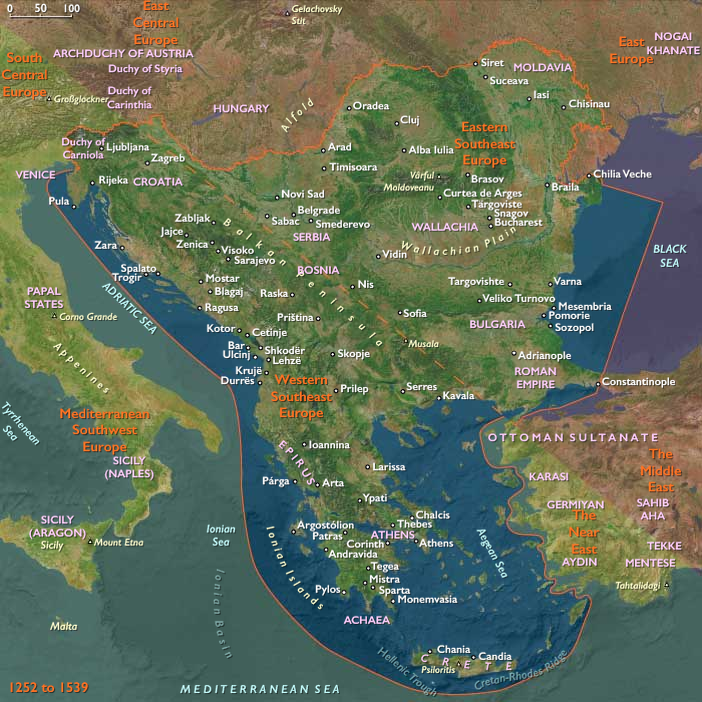
The subregion of Mediterranean Southwest Europe includes Italy (including Sardinia and Sicily), Malta, southern and eastern Spain (Andalusia, Murcia, Valencia, Catalonia), and the Balearic Islands. Anchors span the Po Valley and Venetian–Adriatic gateways, the Apennine spine with Tyrrhenian and Adriatic littorals, the grain and volcanic uplands of Sicily, the rugged Sardinian interior, Malta’s limestone plateau astride central sea-lanes, and Spain’s irrigated huertas and ports from Seville–Cádiz (Atlantic–Mediterranean hinge) through Valencia–Barcelonato the Balearics. Together, these corridors fed and armed Europe’s busiest inland sea.
Climate & Environmental Shifts
Under the Little Ice Age, winters were cooler and variability sharper:
-
Po Valley & northern Italy: alternating droughts and Po floods unsettled wheat/rice rotations; foggy winters extended.
-
Sicily, Sardinia, southern Spain: periodic droughts dented wheat and olive yields; citrus and pastoralism buffered shortfalls.
-
Valencian/Murcian huertas: canal and acequia irrigation moderated dry spells; occasional torrential floods (riadas) damaged terraces.
-
Balearics & Malta: thin soils and rainfall swings drove reliance on cisterns, terracing, and imported grain in lean years.
Subsistence & Settlement
-
Italy: Wheat, barley, vines, and olives dominated; rice spread in Lombardy; urban gardens ringed city-states.
-
Sicily & Sardinia: Grain, olives, vines, citrus, pastoral flocks; granaries supplied Italian and Iberian ports.
-
Southern & eastern Spain: Andalusian cereals, olives, vines; Valencia/Murcia grew rice, sugarcane, mulberry–silk; Catalan uplands raised sheep for wool.
-
Balearics & Malta: Mixed grain, olives, vines, goats; fisheries vital; harbors provisioned passing fleets.
Port cities—Venice, Genoa, Naples, Palermo, Barcelona, Valencia, Seville, Palma, Cagliari—functioned as collection and redistribution hubs for Mediterranean and, increasingly, Atlantic trade.
Technology & Material Culture
-
Irrigation & terracing: acequias, qanat-derived galleries, pozzos/cisterns, stone-walled benches stabilized yields on coasts and islands.
-
Maritime technology: galleys remained the workhorse; Italian and Iberian yards developed round-hulled naos and early caravels; bronze cannon transformed siege and naval warfare.
-
Manufactures: Florentine wool and silk; Venetian glass and print (Aldine press); Valencian silk and sugar; Catalan and Neapolitan shipyards.
-
Architecture & arts: Gothic to Renaissance transitions—Brunelleschi’s dome, Alberti’s façades, Venetian palazzi; Spanish Mudéjar and early Plateresque; island watchtowers and coastal walls.
Movement & Interaction Corridors
-
Aragonese thalassocracy: Barcelona–Valencia–Balearics–Sardinia–Sicily–Naples stitched a western Mediterranean network later inherited by Habsburg Spain.
-
Italian sea-lanes: Venice and Genoa collected Levantine and North African wares; peninsular roads (Via Emilia, Apennine passes) bound inland cities to ports.
-
Iberian hinge: Seville–Cádiz bridged Atlantic and Mediterranean circuits after 1492; Atlantic silver would later amplify these flows.
-
Island waypoints: Malta, Sardinia, and the Balearics provisioned convoys and guarded straits against corsairs.
Cultural & Symbolic Expressions
-
Renaissance humanism: Florence, Rome, and Venice fostered painting, sculpture, architecture, philology; courts of Naples, Ferrara, and Urbino radiated styles into Iberia and the islands.
-
Catholic Christendom: Papal Rome remained a pilgrimage and patronage center; confraternities, processions, and mendicant orders structured urban piety.
-
Iberian transformations: The Fall of Granada (1492) ended Nasrid rule; the Inquisition and expulsion/forced conversion reshaped Andalusian society; Valencian and Catalan towns mixed mercantile pragmatism with reforming currents.
-
Island identities: Genoese, Aragonese, and local elites fused on Corsica/Sardinia; Malta blended Sicilian, Catalan, and Arabic legacies—until 1530, when it became the fief of the Knights Hospitaller.
Environmental Adaptation & Resilience
-
Risk-spreading agriculture: cereal–legume rotations, vine–olive intercropping, and chestnut economies in uplands; rice paddies where water allowed.
-
Water management: canal dredging (Po/Adige), huerta maintenance (Valencia), terrace/cistern upkeep (Malta, Balearics, Ligurian and Amalfi coasts).
-
Urban buffers: state granaries, grain imports, and charitable confraternities mitigated dearth; fisheries and salted staples bridged bad harvests.
Technology & Power Shifts (Conflict Dynamics)
-
Hundred Years’ War (to 1453): peripheral raids reached Languedoc and Catalonia, nudging Aragonese naval policy.
-
Conquest of Naples (1442): Alfonso V of Aragon knit Naples to the Crown of Aragon’s sea empire.
-
Italian Wars (1494–1559): France, Spain, and the Empire fought over Italian hegemony—
-
Battle of Fornovo (1495) checked Charles VIII’s withdrawal;
-
Battle of Cerignola (1503) (Apulia) showcased gunpowder infantry, securing Spanish control in southern Italy;
-
Battle of Agnadello (1509) humbled Venice on the terraferma;
-
Battle of Pavia (1525) delivered a decisive Habsburg victory and Francis I’s capture;
-
the Sack of Rome (1527) shattered papal prestige and artists’ security.
-
-
Western Mediterranean contest: Barbary and Ottoman corsairs raided Sicily, Sardinia, Balearics, and Valencia; Rhodes (1522) fell to the Ottomans, redirecting the Hospitallers to Malta (1530); Preveza (1538) cemented Ottoman naval dominance in the eastern basin with echoes westward.
-
Iberian unification: The crowns of Aragon and Castile united (1479), projecting Spanish power across the peninsula, Italy, and the sea.
Transition
By 1539 CE, Mediterranean Southwest Europe was a crucible of power and culture. Habsburg Spain controlled Naples, Sicily, and Sardinia; Venice and Genoa mediated eastern and western trades under growing Habsburg and Ottoman pressure; Malta stood newly under the Knights as a central bastion; Valencia–Barcelona and Italian ports thrummed with commerce and shipbuilding. Despite climatic swings, terracing, irrigation, and maritime provisioning sustained populations. Renaissance patronage glowed even as Italian Wars and corsair/Ottoman threats remade the political seascape—setting up a long sixteenth century of Spanish predominance and Mediterranean contest.
Portuguese mariners are opening a route around Africa to the East in the fifteenth century.
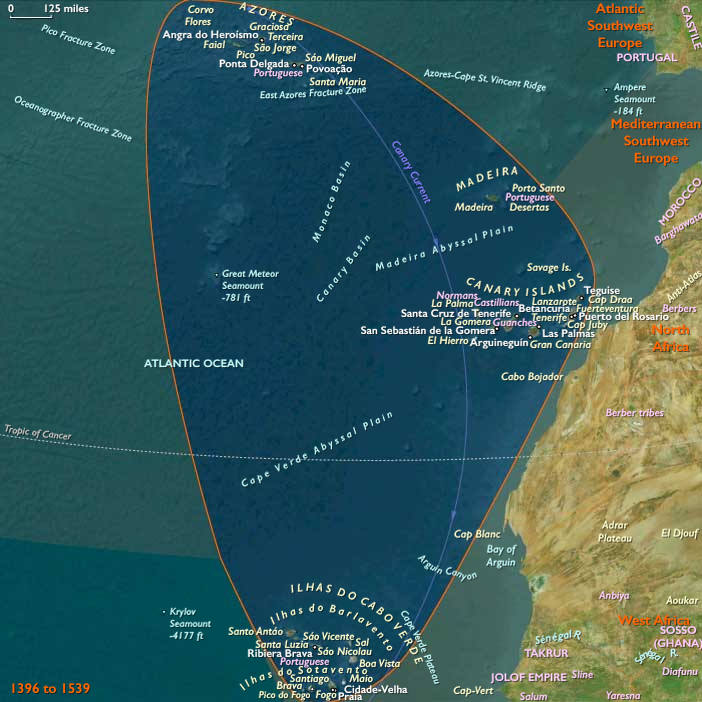
At the same time as the Castilians, they have planted colonies in the Azores and in the Canary Islands (also Canaries; Spanish, Canarias), the latter of which have been assigned to Spain by papal decree.
The conquest of Granada allows the Catholic Kings to divert their attention to exploration, although Christopher Columbus's first voyage in 1492 is financed by foreign bankers.
In 1493 Pope Alexander VI (Rodrigo Borgia, a Catalan) formally approves the division of the unexplored world between Spain and Portugal.
The Treaty of Tordesillas, which Spain and Portugal sign one year later, moves the line of division westward and allows Portugal to claim Brazil.
New discoveries and conquests come in quick succession.
Vasco Núñez de Balboa reaches the Pacific in 1513, and the survivors of Ferdinand Magellan's expedition complete the circumnavigation of the globe in 1522.
In 1519 the conquistador Hernán Cortes subdues the Aztecs in Mexico with a handful of followers, and between 1531 and 1533 Francisco Pizarro overthrows the empire of the Incas and establishes Spanish dominion over Peru.
In 1493, when Columbus brought fifteen hundred colonists with him on his second voyage, a royal administrator had already been appointed for the Indies.
The Council of the Indies (Consejo de Indias), established in 1524, acts as an advisory board to the crown on colonial affairs, and the House of Trade (Casa de Contratacion) regulates trade with the colonies.
The newly established colonies are not Spanish but Castilian.
They are administered as appendages of Castile, and the Aragonese are prohibited from trading or settling there.
The marriage of royal cousins Ferdinand II of Aragon (1452-1516) and Isabella of Castile (1451-1504) in 1469 eventually brings stability to both kingdoms.
Isabella's niece, Juana, bloodily disputes her succession to the throne in a conflict in which the rival claimants are given assistance by outside powers—Isabella by Aragon and Juana by her suitor, the king of Portugal.
The Treaty of Alcacovas ends the war in September 1479, and as Ferdinand has succeeded his father in Aragon earlier in the same year, it is possible to link Castile with Aragon.
Both Isabella and Ferdinand understand the importance of unity; together they effect institutional reform in Castile and leave Spain one of the best administered countries in Europe.
Even with the personal union of the Castilian and the Aragonese crowns, Castile, Aragon, Catalonia, and Valencia remained constitutionally distinct political entities, and they retain separate councils of state and parliaments.
Ferdinand, who had received his political education in federalist Aragon, brings a new emphasis on constitutionalism and a respect for local fueros to Castile, where he is king consort (1479-1504) and continues as regent after Isabella's death in 1504.
Greatly admired by Italian political theorist Niccolo Machiavelli (1469-1527), Ferdinand is one of the most skillful diplomats in an age of great diplomats, and he assigns to Castile its predominant role in the dual monarchy.
Ferdinand and Isabella resume the Reconquest, dormant for more than two hundred years, and in 1492 they capture Granada, earning for themselves the title of Catholic Kings.
The King and Queen persuade the Pope to declare their war a crusade.
The Christians crush one center of resistance after another and finally, in January 1492, after a long siege, the Moorish sultan Muhammad XII surrenders the fortress palace, the renowned Alhambra.
Atlantic Southwest Europe (1396–1539 CE): Estuaries, Shipyards, and the First Oceanic Empires
Geographic & Environmental Context
The subregion of Atlantic Southwest Europe includes continental Portugal and Spain’s Atlantic façade from the Gulf of Cádiz to the Bay of Biscay—the Tagus, Sado, Mondego, Douro, and Minho estuaries; Portugal’s Alentejo and Algarve coasts; Spain’s Guadalquivir–Cádiz seaboard; and the Cantabrian–Galician rías (A Coruña, Vigo, Gijón, Santander) and Basque capes (Bilbao–San Sebastián). These shorelines and river corridors bound maritime towns to grain-and-vine interiors and iron-rich uplands.
Climate & Environmental Shifts
The Little Ice Age brought cooler winters, stormier seas, and variable rains:
-
Iberian west & south coasts: more frequent Atlantic gales and bar shifts at estuary mouths (Douro, Tagus, Guadalquivir), alternately silting and scouring channels.
-
Northwest (Galicia–Asturias–Cantabria): heavy rainfall and rough seas; rich upwelling sustained fisheries.
-
Interior hinterlands: periodic droughts hit Alentejo and Andalusian cereal zones; frosts checked vines and olives in bad years; good years yielded ample wheat, wine, and oil.
Subsistence & Settlement
-
Rural belts: Wheat, rye, barley, olives, and vines; cork oak montado in Alentejo; gardens and orchards along river terraces.
-
Fisheries: Sardine and tunny on the Portuguese and Andalusian shelves; cod and whale began to matter for Basque fleets in the early 16th century. Saltworks (Aveiro, Setúbal, Cádiz) underwrote fish preservation and trade.
-
Ports & river towns: Lisbon (Tagus) and Porto (Douro); Seville and Cádiz (Guadalquivir–Cádiz); A Coruña–Vigo (rías), Santander, Bilbao and San Sebastián on the Bay of Biscay; Viana do Castelo, Figueira da Foz, Setúbal along Portugal’s coast. Urban workshops produced sails, rope, barrels, and victuals for ocean-going fleets.
Technology & Material Culture
-
Shipbuilding & navigation: The caravel (lateen rig, shoal-draft) matured on Portugal’s south coast; rounder naos carried freight across oceans. Magnetic compass, sternpost rudder, astrolabe, cross-staff, portolan charts, and toleta de marteloio tables improved blue-water navigation.
-
Maritime institutions: In Portugal, the Order of Christ’s revenues (successor to the Templars) and the crown’s Casa da Guiné and later Casa da Índia in Lisbon centralized Atlantic/Indian trade. Basque iron and timber supported Biscayan yards.
-
Urban & courtly arts: Manueline architecture (rope, coral, armillary motifs) crowned Lisbon/Belém; Mudéjar–Plateresque blended in Andalusia; guild crafts (textiles, leather, ceramics) supplied ships and cities.
Movement & Interaction Corridors
-
Estuary arteries: The Tagus, Douro, and Guadalquivir funneled grain, wine, oil, salt fish, and hides from interior plains to oceanic convoys; return flows brought spices, gold, and slaves by the early 1500s.
-
Atlantic lanes: Portugal’s Volta do Mar looped down the African coast and home via mid-ocean westerlies; Andalusian–Cantabrian coasting linked Biscay iron and salt fish to southern shipyards and markets.
-
Pilgrimage & fairs: Santiago de Compostela drew pilgrims through Galician ports; Lisbon and Seville fairs knit merchants from Italy, Flanders, and the Maghreb.
-
Imperial routes (first phase): After 1498, spice fleets sailed India–Lisbon; after 1492, Castilian fleets used the Guadalquivir–Seville corridor to the Caribbean.
Cultural & Symbolic Expressions
-
Religious life: Cathedrals and confraternities structured urban devotion; seafarers’ brotherhoods honored Our Lady of Good Voyage; shrines dotted headlands and capes (e.g., Cape St. Vincent).
-
Court and chronicle: Portuguese chronicles (Gomes Eanes de Zurara) celebrated exploration; Iberian courts patronized cartography and cosmography.
-
Communal identities: Fisher guilds, ship carpenters, ropewalkers, coopers, and salt-pan communities developed strong customs and saints’ days; Basque whalers forged distinctive sea rituals.
Environmental Adaptation & Resilience
-
Risk-spreading portfolios: Mixed farming (cereal–vine–olive), stock-raising, and salt-fish curing buffered bad harvests; riverine mills and terraces stabilized yields.
-
Harbor works: Jetties and dredging (Lisbon, Porto, Seville) fought bar siltation; salt granaries and fish warehouses bridged lean seasons.
-
Maritime provisioning: Biscayan and Portuguese fleets salted fish and whale meat; victualing yards stockpiled biscuit, wine, oil, and salted pork for oceanic voyages.
Technology & Power Shifts (Conflict Dynamics)
-
Iberian realignments: The Conquest of Ceuta (1415) opened Portugal’s North African gateway and Atlantic thrust; the War of the Castilian Succession (1475–1479)—including the Battle of Toro (1476)—ended with the Treaty of Alcáçovas (1479), fixing early Atlantic spheres between Castile and Portugal. The Treaty of Tordesillas (1494) divided extra-European worlds meridionally.
-
Oceanic breakout: Vasco da Gama’s voyage (1497–1499) linked the Tagus to India; Pedro Álvares Cabral (1500) reached Brazil; Portugal’s Estado da Índia took shape after the Battle of Diu (1509) and the Capture of Malacca (1511), routing Eastern spices to Lisbon.
-
Castile’s Atlantic: From 1492, Columbus’s voyages (out of Palos/Cádiz) opened Caribbean routes; Seville’s Casa de la Contratación (from 1503) regulated fleets.
-
Privateering & defense: Biscay–Galician coasts armed against English, Breton, and Norman raiders; corsair warfare flickered in the Bay of Biscay and off the Algarve.
Transition
By 1539 CE, Atlantic Southwest Europe had transformed from a cluster of estuarine towns into the launchpad of two oceanic empires. Lisbon and Seville–Cádiz rose as global entrepôts; Biscayan and Galician ports provisioned fleets and pioneered whaling and Atlantic cod. Inland cereals, vines, and olives still fed the system, but caravel and nao had redrawn horizons—binding Iberian estuaries to Africa, Asia, and the Americas, and setting the stage for a sixteenth century of maritime hegemony and imperial rivalry.
The first plot against him is the Stafford and Lovell Rebellion of 1486, which presents no serious threat, but Richard III's nephew John de la Pole, Earl of Lincoln, hatches another attempt the following year.
Using a peasant boy named Lambert Simnel, who poses as Edward, Earl of Warwick (the real Warwick is locked up in the Tower of London), he leads an army of two thousand German mercenaries paid for by Margaret of York into England.
They are defeated and de la Pole killed at the difficult Battle of Stoke, where the loyalty of some of the royal troops to Henry had been questionable.
The king, realizing that Simnel had been merely a dupe, employs him in the royal kitchen.
A more serious menace is Perkin Warbeck, a Flemish youth who poses as Edward IV's son Richard.
Again enjoying the support of Margaret of York, he invades England four times from 1495–1497 before he is finally captured and put in the Tower of London.
Both Warbeck and the Earl of Warwick are too dangerous to keep around even in captivity, and Henry has to execute them in 1499 before Ferdinand and Isabella of Spain will allow their daughter Catherine to come to England and marry his son Arthur.
In 1497, Henry defeats Cornish rebels marching on London.
The rest of his Henry VII's reign is relatively peaceful, despite worries concerning succession after the death of his wife Elizabeth of York in 1503.
Charles leaves Majorca unauthorized in 1460 and lands in Barcelona, where he is welcomed by the two chief factions, the Busca and the Biga.
John does not initially react to the situation, but he calls Charles to his court at Lleida to discuss the proposed marriage of Charles to Isabella, infanta of Castile.
He still refuses to recognize Charles as his "first born", probably seeking to reserve that title for Ferdinand, but arousing opposition in the meantime.
Charles opens negotiations with Henry IV of Castile, his father's inveterate enemy.
At Lleida on December 2, 1460, he is arrested and imprisoned in Morella.
This causes an uproar in Catalonia, where Charles is immensely popular, and the king is forced to suspend court.
The Generalitat and the Diputació, the municipal council of Barcelona, create a Consell del Principat ("Council of the Principality") to settle the matter of the rightful succession.
A parliament is called for January 8, 1461.
The War of the Castilian Succession (1475–1479) and the Treaty of Alcáçovas
The War of the Castilian Succession (1475–1479) was a dynastic and international conflict fought between the supporters of Joanna la Beltraneja, daughter of Henry IV of Castile, and those of Isabella of Castile, Henry IV’s half-sister. This war determined the future of Iberian unification and colonial expansion.
Key Players and Their Alliances
- Isabella of Castile (married to Ferdinand of Aragon)
- Supported by Aragon, seeking to consolidate Spanish unity.
- Opposed by France, which was a rival of Aragon for control in Italy and Roussillon.
- Joanna la Beltraneja (married to her uncle, King Afonso V of Portugal)
- Supported by Portugal, which aimed to maintain Castilian independence and retain influence.
- Backed by France, in opposition to Aragon’s expansion.
Military and Naval Engagements
- Despite initial victories for Joanna’s faction, Afonso V of Portugal failed to act decisively, allowing Isabella to consolidate power.
- The Battle of Toro (1476), though inconclusive, favored Isabella politically, leading to her recognition as Queen of Castile in the Cortes of Madrigal-Segovia (1476).
- The war shifted focus to naval warfare, particularly over control of Atlantic trade routes.
- In 1478, the Portuguese navy won a decisive victory at the Battle of Guinea, securing access to gold and slaves in West Africa.
The Treaty of Alcáçovas (1479): Defining Iberian and Colonial Power
- The treaty recognized Isabella and Ferdinand as sovereigns of Castile, ending Portuguese claims to the throne.
- Portugal, in return, gained exclusive control over the Atlantic trade, except for the Canary Islands, which remained Castilian.
- The treaty formally established Portugal’s hegemony in maritime exploration, securing:
- The Azores, Madeira, and Cape Verde.
- Exclusive rights to trade in West Africa and its gold and slave markets.
- Joanna la Beltraneja lost all claims to the Castilian throne, living the rest of her life in Portugal.
Impact on Colonialism: The Division of the World into Spheres of Influence
- The Treaty of Alcáçovas set a precedent for European colonial expansion, formally dividing newly discovered lands without considering indigenous peoples.
- This principle was further codified in the Treaty of Tordesillas (1494), dividing the New World between Spain and Portugal.
- The same ideology of dividing the world into European spheres of control persisted for centuries, culminating in the Berlin Conference (1884–1885), which partitioned Africa among European colonial powers.
Conclusion: The Treaty’s Lasting Legacy
- The War of the Castilian Succession secured Spanish unification and Portugal’s dominance in Atlantic exploration.
- The Treaty of Alcáçovas established the European precedent for colonialism, shaping the future of global imperialism.
- This principle of "spheres of influence" became an accepted norm in European diplomacy, influencing colonial treaties up to the 20th century.
The war and its aftermath reshaped Iberia, global trade, and European geopolitics, setting the stage for the Age of Exploration and the colonial empires that followed.
Atlantic Southwest Europe: Struggles for Succession and Maritime Triumphs (1468–1479)
From 1468 to 1479, Atlantic Southwest Europe witnessed significant political upheaval driven by dynastic conflicts in Castile, consolidation of royal power in Portugal, and persistent internal disputes within Navarre. Simultaneously, maritime achievements further solidified Portugal’s status as an emerging global naval and commercial power.
Political and Military Developments
- Portugal: King Afonso V (r. 1438–1481) intensified military efforts in Morocco, culminating in the capture of Arzila and Tangier in 1471, solidifying Portugal’s foothold in North Africa and positioning it as a prominent Atlantic maritime power. Domestically, the Portuguese monarchy enjoyed relative stability, reinforcing royal authority and centralization that laid groundwork for future maritime exploration under his son João, who became increasingly influential in policy.
- Northern Castile and León: The contentious succession struggle escalated dramatically following the death of Enrique IV (1474). His daughter, Joanna la Beltraneja, supported by Portugal’s Afonso V, contested the throne against Enrique’s half-sister, Isabella of Castile, sparking the destructive War of the Castilian Succession (1475–1479). The Basque territories, Galicia, and northern Rioja were severely impacted by the conflict, with local nobles divided in allegiance, leading to intermittent warfare and economic disruption.
- Navarre: Navarre endured ongoing instability under Leonor I (1479), whose brief reign reflected continuing succession crises and foreign interference, particularly from neighboring Castile and Aragon, exacerbating internal divisions and undermining effective governance. Persistent political uncertainty deepened Navarre's vulnerability, making it increasingly susceptible to external manipulation.
Economic and Maritime Expansion
- Portuguese Maritime Success: Portugal’s capture of key Moroccan port cities in 1471 significantly boosted trade in gold, ivory, spices, and slaves, enriching Lisbon as a critical European economic hub and stimulating merchant wealth and international commerce. Advances in navigation continued, with improved cartographic knowledge and ship design further enabling Portugal’s pioneering role in European exploration of the Atlantic and African coasts.
- Economic Disruptions in Northern Iberia: In Castile, particularly northern regions including Basque ports and Galicia, commerce and agriculture suffered from the prolonged civil war, although the robust maritime trade in wool and iron persisted despite disruptions, due to well-established northern trading networks. Navarre’s internal turmoil negatively impacted local trade, weakening the region’s commercial stability, though its strategic location kept it involved in broader European trade routes.
Cultural and Social Developments
- Portuguese Courtly Culture: Lisbon's royal court continued patronizing intellectual pursuits, fostering Renaissance humanism and attracting prominent scholars and artists, elevating Portugal’s cultural prestige within Europe. Chroniclers like Gomes Eanes de Zurara actively documented Portuguese maritime conquests, contributing significantly to Europe’s collective knowledge of Africa and the wider Atlantic world.
- Cultural Identity Amidst Conflict: Despite political instability, the Basque Country and Galicia strengthened their local identities, preserving distinct legal traditions (fueros) and language amid centralizing pressures from Castile’s emerging monarchy. Pilgrimage routes, particularly to Santiago de Compostela, remained vibrant conduits for cultural and scholarly exchanges despite disruptions from military conflicts.
Significance and Legacy
The era 1468–1479 decisively shaped the future of Atlantic Southwest Europe. Portugal's military successes cemented its reputation as a preeminent maritime empire, while Castile's dynastic conflicts resolved in favor of Isabella, whose victory set the foundation for unified Spanish monarchy. Navarre’s political fragility highlighted broader Iberian power dynamics, foreshadowing its later absorption by neighboring powers. Economically, culturally, and politically, these developments profoundly influenced subsequent regional histories, driving Portugal toward global expansion and setting the stage for Spain's consolidation as a unified kingdom.