
Ismail Enver Pasha
Ottoman military officer and a leader of the 1908 Young Turk Revolution
1881 CE to 1922 CE
Ismail Enver Pasha (November 22, 1881 – August 4, 1922) is an Ottoman military officer and a leader of the 1908 Young Turk Revolution.
He becomesthe main leader of the Ottoman Empire in both the Balkan Wars (1912–13) and in the First World War (1914–18).
In the course of his career he is known by increasingly elevated titles as he rises through military ranks, including Enver Efendi Enver Bey, and finally Enver Pasha, "pasha" being the honorary title Ottoman military officers gained on promotion to the rank of Mirliva (major general).
After the Ottoman coup d’état of January 1913, Enver Pasha becomes (January 4, 1914) the Minister of War of the Ottoman Empire, forming one-third of the triumvirate known as the "Three Pashas" (along with Talaat Pasha and Djemal Pasha) who hold de facto rule over the Empire from 1913 until the end of the First World War in 1918.
As war minister and de facto Commander-in-Chief (despite his role as the de jure Deputy Commander-in-Chief, as the Sultan formally holds the title), Enver Pasha is one of the most powerful figures of the government of the Ottoman Empire.
Along with Talaat and Djemal, he is one of the principal perpetrators of the Armenian Genocide, of the Assyrian Genocide and of the Greek Genocide and thus is held responsible for the death of between eight hundred thousand and one million,eight hundred thousand Armenians, three hundred thousand Assyrians and three hundred and fifty thousand Greeks.
Prior to the First World War, he is hailed at home as "the hero of the revolution", and Europeans often speak of Ottoman Turkey as "Enverland".
World
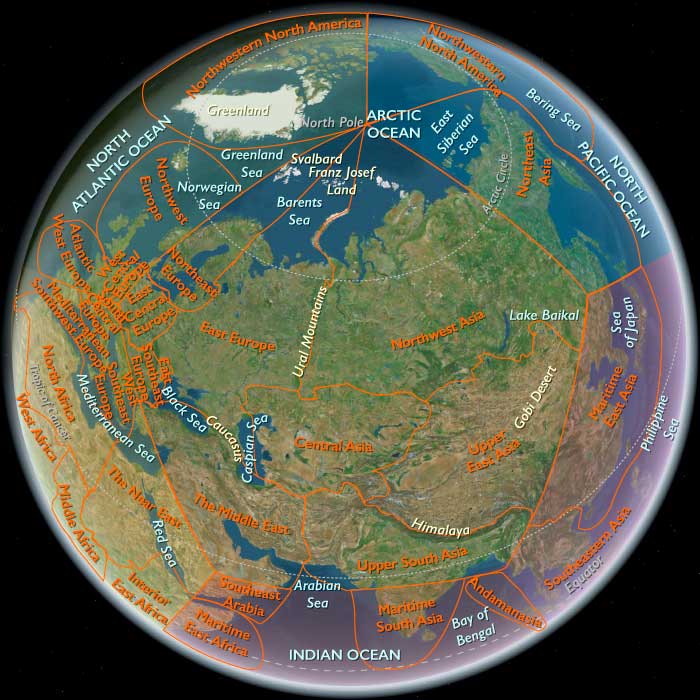
The Great Crossroads
View →Related Events
Showing 6 events out of 6 total
One source of opposition develops among Arab intellectuals in Cairo, Beirut, and Damascus, who
formulate the ideas of a new Arab nationalism.
The primary moving force behind this nascent Arab nationalist movement is opposition to the policies of Sultan Abdul Hamid.
The removal of Sultan Abdul Hamid by the Committee of Union and Progress (the umbrella organization of which the Young Turks is the major element) is widely supported by Arab nationalists.
The committee's program of institutional reform and promised autonomy raises Arab nationalist hopes.
In response, Arab urban intellectuals form clandestine political societies such as the Ottoman Decentralization Party, based in Cairo; Al Ahd (The Covenant Society), formed primarily by army officers in 1914; and Jamiat al Arabiyah al Fatat (The Young Arab Society), known as Al Fatat (The Young Arabs), formed by students in 1911.
The Arab nationalism espoused by these groups, however, lacks support among the Arab masses.
The link between the urban political committees and the desert tribesmen is Hussein ibn Ali Al Hashimi, the grand sharif and amir of Mecca and hereditary custodian of the Muslim holy places. Hussein, head of the Hashimite branch of the Quraysh tribe, claims descent from the Prophet.
Hussein and his sons Abdullah and Faisal (who have been educated as members of the Ottoman elite as well as trained for their roles as Arab chieftains) had spent the years 1893 to 1908 under enforced restraint in Constantinople.
In 1908 Abdul Hamid II appoints Hussein amir of Mecca and allows him and his sons to return to the Hijaz, the western part of present-day Saudi Arabia.
Some sources contend that Hussein's nomination was suggested by the Young Turks, who believed that he would be a stabilizing influence there, particularly if he were indebted to them for his position.
In his memoirs, however, Abdullah will state that Abdul Hamid II had named his father in preference to a candidate proposed by the Young Turks.
Hussein had reportedly asked for the appointment on the grounds that he had an hereditary right to it.
From the outset, Abdullah will write, his father was at odds with the attempts of the Young Turk regime to bring the Hijaz under the centralized and increasingly secularized administration in Constantinople.
Once in office, Hussein proves less tractable than either the sultan or the Turkish nationalists had expected.
Faisal delivers to his father the so-called Damascus Protocol in which the nationalists, who appeal to Hussein as "Father of the Arabs" to deliver them from the Turks, set out the demands for Arab independence that will be used by Faisal in his subsequent negotiations with the British.
In return, the nationalists accept the Hashimites as spokesmen for the Arab cause.
The Arab nationalists want an independent Arab state covering all the Ottoman Arab domains. The nationalist ideal, however, is not very unified; even among articulate Arabs, competing visions of Arab nationalism—Islamic, pan- Arab, and statist—inhibit coordinated efforts at independence.
British policy, however, espouses conflicting objectives; as a result, London becomes involved in three distinct and contradictory negotiations concerning the fate of the region.