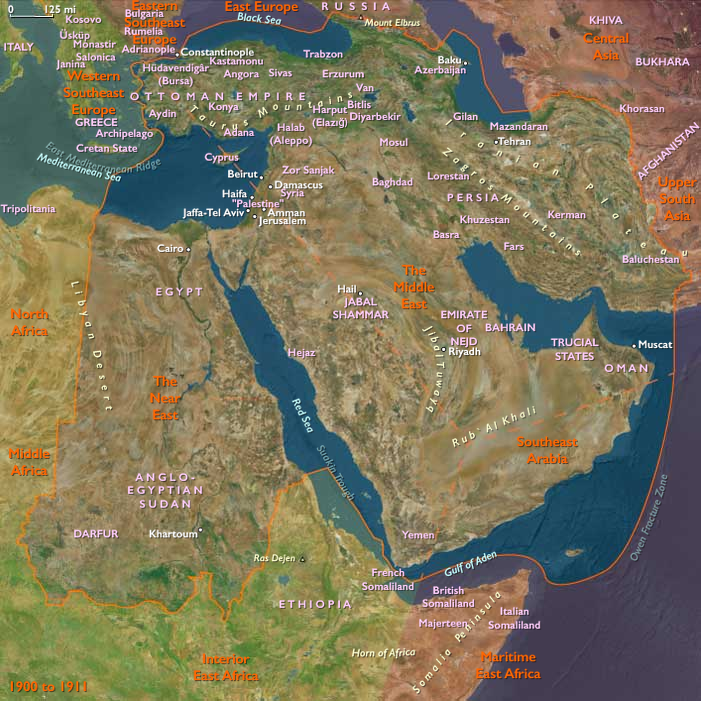
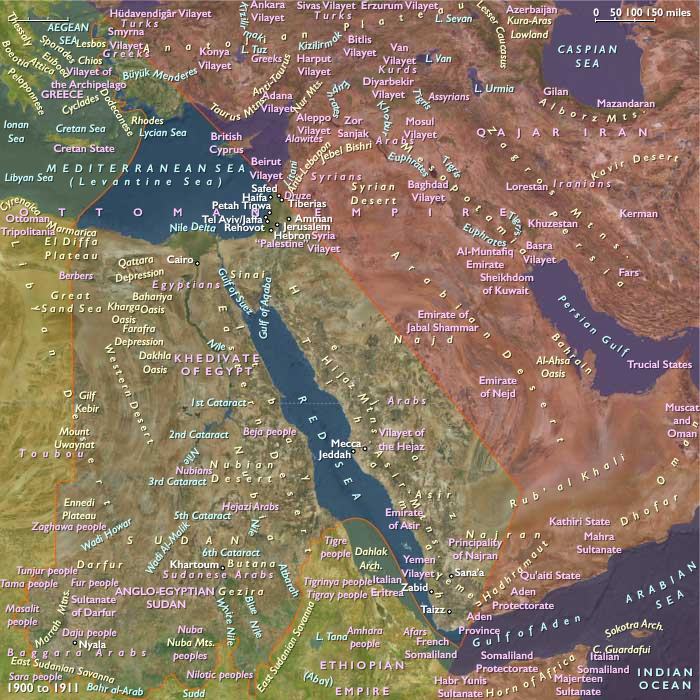
The remote desert tribes of Jordan and…
1900 CE to 1911 CE
The link between the urban political committees and the desert tribesmen is Hussein ibn Ali Al Hashimi, the grand sharif and amir of Mecca and hereditary custodian of the Muslim holy places. Hussein, head of the Hashimite branch of the Quraysh tribe, claims descent from the Prophet.
Hussein and his sons Abdullah and Faisal (who have been educated as members of the Ottoman elite as well as trained for their roles as Arab chieftains) had spent the years 1893 to 1908 under enforced restraint in Constantinople.
In 1908 Abdul Hamid II appoints Hussein amir of Mecca and allows him and his sons to return to the Hijaz, the western part of present-day Saudi Arabia.
Some sources contend that Hussein's nomination was suggested by the Young Turks, who believed that he would be a stabilizing influence there, particularly if he were indebted to them for his position.
In his memoirs, however, Abdullah will state that Abdul Hamid II had named his father in preference to a candidate proposed by the Young Turks.
Hussein had reportedly asked for the appointment on the grounds that he had an hereditary right to it.
From the outset, Abdullah will write, his father was at odds with the attempts of the Young Turk regime to bring the Hijaz under the centralized and increasingly secularized administration in Constantinople.
Once in office, Hussein proves less tractable than either the sultan or the Turkish nationalists had expected.
People
Groups
Arab people
View →
Jews
View →
Christians, Maronite
View →
Muslims, Sunni
View →
Muslims, Shi'a
View →
Mecca, Sharifate of
View →
Christians, Eastern Orthodox
View →
Ottoman Empire
View →
Palestine, Ottoman
View →
Arab nationalism
View →
Syria, Ottoman viyalet of
View →
Hejaz Vilayet
View →
Beirut Vilayet
View →
ZO (Zionist Organization)
View →
Zionism
View →
Commodities
Regions