Ivan Asen I of Bulgaria
Еmperor of Bulgaria
Years: 1160 - 1196
Ivan Asen I (also in Romanian Ioan Asan I, in English John Asen I) rules as emperor (tsar) of Bulgaria 1189–1196.
The year of his birth is unknown.
Related Events
Filter results
Showing 10 events out of 14 total
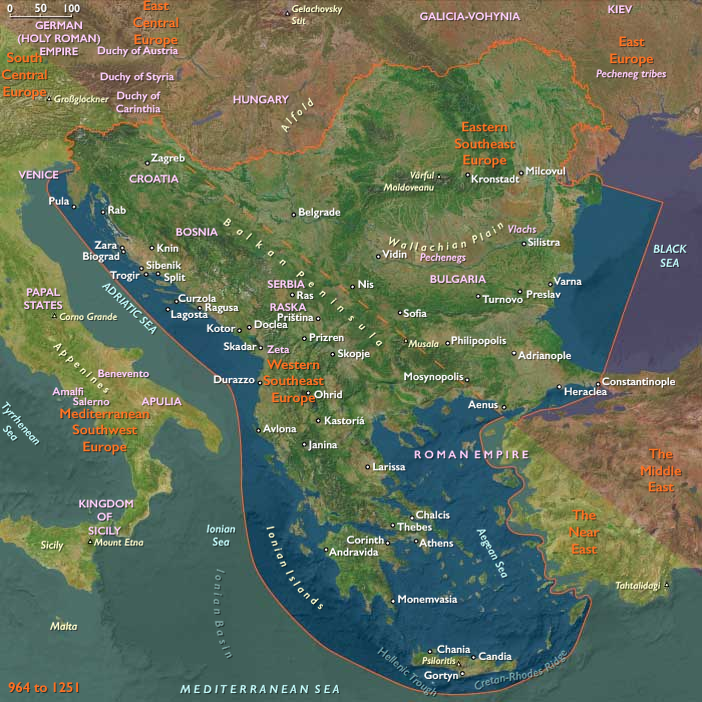
The power of the Eastern Roman Empire has again waned by 1185 because of external conflicts.
The noble brothers Asen and Peter lead a revolt that forces imperial recognition of an autonomous Bulgarian state.
Centered at Turnovo (present-day Veliko Turnovo), this state becomes the Second Bulgarian Empire.
Like the First Bulgarian Empire, the second expands at the expense of a preoccupied Byzantine Empire.
In 1202 Tsar Kaloian (1197-1207) concludes a final peace with Constantinople that gives Bulgaria full independence.
Kaloian also drives the Magyars from Bulgarian territory and in 1204 concludes a treaty with Rome that consolidates Bulgaria's western border by recognizing the authority of the pope.
By the middle of the thirteenth century, Bulgaria again rules from the Black Sea to the Adriatic.
Access to the sea greatly increases commerce, especially with the Italian Peninsula.
Turnovo becomes the center of Bulgarian culture, which enjoys a second golden age.
The final phase of Bulgaria's second Balkan dominance is the reign of Kaloian's successor, Ivan Asen II (1218-41).
In this period, culture continues to flourish, but political instability again threatens.
After the death of Ivan Asen II, internal and external political strife intensify.
Sensing weakness, the Tatars begin what will; be sixty years of raids in 1241, the Byzantines retake parts of the Second Bulgarian Empire, and the Magyars again advance.
The Greeks have ruled harshly over Bulgaria for nearly two centuries, using taxes and the political power of the church to crush opposition.
The first and second Crusades had passed through Bulgaria in this period, devastating the land.
In 1186, after a violent dispute with the new Greek emperor, Asen and Peter, descendants of Vlach landowners and boyars from Turnovo, whose family name is Belgun, lead a popular rising of Vlachs and Bulgarians and proclaim their independence from Constantinople.
Asen is crowned tsar as Ivan Asen I at Turnovo, and …
…Peter becomes ruler of the eastern half of the kingdom, with his residence at Preslav (now Veliki Preslav).
Isaac fails to crush the revolt of the Bulgarians and Vlachs, even though he leads expeditions against them in 1186-87.
The Asen brothers regroup, obtain the support of the Cumans, and launch a series of devastating raids against the empire in Thrace and Macedonia.
The brothers check the imperial army in Thrace in 1187; and, in the armistice that follows, which forces Constantinople’s recognition of an autonomous Bulgarian state, …
…their younger brother Kaloyan is sent as hostage to Constantinople.
He escapes, however, and war with Bulgaria breaks out, to continue intermittently.
In other developments, Constantinople patches things up with Venice in 1187.
Conrad of Monferrat, following his family's alliance with Manuel I Komnenos, had in 1179 led an army against Frederick Barbarossa's forces, then commanded by the imperial Chancellor, Archbishop Christian of Mainz.
He had defeated them at Camerino in September, taking the Chancellor hostage.
(He had previously been a hostage of the Chancellor.)
Leaving the captive in his brother Boniface's care, he had gone to Constantinople to be rewarded by the Emperor, returning to Italy shortly after Manuel's death in 1180.
Then in his mid-thirties, his personality and good looks had made a striking impression at the imperial court.
Isaac II Angelus had in the winter of 1186–1187 offered his sister Theodora as a bride to Conrad's younger brother Boniface, to renew the imperial family’s alliance with Montferrat, but Boniface is married.
Conrad, recently widowed, had taken the cross, intending to join his father in the Kingdom of Jerusalem; instead, he accepts Isaac's offer and returns o Constantinople in spring 1187.
On his marriage, he is awarded the rank of Caesar.
However, almost immediately, he has to help the Emperor defend his throne against a revolt, led by General Alexios Branas, who is doubly linked to the imperial Komnenos family.
He is the son of Michael Branas and of Maria Komnene, who was the great-niece of Alexios I Komnenos.
He himself had married Anna Vatatzaina, the niece of Manuel I Komnenos, and her sister, Theodora, had been Manuel's lover.
Branas is one of relatively few generals who had never rebelled against Andronikos I Komnenos, who had rewarded his loyalty by raising him to the exalted rank of protosebastos.
Branas had led several successful campaigns on his behalf, against the forces of Béla III of Hungary in 1183, against a rebellion led by Andronikos, Isaac and Alexios Angelos in 1184, and against the Norman invaders under William II of Sicily in 1185 (Battle of Demetritzes).
Shortly after the accession of Isaac II Angelos, Branas is in 1187 sent to counter the Vlach-Bulgarian Rebellion.
This time he does rebel, but is defeated by Conrad of Montferrat, the emperor's brother-in-law, who commands the center of the imperial forces in the battle.
Branas wounds Conrad slightly in the shoulder, who nevertheless unhorses him, his lance striking the cheekpiece of his helmet.
Branas is then beheaded by Conrad's supporting foot soldiers.
The head is taken to the imperial palace, where it is treated like a football, and is then sent to Branas's wife Anna, who (according to the historian Niketas Choniates) reacts bravely to the shocking sight.
However, Conrad, feeling that his service had been insufficiently rewarded, wary of Constantinople’s anti-Latin sentiment (his youngest brother Renier had been murdered in 1182) and of possible vengeance-seeking by Branas's family, sets off for the Kingdom of Jerusalem in July 1187 aboard a Genoese merchant vessel.
Serbia’s proposed alliance with the German Crusaders is not concluded, because Frederick concludes the Treaty of Adrianople with Isaac in February 1190.
Matters are complicated by a secret alliance between the Emperor of Constantinople and Saladin, warning of which is supplied by a note from Sibylla, ex-Queen of Jerusalem, but Isaac is soon forced to assist Frederick, whose avowed intention, at least at one time, was to conquer Constantinople.
Emperor Isaac II Angelos had been forced to conclude a true after his second campaign in Moesia and the fruitless siege of Lovech in 1187, thus de facto recognizing the independence of Bulgaria.
Until 1189, both sides had observed the truce.
The Bulgarians had used this time to further organize their administration and military.
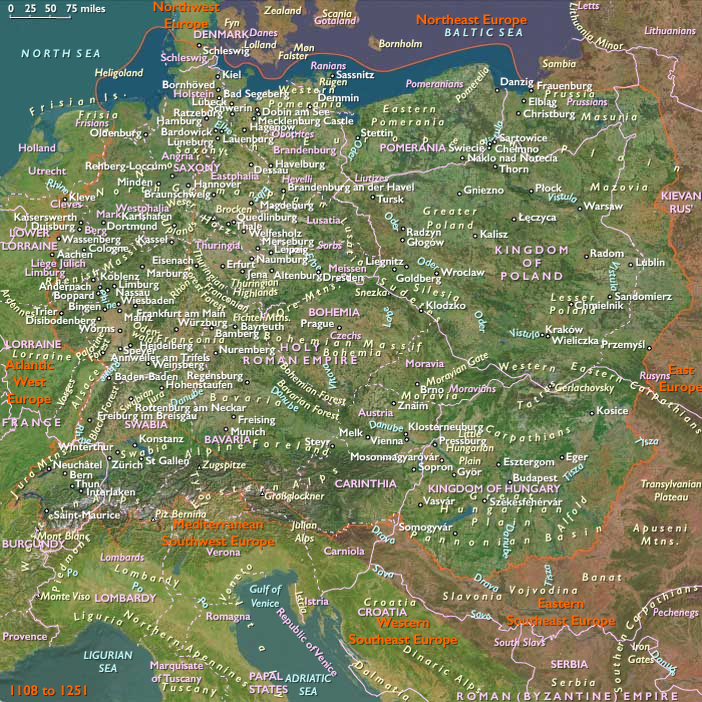
When the soldiers of the Third Crusade reached the Bulgarian lands at Niš, Asen and Peter had offered to help the Emperor of the Holy Roman Empire, Frederick I Barbarosa, with a force of forty thousand against Constantinople.
The relations between the Crusaders and the Empire have smoothed, however, and the Bulgarian proposal had been evaded.
Constantinople prepares a third campaign to avenge the Bulgarian actions.
Like the previous two invasions, they manage to overcome the passes of the Balkan mountains.
They make a bluff, indicating that they would pass near the sea by Pomorie, but instead head west and pass through the Rishki Pass to Preslav.
The Byzantine army next marches westwards to besiege the capital at Turnovo.
At the same time, the imperial fleet reaches the Danube in order to bar the way of Cuman auxiliaries from the northern Bulgarian territories.
The defense of the city is led by Asen himself and the morale of his troops is very high.
The Greeks’ morale, on the other hand, is quite low for several reasons: the lack of any military success, heavy casualties and particularly the fact that the soldiers' pay is in arrears.
This is used by Asen, who sends an agent in the guise of a deserter to the imperial camp.
The man tells Isaac II that, despite the efforts of the imperial navy, an enormous Cuman army has passed the river Danube and is heading towards Tarnovo to relive the siege.
The Emperor panics and immediately calls for a retreat through the nearest pass.
The retreating imperial army slowly marches southwards, their troops and baggage train stretching for kilometers.
The Bulgarian monarch having deduced that his opponent will go through the Tryavna Pass, the Bulgarians reach the pass before them and stage an ambush from the heights of a narrow gorge.
The imperial vanguard concentrates their attack on the center, where the Bulgarian leaders are positioned, but once the two main forces meet and hand to hand combat ensues, the Bulgarians stationed on the heights shower the Greek force below with rocks and arrows.
In panic, the imperial army breaks up and begins a disorganized retreat, prompting a Bulgarian charge, who slaughter everyone on their way.
Isaac II barely escapes; his guards have to cut a path through their own soldiers, enabling their commander's flight from the rout.
The Byzantine historian Niketas Choniates writes that only Isaac Angelos escaped and most of the others perished.
The battle is a major catastrophe for Constantinople.
The victorious army captures the imperial treasure including the golden helmet of the East Roman Emperors, the crown, and the Imperial Cross, which is considered the most valuable possession of Constantinople’s rulers—a solid gold reliquary containing a piece of the Holy Cross.
It is thrown in the river by an Orthodox cleric but is recovered by the Bulgarians.
These trophies will later became the pride of the Bulgarian Treasury and will be carried around the capital, Turnovo, during official occasions.