John Frederick of Saxony
Elector of Saxony
Years: 1503 - 1554
John Frederick I of Saxony (German: Johann Friedrich I; b. Torgau, 30 June 1503 – d. Weimar, 3 March 1554), called John the Magnanimous, is Elector of Saxony and Head of the Protestant Confederation of Germany (the Schmalkaldic League), "Champion of the Reformation".

Related Events
Filter results
Showing 10 events out of 13 total
Cranach had gone in 1509 to the Netherlands, where he painted the Emperor Maximilian and the boy who afterwards will become Emperor Charles V. Until 1508, Cranach had signed his works with his initials.
In that year the elector had given him the winged snake as a emblem, or Kleinod, which supersedes the initials on his pictures after that date.
The Torgau Altarpiece, painted in 1509 shows the influences of Quentin Massys and Jan Gossaert, as well as of Flemish and Italian Renaissance artists.
Luther, having lost popular support after urging suppression of the Knights' Revolt and the Peasants' War, finds personal solace in his marriage to a former Cistercian nun, Katherina von Bora, daughter to a family of Saxon landed gentry.
According to common belief, she was born on January 29, 1499 in Lippendorf; however, there is no evidence of this date from contemporary documents.
Due to the various lineages within the family and the uncertainty about Katharina's birth name, there were and are diverging theories about her place of birth.
Lately, however, a different view upon this matter has been proposed: that she was born in Hirschfeld and that her parents are supposed to have been a Hans von Bora zu Hirschfeld and his wife Anna von Haugwitz.
Neither can be historically proven.
It is also possible that Katharina was the daughter of a Jan von Bora auf Lippendorf and his wife Margarete, whose family name has not been established.
Both were only specifically mentioned in the year 1505.
It is certain that her father sent the five-year-old Katharina to the Benedictine cloister in Brehna in 1504 for education.
This is documented in a letter from Laurentius Zoch to Martin Luther, written on October 30, 1531.
This letter is the only evidence for Katharina von Bora's time spent within the monastery.
At the age of nine she moved to the Cistercian monastery of Marienthron (Mary's Throne) in Nimbschen, near Grimma, where her maternal aunt was already a member of the community.
Katharina is well documented at this monastery in a provision list of 1509/10.
After several years of religious life, Katharina became interested in the growing reform movement and grew dissatisfied with her life in the monastery.
Conspiring with several other nuns to flee in secrecy, she contacted Luther and begged for his assistance.
On Easter Eve, 4 April 1523, Luther had sent Leonhard Köppe, a city councilman of Torgau and merchant who regularly delivered herring to the monastery.
The nuns successfully escaped by hiding in Köppe's covered wagon among the fish barrels, and fled to Wittenberg.
A local student wrote to a friend: 'A wagon load of vestal virgins has just come to town, all more eager for marriage than for life.
God grant them husbands lest worse befall."
Luther at first asked the parents and relations of the refugee nuns to admit them again into their houses, but they declined to receive them, possibly as this was participating in a crime under canon law.
Within two years, Luther has been able to arrange homes, marriages, or employment for all of the escaped nuns—except for Katharina.
She first was housed with the family of Philipp Reichenbach, the city clerk of Wittenberg, and later went to the home of Lucas Cranach the Elder and his wife, Barbara.
Katharina has a number of suitors, including Wittenberg University alumnus Jerome (Hieronymus) Baumgärtner (1498–1565) of Nuremberg and a pastor, Kaspar Glatz of Orlamünde, but none of the proposed matches have resulted in marriage.
Finally, she tells Luther’s friend and fellow reformer, Nikolaus von Amsdorf, that she will be willing to marry only Luther or himself.
Luther eventually marries Katharina on June 13, 1525, before witnesses including Justus Jonas, Johannes Bugenhagen, and Barbara and Lucas Cranach the Elder.
There is a wedding breakfast the next morning with a small company, but two weeks later, on June 27, they hold a more formal public ceremony that is presided over by Bugenhagen.
Katharina is twenty-six years old, Luther forty-one.
The couple takes up residence in the "Black Cloister" (Augusteum), the former dormitory and educational institution for Augustinian friars studying in Wittenberg, given as a wedding gift by the reform-minded John Frederick, Elector of Saxony, who is the son and nephew of Luther's protectors, John, Elector of Saxony and Frederick III, Elector of Saxony.
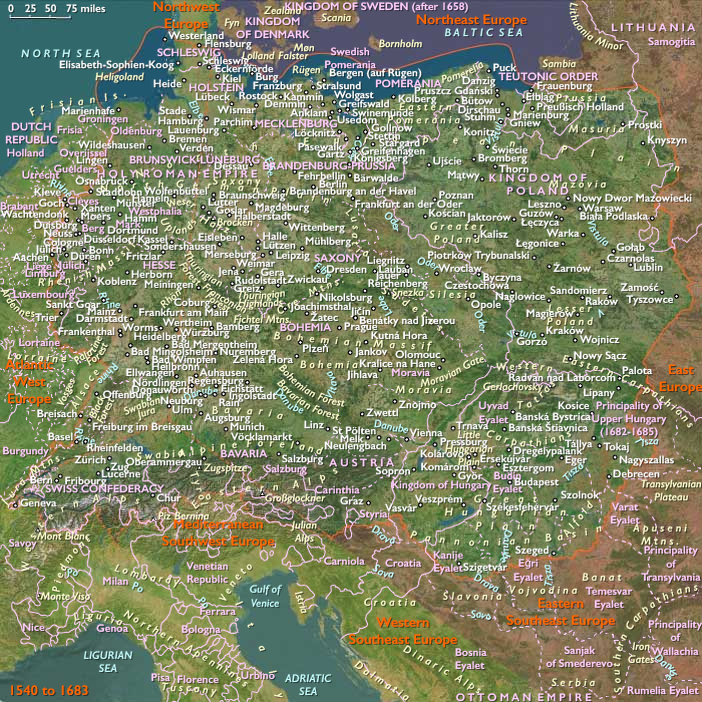
East Central Europe (1528–1539 CE): Aftermath of the German Peasants' War, Habsburg Consolidation, and Deepening Religious Division
Between 1528 and 1539 CE, East Central Europe—including Poland, Hungary, Czechia, Slovakia, and eastern portions of Germany and Austria—experienced significant political, religious, and social transformations. This era was profoundly shaped by the aftermath of the German Peasants' War (1524–1525)—Europe's largest and most extensive popular uprising before the French Revolution—which decisively reinforced aristocratic dominance, reshaped alliances between secular rulers and reformers, and intensified the confessional divisions emerging from the Protestant Reformation. At the same time, the Habsburg dynasty solidified its rule in Bohemia, Hungary, and Austria, responding both to internal unrest and external Ottoman threats, and setting patterns of governance and religious affiliation with lasting implications.
Political and Military Developments
Aftermath and Consequences of the German Peasants' War
-
Magnitude and Scope:
The German Peasants' War (1524–1525) had involved up to 300,000 peasants, miners, artisans, and urban workers across vast territories in Germany, profoundly affecting East Central European regions, particularly Thuringia, Franconia, parts of Saxony, and areas near Salzburg and Upper Austria. Radical reformers like Thomas Müntzer, who led a fierce and eventually defeated revolt in Thuringia, symbolized the complex interplay of religious radicalism and social grievances. -
Aristocratic Reaction and Consolidation of Noble Power:
The brutal suppression of the uprising by noble and imperial authorities significantly bolstered aristocratic dominance, reinforced serfdom, and restricted peasant rights. Noble leaders emerged strengthened, while peasant and lower-class demands for social and economic reform were violently quashed. This outcome decisively shaped the rural social structure and power relations in the German-speaking regions of East Central Europe for centuries.
Habsburg Authority and Territorial Consolidation
-
Bohemia and Hungary under Ferdinand I:
Ferdinand I of Habsburg (r. 1527–1564), ruler of Austria, Bohemia, and parts of Hungary, reinforced centralized governance and intensified administrative and military reforms to combat internal unrest and external Ottoman threats. His reign provided political stability despite ongoing conflict, especially along Hungary's contested frontiers. -
Ottoman Pressure and Fragmentation of Hungary:
Central Hungary remained divided between Habsburg-controlled Royal Hungary in the west and Ottoman-dominated regions around Buda, creating lasting geopolitical tensions and reinforcing the critical strategic importance of Austrian and Hungarian border fortresses.
Economic and Technological Developments
Disruptions and Adaptations Post-Peasants' War
-
Following the Peasants' War, rural economies, especially in Franconia, Thuringia, Saxony, and parts of Austria, faced temporary disruptions but quickly rebounded under tighter feudal oversight. This led to stricter lord-peasant relationships, stabilizing but severely limiting peasants' economic and social mobility.
-
Mining towns (Joachimsthal, Kutná Hora, Banská Štiavnica) continued their critical role in financing regional economies, enabling rapid post-war economic recovery and supporting the strengthened noble order.
Cultural and Artistic Developments
Protestant Reformation and Lutheran-Catholic Polarization
-
The aftermath of the Peasants' War marked a turning point for the Protestant Reformation. Key reformers, notably Martin Luther, explicitly condemned the rebels, firmly aligning Lutheranism with established political authorities. This move significantly shaped the religious landscape, pushing the Reformation toward conservative, state-supported Protestantism.
-
Throughout German-speaking East Central Europe, Lutheranism gained official adoption in numerous territories, intensifying emerging religious divisions. Prominent princes and cities openly embraced Lutheran doctrines:
-
Lutheran territories included: Electoral Saxony (under Elector John the Steadfast), Landgraviate of Hesse, Duchies of Prussia, Brunswick-Lüneburg, and Saxe-Weimar, as well as important imperial cities such as Nuremberg.
-
Catholic territories, by contrast, included: Austria, Bavaria, and the ecclesiastical principalities (Salzburg, Bamberg, Regensburg, Passau). This growing distinction created political alignments that became increasingly central to regional and imperial politics in the following centuries.
-
Settlement and Urban Development
Fortification and Urban Consolidation
-
Strategic fortifications and urban renewal projects became central priorities, particularly in Habsburg territories along the Ottoman frontier. Cities such as Vienna, Pressburg (Bratislava), and Graz received enhanced fortifications, improved infrastructure, and expanded civic and economic functions.
Social and Religious Developments
Reinforcement of Aristocratic Dominance and Feudal Control
-
The peasants' defeat solidified feudal and aristocratic dominance, cementing stricter serfdom in many territories and sharply limiting lower-class aspirations. This outcome dramatically influenced social hierarchies, creating tensions that lingered into later centuries.
Growing Lutheran-Catholic Divide
-
The period witnessed decisive steps toward institutionalizing the religious division. Lutheran churches and ecclesiastical structures emerged distinctly within territories whose rulers had embraced Protestantism, establishing a lasting Lutheran presence.
-
Conversely, regions remaining Catholic—particularly under the staunchly Catholic Habsburgs—strengthened Counter-Reformation efforts, promoting religious education, monastic revival, and ecclesiastical discipline.
Long-Term Consequences and Historical Significance
The era 1528–1539 CE crucially shaped East Central Europe's social, religious, and political trajectory. The aftermath of the German Peasants' War reinforced aristocratic dominance, intensified social hierarchies, and redirected the Reformation toward conservative alignments with political authorities. The resulting Lutheran-Catholic polarization profoundly influenced the region's political alliances, setting clear distinctions between territories based on confessional affiliations. Habsburg administrative and defensive consolidations established enduring governance structures across Austria, Bohemia, and Hungary, shaping regional stability amid ongoing Ottoman pressures.
These developments provided the political, religious, and social frameworks that shaped East Central Europe throughout the later 16th and into the 17th century, profoundly affecting the dynamics of subsequent conflicts, particularly during the Wars of Religion, Thirty Years' War, and ongoing struggles between Protestant and Catholic states and principalities.
Pope Paul III issues a bull calling for a general council of the Roman Catholic Church to deal with the Reformation movement.
In response, Johann Friedrich (John Frederick), Lutheran elector of Saxony, seeks to determine what issues can be negotiated with the Roman Catholics and what can not be compromised.
He therefore asks Martin Luther to review earlier statements of faith by the Reformers to determine what is essential to the faith.
After Luther prepares the articles, he invites several Reformers to Wittenberg to discuss them, and after some minor changes, eight theologians sign them.
They are then sent to the Elector in January 1537, and become known as the Schmalkaldic Articles.
Philipp Melanchthon writes “Treatise on the Power of the Papacy”, a confession of faith that is added to Luther's.
Like Luther, Melanchthon emphasizes the justification of the sinner by faith in Christ as a gift of God's grace alone, as taught by Saint Paul.
The Holy Roman Empire in the sixteenth century is a centralized state in name only, divided into many princely and city states that provide a powerful check on the rule of the Holy Roman Emperor.
The division of power between the emperor and the various states have made the Reformation in Germany possible, as individual states defend reformers within their territories.
Martin Luther has been supported in the Electorate of Saxony, by Frederick III and his successors John and John Frederick.
Philip I, Landgrave of Hesse—whose lands lie midway between Saxony and the Rhine—also supports the Reformation, and he figures prominently in the lives of both Luther and Martin Bucer.
Bucer had acted as a mediator between Luther and the other leading reformer, the late Huldrych Zwingli, who had differed on the doctrine of the eucharist.
Bucer had later sought agreement on common articles of faith such as the Tetrapolitan Confession and the Wittenberg Concord, working closely with Philipp Melanchthon on the latter.
The Emperor Charles V, who has to balance the demands of his imperial subjects, is often distracted by war with France and the Ottoman Empire and in Italy.
The political rivalry among all the players greatly influences the ecclesiastical developments within the Empire.
In addition to the princely states, free imperial cities, nominally under the control of the Emperor but really ruled by councils that act like sovereign governments, are scattered throughout the Empire.
As the Reformation has taken root, clashes have broken out in many cities between local reformers and conservative city magistrates.
In the Truce of Frankfurt of 1539, Emperor Charles and the leaders of the Schmalkaldic League, a defensive alliance of Lutheran princes within the Empire, had agreed on a major colloquy to settle all religious issues within the imperial domains.
Bucer has placed great hopes on this meeting: he believes it will be possible to persuade most German Catholics to accept the doctrine of sola fide as the basis for discussions on all other issues.
Under various pseudonyms, he has published tracts promoting a German national church.
A conference in Haguenau had begun on June 12, 1540, but during a month's discussion the two sides had failed to agree on a common starting point, and decided to reconvene in Worms.
Melanchthon leads the Protestants, with Bucer a major influence behind the scenes.
When the colloquy again makes no progress, the imperial chancellor, Nicholas Perrenot de Granvelle, calls for secret negotiations.
Bucer now begins working with Johannes Gropper, a delegate of the archbishop of Cologne, Hermann von Wied.
Aware of the risks of such apparent collusion, he is determined to forge unity among the German churches.
The two agree on twenty-three articles in which Bucer concedes some issues toward the Catholic position.
These include justification, the sacraments, and the organization of the church.
Four disputed issues are left undecided: veneration of the saints, private masses, auricular confession, and transubstantiation.
The results are published in the "Worms Book", which they confidentially present to a prince on each side of the religious divide: Philip of Hesse and Joachim II, Elector of Brandenburg.
Philip of Hesse is, with John Frederick I, Elector of Saxony, a cofounder of the Schmalkaldic League, a defensive alliance of Lutheran princes within the Holy Roman Empire that has enabled the Reformation to take hold throughout Germany.
It had originated in 1531 as a defensive religious alliance, with the members pledging to defend each other should Charles V, the Holy Roman Emperor, attack their territories.
The League had quickly become more of a territorial political movement, as breaking from the Catholic Church offers significant economic advantages.
The league had in December 1535 admitted anyone who would subscribe to the Augsburg Confession, thus Anhalt, Württemberg, Pomerania, as well as the free imperial cities of Augsburg, Hanover, Frankfurt am Main, and Kempten have joined the alliance.
Francis I of France had joined the League against the Habsburgs in 1535, but later retracted due to religious conflicts from within.
It had allied in 1538 with newly reformed Denmark.
The League had in 1539 acquired Brandenburg, which is under the leadership of Joachim II Hector.
Philip, in effecting a bigamous marriage in 1540 to Margaret of Saale, has lost the support of many reformers, forcing him to make peace in 1541 with Emperor Charles.
Relations between France and England are collapsing by early 1543.
Henry is already angered by Francis’s refusal to pay the various pensions, which are owed to him under the terms of past treaties.
He is now faced with the potential of French interference in Scotland, where he is entangled in the midst of an attempt to marry his son to Mary, Queen of Scots, which will develop into the open warfare of the "Rough Wooing.”
He had intended to begin a war against Francis in the coming summer, but negotiating a treaty to this effect with Emperor Charles V proves difficult.
Because Henry is, in Charles's eyes, a schismatic, the Emperor cannot promise to defend him against attack, nor sign any treaty which refers to him as the head of the Church—both points upon which Henry insists.
Negotiations continue for weeks; finally, on February 11, 1543, Henry and Charles sign a treaty of offensive alliance, pledging to invade France within two years.
Henry had sent Francis an ultimatum in May 1543, threatening war within twenty days.
On June 22 he at last declares war.
King Henry and Emperor Charles had signed a treaty on December 31, 1543, pledging to invade France in person by June 20, 1544; each is to provide an army of no less than thirty-five thousand infantry and seven thousand cavalry for the venture.
Against this, Francis can muster about seventy thousand men in his various armies.
The campaign cannot begin, however, until Henry and Charles resolve their personal conflicts with Scotland and the German princes, respectively.
The Earl of Hertford on May 15 informs Henry that Scotland, after his raids, is no longer in a position to threaten him.
Henry now begins to prepare for a personal campaign in France—against the advice of his council and the Emperor, who believe that his presence will be a hindrance.
Charles has meanwhile reached an understanding with the princes at the Diet of Speyer, and the Electors of Saxony and Brandenburg have agreed to join his invasion of France.