John, King of Denmark
Years: 1455 - 1513
John, also known as Hans; né Johannes (February 2, 1455 – February 20, 1513) is King of Denmark (1481–1513), Norway (1483–1513) and as John II (Swedish: Johan II) of Sweden (1497–1501) in the Kalmar Union, and also Duke of Schleswig and Holstein.
The three most important political goals of King John are the restoration of the Kalmar Union, reduction of the dominance of the Hanseatic League, and the building of a strong Danish royal power.
Related Events
Filter results
Showing 10 events out of 22 total
Eric's foreign policy engulfs Denmark in a succession of wars with the Holstein counts and the city of Lübeck.
When the Hanseatic League imposes a trade embargo on Scandinavia, the Swedes (who see their mining industry adversely affected) rise up in revolt.
The three countries of the Kalmar Union all declare Eric deposed in 1439.
However, support for the idea of regionalism continues, so when Eric's nephew Christopher of Bavaria comes to the throne in 1440, he manages to get himself elected in all three kingdoms, briefly reuniting Scandinavia (1442–1448).
The Swedish nobility grows increasingly unhappy with Danish rule and the union soon becomes merely a legal concept with little practical application.
During the subsequent reigns of Christian I (1450–1481) and Hans (1481–1513), tensions grow, and several wars between Sweden and Denmark erupt.
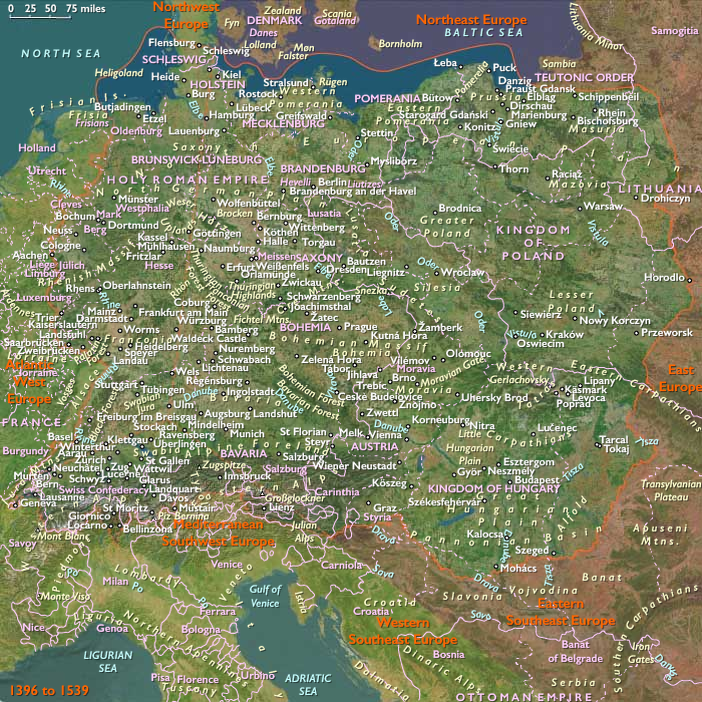
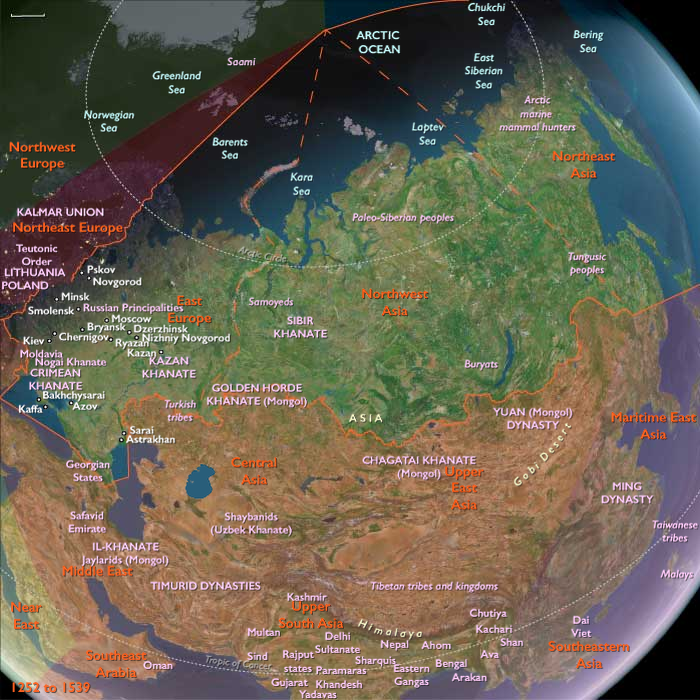
Northeast Europe (1480–1491 CE): Deepening Union Fragmentation, Polish–Lithuanian Expansion, and Regional Realignments
Between 1480 and 1491 CE, Northeast Europe experienced profound political transformations driven by the continued fracturing of the Kalmar Union, sustained Polish–Lithuanian ascendancy, and the ongoing decline of the Teutonic Knights. Strategic diplomatic maneuvers and emerging power dynamics reshaped the geopolitical landscape, setting the stage for critical future developments.
Accelerating Decline of the Teutonic Knights
The Teutonic Knights, severely weakened by internal discord, financial instability, and diplomatic isolation, found their influence increasingly diminished. The Order’s political and territorial control within Prussia continued to erode, facilitating further encroachments by neighboring powers, particularly the strengthening Polish–Lithuanian Union. Unable to reverse their decline, the Teutonic Knights faced intensified pressure and vulnerability during this era.
Fragmentation and Tensions within the Kalmar Union
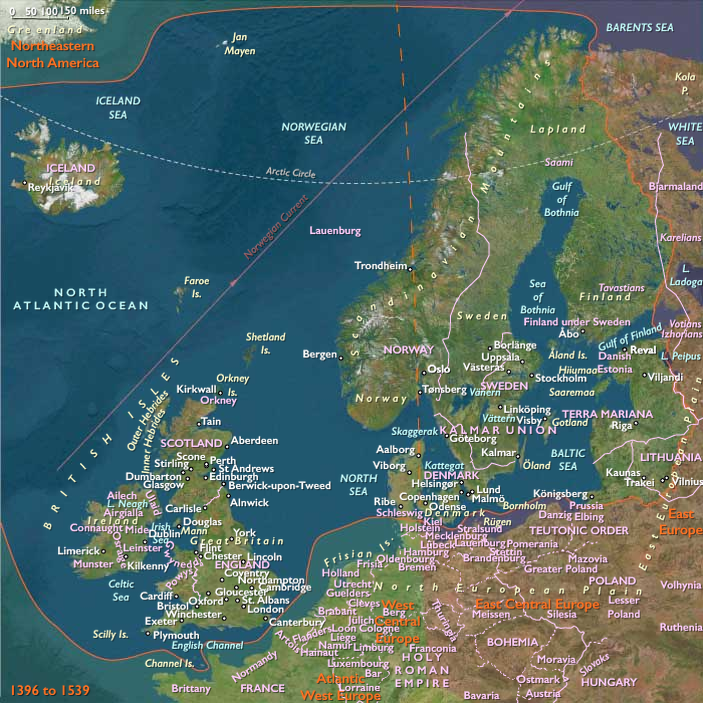
Conflicts within the Kalmar Union deepened under Danish King John (Hans), who succeeded Christian I in 1481. His reign saw escalating disputes, particularly between Danish central authority and Swedish nobility, further fueling movements for Swedish autonomy. The resulting political instability significantly weakened the cohesion and effectiveness of the Union, increasingly pushing it toward eventual disintegration.
Polish–Lithuanian Union’s Continued Territorial Expansion
Under Casimir IV Jagiellon, the Polish–Lithuanian Union extended its territorial and political influence. Effective diplomatic initiatives and military campaigns solidified its dominance in Eastern Europe, reinforcing regional stability while significantly weakening the strategic positions of rival states, notably the Teutonic Order in Prussia.
Strategic Maneuvering of the Livonian Confederation
The Livonian Confederation, administered from its political and commercial center in Riga, continued adeptly navigating regional complexities. Enhancing its diplomatic alliances, reinforcing defensive structures, and undertaking internal administrative reforms, the Confederation maintained its autonomy and economic prosperity despite the shifting power dynamics in the region.
Continued Integration of Swedish Finland
Despite the increasing fracturing within the Kalmar Union, Sweden continued consolidating its political and administrative control over southern Finland. Investments in fortifications, ecclesiastical infrastructure, and governmental reforms further cemented Finland’s integration, ensuring sustained political and cultural alignment with Sweden amid broader regional uncertainties.
Economic Stability and Urban Prosperity
Major urban centers, including Reval (Tallinn), Riga, Königsberg, and Visby on Gotland, sustained economic growth through robust maritime commerce and expanded trade networks. These cities remained vital economic hubs, providing stability and resilience against the backdrop of political tensions and shifting alliances.
Ecclesiastical Influence and Cultural Cohesion
The significant roles of ecclesiastical institutions—especially the influential Teutonic Order and regional bishoprics—remained central to education, governance, and cultural continuity. Their continued prominence bolstered Latin Christian traditions, enhancing regional stability and identity during an era marked by geopolitical uncertainty.
Ongoing Geopolitical Realignments
Regional geopolitics remained complex, driven by the persistent tensions within the Kalmar Union, Polish–Lithuanian territorial ambitions, and the continued deterioration of the Teutonic Knights’ authority. The period was characterized by strategic diplomatic maneuvering, shifting alliances, and carefully managed conflicts, reflecting the region's intricate political dynamics.
Legacy of the Era
The period from 1480 to 1491 CE was crucial in shaping Northeast Europe’s subsequent historical trajectory, marked by deepening fragmentation within the Kalmar Union, continued expansion of the Polish–Lithuanian Union, and persistent regional economic vitality. These developments profoundly influenced future political alignments, cultural identities, and territorial configurations across Northeast Europe.
Northwest Europe (1480–1491 CE): Consolidation, Conflict, and Cultural Expansion
England: Consolidation of Yorkist Power
Following years of dynastic turmoil, Edward IV effectively stabilized his reign and strengthened the Yorkist hold on power, ruling with considerable authority until his sudden death in 1483. His young heir, Edward V, briefly ascended the throne, but Edward IV’s brother, Richard, Duke of Gloucester, seized the crown, becoming Richard III. Richard III's reign was overshadowed by controversy, especially surrounding the disappearance of Edward V and his brother, the "Princes in the Tower," presumed murdered. In 1485, the Lancastrian claimant Henry Tudor challenged Richard at the Battle of Bosworth Field, where Richard III was killed, effectively ending the Wars of the Roses. Henry Tudor became Henry VII, establishing the Tudor dynasty and marking a significant turning point in English history. Sporadic Yorkist revolts continued, resulting in the last pitched battles of the Wars of the Roses, though stability gradually returned under Henry VII's cautious but firm governance.
Scotland: Persistent Nobility Conflict
In Scotland, King James III faced continued tensions and rebellions due to his unpopular favoritism toward commoners and estrangement from powerful noble factions. Conflict culminated dramatically in 1488 at the Battle of Sauchieburn, where James III was killed and succeeded by his son, James IV, whose reign ushered in greater political stability and cultural growth, enhancing Scotland’s Renaissance. An agreement between James III and the Macdonald “Lord of the Isles” in 1480 turned Macdonald’s illegitimate son, Aonghas Óg, against both his father and the central government, leading to continued violent divisions in the Highlands until Aonghas’s assassination in 1490. Anglo-Scottish truces negotiated in 1484, 1487, and again in 1491 contributed to relative peace.
Ireland: Gaelic Dominance and Limited English Influence
Ireland saw sustained Gaelic power, with dominant families such as the Fitzgeralds and O'Neills continuing to effectively limit English authority largely to the region around The Pale. Despite intermittent English efforts at asserting greater control, Gaelic society flourished culturally and politically, strengthening the autonomous Irish identity through continued production of native poetry and adherence to traditional Brehon laws.
Scandinavia: Fragile Stability of the Kalmar Union
The Kalmar Union under King Hans (John) continued to experience tensions, especially from Sweden, which persistently sought greater independence. King Hans pursued a balanced policy combining diplomatic efforts and strategic marital alliances to maintain Danish dominance. The Union remained intact, albeit fragile, highlighting the ongoing struggle between centralized royal power and regional independence movements.
Iceland: Preservation of Literary Heritage
In Iceland, isolation and limited economic resources compelled continued cultural self-reliance. Manuscript production persisted robustly, preserving essential Icelandic sagas and poetic traditions. Despite external pressures, Icelanders remained culturally vibrant, carefully transmitting their historical narratives and literary achievements from generation to generation.
Cultural and Intellectual Advances
The period experienced remarkable cultural expansion. In England, William Caxton’s Westminster press continued publishing essential literary works, including Sir Thomas Malory’s influential Morte Darthur in print form in 1485, greatly impacting literary traditions. Caxton’s press also produced a translation in 1481 of the Flemish version of Reynard the Fox, and his translation of Vincent of Beauvais’s Myrour of the Worlde. Additionally, Caxton published his Vocabulary in French and English and numerous works by Chaucer and Gower, solidifying the English literary language. Caxton’s associate, Theoderic Rood, introduced printing to Oxford, enhancing scholarly output, including influential texts like John Ankywyll's Compendium totius grammaticae.
Architectural innovations proceeded with widespread adoption of the Perpendicular Gothic style, particularly in church construction, exemplified by the ongoing enhancements to York Minster, whose Magdalen Tower became an iconic Oxford landmark. Music and visual arts flourished, shaped by influences from continental Europe and regional creativity.
Legacy of the Era
By 1491 CE, Northwest Europe entered a period marked by renewed dynastic stability, cultural enrichment, and persistent regional autonomy. England transitioned smoothly into Tudor rule, Scotland saw relative internal peace under James IV, Ireland maintained robust Gaelic autonomy, and the Kalmar Union navigated continuing internal strains. The enduring literary and cultural heritage, supported by innovations in printing and artistic expression, laid strong foundations for Northwest Europe’s subsequent development.
John, born at Aalborghus, in Aalborg, to Christian I of Denmark and Dorothea of Brandenburg, daughter of Margrave John of Brandenburg, had in 1478 married Christina of Saxony, granddaughter of Frederick the Gentle of Saxony.
This produced the following offspring: Christian II, Francis, Knud, and Elisabeth, who later married as princess of Brandenburg.
In 1458, John's father, King Christian I, had had the Norwegian Council of the Realm commit to electing Christian's eldest son as next king of Norway upon his death.
A similar declaration had been made in Sweden.
In 1467, John had been hailed as successor to the throne in Denmark.
John uses the title heir to the throne of Norway, in line with Norway's old status as a hereditary kingdom, but this is a claim the Norwegian Council had not immediately recognized.
Consequently, upon King Christian's death in May 1481, John's position is unchallenged in Denmark, whereas …
…in Norway the Council of the Realm assumes royal authority, and an interregnum ensues.
No serious rival candidates to the Norwegian throne exist, but the Council is determined to demonstrate Norway's status as a sovereign kingdom.
Printed works appear in Sweden in 1483.
A meeting between the Councils of Denmark, Sweden and Norway had been scheduled for January 13, 1483 at Halmstad, to work out the terms for electing John as king—his håndfæstning.
The Swedish Council fails to turn up at the meeting, but the Norwegian and Danish councils proceed to produce a joint declaration containing the terms for John's rule, and electing him king.
It is hoped that Sweden will later accept the same document and thereby acknowledge John as king.
John is subsequently crowned King of Denmark in Copenhagen on May 18, and …
…King of Norway in Trondheim on July 20.
The Muscovite-Lithuanian Wars, also known as the Russo-Lithuanian Wars, or just either Muscovite Wars or Lithuanian Wars, are a series of wars between the Grand Duchy of Lithuania, allied with the Kingdom of Poland, and Grand Duchy of Moscow.
After several defeats at the hands of Ivan III and Vasily III, the Lithuanians are increasingly reliant on Polish aid, which eventually becomes an important factor in the creation of the Polish-Lithuanian Commonwealth.
In the first series of wars in the fifteenth century, the Lithuanians will gain control of a lot of Rus' territories, from Kiev to Mozhaisk.
The Russo-Swedish War of 1495–1497 is a result of an alliance between Ivan III of Russia and Hans of Denmark, who is waging war against the Sture family of Sweden in the hope of regaining the Swedish throne.
It is believed that Hans promised to concede some stretches of Finnish lands to the Russian monarch, although he does not bother to honor the agreement after he has been crowned King of Sweden at the close of the war.
Northeast Europe (1492–1503 CE): Union Fragmentation, Rising Regional Powers, and Shifting Alliances
Between 1492 and 1503 CE, Northeast Europe faced transformative geopolitical developments, characterized by increasing instability within the Kalmar Union, continued weakening of the Teutonic Order, and the rising assertiveness of regional powers. Strategic diplomatic shifts, territorial realignments, and sustained economic prosperity defined this crucial era.
Deepening Instability within the Kalmar Union
Internal fractures intensified within the Kalmar Union, particularly following the ascension of John (Hans) as King of Denmark, Norway, and Sweden in 1481. Despite his efforts to consolidate authority, persistent Swedish resistance and internal discontent hindered effective governance, weakening union cohesion and fueling regional tensions. The instability that defined this era laid critical groundwork for the Union’s later fragmentation.
Teutonic Order’s Continuing Decline
The Teutonic Order persisted in its steady decline due to ongoing internal divisions, financial hardships, and diplomatic isolation. Pressured heavily by the increasingly dominant Polish–Lithuanian Union, the Order faced territorial vulnerability in Prussia and struggled to maintain effective administration in regions such as Estonia. Efforts to stabilize major urban centers, including Königsberg and Reval (Tallinn), provided only limited relief, leaving the Order exposed to further external challenges.
Polish–Lithuanian Union’s Geopolitical Expansion
Under John I Albert, and subsequently Alexander Jagiellon, the Polish–Lithuanian Union continued to assert strong regional leadership. With diplomatic skill, military effectiveness, and internal administrative strength, the Union expanded its territorial influence and solidified control over contested borderlands. These actions firmly established Poland-Lithuania as a major geopolitical force, significantly altering regional balances of power.
Strategic Stability in the Livonian Confederation
The Livonian Confederation, governed from its economic and diplomatic hub at Riga, maintained political autonomy and economic resilience through strategic governance, fortified urban defenses, and effective diplomatic outreach. These actions allowed the Confederation to navigate complex regional dynamics successfully, preserving its stability and relevance amid shifting alliances and political pressures.
Continued Swedish Integration and Stability in Finland
Despite escalating tensions within the Kalmar Union, Sweden continued to strengthen governance in southern Finland. Reinforced fortifications, efficient administrative frameworks, and enhanced ecclesiastical institutions promoted political stability and cultural cohesion, ensuring Finland’s secure integration and strategic significance within Sweden’s domain.
Prosperity and Economic Resilience in Major Urban Centers
Urban centers such as Reval (Tallinn), Riga, Königsberg, and Visby on Gotland sustained significant economic growth and urban resilience. Expanded maritime trade networks, strong commercial activity, and stable urban governance facilitated economic prosperity, bolstering regional stability despite ongoing political upheavals.
Ecclesiastical Influence and Cultural Cohesion
Influential ecclesiastical institutions, particularly regional bishoprics and the Teutonic Order, continued their essential roles in social governance, educational support, and cultural continuity. Their sustained promotion of Latin Christian traditions provided regional stability, reinforcing social cohesion amid shifting political landscapes.
Strategic Diplomacy Amid Rising Tensions
Diplomatic interactions and strategic negotiations intensified amid shifting geopolitical alignments involving the Kalmar Union, Teutonic Order, Polish–Lithuanian Union, and Livonian Confederation. Diplomatic maneuvers aimed at mitigating conflict, stabilizing territorial boundaries, and managing regional rivalries highlighted the complexity of Northeast Europe's geopolitical climate during this era.
Legacy of the Era
The era from 1492 to 1503 CE was pivotal in reshaping Northeast Europe’s geopolitical landscape, defined by intensifying union instability, continued decline of traditional regional powers, and assertive expansion by emerging powers. These transformative dynamics significantly influenced territorial alignments, diplomatic strategies, and regional identities, profoundly shaping Northeast Europe's subsequent historical trajectory.