
John Randolph of Roanoke
American politician and planter
1773 CE to 1833 CE
John Randolph (June 2, 1773 – May 24, 1833), known as John Randolph of Roanoke, is a planter, and a Congressman from Virginia, serving in the House of Representatives at various times between 1799 and 1833, the Senate (1825–1827), and also as Minister to Russia (1830).
After serving as President Thomas Jefferson's spokesman in the House, he breaks with Jefferson in 1803 and becomes the leader of the "Old Republican" or "Quids", an extreme states' rights vanguard of the Democratic-Republican Party who want to restrict the role of the federal government.
Specifically, Randolph promotes the Principles of '98, which say that individual states can judge the constitutionality of central government laws and decrees, and can refuse to enforce laws deemed unconstitutional.
A quick thinking orator with a wicked wit, he is committed to republicanism and advocates a commercial agrarian society throughout his three decades in Congress.
Randolph vehemently opposes the War of 1812 and the Missouri Compromise of 1820; he is active in debates about tariffs, manufacturing, and currency.
With mixed feelings about slavery, he is one of the founders of the American Colonization Society in 1816, to send free blacks to a colony in Africa.
While opposed to the slave trade, Randolph remains dependent on hundreds of slaves to work his tobacco plantation.
He provides for their manumission and resettlement in Ohio in his will.
Voters enjoy both his fiery character and his lively electioneering methods.
Randolph appeals directly to yeomen, using entertaining and enlightening oratory, sociability, and community of interest, particularly in agriculture, that lead to an enduring voter attachment to him regardless of his personal deficiencies.
His defense of limited government appeals to modern and contemporary conservatives, most notably Russell Kirk (1918–1994).
World
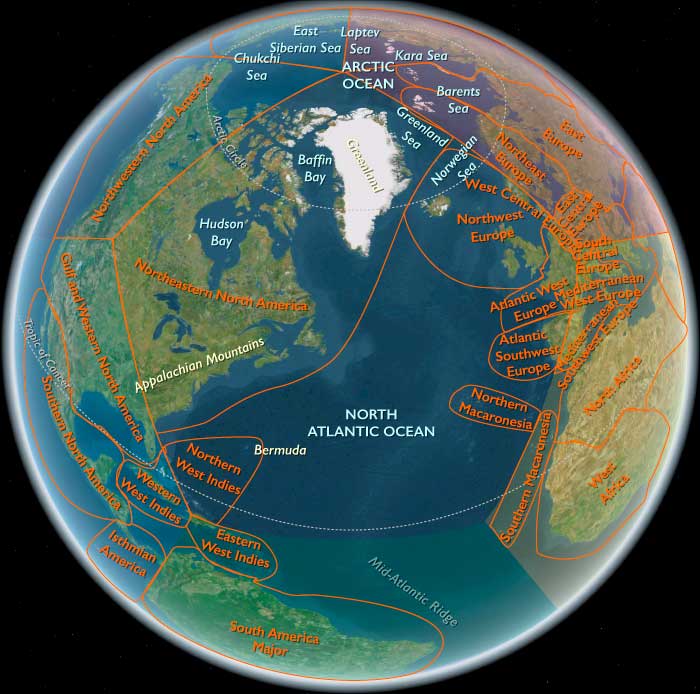
The Atlantic Lands
View →Related Events
Showing 2 events out of 2 total
The instability of state banks leads to the chartering of the Second Bank of the United States in 1816.
Political support for the revival of a national banking system is rooted in the early nineteenth century-transformation of the country from simple Jeffersonian agrarianism towards one interdependent with industrialization and finance.
In the aftermath of the War of 1812, the federal government suffers from the disarray of an unregulated currency and a lack of fiscal order; business interests seek security for their government bonds.
A national alliance has arisen to legislate a central bank to address these needs.
The political climate—dubbed the Era of Good Feelings—favors the development of national programs and institutions, including a protective tariff, internal improvements and the revival of a Bank of the United States.
Southern and western support for the Bank, led by Republican nationalists John C. Calhoun of South Carolina and Henry Clay of Kentucky, is decisive in the successful chartering effort.
The charter is signed into law on April 10, 1816 by President James Madison, who had presided over the expiration of the First Bank of the United States's charter in 1811.
However, the war had convinced him of the need for a central bank, which he hopes will aid the government in borrowing money and also help curb inflation.
Designed along the same lines as the first bank, the new charter empowers the US president to name five of the bank’s twenty-five directors.
William Jones becomes the bank’s first president.
Opposition to the Bank's revival emanates from two interests.
Old Republicans, represented by John Taylor of Caroline and John Randolph of Roanoke, characterize the Second Bank of the United States as both constitutionally illegitimate and a direct threat to Jeffersonian agrarianism, state sovereignty and the institution of slavery, expressed by Taylor's statement that "...if Congress could incorporate a bank, it might emancipate a slave".
Hostile to the regulatory effects of the central bank, private banks—proliferating with or without state charters—had scuttled rechartering of the first BUS in 1811.
These interests will play significant roles in undermining the institution during the administration of U.S. President Andrew Jackson, from 1829 to 1837.
The BUS is launched in the midst of a major global market readjustment as Europe recovers from the Napoleonic Wars.
The central bank is charged with restraining uninhibited private bank note issue—already in progress —that threaten to create a credit bubble and the risks of a financial collapse.
Government land sales in the West, fueled by European demand for agricultural products, insures that a speculative bubble will form.
Simultaneously, the national bank is engaged in promoting a democratized expansion of credit to accommodate laissez-faire impulses among eastern business entrepreneurs and credit hungry western and southern farmers.
Charles Fenton Mercer, a Federalist member of the Virginia General Assembly, had discovered accounts of earlier legislative debates on black colonization in the wake of Gabriel Prosser's rebellion, and Mercer had pushed the state to support the idea.
One of his political contacts in Washington City, John Caldwell, in turn contacted, his brother-in-law and a Presbyterian minister, who had endorsed the plan.
Officially established at the Davis Hotel in Washington, D.C., attendees include James Monroe, Bushrod Washington, Andrew Jackson, Francis Scott Key, and Daniel Webster, with Henry Clay presiding over the meeting.
Its co-founders are considered to be Henry Clay, John Randolph of Roanoke, Richard Bland Lee and Bushrod Washington.
Mercer is unable to go to Washington for the meeting.
Although Randolph believed that the removal of free blacks will "materially tend to secure" slave property, the vast majority of early members are philanthropists, clergy, and abolitionists who want to free African slaves and their descendants and provide them with the opportunity to "return" to Africa.
Few members are slave-owners, and the Society will never enjoy much support among planters in the Lower South.
This is the area that will develop most rapidly in the nineteenth century with slave labor, and initially it has few free blacks, who live mostly in the Upper South.
The colonization effort results from a mixture of motives.
Free-born blacks, freedmen, and their descendants, encounter widespread discrimination in the U.S. of the early nineteenth century.
Whites generally perceive them as a burden on society and a threat to white workers because they undercut wages.
Some abolitionists believe that blacks cannot achieve equality in the United States because of discrimination and will be better off in Africa where they can organize their own society.
Many slaveholders worry that the presence of free blacks is a threat to the slave societies of the South, especially after some are involved directly in slave rebellions.
The Society appears to support contradictory goals: free blacks should be removed because they can not benefit America; on the other hand, free blacks will prosper and thrive under their own leadership in another land.
Some Society members are openly racist and frequently argue that free blacks will be unable to assimilate into the white society of America.
John Randolph, a Virginia politician and major slaveholder, says that free blacks are "promoters of mischief."
At this time, about two million African Americans live in the United States; two hundred thousand are free persons of color, with most in the North, where they are restricted by law in various states.
Henry Clay, a US Representative from Kentucky, considers slavery to have a negative effect on the southern economy, but in this period Kentucky has become a state that is selling slaves to the Deep South, where demand is booming because of the rise of cotton.
Clay thinks that deportation of free blacks is preferable to trying to integrate them in America.
Reverend Finley suggestsat the inaugural meeting of the Society that a colony be established in Africa to take free people of color, most of whom had been born free, away from the United States.
Finley means to colonize "(with their consent) the free people of color residing in our country, in Africa, or such other place as Congress may deem most expedient."
The organization will establish branches throughout the United States, and will be instrumental in establishing the colony of Liberia.