Joseph Haydn
Austrian composer
Years: 1732 - 1809
(Franz) Joseph Haydn (March 31,1732 – May 31, 1809) is an Austrian composer of the Classical period.
He is instrumental in the development of chamber music such as the piano trio and his contributions to musical form have earned him the epithets "Father of the Symphony" and "Father of the String Quartet".
Haydn spends much of his career as a court musician for the wealthy Esterházy family at their remote estate.
Until the later part of his life, this isolates him from other composers and trends in music so that he is, as he puts it, "forced to become original".
Yet his music circulates widely and for much of his career he ss the most celebrated composer in Europe.
He is a friend and mentor of Mozart, a teacher of Beethoven, and the older brother of composer Michael Haydn.
Related Events
Filter results
Showing 8 events out of 8 total
East Central Europe (1684–1827 CE): From Vienna’s Salvation to the Age of Revolutions
Geography & Environmental Context
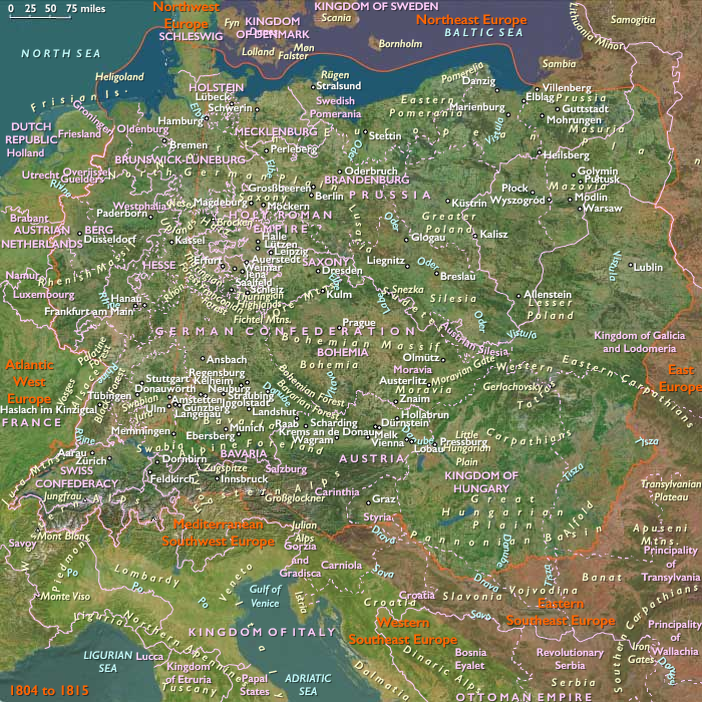
East Central Europe includes the greater part of Germany east of 10°E (Brandenburg, Saxony, Thuringia, Franconia, eastern Bavaria, Silesia), together with Bohemia and Moravia, the Austrian heartlands (Vienna, Lower and Upper Austria, Carinthia, Styria), and parts of the upper Danube basin. Anchors include the Elbe and Oder valleys, the Ore and Sudeten Mountains, the Danube corridor through Vienna, and the Vienna Woods and Alpine forelands. These landscapes connected the Holy Roman Empire’s patchwork of German states with the Habsburg monarchy’s Danubian dominion.
Climate & Environmental Shifts
The end of the Little Ice Age produced climatic instability—harsh winters (notably 1708–09, “the Great Frost”) and drought years interspersed with good harvests. Floods along the Elbe, Oder, and Danube repeatedly damaged fields and towns. The spread of the potato and clover improved food security and fodder supplies, mitigating famine after mid-century. By the early 19th century, agrarian innovation was widespread.
Subsistence & Settlement
-
Agriculture: Rye, oats, and wheat remained staples, with potatoes gradually adopted across Saxony, Bohemia, and Austria. Vineyards revived in Franconia and along the Danube. Sheep grazing supported a wool trade in Silesia and Saxony.
-
Urban centers:
-
Vienna expanded as the Habsburg capital and cultural hub.
-
Prague rebuilt after Thirty Years’ War devastation.
-
Berlin emerged as Brandenburg-Prussia’s capital.
-
Leipzig’s trade fairs tied Central Europe into global commerce.
-
-
Industrial proto-centers: Saxon textiles, Silesian mining, and Austrian ironworks foreshadowed later industrial revolutions.
Technology & Material Culture
-
Transport: The Elbe and Danube carried bulk goods; improved roads supported armies and post coaches. Canals were planned but rarely realized.
-
Industry: Mining of silver, salt, and iron; Saxon porcelain (Meissen, from 1710) became a prestige export.
-
Everyday life: Timber-framed villages and baroque towns persisted; after 1750, rococo and neoclassical styles marked elite culture. New consumer goods—coffee, sugar, porcelain, printed cottons—spread among urban middle classes.
Movement & Interaction Corridors
-
Danube corridor: Vienna to Budapest and Belgrade, supplying grain and military convoys.
-
Elbe corridor: Leipzig and Dresden to Hamburg.
-
Military marches: Repeated campaigns of Habsburg, Prussian, and Saxon armies moved through Silesia, Bohemia, and Austria.
-
Intellectual networks: Universities (Halle, Jena, Vienna, Prague) circulated Enlightenment and Romantic thought.
Cultural & Symbolic Expressions
-
Baroque Catholicism: Habsburg Austria rebuilt monasteries and churches in monumental style, asserting Catholic power.
-
Protestant learning: Saxony and Brandenburg cultivated Pietism and rationalist theology; universities fostered Enlightenment scholarship.
-
Music and arts: Vienna became a musical capital—Haydn, Mozart, and Beethoven transformed European culture. German literature blossomed in Leipzig, Weimar, and Berlin (Goethe, Schiller).
-
National awakenings: Early stirrings of Czech, Slovak, and German romantic nationalism emerged, emphasizing folk traditions and vernacular culture.
Environmental Adaptation & Resilience
-
Potato adoption: Widespread cultivation reduced famine vulnerability after the 1770s.
-
Agricultural reforms: Enclosure, crop rotation, and estate rationalization under enlightened absolutists.
-
Disaster response: Parish granaries and charitable institutions distributed food in bad years.
-
Forest regulation: Habsburg and Prussian forestry codes sought sustainable timber supply.
Political & Military Shocks
-
Ottoman wars: The failed Ottoman siege of Vienna (1683) was followed by Habsburg advances into Hungary and the Balkans.
-
War of the Spanish Succession (1701–1714): Austria gained territories in Italy and the Low Countries.
-
Pragmatic Sanction (1713): Secured Maria Theresa’s succession, contested in the War of the Austrian Succession (1740–1748).
-
Silesian Wars (1740–1763): Frederick the Great seized Silesia, establishing Prussia as Austria’s rival.
-
Seven Years’ War (1756–1763): A global war with East Central Europe as a major theater; Prussia survived against Austria, Russia, and France.
-
Napoleonic Wars (1792–1815): Vienna repeatedly occupied; the Holy Roman Empire dissolved (1806); Austria fought at Austerlitz (1805), Wagram (1809), Leipzig (1813).
-
Congress of Vienna (1815): Austria regained centrality in German affairs, while Prussia expanded in the Rhineland.
-
1820s unrest: Student protests and secret societies (Carlsbad Decrees, 1819) signaled the era of rising nationalism and liberalism.
Transition
From 1684 to 1827, East Central Europe was reshaped by warfare, dynastic rivalry, and cultural efflorescence. The Habsburgs defended Vienna, expanded southward, and patronized Catholic Baroque and Enlightenment reform. Prussia emerged as a disciplined military state, rivaling Austria for dominance in the German lands. Saxony and Bohemia rebuilt as cultural and economic hubs, while peasants adopted potatoes and clover to stabilize food supplies. By 1827, the subregion was firmly part of a Europe redefined by the Napoleonic Wars and the Vienna settlement—its dynasties resilient, but new currents of nationalism and revolution already stirring.
Several new German universities are founded, some soon considered among Europe's best.
An increasingly literate public makes possible a jump in the number of journals and newspapers.
At the end of the seventeenth century, most books printed in Germany were in Latin; by the end of the next century, all but five percent are in German.
The eighteenth century also sees a refinement of the German language and a flowering of German literature with the appearance of such figures as Gotthold Lessing, Johann Wolfgang von Goethe, and Friedrich Schiller.
German music also reaches great heights with the Bach family, George Frederick Handel, Joseph Haydn, and Wolfgang Amadeus Mozart.
East Central Europe (1756–1767 CE): Seven Years’ War, Austro-Prussian Rivalry, and Regional Transformations
Between 1756 and 1767 CE, East Central Europe—encompassing modern-day Poland, Czechia, Slovakia, Hungary, and eastern Germany and Austria east of 10°E and north of the defined boundary—became a pivotal theater in the broader European conflict of the Seven Years' War (1756–1763). The intense struggle between Habsburg Austria under Maria Theresa and Prussia led by Frederick the Great profoundly influenced regional geopolitics, shaping subsequent political alliances, accelerating military and administrative reforms, and impacting economic, social, and cultural dynamics across the region.
Political and Military Developments
Seven Years’ War and East Central Europe (1756–1763)
-
The Seven Years' War erupted as a coalition—including Austria, France, Russia, Sweden, and Saxony—sought to diminish Prussian dominance, specifically aiming to reclaim Silesia for Austria.
-
East Central Europe experienced intense military engagements, notably in Saxony, Silesia, Bohemia, and Brandenburg, witnessing major battles such as:
-
Battle of Lobositz (1756), initial Prussian-Austrian clash in Bohemia.
-
Battle of Prague (1757), a costly Prussian victory.
-
Battle of Kolín (1757), significant Austrian victory halting Prussian advances toward Vienna.
-
Battle of Kunersdorf (1759), severe defeat for Prussia by Austrian-Russian forces.
-
Battle of Torgau (1760), costly Prussian victory, preserving Frederick’s tenuous control.
-
-
Despite heavy losses and near collapse, Frederick II’s resilience, aided by shifting alliances (notably Russian withdrawal after 1762), enabled Prussia to maintain control of Silesia through the Treaty of Hubertusburg (1763).
Treaty of Hubertusburg (1763) and Aftermath
-
The treaty formally ended hostilities between Austria and Prussia, affirming Prussia’s permanent possession of Silesia but restoring other prewar territorial boundaries.
-
Austria recognized Prussian dominance in Silesia, definitively altering regional power dynamics and cementing Prussia as a primary European power alongside Austria.
Polish-Lithuanian Commonwealth: Increasing Instability
-
Poland-Lithuania, though nominally neutral, was severely affected by war-induced economic disruptions and diplomatic pressures, becoming increasingly vulnerable to interference from neighboring powers, especially Russia and Prussia.
Economic and Technological Developments
Economic Strain and Recovery
-
Wartime devastation significantly strained regional economies, particularly in Saxony, Silesia, and Bohemia, resulting from military requisitions, disruptions to agriculture, and destruction of trade routes.
-
Postwar economic recovery was aided by governmental reforms, investment in industry, trade revitalization, and agricultural productivity, notably in Silesia and Austria’s Bohemian and Moravian provinces.
Continued Infrastructure Investment
-
Austria and Prussia prioritized rebuilding and enhancing infrastructure after 1763, including roads, bridges, waterways, and fortifications, stimulating economic revival and increased connectivity within East Central Europe.
Cultural and Artistic Developments
Enlightenment Influence and Cultural Flourishing
-
Enlightenment ideals continued influencing intellectual, cultural, and scientific life across East Central Europe. Vienna, Berlin, Dresden, and Prague became dynamic centers of Enlightenment thought, art, and architecture.
-
Prominent figures such as composers Franz Joseph Haydn in Austria and Carl Philipp Emanuel Bach in Prussia enriched regional cultural life, contributing significantly to European musical heritage.
Rococo and Early Classicism
-
Artistic patronage thrived despite wartime disruptions. Rococo art and architecture flourished, evolving gradually toward early neoclassical styles evident in palaces, urban residences, and public buildings across Vienna, Dresden, and Berlin.
Settlement and Urban Development
Postwar Urban Reconstruction and Growth
-
Cities heavily impacted by wartime destruction—including Dresden, Leipzig, Prague, and Breslau (Wrocław)—underwent significant postwar reconstruction, resulting in urban renewal and enhanced civic infrastructure.
-
Renewed urban prosperity stimulated trade, industry, and population growth, strengthening major urban centers as economic and cultural hubs.
Social and Religious Developments
Administrative and Military Reforms
-
Austria and Prussia implemented significant administrative reforms inspired by wartime experience, improving bureaucracy, taxation, military organization, and state centralization. These reforms strengthened state authority and social stability, underpinning future modernization efforts.
Religious Diversity and Tolerance
-
Despite ongoing religious tensions, regional states continued promoting policies of religious tolerance. Frederick II notably extended religious freedoms within Prussia, enhancing social cohesion and economic productivity by accommodating diverse religious communities, including Protestants, Catholics, and Jews.
Long-Term Consequences and Historical Significance
The period 1756 to 1767 CE was transformative for East Central Europe, decisively shaped by the Seven Years’ War and the resultant Treaty of Hubertusburg. Prussia’s permanent retention of Silesia dramatically altered regional balance, firmly establishing Prussia as a leading European power and intensifying the Austro-Prussian rivalry. The war-induced administrative and military reforms significantly modernized governmental structures, facilitating enhanced state centralization and efficiency. Postwar economic recovery, infrastructural improvements, and cultural vitality under Enlightenment influence reinforced regional stability and prosperity, laying crucial foundations for subsequent developments in East Central Europe’s political, economic, and cultural trajectory.
East Central Europe (1780–1791 CE): Joseph II’s Radical Reforms, Prussian Ascendancy, and Growing Polish Vulnerability
Between 1780 and 1791 CE, East Central Europe—comprising modern-day Poland, Czechia, Slovakia, Hungary, and those regions of eastern Germany and Austria east of 10°E and north of the defined boundary—experienced significant internal reforms, intensified geopolitical rivalries, and increasing vulnerability of the Polish–Lithuanian Commonwealth. Dominated by the ambitious reforms of Joseph II of Austria, the era saw heightened tensions between the Habsburg Monarchy and Prussia, and growing threats from an increasingly assertive Russia. These developments set the stage for dramatic political and territorial upheavals.
Political and Military Developments
Joseph II’s Radical Reforms in Austria (1780–1790)
-
Following the death of Maria Theresa in 1780, her son Joseph II (r. 1780–1790) accelerated extensive Enlightenment reforms in the Habsburg domains, aiming at radical modernization:
-
Abolition of serfdom (1781), dramatically reshaping rural social structures.
-
Centralization of administrative and judicial systems to reduce noble power.
-
Imposition of German as the official administrative language (1784), sparking resistance among non-German populations in Hungary, Czechia, Slovakia, and Galicia.
-
-
Although driven by Enlightenment ideals, Joseph’s reforms provoked widespread backlash, particularly among Hungarian nobles, Slovak and Czech intellectuals, and Polish elites in Galicia, ultimately leading to significant unrest and political instability.
Continued Polish Vulnerability and Constitutional Efforts
-
The Polish–Lithuanian Commonwealth, significantly weakened after the First Partition (1772), sought internal reforms to stave off further decline:
-
The Great Sejm (1788–1792) convened, aiming for sweeping constitutional reform to strengthen central authority and reduce foreign interference.
-
On May 3, 1791, Poland adopted the progressive Constitution of May 3, Europe's first modern codified national constitution, introducing significant political reforms, centralizing governance, and attempting to restore Polish sovereignty.
-
Prussian Ascendancy under Frederick II and Frederick William II
-
Frederick the Great (r. 1740–1786) consolidated Prussian territorial gains, enhancing the kingdom’s economic strength, administrative efficiency, and military power.
-
His successor, Frederick William II (1786–1797), pursued a cautious but assertive foreign policy, positioning Prussia as a critical rival to Austria and actively monitoring developments in Poland, setting the stage for future intervention.
Economic and Technological Developments
Economic Growth and Agricultural Modernization
-
Agricultural reforms, notably Joseph II’s abolition of serfdom in Austria and improved farming methods, significantly increased agricultural productivity and rural prosperity across the region, despite causing considerable social disruption.
-
Prussia continued agricultural and economic advancements, particularly in West Prussia, benefiting from fertile lands, Baltic trade, and efficient administrative practices.
Industrial and Commercial Advances
-
Industrial and commercial activities expanded notably in urban centers such as Vienna, Prague, Budapest, Leipzig, and Wrocław (Breslau), enhancing trade networks connecting East Central Europe to broader European markets.
Cultural and Artistic Developments
Intellectual Vibrancy and Enlightenment Influence
-
Joseph II’s reforms and patronage significantly influenced intellectual and cultural life, with Vienna and Prague emerging as prominent centers of Enlightenment thought, artistic innovation, and educational reform.
-
Key Enlightenment thinkers and cultural figures, including composers Wolfgang Amadeus Mozart and Joseph Haydn, flourished during this period, significantly enriching regional cultural heritage.
National Awakening in Hungary, Czechia, and Poland
-
Rising national consciousness emerged strongly in response to Joseph II’s centralizing reforms:
-
Hungarian nobles, Czech intellectuals, and Polish elites increasingly articulated distinctive national identities, advocating linguistic and cultural autonomy.
-
Literary and cultural movements strengthened national identities, laying the foundations for future national struggles and cultural revivals.
-
Settlement and Urban Development
Accelerated Urban Expansion
-
Major cities such as Vienna, Prague, Budapest, Leipzig, and Warsaw expanded significantly in size, infrastructure, and population, becoming vibrant centers of trade, culture, and intellectual discourse.
-
New administrative and civic structures supported urban growth, reflecting intensified central governance and cultural patronage.
Social and Religious Developments
Transformation of Social Structures
-
Joseph II’s abolition of serfdom profoundly altered social hierarchies, empowering peasants economically yet sparking significant noble resistance and societal tensions throughout Austria, Bohemia, Moravia, Hungary, and Galicia.
Religious Reform and Toleration
-
Joseph II continued to advocate religious tolerance and reform:
-
Edicts such as the Patent of Toleration (1781) significantly relaxed religious restrictions, allowing greater religious freedom for Protestants, Jews, and Orthodox Christians, though encountering opposition from conservative Catholic clergy.
-
Long-Term Consequences and Historical Significance
The period 1780–1791 CE was pivotal for East Central Europe. Joseph II’s ambitious but controversial reforms radically reshaped social, economic, and political landscapes within the Austrian domains, stimulating both modernization and nationalist backlash. Poland’s groundbreaking Constitution of May 3 represented a last attempt to reclaim sovereignty, though it intensified regional geopolitical tensions. Prussia continued to consolidate power, setting the stage for intensified rivalry with Austria and further partitions of Poland. Collectively, these transformations profoundly influenced the region’s historical trajectory, laying foundations for subsequent national movements, revolutionary upheavals, and geopolitical realignments into the nineteenth century.
East Central Europe (1792–1803 CE): Partition of Poland, Revolutionary Turmoil, and Napoleonic Reordering
Between 1792 and 1803 CE, East Central Europe—including Poland, Czechia, Slovakia, Hungary, and territories within eastern Germany and Austria east of 10°E and north of the defined boundary—underwent dramatic geopolitical upheaval characterized by the final partitions of Poland, revolutionary turmoil linked to the aftermath of the French Revolution, and significant reshaping of political alliances due to the expanding influence of Napoleon Bonaparte. These developments fundamentally altered the region’s political landscape, decisively ending Polish statehood, challenging Austrian and Prussian dominance, and laying foundations for future nationalist movements.
Political and Military Developments
Final Partitions of Poland (1793, 1795)
-
Facing intense pressure from neighboring powers, the Polish–Lithuanian Commonwealth struggled to maintain sovereignty despite its progressive Constitution of 1791.
-
Second Partition (1793): Following the War in Defense of the Constitution (1792), Prussia and Russia annexed significant Polish territories, drastically weakening Polish autonomy.
-
Kościuszko Uprising (1794): Polish national hero Tadeusz Kościuszko led a significant but ultimately unsuccessful insurrection aimed at reclaiming independence, highlighting deepening patriotic sentiments but accelerating Poland’s dissolution.
-
Third Partition (1795): Austria, Prussia, and Russia completely dismantled the Commonwealth, eradicating independent Polish sovereignty for over a century.
Revolutionary Impact and Austrian Instability
-
The ideological turmoil unleashed by the French Revolution (1789) profoundly impacted East Central Europe, particularly within Habsburg Austria:
-
Emperor Francis II (1792–1835), alarmed by revolutionary ideals, adopted conservative policies, restricting political freedoms and tightening administrative control.
-
The region saw widespread social and intellectual ferment as revolutionary and nationalist ideas spread, despite intensified imperial censorship and police surveillance.
-
Prussian Ambitions and Territorial Expansion
-
Prussia, under King Frederick William II (1786–1797) and subsequently Frederick William III (1797–1840), expanded significantly by gaining Polish territories, notably Warsaw, through the partitions.
-
Strengthened economically and militarily, Prussia continued consolidating its eastern provinces, enhancing administrative efficiency, and extending its regional influence.
Napoleonic Reordering Begins
-
The rise of Napoleon profoundly affected East Central European politics:
-
Napoleon’s early victories (1796–1797) against Austria in northern Italy forced the Habsburg Monarchy into disadvantageous peace treaties (Treaty of Campo Formio, 1797), altering regional power balances and provoking extensive military and administrative reforms within Austria.
-
Economic and Technological Developments
Economic Realignments
-
The partitions of Poland shifted regional trade routes and economic structures, integrating Polish territories more deeply into Austrian, Prussian, and Russian economic frameworks.
-
Prussia capitalized economically by further developing agriculture, industry, and trade in newly acquired territories, enhancing prosperity in cities like Warsaw, Poznań (Posen), and Gdańsk (Danzig).
Industrial and Agricultural Progress
-
Industrial growth accelerated, notably in Austrian and Prussian regions, stimulated by modernized agricultural practices and increased demand from growing urban populations.
Cultural and Artistic Developments
Intensified National Identity and Cultural Revival
-
Despite political subjugation, Polish national identity deepened significantly, expressed in literature, music, and art that celebrated Polish history, culture, and struggle for independence.
-
Notable intellectual and cultural figures emerged, including poets and historians who laid the foundations for future nationalist movements in Poland, Bohemia, and Hungary.
Enlightenment and Romantic Influence
-
Enlightenment ideals and early Romanticism profoundly influenced regional intellectual and artistic culture, particularly in Prague, Vienna, and Budapest, fueling demands for greater cultural and political autonomy among the Czech and Hungarian intelligentsia.
Settlement and Urban Development
Urban Integration and Expansion
-
Major urban centers, notably Vienna, Warsaw, Prague, and Budapest, expanded infrastructure and economic activities, benefiting from increased administrative centralization and economic integration resulting from partition-driven reorganization.
Social and Religious Developments
Social Instability and Class Tensions
-
The partitions and revolutionary turmoil heightened social tensions, with increased dissatisfaction among peasants, urban workers, and the growing middle class due to rigid social hierarchies and limited political representation.
Conservative Religious Policies
-
Both Austria and Prussia enacted conservative religious policies aimed at countering revolutionary secularism, reinforcing traditional Catholic (Austria) and Protestant (Prussia) institutions to maintain social control.
Long-Term Consequences and Historical Significance
The period 1792–1803 CE marked a decisive turning point in East Central Europe’s history. The dissolution of Poland profoundly reshaped regional geopolitics, permanently altering political boundaries and intensifying nationalist aspirations. Revolutionary ideas continued spreading, significantly influencing cultural, social, and political developments throughout the region. The emergence of Napoleon Bonaparte as a dominant European figure began a transformative era, setting the stage for major realignments that would define East Central Europe’s trajectory in the early nineteenth century.
Joseph Haydn composes his two great oratorios, The Creation (1798) and The Seasons (1801), in collaboration with his librettist and mentor Gottfried van Swieten, and with funding from van Swieten's Gesellschaft der Associierten.
Both are enthusiastically received.
Haydn frequently appears before the public, often leading performances of The Creation and The Seasons for charity benefits, including Tonkünstler-Societät programs with massed musical forces.
He also composes instrumental music: the popular Trumpet Concerto, and the last nine in his long series of string quartets, including the Fifths, Emperor, and Sunrise.
A brief work, "Gott erhalte Franz den Kaiser" (the "Emperor's Hymn"; 1797), achieves great success and becomes "the enduring emblem of Austrian identity right up to the First World War" (Jones); in modern times it will become (with different words) the national anthem of Germany.
During the later years of this successful period, Haydn faces incipient old age and fluctuating health, and he has to struggle to complete his final works.
His last major work, from 1802, is the sixth mass for the Esterházys, the Harmoniemesse.
Haydn had returned to Vienna in 1795.
Prince Anton had died, and his successor Nikolaus II had proposed that the Esterházy musical establishment be revived with Haydn serving again as Kapellmeister.
Haydn had taken up the position on a part-time basis.
He spends his summers with the Esterházys in Eisenstadt, and over the course of several years writes six masses for them.
By this time Haydn has become a public figure in Vienna.
He spends most of his time in his home, a large house in the suburb of Windmühle, and writes works for public performance.
His fame as a theorist will attract to him in the Austrian capital a large number of pupils, some of whom afterward will become eminent musicians.
Among these are Johann Nepomuk Hummel, Ignaz Moscheles, Josef Weigl (1766–1846), Ludwig-Wilhelm Tepper de Ferguson (1768 – after 1824), Antonio Casimir Cartellieri, Ludwig van Beethoven, Anton Reicha and Franz Xaver Wolfgang Mozart.
Beethoven had arrived in Vienna in 1792 to study with Joseph Haydn but quickly became infuriated when his work was not being given attention or corrected.
Haydn had recommended his friend Albrechtsberger, with whom Beethoven now studies harmony and counterpoint.
On completion of his studies, the young student notes, "Patience, diligence, persistence, and sincerity will lead to success," which reflects Albrechtsberger's own compositional philosophy.
When Beethoven is finished studying with Albrechtsberger he decides to get a few more tips and pointers, so to speak, from Haydn.
From here Beethoven possibly studies with Antonio Salieri, but this is unknown as a fact.
It is also quite possible that Beethoven had gone off on his own to make a living, only then returning after he had a stable career.
Albrechtsberger, born at Klosterneuburg, near Vienna, had originally studied music at Melk Abbey and philosophy at a Benedictine seminary in Vienna, has become one of the most learned and skillful contrapuntists of his age.
Albrechtsberger's earliest classmates included Michael Haydn and Franz Joseph Aumann.
After being employed as organist at Raab in 1755 and Maria Taferl in 1757, he had been appointed Thurnermeister back at Melk Abbey.
In 1772 he had been appointed organist to the court of Vienna.
Ludwig van Beethoven's Symphony No. 1 in C major, Op. 21, premieres at the Burgtheater, in Vienna, on April 2, 1800.
It is not known exactly when Beethoven finished writing this work, but sketches of the finale will be found to be from 1795.
Dedicated to Baron Gottfried van Swieten, an early patron of the composer, the symphony is clearly indebted to Beethoven's predecessors, particularly his teacher Joseph Haydn as well as Wolfgang Amadeus Mozart, but nonetheless has characteristics that mark it uniquely as Beethoven's work, notably the frequent use of sforzandi and the prominent, more independent use of wind instruments.
Sketches for the finale are found among the exercises Beethoven wrote while studying counterpoint under Johann Georg Albrechtsberger in the spring of 1797.