Joseph I
Holy Roman Emperor; King of Germany
Years: 1678 - 1711
Joseph I (26 July 1678 – 17 April 1711), Holy Roman Emperor, King of Bohemia, King of Hungary, King of the Romans is the elder son of Emperor Leopold I and his third wife, Eleonore-Magdalena of Pfalz-Neuburg, who is the daughter of Philipp Wilhelm, Elector Palatine.
Related Events
Filter results
Showing 10 events out of 15 total
Leopold I (1656-1705) defeats the Turks and paves the way for the restoration of the Kingdom of Hungary to its previous territorial dimensions.
The brief reign of Joseph I (1705-11) is followed by that of Charles VI (1711-40).
Between 1720 and 1725, Charles concludes a series of treaties by which the various estates of the Habsburg lands recognize the unity of the territory under Habsburg rule and accept hereditary Habsburg succession, including the female line.
The struggle between the Bohemian estates and Habsburg absolutism results in the complete subordination of the Bohemian estates to Habsburg interests.
In the aftermath of the defeat at White Mountain, the Czechs had lost their native noble class, their reformed religion, and a vibrant Czech Protestant culture.
With the influx of foreigners, primarily Germans, the German language has become more prominent in government and polite society.
It seems that Bohemia is destined to become a mere province of the Habsburg realm.
The reigns of Maria-Theresa (1740-80) and her son Joseph II (1780-90), Holy Roman Emperor and coregent from 1765, are characterized by enlightened rule.
Influenced by the ideas of eighteenth-century Enlightenment philosophers, Maria-Theresa and Joseph work toward rational and efficient administration of the Bohemian Kingdom.
In this respect, they oppose regional privilege and the rights of the estates and prefer to rule through a centrally controlled imperial bureaucracy.
At the same time, they institute reforms to eliminate the repressive features of the Counter-Reformation and to permit secular social progress.
The Prussian king, Frederick II, joined by the dukes of Bavaria and Saxony, invades the Bohemian Kingdom in 1741.
The duke of Bavaria, Charles Albert, is proclaimed king by the Czech nobility.
Although Maria-Theresa regains most of the Bohemian Kingdom and is crowned queen in Prague in 1743, all of the highly industrialized territory of Silesia except for Tesm, Opava, and Krnov is ceded to Prussia.
In attempting to make administration more rational, Maria-Theresa embarks on a policy of centralization and bureaucratization.
What remains of the Bohemian Kingdom is now merged into the Austrian provinces of the Habsburg realm.
The two separate chancelleries are abolished and replaced by a joint Austro-Bohemian chancellery.
The Czech estates are stripped of the last remnants of their political power, and their functions are assumed by imperial civil servants appointed by the queen.
The provinces of the Czech and Austrian territories are subdivided into administrative districts.
German becomes the official language.
Further reforms introduced by Maria-Theresa and Joseph II reflect such Enlightenment principles as the dissolution of feudal social structures and the curtailment of power of the Catholic Church.
Maria-Theresa nationalizes and Germanizes the education system, eliminates Jesuit control, and shifts educational emphasis from theology to the sciences.
Serfdom is modified: robota (forced labor on the lord's land) is reduced, and serfs can marry and change domiciles without the lord's consent.
Joseph II abolishes serfdom altogether.
Joseph's Edict of Toleration extends freedom of worship to Lutherans and Calvinists in 1781 .
Maria Theresa had begun administrative and economic reforms in 1749, drawing on mercantilist theory and examples provided by Prussian and French reforms.
In addition, she had undertaken reforms in the social, legal, and religious spheres.
During the coregency and after Maria Theresa's death, Joseph has continued the reforms along the lines pursued by his mother, but mother and son had sharply different motivations.
Maria Theresa, a pious Catholic empress working within the structure of a paternalistic, baroque absolutism, had been unsympathetic to the Enlightenment.
Joseph, in contrast, gives the reforms an ideological edge reflecting the utilitarian theories of the Enlightenment.
Because his reforms are more ideologically driven and thus less flexible and pragmatic, they frequently are also less successful and disrupt the stability of the Habsburg Empire.
Maria Theresa's husband is emperor but she rules the Habsburg lands.
However, when her son Joseph becomes Holy Roman Emperor after the death of her husband in 1765, she makes her son coregent.
Following Maria Theresa's death in 1780, Joseph II reigns in his own right until his death in 1790.
The Counter-Reformation's political and religious goals have largely been accomplished by the time Maria Theresa comes to the throne, but maintaining Austria's great-power status urgently requires broad internal reform and restructuring to strengthen the central authority of the monarchy and curtail the power of the nobility.
East Central Europe (1696–1707 CE): Great Northern War, Habsburg Consolidation, and Dynastic Realignments
Between 1696 and 1707 CE, East Central Europe—including modern-day Poland, Czechia, Slovakia, Hungary, and eastern parts of Germany and Austria east of 10°E and north of the defined southeastern boundary—witnessed profound geopolitical shifts driven by the outbreak of the Great Northern War (1700–1721), continued Habsburg consolidation in formerly Ottoman-held Hungary, dynastic struggles within Poland-Lithuania, and Brandenburg-Prussia’s elevation as the Kingdom of Prussia.
Political and Military Developments
Outbreak and Early Stages of the Great Northern War
-
The outbreak of the Great Northern War in 1700 pitted a coalition of Denmark-Norway, Saxony-Poland-Lithuania (under King Augustus II the Strong), and Russia against the rapidly expanding Swedish Empire led by the dynamic young king, Charles XII.
-
Early stages saw remarkable Swedish victories, notably the decisive Crossing of the Düna (also known as the Battle of Daugava or Battle of Spilves) on July 19, 1701, near the city of Riga. During this engagement, Charles XII successfully crossed the Düna (Daugava) River, defeating the combined Saxon-Russian forces and compelling Augustus II into retreat, severely crippling Saxon ambitions in the Baltic region. This Swedish triumph profoundly reshaped political and military alliances throughout East Central Europe.
Polish-Lithuanian Instability under Augustus II
-
Augustus II (r. 1697–1706, 1709–1733), Elector of Saxony and King of Poland, aimed to strengthen royal authority and dynastic ambitions but struggled to maintain internal cohesion amid powerful magnate factions and external Swedish pressure.
-
The Swedish victory at the Battle of Kliszów (1702) significantly weakened Augustus’s position, ultimately leading to his temporary deposition in 1704 in favor of the pro-Swedish King Stanisław Leszczyński.
Brandenburg-Prussia’s Ascension as the Kingdom of Prussia (1701)
-
In 1701, Elector Frederick III of Brandenburg crowned himself King Frederick I of Prussia, elevating Brandenburg-Prussia to royal status and significantly increasing its prestige within European politics.
-
This elevation, sanctioned by Holy Roman Emperor Leopold I in exchange for Frederick’s support in the War of the Spanish Succession, substantially reshaped regional political dynamics and established Prussia as a powerful new player on the continental stage.
Habsburg Consolidation and Continued Ottoman Conflict
-
The Habsburg monarchy, under Emperor Leopold I (1658–1705) and his successor Joseph I (1705–1711), continued administrative and political consolidation in newly reclaimed Hungarian territories, systematically integrating these regions into their centralized empire.
-
Despite ongoing resistance from Hungarian nobility, especially Protestant magnates, the Habsburgs effectively solidified their authority, instituting direct imperial administration in key areas like Transylvania and southern Hungary.
Economic and Technological Developments
War-driven Economic Challenges and Opportunities
-
Ongoing conflicts, notably the Great Northern War and localized resistance in Hungary, disrupted trade and agriculture in affected regions, particularly Poland and Hungary, causing temporary economic downturns.
-
Conversely, territories like Brandenburg-Prussia, Bohemia, and Austrian provinces saw accelerated economic and infrastructural growth driven by centralized administrative reforms, expanded trade networks, and wartime manufacturing.
Infrastructure Improvements and Urban Growth
-
Major cities, especially Berlin, Vienna, Prague, Dresden, and Leipzig, continued extensive urban improvements and fortification enhancements, significantly improving regional infrastructure and boosting commercial activity despite broader instability.
Cultural and Artistic Developments
Baroque Splendor and Courtly Culture
-
Courtly culture flourished dramatically, particularly in Vienna, Dresden, and Prague, exemplified by lavish architectural projects and the patronage of music and arts under Habsburg and Saxon rulers. Dresden emerged as a major cultural center under Augustus II, famed for opulent Baroque architecture and vibrant courtly life.
-
The era saw continued prominence of Baroque artistic and architectural styles, which reinforced regional cultural identities and dynastic prestige.
Influence of Intellectual and Educational Institutions
-
Catholic educational institutions expanded significantly across Bohemia, Austria, and Hungary, strongly supporting the Counter-Reformation agenda. Jesuit colleges and seminaries reinforced regional religious and intellectual life.
-
Protestant universities in Brandenburg-Prussia and Saxony remained vibrant centers of scholarship, contributing to regional literacy, scientific inquiry, and theological discourse.
Settlement and Urban Development
Post-War Reconstruction and Expansion
-
Territories impacted by warfare, especially in Hungary and Poland, initiated reconstruction and revitalization efforts, supported by imperial and noble patronage. Infrastructure projects and fortification improvements promoted urban recovery and future resilience.
-
Prussian cities, notably Berlin, experienced substantial urban expansion, reshaping cityscapes and enhancing their political, economic, and cultural significance.
Social and Religious Developments
Protestant-Catholic Tensions and Habsburg Integration
-
Tensions remained pronounced in Habsburg Hungary, where Protestant noble resistance clashed repeatedly with imperial Catholic administrative centralization, fueling persistent social unrest and resistance movements.
-
Religious policies, including intensified Counter-Reformation activities and restrictions on Protestant worship, continued shaping regional demographics and social dynamics significantly.
Aristocratic Dominance and Local Governance
-
Polish magnates retained extensive autonomy, complicating central governance under Augustus II, whose rule was undermined by powerful aristocratic factions, further fragmenting Poland-Lithuania’s political cohesion.
-
In Brandenburg-Prussia and Austria-Bohemia, aristocratic elites aligned more closely with centralizing rulers, consolidating their positions within emerging bureaucratic and military structures.
Long-Term Consequences and Historical Significance
The era 1696–1707 CE profoundly reshaped East Central Europe’s geopolitical landscape. The Great Northern War’s outbreak significantly altered regional alliances and destabilized Poland-Lithuania, highlighting its internal vulnerabilities. Brandenburg-Prussia’s elevation as the Kingdom of Prussia permanently altered the balance of power within the Holy Roman Empire, setting a course toward future German consolidation. Continued Habsburg expansion and centralization in Hungary stabilized the monarchy’s southeastern frontier, despite sparking enduring local resistance. Collectively, these developments laid critical foundations for subsequent eighteenth-century political, economic, and cultural transformations across East Central Europe.
Emperor Leopold’s son Joseph becomes King of the Romans on January 6, 1690.
Joseph had received the crown of Hungary in 1687.
Born in Vienna, and educated strictly by Prince Dietrich Otto von Salm, he had become a good linguist.
The Earl of Galway leads another attempt on Madrid in 1707, but Berwick roundly defeats him at the Battle of Almansa on April 25.
In another attempt on Madrid, his army is severely defeated by the Marquis de Bay at the Battle of La Gudina, being forced to withdraw its troops from Spain.
The war in Spain settles hereafter nto indecisive skirmishing from which it would not subsequently emerge.
England is in 1707 united with the Kingdom of Scotland to form Great Britain, negotiations having started the previous year.
Great Britain therefore replaces England as a party to the war.
Also in 1707, the War briefly intersects with the Great Northern War, which is being fought simultaneously in Northern Europe.
A Swedish army under Charles XII arrives in Saxony, where he had just finished chastising the Elector Augustus II and forcing him to renounce his claims to the Polish throne.
Both the French and the Allies send envoys to Charles's camp, and the French hope to encourage him to turn his troops against the Emperor Joseph I, who Charles feels had slighted him by his support for Augustus.
However, Charles, who likes to see himself as a champion of Protestant Europe, greatly dislikes Louis XIV for his treatment of the Huguenots, and is generally uninterested in the western war.
He turns his attention instead to Russia, ending the possibility of Swedish intervention.
Prince Eugene leads an allied invasion of southern France from Italy later in 1707, but is stalled by the French army.
Marlborough, in the meantime, remains in the Low Countries, where he is caught up in capturing an endless succession of fortresses.
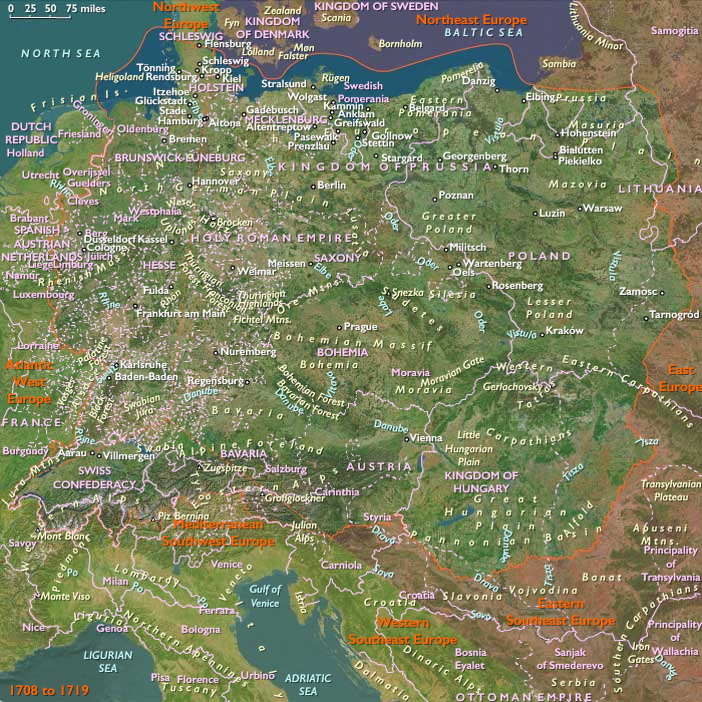
East Central Europe (1708–1719 CE): Swedish Decline, Russian Ascendancy, and Pragmatic Sanction
Between 1708 and 1719 CE, East Central Europe—including the territories of modern-day Poland, Czechia, Slovakia, Hungary, and eastern parts of Germany and Austria east of 10°E and north of the previously defined boundary—experienced decisive shifts resulting from the climax of the Great Northern War, further Habsburg consolidation under Emperor Charles VI, and the pivotal dynastic decision embodied in the Pragmatic Sanction of 1713.
Political and Military Developments
Decisive Turn of the Great Northern War (1709–1719)
-
The turning point of the Great Northern War came with the crushing defeat of Sweden's Charles XII by Russian forces under Peter the Great at the Battle of Poltava (1709). This event decisively ended Swedish dominance in the Baltic and drastically shifted regional power dynamics toward Russia.
-
Following Poltava, Saxon-Polish King Augustus II the Strong was restored to power, ending the brief reign of the pro-Swedish king Stanisław Leszczyński, and reaffirming Polish-Lithuanian ties to Saxony and Russia.
Habsburg Consolidation under Charles VI (1711–1719)
-
Charles VI succeeded Joseph I as Holy Roman Emperor (1711–1740), continuing Habsburg consolidation in Hungary and reinforcing imperial administration in Bohemia and the Austrian hereditary lands.
-
He successfully ended the Rákóczi Uprising (1703–1711) with the Treaty of Szatmár (1711), securing Habsburg authority in Hungary by offering amnesty, religious concessions, and the preservation of Hungarian estates' traditional privileges.
Pragmatic Sanction (1713)
-
To secure the Habsburg hereditary lands for his daughter Maria Theresa, Emperor Charles VI issued the Pragmatic Sanction of 1713, ensuring unified succession across Austria, Bohemia, Hungary, and other Habsburg territories. This measure, though initially accepted by many European powers, laid groundwork for future conflict upon his death.
Expansion and Stability of the Kingdom of Prussia
-
Under King Frederick William I (1713–1740), the recently established Kingdom of Prussia experienced significant administrative and military reform, laying foundations for future Prussian military might.
-
Frederick William I increased central control, enhanced state bureaucracy, and developed Europe's most disciplined and effective standing army, profoundly reshaping regional political dynamics.
Economic and Technological Developments
Post-War Economic Recovery and Trade Reorientation
-
The end of large-scale hostilities in Poland-Lithuania, Brandenburg-Prussia, and Hungary allowed significant economic recovery. Agriculture, manufacturing, and commerce rebounded, though trade routes increasingly realigned eastward toward growing Russian markets.
-
Prussia, in particular, benefited significantly from improved infrastructure and administrative reforms under Frederick William I, enhancing agricultural productivity, industry, and trade.
Habsburg Economic and Infrastructure Reforms
-
The Habsburg administration under Charles VI implemented comprehensive economic and administrative reforms, particularly in Hungary and Bohemia. These measures improved taxation, infrastructure, and agricultural output, promoting stability and growth.
Cultural and Artistic Developments
Continued Flourishing of Baroque Culture
-
Baroque culture remained dominant, particularly in Habsburg territories (Vienna, Prague, Budapest), Saxon Dresden, and newly stable Polish-Lithuanian cities like Kraków and Warsaw.
-
Court patronage under Augustus II in Dresden produced some of Europe's most opulent Baroque architecture and cultural patronage, notably in music and the arts.
Educational Expansion and Scientific Inquiry
-
Educational and intellectual institutions expanded significantly, notably in Brandenburg-Prussia, Austria, and Bohemia. These institutions increasingly focused on science, medicine, and modern philosophical inquiry, reflecting early Enlightenment influences from Western Europe.
Settlement and Urban Development
Urban Recovery and Infrastructure Improvements
-
Cities throughout East Central Europe recovered and expanded significantly after wartime disruptions, notably Berlin, Vienna, Prague, Dresden, Leipzig, Warsaw, and Kraków, marked by improved infrastructure, fortified defenses, and urban beautification projects.
-
In Prussia, administrative centralization fostered urban expansion, notably transforming Berlin into a thriving administrative, commercial, and military center.
Social and Religious Developments
Religious Policy and Tolerance in Habsburg Territories
-
Charles VI promoted moderate religious tolerance policies, especially in Hungary post-1711, easing tensions and stabilizing relations with Protestant Hungarian estates, thus significantly improving internal stability and loyalty to the crown.
Aristocratic Authority and Administrative Centralization
-
Aristocratic dominance remained influential throughout Poland-Lithuania, Hungary, and Saxony, although centralizing monarchs in Prussia and Habsburg lands steadily curtailed noble autonomy, advancing state centralization and bureaucratic control.
Long-Term Consequences and Historical Significance
The period 1708–1719 CE decisively reshaped East Central Europe’s political, economic, and cultural landscape. The catastrophic Swedish defeat at Poltava marked a permanent shift of Baltic dominance toward Russia, significantly impacting regional geopolitics. Augustus II's restoration strengthened Polish-Lithuanian connections to Saxony and Russia, though it deepened internal tensions. Habsburg consolidation under Charles VI secured stability in Hungary and Bohemia, while the Pragmatic Sanction significantly influenced future dynastic politics. Prussian military and administrative reforms under Frederick William I laid the foundations for its rise as a dominant European power. Collectively, these events established the conditions for significant transformations in East Central Europe, shaping the geopolitical and cultural order for the remainder of the 18th century.