Julia Maesa
Roman citizen; daughter of Julius Bassianus, priest of the sun god Heliogabalus; and grandmother of Roman emperors Elagabalus and Alexander Severus
Years: 165 - 224
Julia Maesa (7 May ca.
165 CE–ca.
3 August 224) is a Roman citizen and daughter of Julius Bassianus, priest of the sun god Heliogabalus, the patron god of Emesa (modern Homs) in the Roman province of Syria.
Grandmother of both the Roman emperors Elagabalus and Alexander Severus, she figures prominently in the ascension of each to the title at the age of fourteen.
Related Events
Filter results
Showing 10 events out of 15 total
The surviving members of the Severan dynasty, headed by Julia Maesa (Caracalla's aunt) and her daughters, foster this discontent.
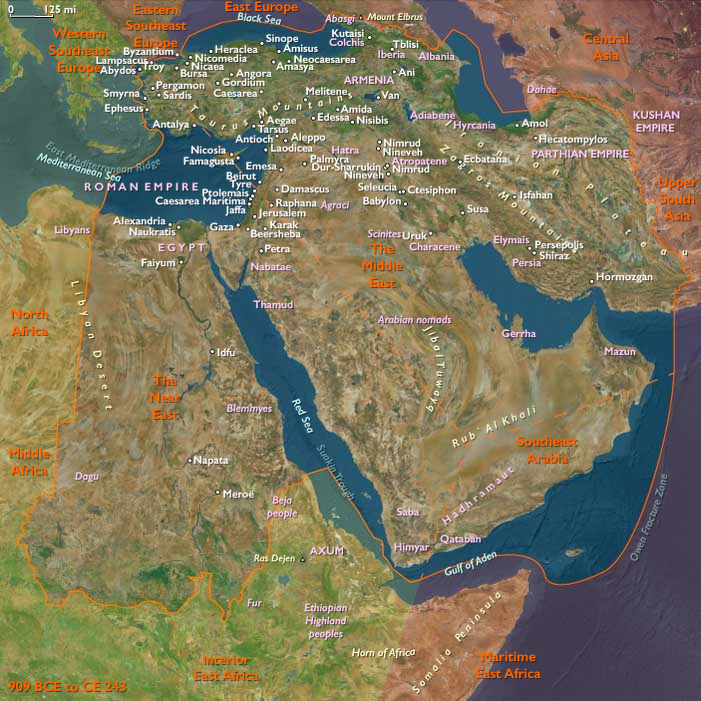
When Macrinus came to power, he suppressed the threat against his reign by the family of his assassinated predecessor by exiling them—Julia Maesa, her two daughters, and her eldest grandson Elagabalus—to their estate near Emesa in Syria, where the Severan women plot, with Julia Maesa’s eunuch advisor and Elagabalus' tutor Gannys, to place another Severan on the imperial throne.
They use their hereditary influence over the cult of sun-deity Elagabalus (the Latinized form of El-Gabal) to proclaim Soaemias' son Elagabalus (named for his family's patron deity) as the true successor to Caracalla.
The false rumor is spread by Elagabalus, with the assistance of the Severan women, that he is Caracalla's illegitimate son and thus the child of a union between first cousins.
He is therefore due the loyalties of Roman soldiers and senators who had sworn allegiance to Caracalla.
Born around the year 203, as Varius Avitus Bassianus to the family of Sextus Varius Marcellus and Julia Soaemias Bassiana, his father had initially been a member of the equestrian class, but had later been elevated to the rank of senator.
His grandmother Julia Maesa is the widow of the Consul Julius Avitus, the sister of Julia Domna, and the sister-in-law of emperor Septimius Severus.
Her daughter Julia Soaemias is a cousin of Caracalla.
Other relatives include his aunt Julia Avita Mamaea and uncle Marcus Julius Gessius Marcianus and their son Alexander Severus.
Elagabalus's family holds hereditary rights to the priesthood of the sun god El-Gabal, of whom Elagabalus is the high priest at Emesa (modern Homs) in Syria.
Elagabalus was initially venerated at Emesa.
The name is the Latinized form of the Syrian Ilāh hag-Gabal, which derives from Ilāh ("god") and gabal ("mountain"), resulting in "the God of the Mountain" the Emesene manifestation of the deity.
The cult of the deity had spread to other parts of the Roman Empire in the second century.
For example, a dedication has been found as far away as Woerden (Netherlands).
The god is later imported and assimilated with the Roman sun god, who was known as Sol Indiges in republican times and as Sol Invictus during the second and third centuries.
Macrinus' short reign, while important for its historical "firsts", is cut short due to the inability of this otherwise accomplished man to control or satisfy the soldiery.
After Julia Maesa displays her wealth to the Legio III Gallica at Raphana, they swear allegiance to Elagabalus.
At sunrise on May 16, 218, Publius Valerius Comazon Eutychianus, commander of the legion, declares him emperor.
To strengthen his legitimacy through further propaganda, Elagabalus assumes Caracalla's names, Marcus Aurelius Antoninus.
In response, Macrinus dispatches his Praetorian prefect Ulpius Julianus to the region with a contingent of troops he considers strong enough to crush the rebellion.
However, this force soon joins the faction of Elagabalus when, during the battle, they turn on their own commanders.
The officers are killed and Julianus' head is sent back to the emperor.
Macrinus now sends letters to the Senate denouncing Elagabalus as the False Antoninus and claiming he is insane.
Both consuls and other high ranking members of Rome's leadership condemn him, and the Senate subsequently declares war on both Elagabalus and Julia Maesa.
A force under Bassianus’s tutor Gannys marches on Antioch and engages a force under Macrinus Macrinus and his son, who, weakened by the desertion of the Second Legion due to bribes and promises circulated by Julia Maesa, are defeated on June 8, 218 at the Battle of Antioch.
Macrinus flees toward Italy, disguised as a courier, but is later intercepted near Chalcedon and executed in Cappadocia.
His son Diadumenianus, sent for safety to the Parthian court, is captured at Zeugma and also put to death.
The demise of Macrinus has reinforced the notion of the soldiers as the true brokers of power in the third-century empire and highlighted the importance of maintaining the support of this vital faction.
Elagabalus declares the date of the victory at Antioch to be the beginning of his reign and assumes the imperial titles without prior senatorial approval, which violates tradition but is a common practice among third-century emperors nonetheless.
Letters of reconciliation are dispatched to Rome extending amnesty to the Senate and recognizing the laws, while also condemning the administration of Macrinus and his son.
The senators respond by acknowledging Elagabalus as emperor and accepting his claim to be the son of Caracalla.
Caracalla and Julia Domna are both deified by the Senate, both Julia Maesa and Julia Soaemias are elevated to the rank of Augustae, and the memory of Macrinus and Diadumenianus is condemned and vilified by the Senate.
The former commander of the Third Legion, Comazon, is appointed to be commander of the Praetorian Guard.
Elagabalus and his entourage spend the winter of 218 in Bithynia at Nicomedia, where the emperor's religious beliefs first manifest themselves as a problem.
The contemporary historian Cassius Dio suggests that Gannys was in fact killed by the new emperor because he was forcing Elagabalus to live "temperately and prudently."
To help Romans adjust to the idea of having an oriental priest as emperor, Julia Maesa has a painting of Elagabalus in priestly robes sent to Rome and hung over a statue of the goddess Victoria in the Senate House.
This places senators in the awkward position of having to make offerings to Elagabalus whenever they make offerings to Victoria.
The legions, dismayed at his behavior, quickly come to regret their decision to have him supported as emperor.
While Elagabalus is still on his way to Rome, brief revolts break out by the Fourth Legion, at the instigation of Gellius Maximus, and by the Third Legion, which itself had been responsible for the accession of Elagabalus as emperor, under command of Senator Verus.
The rebellion is quickly struck down, and the Third Legion disbanded.
Comazon and other allies of Julia Maesa and Elagabalus are given powerful and lucrative positions in the autumn of 219 when the new emperor’s entourage reaches Rome, much to the outrage of many senators who do not consider them to be respectable.
After Comazon's tenure as Praetorian prefect, he will serve as the city prefect of Rome three times, and as consul twice.
Elagabalus soon devalues the Roman currency, decreasing the silver purity of the denarius from 58% to 46.5%—the actual silver weight dropping from 1.82 grams to 1.41 grams.
He also demonetized the antoninianus during this period in Rome.
Elagabalus tries to have his presumed lover, the charioteer Hierocles, declared Caesar, while another alleged lover, the athlete Aurelius Zoticus, is appointed to the non-administrative but influential position of Cubicularius.
His offer of amnesty for the Roman leadership is largely honored, though the jurist Ulpian is exiled.
The relationships between Julia Maesa, Julia Soaemias, and Elagabalus are strong, at first.
His mother and grandmother become the first women to be allowed into the Senate, and both received senatorial titles: Soaemias the established title of Clarissima and Maesa the more unorthodox Mater Castrorum et Senatus.
While Julia Maesa tries to position herself as the power behind the throne and subsequently the most powerful woman in the world, Elagabalus will prove to be highly independent, set in his ways, and impossible to control.
Sun worship has increased throughout the Empire since the reign of Septimius Severus.
Elagabalus, in his dual role as Roman Emperor and hereditary priest of the god El-Gabal at his hometown, Emesa, sees this as an opportunity to install El-Gabal as the chief deity of the Roman Pantheon.
The god is renamed Deus Sol Invictus, meaning God the Undefeated Sun, and placed over Jupiter.
As a sign of the union with the Roman religion, Elagabalus gives either Astarte, Minerva, Urania, or some combination of the three, to El-Gabal as a wife.
He provokes further outrage when he takes as his second wife the Vestal Virgin Aquilia Severa, claiming the marriage will produce "god-like children".
This is a flagrant breach of Roman law and tradition, which holds that any Vestal found to have engaged in sexual intercourse before her thirty-year vow of celibacy has been fulfilled is to be buried alive.
A lavish temple called the Elagabalium is built on the east face of the Palatine Hill to house El-Gabal, who is represented by a black conical meteorite from Emesa.
Herodian wrote "this stone is worshipped as though it were sent from heaven; on it there are some small projecting pieces and markings that are pointed out, which the people would like to believe are a rough picture of the sun, because this is how they see them".
(Herodian, Roman History V.3) In order to become the high priest of his new religion, Elagabalus has himself circumcised.
(Cassius Dio, Roman History LXXX.11) He forces senators to watch while he dances around the altar of Deus Sol Invictus to the sound of drums and cymbals, and each summer solstice he holds a festival dedicated to the god, which becomes popular with the masses because of the free food widely distributed there.
During this festival, Elagabalus places the Emesa stone on a chariot adorned with gold and jewels, which he parades through the city.
The most sacred relics from the Roman religion are transferred from their respective shrines to the Elagabalium, including the Great Mother, the fire of Vesta, the Shields of the Salii and the Palladium, so that no other god except El-Gabal will be worshipped.
Elagabalus' eccentricities, particularly his relationship with Hierocles, have by 221 increasingly infuriated the soldiers of the Praetorian Guard, a significant portion of whom are Illyrians, having distinguished themselves as warriors in the Roman legions.
When Elagabalus’s grandmother, Julia Maesa, perceives that popular support for the emperor is quickly wavering, she decides that he and his mother, who had encouraged his religious practices, have to be replaced.
As alternatives, she turns to her other daughter Julia Avita Mamaea and her son, the thirteen-year-old Severus Alexander.
Persuading Elagabalus to appoint his cousin as his heir, Alexander is bestowed with the title of Caesar and shares the consulship with the emperor this year.
However, Elagabalus reconsiders this arrangement when he begins to suspect that the Praetorian Guard favors his cousin over himself.
Elagabalus' sexual orientation and gender identity are the source of much controversy and debate.
All told, Elagabalus will marry and divorce five women, three of whom are known.
His first wife was Julia Cornelia Paula; the second is the Vestal Virgin Julia Aquilia Severa, but within a year, he abandons her and marries Annia Aurelia Faustina, a descendant of Marcus Aurelius.
It is her beauty and her high prominent imperial ancestry that have attracted Elagabalus to her.
In order to marry her, he orders the execution of her husband, Pomponius Bassus.
After the death of the latter, Elagabalus forbids her to mourn Bassus.
In July 221, Elagabalus takes Faustina as his third wife.
Roman society is more accepting of his marriage to her than of his second marriage to the Vestal Virgin Julia Aquilia Severa.
Through her marriage to Elagabalus, she becomes Empress of Rome.
When she marries Elagabalus, it seems for a time that the Nerva–Antonine dynasty rule has returned to Rome.
He gives her the title of Annia Faustina Augusta and adds the Latin name Julia to her name.
Numismatic and other evidence that have survived of her date from her second, brief marriage, to Elagabalus.
Elagabalus has hoped she will bear him an heir, so that his maternal cousin will not inherit the throne; however, she bears him no children and, towards the end of 221, Elagabalus divorces her; it is not known why.
There are no surviving sources stating how Annia Aurelia Faustina ruled when she was a Roman Empress.
Elagabalus returns to Julia Aquilia Severa, claiming that the original divorce was invalid, and remarries her, as his fourth wife.
Although Elagabalus returns to Severa by the end of the year, according to Cassius Dio, his most stable relationship seems to have been with his chariot driver, a blond slave from Caria named Hierocles, whom he refers to as his husband.
The Augustan History claims that he also married a man named Zoticus, an athlete from Smyrna, in a public ceremony at Rome.
Cassius Dio reported Elagabalus would paint his eyes, epilate his hair and wear wigs before prostituting himself in taverns and brothels, (Cassius Dio, Roman History LXXX.14) and even the imperial palace: Finally, he set aside a room in the palace and there committed his indecencies, always standing nude at the door of the room, as the harlots do, and shaking the curtain which hung from gold rings, while in a soft and melting voice he solicited the passers-by. (Cassius Dio, Roman History LXXX.13)
Herodian commented that Elagabalus pampered his natural good looks by wearing too much make-up.
He was described as having been "delighted to be called the mistress, the wife, the Queen of Hierocles" and was said to have offered vast sums of money to the physician who could equip him with female genitalia. (Cassius Dio, Roman History LXXX.16)
Subsequently, Elagabalus has often been characterized by modern writers as transgender, most likely transsexual.
Elagabalus, to see how the Praetorians would react following the failure of various attempts at Alexander's life, strips his cousin of his titles, revokes his consulship, and circulates the news that Alexander is near death.
A riot ensues, and the guard demands to see Elagabalus and Alexander in the Praetorian camp.
The emperor complies and on March 11, 222, he presents his cousin, along with his mother Julia Soaemias.
Upon arrival the soldiers start cheering Alexander, while ignoring Elagabalus, who orders the summary arrest and execution of anyone who had taken part in this revolt.
In response, the Praetorians attack Elagabalus and his mother:
So he made an attempt to flee, and would have got away somewhere by being placed in a chest, had he not been discovered and slain, at the age of 18. His mother, who embraced him and clung tightly to him, perished with him; their heads were cut off and their bodies, after being stripped naked, were first dragged all over the city, and then the mother's body was cast aside somewhere or other, while his was thrown into the river. (Cassius Dio, Roman History LXXX.20)
Following his demise, many associates of Elagabalus are killed or deposed, including Hierocles and Comazon.
His religious edicts are reversed and El-Gabal is returned to Emesa.
Women are barred from ever attending meetings of the Senate, and damnatio memoriae—erasing a person from all public records—is decreed upon him.
The source of many of these stories of Elagabalus's debauchery is the Augustan History (Historia Augusta), which scholarly consensus now feels to be unreliable in its details.
The Historia Augusta was most likely written near the end of the fourth century during the reign of emperor Theodosius I, drawing as much upon the invention of its author as actual historical sources.
The life of Elagabalus as described in the Augustan History is believed to be largely a work of historical fiction.
Only the sections 13 to 17, relating to the fall of Elagabalus, are considered to hold any historical value.
Sources more credible than the Augustan History include the contemporary historians Cassius Dio and Herodian.
Cassius Dio's account of his reign is generally considered more reliable than the Augustan History, although it should be noted that Dio, although he was a contemporary of Elagabalus, spent the larger part of this period outside of Rome and had to rely on secondhand accounts when composing his Roman History.
Furthermore, the political climate in the aftermath of Elagabalus' reign, as well as his own position within the government of Alexander, likely imposed restrictions on the extent to which his writing on this period is truthful.
Herodian is considered the most important source on the religious reforms which took place during the reign of Elagabalus, which have been confirmed by modern numismatical and archaeological evidence.
While Herodian is deemed not as reliable as Cassius Dio, his lack of literary and scholarly pretensions make him less biased than senatorial historians.
Alexander Severus is young, amiable, well-meaning, and entirely under the dominion of his mother.
Julia Mamaea is a woman of many virtues, and she surrounds the young emperor with wise councilors, under the administration of the famous jurist and praetorian praefect Ulpian, who is also from Syria.
Alexander’s reign contains some of the last major building works constructed in Rome before the reign of Diocletian.
He builds the last of the eleven ancient aqueducts of Rome, the twenty-two kilometer long Aqua Alexandrina, to supply his enlargement of the Thermae of Nero, which have been renamed after the emperor (Thermae Alexandrinae).