Konstanty Ostrogski
Grand Hetman of Lithuania
Years: 1460 - 1530
Kostiantyn Ivanovycz Ostrogski (c. 1460 – August 10, 1530) is a magnate of the Grand Duchy of Lithuania and later a Grand Hetman of Lithuania from September 11, 1497 until his death.
As a speaker of the Ruthenian language he is considered to be one of the precursors of the Belarusian language and a national hero in Belarus.
Related Events
Filter results
Showing 10 events out of 10 total
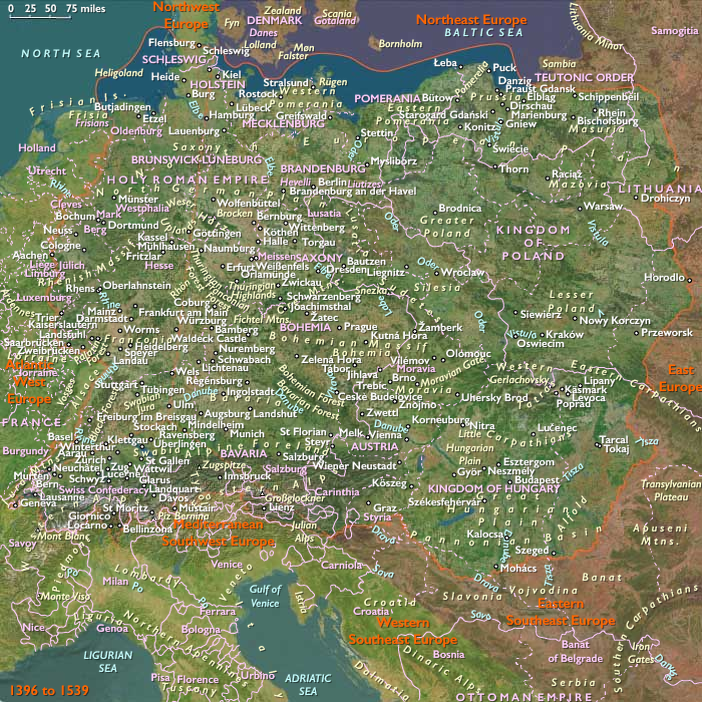
The Lithuanians suffer a crushing defeat in the Battle of Vedrosha on July 14, 1500, in which the skilled Russian commander, Prince Daniil Shchenya, employs tactics similar to those that had proved successful for the Russian army in the Battle of Kulikovo in 1380.
Vedrosha is a great victory for the Russians.
Some eight thousand Lithuanians are killed, and many more are taken prisoner, including Prince Konstanty Ostrogski, the first ever Grand Hetman of Lithuania.
The defeat is one of the reasons for the proposed Union of Mielnik between Poland and Lithuania.
After the battle, the Lithuanians lose the possibility of military initiative and restrict themselves to defensive actions.
The relationship between Muscovy and Lithuania has remained tense despite the mutual peace signed by the two countries.
Sigismund I has demanded extradition of Michael Glinski for trial, while Vasili III demands better treatment of his widowed sister Helena.
Vasili also discovers that Sigismund is paying Khan Meñli I Giray to attack the Grand Duchy of Moscow.
Albert of Prussia has at the same time become the Grand Master of the Teutonic Knights and is unwilling to acknowledge Poland's suzerainty as required by the Second Peace of Thorn (1466).
The tension will eventually result in the Polish–Teutonic War (1519–21) and ally Maximilian I, Holy Roman Emperor with Vasili III.
Muscovy had in December 1512 invaded the Grand Duchy of Lithuania with a goal to capture Smolensk, a major trading center.
The fortress of Smolensk is at this time the easternmost outpost of the Grand Duchy of Lithuania and one of the most important strongholds guarding it from the east.
It has repelled several Muscovite attacks, including six- and four-week sieges in 1513, but in July 1514 a Muscovite army besieges and finally captures it, chiefly through the aid of the rebel Lithuanian prince, Mikhail Glinski, who had provided Vasili III with artillery and engineers.
Prince Vasily Nemoy Shuysky is left as viceregent in Smolensk.
This angers Glinski, who threatens to rejoin Sigismund I, but he is imprisoned by the Russians.
Vasili III, spurred on by this initial success, orders his forces farther into present-day Belarus, occupying the towns of Krichev, …
…Mstislavl and …
…Dubrovna.
Sigismund has meanwhile gathered some thirty-five thousand troops for war with his eastern neighbor.
This army is inferior in numbers, but consists mostly of well-trained cavalry.
The forces of the Grand Duchy of Lithuania and the Kingdom of Poland placed under the command of Hetman Konstanty Ostrogski include sixteen thousand Lithuanian cavalry, fourteen thousand Polish cavalry (light and heavy), three thousand Polish mercenary infantry, and twenty-five hundred volunteers, mostly from Bohemia.
Sigismund leaves four thousand to five thousand men in the town of Barysau, while the main force, around thirty thousand strong, moves on to face the Muscovites.
Several skirmishes at the end of August take place at the crossings of the Berezina, Bobr and Drut Rivers, but the Muscovite army avoids a major confrontation.
The Muscovites, suffering negligible losses, advance to the area between Orsha and Dubrovno on the Krapivna River, where they set up camp.
Ivan Chelyadnin, confident that the Lithuanian-Polish forces will have to cross one of the two bridges on the Dnieper River, splits his own forces to guard those crossings.
However, Ostrogski's army crosses the river farther north via two pontoon bridges.
On the night of September 7, the Polish-Lithuanian army begins preparations for a final battle with the Muscovites.
Hetman Konstantyn Ostrogski places most of his sixteen thousand horses from the Grand Duchy in the center, while most of the Polish infantry and the auxiliary troops manned the flanks.
The Bohemian and Silesian infantry are deployed in the center of the line, in front of the reserves comprising Lithuanian and Polish cavalry.
On September 8, 1514, shortly after dawn, Ivan Chelyadnin gives the order to attack.
The Muscovite forces attempt to outflank the Lithuanians and Poles by attacking their flanks, which are manned by Polish, Lithuanian light hussar and Tatar troops.
One of the pincers of the attack is commanded by Chelyadnin personally, while the other is led by Prince Bulgakov-Golitsa.
The initial attack fails, and the Muscovites withdraw toward their starting positions.
Chelyadnin is still confident that the odds, almost 3:1 in his favor, will give him victory.
However, preoccupied with his own wing of the Muscovite forces, he loses track of the other sectors and fails to coordinate a defense against the counterattack by the Lithuanian light and Polish heavy cavalry, which until now has been kept in reserve.
The Lithuanian and Polish light horse and Tarars attack the overextended center of the Muscovite lines in an attempt to split them.
At the crucial moment, the Polish-Lithuanian cavalry seems to waver, then goes into retreat.
The Muscovites pursue with all their cavalry reserves.
The Lithuanian Tatars and Polish cavalry, after retreating for several minutes under chase from the Russians, suddenly turn to the sides.
The Muscovite cavalry now finds themselves confronted by artillery concealed in the forest.
From both sides, Polish and Lithuanian forces appear and proceed to surround the Muscovites.
Ivan Chelyadnin sounds retreat, which soon becomes a rout.
The Muscovite forces are pursued by the army of the Grand Duchy of Lithuania for five kilometers.
The Muscovite defeat is often attributed to repeated failures by Ivan Chelyadnin and Golitsa to coordinate their operations.
Sigismund von Herberstein reports that forty thousand Muscovites were killed.
According to accounts in Polish chronicles, thirty thousand Russians were killed and an additional three thousand were taken captive, including Ivan Chelyadnin and eight other commanders.
The forces of the Grand Duchy of Lithuania and Kingdom of Poland seize the Muscovite camp and all three hundred cannon.

Ostrogski's forces continue their pursuit of the routed Russian army and retake most of the previously captured strongholds, including Mstislavl and Krychev, and the advancement of the Russians is stopped for four years.
However, the Lithuanian and Polish forces are too exhausted to besiege Smolensk before the winter.
This means that Ostrogski does not reach the gates of Smolensk until late September, giving Vasili III enough time to prepare defense.
Hetman Konstanty Ostrogski had entered Vilnius in triumph in December 1514.
To commemorate the victory over the Muscovites, two Orthodox churches are erected: the Church of the Holy Trinity and the Church of Saint Nicholas, which remain among the most impressive examples of Orthodox Church architecture in Lithuania.
Immediately after the victory, the Polish–Lithuanian state starts to exploit the battle for its propaganda aimed at other nations in Europe, with the intent of improving the image of Poland-Lithuania abroad.
Several panegyrical accounts of the battle are sent to Rome.
Maximilian, in order to reduce the growing pressures on the Empire brought about by treaties between the rulers of France, Poland, Hungary, Bohemia, and Russia, as well as to secure Bohemia and Hungary for the Habsburgs, meets with the Jagiellonian kings Ladislaus II of Hungary and Bohemia and Sigismund I of Poland at the First Congress of Vienna on July 22, 1515.
Here they arrange for Maximilian's granddaughter Mary to marry Louis, the son of Ladislaus, and for Anne (the sister of Louis) to marry Maximilian's grandson Ferdinand (both grandchildren being the children of Philip the Handsome, Maximilian's son, and Joanna of Castile.
The broad coalition against Lithuania and Poland ceases, but the war between the Grand Duchy of Lithuania and Grand Duchy of Moscow will last until 1520.