The Middle East: 1485–1342 BCE
Empires in Conflict: Egypt, Hittites, and Emerging Kingdoms
Egyptian-Hittite Rivalry and Regional Powers
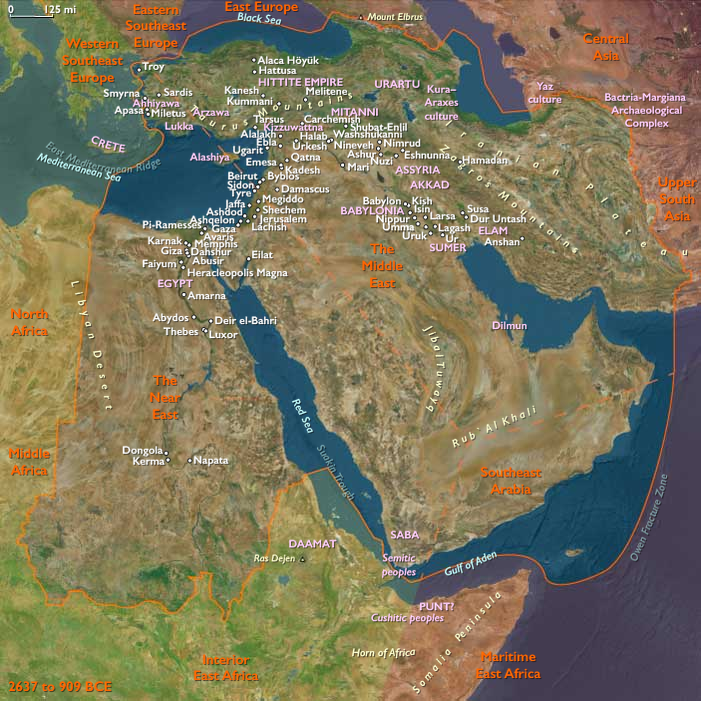
Following the Hyksos expulsion, Egypt under Pharaoh Thutmose III (1490–1425 BCE) vigorously seeks to reestablish dominance in Syria. However, Egypt’s ambitions clash with the rising power of the Hittites, whose resurgence in Anatolia marks a period of intense geopolitical rivalry. From the fifteenth through the thirteenth centuries BCE, these two empires contest control over Syria and the surrounding regions. Their prolonged conflict creates a geopolitical vacuum east of the Jordan River, enabling the rise of small yet influential kingdoms—Edom, Moab, Bashan, Gilead, and Ammon (centered on Rabbath Ammon, present-day Amman). These kingdoms, recognized from biblical narratives, thrive economically through metallurgy, agriculture, and strategic trade routes linking Egypt and Mediterranean ports to Arabia and the Persian Gulf.
Cyprus and the Rise of Alashiya
The Late Bronze Age (1600–1050 BCE) marks a pivotal period for Cyprus, known as Alashiya in contemporary texts. Alashiya becomes crucially important to Egypt and other Near Eastern states as a copper supplier. The Cypriot city of Enkomi, strategically located for maritime commerce, emerges as a major trading center by the late fifteenth century BCE. Cypriot artisans, renowned for their jewelry, bronze figures, and ivory carvings, establish robust trade relationships with the Mycenaean Greeks, importing pottery and possibly hosting Greek craftsmen.
Phoenician Maritime Dominance
Phoenician city-states—most notably Berytus (Beirut), Byblos, Ugarit, Sidon, and Tyre—rise to prominence as major maritime trading centers by the mid-second millennium BCE. Their strategic coastal locations facilitate extensive trade networks dealing in highly valued commodities such as purple dyes (later known as Tyrian purple), cedar wood, glass, and luxury metal artifacts. Phoenician merchants dominate Mediterranean trade routes, extending cultural and economic influence far beyond their home ports.
The Hurrian State of Mitanni
By the early fifteenth century BCE, the Hurrians consolidate their fragmented territories into the powerful kingdom of Mitanni, extending from eastern Anatolia through northern Syria to the Mediterranean. Mitanni, led by an Indo-Iranian aristocracy known as maryannu, utilizes advanced chariot warfare to exert regional dominance. Egyptian attempts to reclaim territories in Palestine and Syria encounter Mitanni's resistance, ultimately resulting in shifting alliances that see Egypt allying with Mitanni against Hittite expansion by 1430 BCE.
Hittite Revival and Technological Advancements
The Hittite empire, reestablished in Anatolia, reaches new heights during this period. Their military innovations include widespread adoption of chariot warfare and early iron metallurgy techniques, notably iron smelting in bloomery furnaces by 1400 BCE. Hittite society maintains advanced legal and constitutional systems, evident in their recorded laws, which notably emphasize reparations over capital punishment. The capital, Hattusa, undergoes significant urban development, featuring advanced domestic architecture with paved washrooms and clay tubs.
Kassite Babylon: Continuity and Cultural Innovation
Under Kassite rule, Babylon reasserts itself as a central power in Mesopotamia. Kassite kings such as Kurigalzu I (late fifteenth century BCE) reinforce diplomatic ties with neighboring Assyria. Culturally, the Kassite period sees the composition of the Enuma Elish, the Babylonian creation epic celebrating Babylon’s supremacy. Architecturally, temples such as the Temple of Karaindash in Uruk exemplify Kassite innovation, incorporating sculpted bricks and oriented toward the rising sun.
Assyrian Independence and Cultural Flourishing
The northern Mesopotamian city-state of Assur regains independence from Mitanni in the fourteenth century BCE, marking the beginning of Assyrian expansion. Assyrian rulers pursue aggressive regional campaigns and establish their presence as a major Near Eastern power. Assyrian culture, notably elaborate dress styles and botanical gardens, reflects a sophisticated urban society maintaining diplomatic correspondences with contemporary Egyptian and Kassite rulers.
Middle Elamite Revival
In southwestern Iran, the Elamite kingdom experiences resurgence during the Middle Elamite period, marked by cultural and linguistic Elamization, particularly under the Kidinuid dynasty around 1500–1400 BCE. Elamite art flourishes, reflecting a vibrant cultural identity distinct from Mesopotamian traditions.
Cultural Exchange and Economic Networks
Trade continues to flourish throughout the region, bolstered by strong maritime and overland routes connecting Egypt, Cyprus, Anatolia, and Mesopotamia. Cities such as Ugarit maintain significant contact with Egypt and Cyprus, fostering cultural exchanges evident in language and writing systems. Metallurgical innovations, including the early use of brass at Nuzi and refined iron smelting techniques among the Hittites, mark significant technological advancements, enhancing economic productivity.
This era, defined by shifting alliances, cultural exchanges, technological innovations, and the emergence of powerful states, sets the stage for dynamic developments across the Middle East.