Louis the German
King of Eastern Francia
Years: 806 - 876
Louis (also Ludwig or Lewis) the German (806 – 28 August 876), also known as Louis II, is a grandson of Charlemagne and the third son of the succeeding Frankish Emperor Louis the Pious and his first wife, Ermengarde of Hesbaye.
He receives the appellation 'Germanicus' shortly after his death in recognition of the fact that the bulk of his territory had been in the former Germania.
Louis II is made the King of Bavaria from 817 following the Emperor Charlemagne's practice of bestowing a local kingdom on a family member who then served as one of his lieutenants and the local governor.
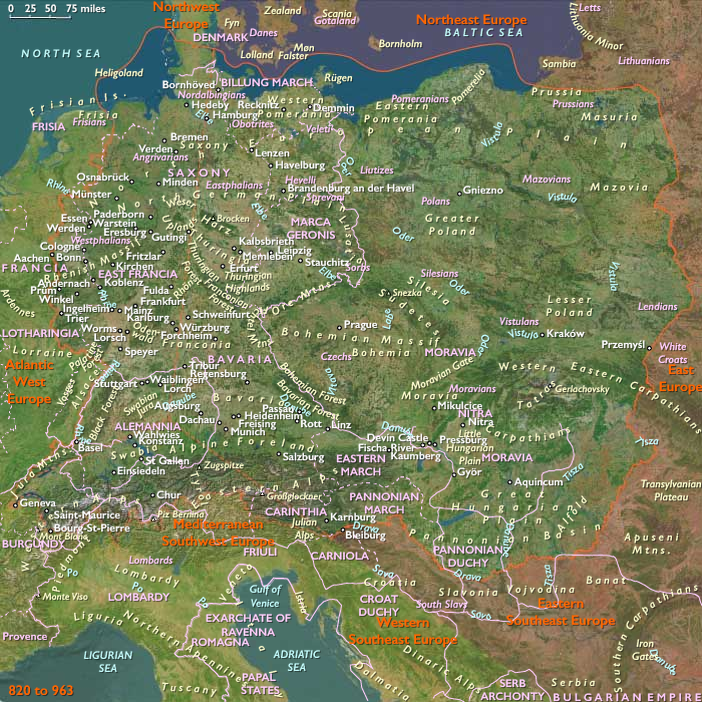
When his father, Louis I (called the pious), partitions the empire toward the end of his reign in 843, he is made King of East Francia, a region that spans the Elbe drainage basin from Jutland southeasterly through the Thuringerwald into modern Bavaria from the Treaty of Verdun in 843 until his death.

Related Events
Filter results
Showing 10 events out of 78 total
Atlantic West Europe (676–819): From Merovingian Fragmentation to Carolingian Unity
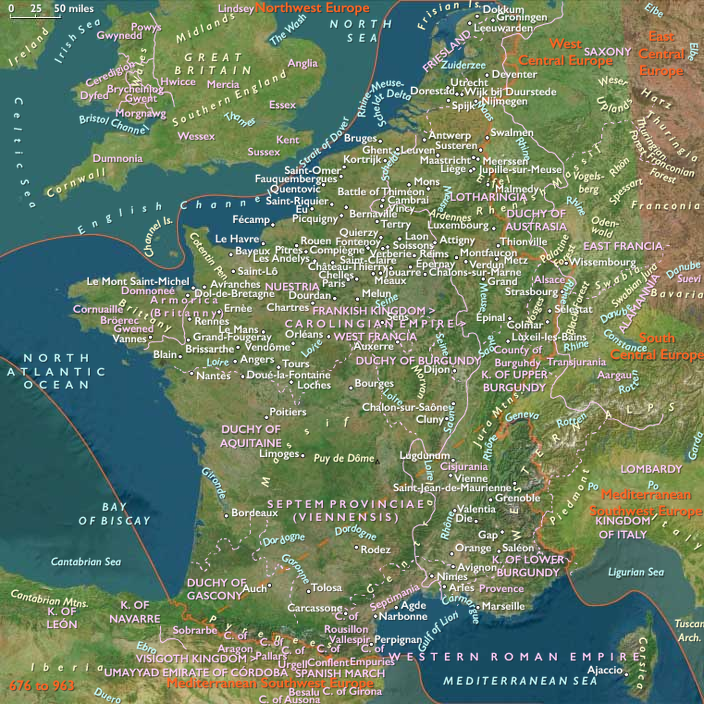
Between 676 and 819, Atlantic West Europe—including regions corresponding to modern-day France (Neustria, Austrasia, Aquitaine, Brittany, Burgundy) and the Low Countries—underwent profound political restructuring, evolving from fragmented Merovingian rule into the unified, culturally vibrant Carolingian Empire. This age witnessed the pivotal transition from declining royal authority to the consolidation of power under influential mayors of the palace, culminating in the ascendance of Charlemagne and the flowering of the Carolingian Renaissance.
Political and Military Developments
Merovingian Fragmentation and Austrasian Dominance (676–714)
- Following the assassination of Childeric II (675), the Frankish kingdoms—Neustria, Austrasia, and Burgundy—descended into rivalry and weakened royal power.
- Pepin of Herstal, Austrasian mayor of the palace, established dominance after the decisive Battle of Tertry (687), consolidating power over Neustria and Burgundy, thereby shifting control away from Merovingian kings to the mayors of the palace.
Carolingian Rise (715–751)
- Charles Martel (r. 718–741), son of Pepin of Herstal, fortified the Carolingian position by defeating Neustrian rivals and asserting authority over Aquitaine, Burgundy, and the Low Countries.
- His victory at Tours-Poitiers (732) halted the northward expansion of Umayyad forces, significantly shaping the future of Atlantic West Europe and earning him legendary status.
Carolingian Consolidation and Expansion (752–819)
- Pepin the Short (r. 751–768), Charles Martel's son, deposed the last Merovingian king (751), becoming king himself with papal sanction. His reign legitimized Carolingian rule, strengthened royal authority, and subdued Aquitaine.
- Charlemagne (r. 768–814) dramatically expanded Frankish territory through wars against Saxons, Lombards, Avars, and Muslim Spain, solidifying control over Aquitaine, Brittany, and parts of Burgundy.
- Charlemagne’s imperial coronation in 800 by Pope Leo III established the Carolingian Empire, a cultural and political unity unprecedented since Rome.
- Louis the Pious (r. 814–840) inherited a vast, culturally vibrant empire, though internal tensions foreshadowed future divisions.
Economic and Social Developments
Agricultural Revival and Feudal Foundations
- Improved stability under the Carolingians spurred agricultural expansion and economic recovery. Monastic estates spearheaded land clearance, technological innovations, and improved farming practices, laying groundwork for medieval manorialism.
- Proto-feudal relationships emerged as local aristocrats and monasteries provided peasants protection in exchange for labor, reinforcing hierarchical rural societies.
Urban Development and Commercial Renewal
- Trade gradually revived as towns such as Paris, Lyon, Nantes, Tours, and Utrecht benefited from increased political stability, becoming regional market centers.
- The Carolingian monetary reforms, especially the introduction of the silver denier, standardized and facilitated trade throughout Atlantic West Europe.
Religious and Cultural Developments
Expansion of Christianity and Ecclesiastical Reforms
- Carolingian rulers promoted Christianity vigorously, supporting missionary work in Saxony and among neighboring peoples.
- St. Boniface (d. 754), supported by Charles Martel and Pepin the Short, reorganized the Frankish church, strengthened papal ties, and founded key bishoprics throughout Atlantic West Europe.
Carolingian Renaissance
- Charlemagne’s court at Aachen became the heart of an intellectual revival, attracting scholars like Alcuin of York, Paul the Deacon, and Einhard.
- The establishment of cathedral and monastic schools, along with manuscript production centers in monasteries such as Corbie, Tours, and Fulda, significantly advanced literacy, education, and classical scholarship.
- Revival and standardization of Latin, script reforms (Caroline minuscule), and illuminated manuscripts marked cultural achievements.
Intellectual and Artistic Developments
Artistic and Architectural Innovations
- The period saw an evolution from Merovingian artistic traditions to Carolingian art, blending Classical Roman, Byzantine, and Germanic elements.
- Notable architectural projects included Charlemagne’s palace chapel at Aachen, Abbey of Saint-Denis, and monasteries throughout the empire.
Legacy and Significance
The era from 676 to 819 in Atlantic West Europe transformed a fragmented post-Roman landscape into a unified, culturally dynamic Carolingian Empire. The rise of the Carolingian dynasty established a powerful political order, revitalized economic life, and fostered a vibrant intellectual and artistic culture, laying the critical foundations for medieval European civilization.
Louis and his court are crossing a wooden gallery from the cathedral to the palace in Aachen on Maundy Thursday 817, when the gallery collapses, killing many.
Louis, having barely survived and feeling the imminent danger of death, begins planning for his succession; three months later he issues an Ordinatio Imperii, an imperial decree that lays out plans for an orderly succession.
He had already given his two eldest sons a share in the government in 815, when he had sent his elder sons Lothair and Pepin to govern Bavaria and Aquitaine respectively, though without the royal titles.
Now, he proceeds to divide the empire among his three sons and his nephew Bernard of Italy: Lothair is proclaimed and crowned co-emperor in Aachen by his father.
He is promised the succession to most of the Frankish dominions (excluding the exceptions below), and will be the overlord of his brothers and cousin.
Bernard, the son of Charles's son Pippin of Italy, is confirmed as King of Italy, a title he had been allowed to inherit from his father by Charles.
Pepin is proclaimed King of Aquitaine, his territory including Gascony, the march around Toulouse, and the counties of Carcassonne, Autun, Avallon and Nevers.
Louis, the youngest son, is proclaimed King of Bavaria and the neighboring marches.
If one of the subordinate kings dies, he is to be succeeded by his sons.
If he dies childless, Lothair will inherit his kingdom.
In the event of Lothair dying without sons, one of Louis the Pious' younger sons will be chosen to replace him by "the people".
Above all, the Empire will not be divided: the Emperor will rule supreme over the subordinate kings, whose obedience to him is mandatory.
With this settlement, Louis tries to combine his sense for the Empire's unity, supported by the clergy, while at the same time providing positions for all of his sons.
Instead of treating his sons equally in status and land, he has elevated his first-born son Lothair above his younger brothers and given him the largest part of the Empire as his share.
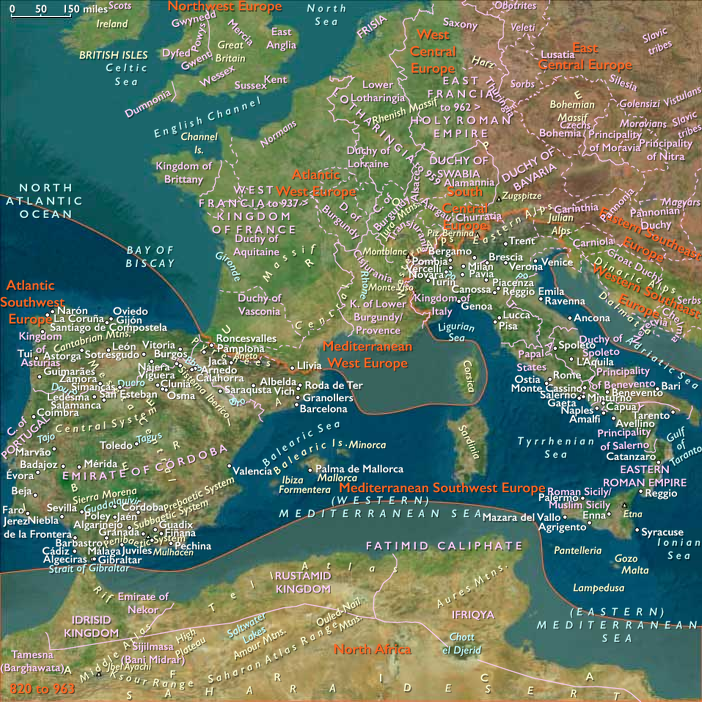
The Division of the Carolingian Empire and the Rise of Feudal France (843–10th Century)
Though Louis the Pious (814–840) successfully maintains the unity of Charlemagne’s empire during his lifetime, his death leads to a power struggle among his sons. This results in the Treaty of Verdun (843), which formally divides the Carolingian Empire into three separate kingdoms:
- East Francia → Louis the German (precursor to the Holy Roman Empire/Germany)
- Middle Francia → Lothair I (including the imperial title and lands stretching from the North Sea to Italy)
- West Francia → Charles the Bald (the forerunner of modern France)
Of these, West Francia, which roughly corresponds to modern France, will experience increasing decentralizationand internal fragmentation, setting the stage for the rise of feudalism.
The Viking Threat and the Decline of Royal Power
Throughout the 9th and 10th centuries, Viking raiders devastate the coasts and river valleys of France, frequently sacking towns, monasteries, and trade centers. With the Carolingian monarchy weakened by internal division, local nobles take increasing responsibility for defense and governance.
This period witnesses a major shift in power:
- Titles and lands become hereditary, rather than being granted or revoked by the king.
- Local lords build castles and raise private armies, exerting more control over their regions.
- The French king’s authority weakens, becoming more religious and ceremonial rather than military and administrative.
This process leads to the emergence of feudalism, where the king’s power is increasingly challenged by powerful noblemen who act as semi-independent rulers within their own domains.
The Rise of Overmighty Vassals: The Norman Challenge
Over time, some of the king’s vassals become so powerful that they rival or even surpass royal authority. One of the most notable examples is the Duke of Normandy:
- In 1066, William the Conqueror, Duke of Normandy, invades England and claims the English crown after his victory at the Battle of Hastings.
- As both King of England and Duke of Normandy, William remains a vassal of the French king in Normandy but also a sovereign ruler in England, creating recurring tensions between the two realms.
- This dual status will lead to centuries of conflict, culminating in the Hundred Years’ War (1337–1453) between England and France.
The Legacy of the Treaty of Verdun
The Treaty of Verdun (843) marks the beginning of medieval Europe’s political landscape, dividing Charlemagne’s empire into the roots of modern France, Germany, and Italy. However, the weakening of royal power in West Francia ensures that France will take centuries to reassert central authority, with feudal lords ruling their lands like independent princes until the emergence of stronger monarchs in the 12th and 13th centuries.
Atlantic West Europe, 820–831: Dynastic Consolidation and Carolingian Stability
Between 820 and 831, Atlantic West Europe—which included Brittany, Aquitaine, Normandy, Burgundy, central France, Alsace, Franche-Comté, and the Low Countries—experienced a period of relative stability under Carolingian rule, although internal tensions foreshadowed future divisions.
Political and Military Developments
-
Carolingian Empire: Rule of Louis the Pious
- Louis the Pious (r. 814–840) continued to govern the vast Carolingian Empire from Aachen, maintaining imperial unity but increasingly challenged by succession disputes among his sons.
- Attempts to provide inheritance for his sons (Lothair, Pepin I of Aquitaine, Louis the German, and Charles the Bald) initiated complex internal dynamics, undermining central authority.
-
Aquitaine: Semi-Autonomous Rule
- Pepin I, as King of Aquitaine (817–838), enjoyed substantial regional autonomy, laying the foundations for Aquitaine’s distinct political identity within the empire.
-
Brittany: Independent Struggles
- Brittany, under Nominoë, asserted independence from Frankish overlordship, beginning a protracted struggle for autonomy that characterized much of the ninth century.
Economic and Social Developments
- Carolingian Economic Stability
- The Carolingian economic renaissance continued from Charlemagne’s era, with sustained agricultural productivity, trade, and monetization, supporting urban growth, particularly around key centers such as Tours, Orléans, and Nantes.
Religious and Cultural Developments
-
Monastic and Intellectual Continuity
- Monasteries, notably Saint Martin of Tours, preserved and expanded their cultural and intellectual role, copying manuscripts and promoting Carolingian learning and literacy.
-
Continued Carolingian Renaissance
- The Carolingian Renaissance's cultural flowering continued, fostering artistic and literary works, scriptoria productivity, and scholarly efforts, particularly in monastic centers.
Legacy
This era provided stability but also revealed underlying dynastic fragility that would soon lead to fragmentation, notably in the coming disputes among Louis the Pious's heirs. Atlantic West Europe enjoyed a continuation of Carolingian cultural and economic flourishing, even as seeds of political division were sown.
The many tribes—Danes, Obotrites, Slovenes, Bretons, Basques—that inhabit the frontier lands at the start of the reign of Louis the German over Eastern Francia had remained in awe at the power of the Frankish emperor and dared not stir up any trouble.
The Sorbs in 818 had rebelled, however, and had been quickly followed by Slavomir, chief of the Obotrites, who had been captured and abandoned by his own people, being replaced in 818 by Ceadrag.
Soon, Ceadrag too had turned against the Franks and allied with the Danes, who will shortly become the greatest menace of the Franks.
A greater Slavic menace is gathering on the southeast, where, Ljudevit Posavski, the Croat Prince of Savia from about 810, is harassing the border at the Drava and Sava rivers.
As the ruler of the Pannonian Croats, his successful resistance of Frankish domination is an important precursor to the eventual unification of Croatian duchies in Dalmatia and Pannonia into the Kingdom of Croatia.
The margrave of Friuli, Cadolah, had been sent out against him, but he had died on campaign and in 820 his margarvate had been invaded by Slovenes.
An alliance had been made in 821 with Borna, duke of Dalmatia, and in 822 Ljudevit is brought to heel.
After being forced to flee, Ljudevit becomes a ruler over the Serbs, maintaining close ties with the Carantanians and Timokians (the Slavs, or Vlachs, in the Timok River valley).
Lothair, Emperor Louis’ eldest son by Ermengarde, is the heir to the entire Carolingian Empire, but has to share it with his brothers because of the traditional Frankish practice of division of patrimonies among all surviving sons.
Lothair had probably passed his early life at the court of his grandfather Charlemagne, until 815 when he became king of Bavaria.
When Louis divided the Empire between his sons in 817, Lothair had been crowned joint emperor at Aix-la-Chapelle (Aachen) and given a certain superiority over his brothers, Pepin and Louis, who had respectively received Aquitaine and Bavaria.
Lothair was also given the Iron Crown of Lombardy, then still held by Louis the Pious' nephew Bernard.
After Bernard’s death, Lothair had received the Italian kingdom.
In 821, he had married Ermengarde, daughter of Hugh, count of Tours, and in 822 assumed the government of Italy.
On April 5, 823, he had been crowned co-emperor again by Pope Paschal I, this time at Rome.
In November 824, he promulgates a statute concerning the relations of pope and emperor which reserves the supreme power to the secular potentate, and from this time he is to issue various ordinances for the good government of Italy.
Peace continues in the Frankish realms until 827, when the younger Louis, who had received Bavaria and the neighboring marches, the former realm of Lothair, has to deal with a Bulgarian horde descending on Pannonia.
The Accusation Against Bernard of Septimania and the 830 Revolt
Bernard of Septimania, one of Louis the Pious’ closest advisors, finds himself at the center of court intrigue and dynastic conflict in the early 9th century.
According to Thegan of Trier’s Gesta Hludowici, Bernard is accused of having an illicit relationship with Empress Judith of Bavaria, Louis’ second wife. Thegan dismisses these claims as lies, but the rumors spread widely, intensifying political tensions at court.
The April 830 Riot at Rennes
By April 830, Louis the Pious' sons—Lothair, Pepin, and Louis the German—oppose their father’s rule, believing that Empress Judith and her allies (including Bernard) hold too much influence at court.
- While the Frankish army is gathered at Rennes to fight the Bretons, the rumors trigger unrest among the soldiers.
- A riot erupts, fueled by resentment toward Bernard and the Empress, reflecting the wider dynastic struggle between Louis and his rebellious sons.
- Facing serious threats to his life, Bernard flees the court, abandoning his position.
Bernard’s Fall from Power
- According to the Annales Bertiniani, Bernard returns to Barcelona, where he had previously served as Count of Barcelona and Margrave of Septimania.
- His brother, Eribert, who remained at court, is banished.
- Bernard is deprived of the County of Autun, a title he had held for some time.
The Aftermath: Dynastic Conflicts Continue
Bernard’s fall from favor marks a turning point in the struggles between Louis the Pious and his rebellious sons. Over the next decade, these dynastic conflicts will further destabilize the Carolingian Empire, leading to civil wars, shifting alliances, and the eventual fragmentation of the empire under the Treaty of Verdun (843).
The Restoration of Louis the Pious at Nijmegen (October 830)
Following the April 830 revolt led by his three elder sons—Lothair I, Pepin of Aquitaine, and Louis the German—against their father, Emperor Louis the Pious, a brief civil war ensues. This rebellion, sparked by court tensions, allegations against Empress Judith, and resentment toward Bernard of Septimania, results in Louis’ temporary loss of power.
However, by October 830, Louis regains authority at an assembly in Nijmegen, marking a short-lived victory in his struggle to maintain control over the Carolingian Empire.
The Nijmegen Assembly and Louis’ Restoration
- Lothair I, who had previously attempted to assert imperial authority, is forced to submit to his father’s rule.
- The alliance between the rebellious sons weakens, allowing Louis to regain support among the Frankish nobility.
- Bernard of Septimania, accused of an affair with Empress Judith, remains in exile, while Judith herself is cleared of the allegations.
Aftermath and Continued Dynastic Struggles
Although Louis recovers his throne in 830, his sons’ ambitions remain unchecked, leading to further rebellions:
- In 833, his sons rise against him again, culminating in the Field of Lies, where Louis is betrayed and temporarily deposed.
- Though restored again in 834, these continuous power struggles destabilize the empire, setting the stage for the Treaty of Verdun (843) and the eventual partitioning of the Carolingian realm.
The assembly at Nijmegen represents one of many temporary victories for Louis the Pious in his ongoing struggle to maintain unity within an empire increasingly torn by dynastic rivalries.
Judith of Bavaria, Louis's second wife, had won the consent of her stepson Lothair on his return to his father's court,to her plan for securing a kingdom for her son Charles, a scheme that had been implemented in 829 when the young prince was given Alemannia as king.
Lothair, however, soon changes his attitude.
In Gascony and the chronically troublesome Pyrenees borderlands, Counts Hugh and Matfrid have failed to support the Louis’s military efforts, and the emperor has summarily stripped them of their positions.
This forceful action and a growing resentment of the efforts of Judith on behalf of her seven-year-old son, the target of resentment by his three adult half brothers, is the cause of a growing dispute between Louis and his son and coemperor, Lothair.
The quarrel over Charles’ future inheritance leads in 830 to open conflict.
Pepin, Louis the German, and Lothair, aided by Hugh and Matfrid, seek to “free”; the emperor from the tyranny of the “jezebel” Judith, but Louis's supporters, sowing discord among his elder sons, in October 830 restore him to authority.
The abortive coup claims a victim, however, when the Ordinatio imperii is replaced by a new Divisio regnorum, which calls for a division of the empire into four approximately equal kingdoms that are to become independent upon Louis's death, thus restoring the traditional Frankish practice of succession.
Supporters of a unified empire agitate against the Divisio, while the involvement of opportunistic nobles exacerbated the continuing conflict among the brothers.