Mahmud Hotak
Emir of Afghanistan/Shah of Iran
Years: 1697 - 1725
Shah Mahmud Hotak, also known as Mahmud Ghilzai (1697?— April 22, 1725), is an Afghan ruler of the Hotaki dynasty who defeats and overthow sthe Safavid dynasty to become the king of Persia from 1722 until his death in 1725.
He is the eldest son of Mirwais Hotak, the chief of the Ghilzai-Pashtun tribe of Afghanistan, who has made the Kandahar region independent from Persian rule in 1709.
When Mirwais dies in 1715, he is succeeded by his brother, Abdul Aziz, but the Ghilzai Afghans persuade Mahmud to seize power for himself and in 1717 he overthrows and killed his uncle.
Related Events
Filter results
Showing 10 events out of 18 total
Mir Wais dies of a natural cause in November 1715 and is succeeded by his brother Abdul Aziz, who will soon be killed by Mir Wais' son Mahmud, allegedly for planning to return sovereignty over Qandahar to Persia.
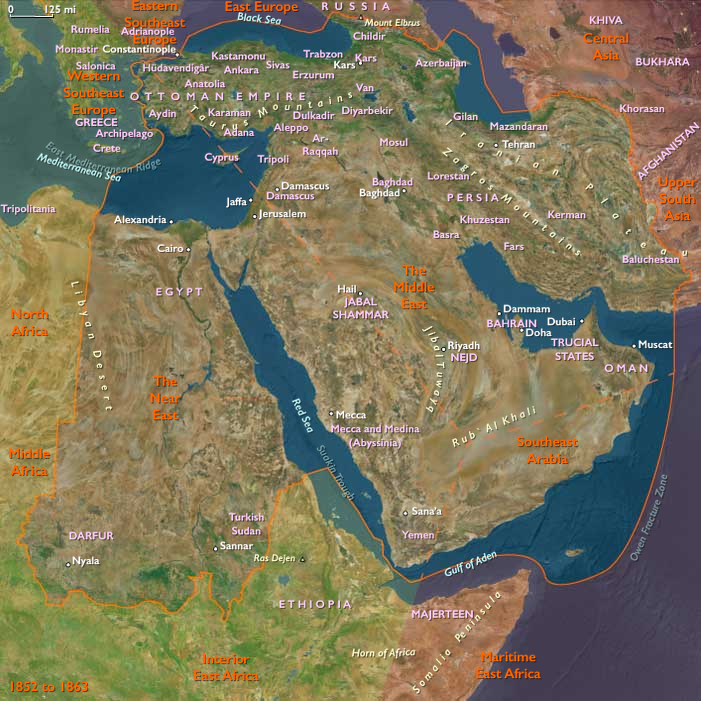
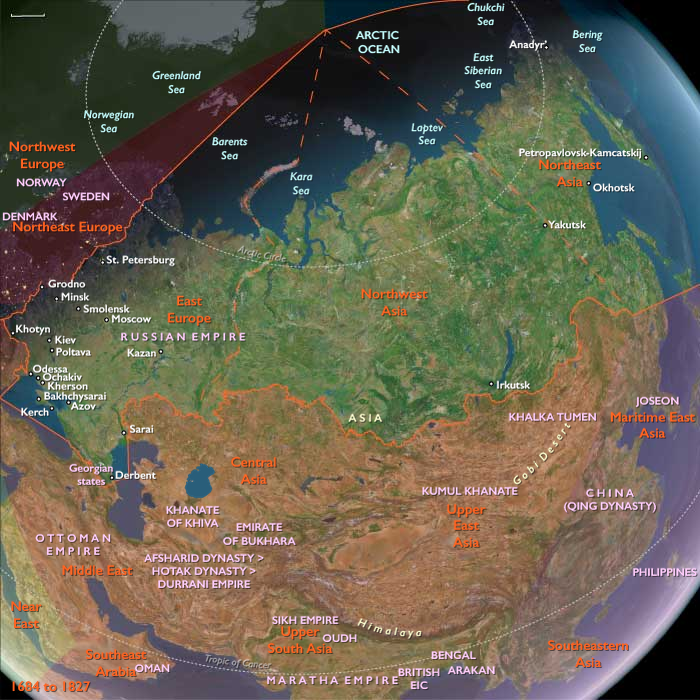
The Middle East: 1720–1731 CE
Dynastic Shifts and Regional Upheaval
This era marks significant realignments across the Middle East as major empires face internal struggles and emerging powers begin to reshape regional dynamics.
In Safavid Persia, internal decay reaches a critical point, culminating dramatically in 1722 when Afghan forces, led by Mahmud Hotak, invade and capture Isfahan, effectively ending Safavid dominance. Sultan Husayn is forced to abdicate, and Afghan rulers briefly establish control over central Persia. This upheaval sends ripples throughout the region, destabilizing traditional power balances and leaving Persia fractured and vulnerable to further incursions.
In response to Safavid collapse, Russia and the Ottoman Empire seize the opportunity to expand their territories. The Ottomans occupy western provinces, including Azerbaijan, Armenia, and parts of western Persia. The Treaty of Constantinople in 1724 formalizes a division of Persian territories between these two empires, intensifying geopolitical rivalries and complicating local governance.
In Iraq, despite nominal Ottoman rule, tribal autonomy continues to prevail, exacerbated by weakened central authority. Cities like Basra and Baghdad are governed by influential local dynasties and prominent tribal leaders, further fragmenting imperial governance. This decentralization fosters economic stagnation and internal instability, making Iraq a frontier region with limited control from Constantinople.
On the Arabian Peninsula, the Yarubid Imamate in Oman faces severe internal strife following a disputed succession after Imam Sultan bin Saif II's death in 1718. This dynastic turmoil leads to a debilitating civil war that weakens Oman’s maritime dominance and disrupts its established trading networks in East Africa and the Indian Ocean. Rival factions within the Yarubid dynasty vie fiercely for supremacy, severely diminishing the state’s previous power and cohesiveness.
Meanwhile, in the Levant, specifically Lebanon and Syria, Ottoman governance continues to decline, allowing powerful local families and tribal leaders to consolidate control. Beirut and Aleppo maintain economic vitality, largely due to ongoing European trade interests. French and British traders, protected under agreements known as "capitulations," continue to establish influential commercial presences, furthering European cultural and political influence in the region.
In Caucasian Armenia and Georgia, the fragmentation and instability caused by declining Persian power and Ottoman territorial ambitions increase local vulnerability. While Armenians under Ottoman administration retain religious autonomy through the millet system, Georgia remains fractured, its territories contested between Ottoman and Persian spheres of influence.
Legacy of the Era
Between 1720 and 1731 CE, the Middle East experiences pivotal shifts as the Safavid collapse significantly alters regional power structures. Afghan incursions into Persia, Ottoman-Russian territorial expansions, Omani civil strife, and enhanced European influence characterize a turbulent period. These events set the stage for subsequent power realignments that will reshape the region profoundly in the decades to come.
Medieval and obsolescent forms of government have given place to effective autocracy in the course of Peter's reign.
He had in 1711 abolished the boyarskaya duma, or boyar council, and established by decree of the Senate as the supreme organ of state—to coordinate the action of the various central and local organs, to supervise the collection and expenditure of revenue, and to draft legislation in accordance with his edicts.
Martial discipline is extended to civil institutions, and an officer of the guards is always on duty in the Senate.
From 1722, moreover, there is a procurator general keeping watch over the daily work of the Senate and its chancellery and acting as “the eye of the sovereign.” When Peter had come to power, the central departments of state had been the prikazy, or offices, of which there were about eighty, functioning in a confused and fragmented way.
To replace most of this outmoded system, Peter in 1718 had instituted nine “colleges” (kollegy), or boards, the number of which is by 1722 expanded to thirteen.
Their activities are controlled, on the one hand, by the General Regulation and, on the other, by particular regulations for individual colleges, and indeed there are strict regulations for every branch of the state administration.
Crimes against the state come under the jurisdiction of the Preobrazhensky Office, responsible immediately to the tsar.
In 1722 also, Peter creates a new order of precedence, known as the Table of Ranks.
Formerly, precedence had been determined by birth.
In order to deprive the boyars of their high positions, Peter directs that precedence should be determined by merit and service to the Emperor.
This replaces the old system of promotion in the state services, which had been according to ancestry, by one of promotion according to services actually rendered.
It classifies all functionaries—military, naval, and civilian alike—in fourteen categories, the fourtenth being the lowest and the firsst the highest; and admission to the eighth category confers hereditary nobility. (The Table of Ranks will continue to remain in effect until the Russian monarchy is overthrown in 1917.)
Peter also introduces new taxes to fund improvements in Saint Petersburg.
He abolishes the land tax and household tax, and replaces them with a capitation.
The taxes on land on households are payable only by individuals who own property or maintain families; the new head taxes, however, are payable by serfs and paupers.
Despite Russia’s exhaustion after the Second or Great Northern War, Peter, who has long contemplated establishing a trade route to India via the countries east of the Caspian Sea, is apprehensive over the Turkish push toward the region.
Even during the second half of the Northern War, Peter had sent exploratory missions to the East—to the Central Asian steppes in 1714, to the Caspian region in 1715, and to Khiva in 1717.
The end of the war leaves him free to resume a more active policy on his southeastern frontier.
Losses suffered by some Russian merchants during one of the many tribal uprisings in the Persian realms, ongoing since 1709, provide Peter with the pretext for launching a war against a Persia weakened by the Afghan rebellions.

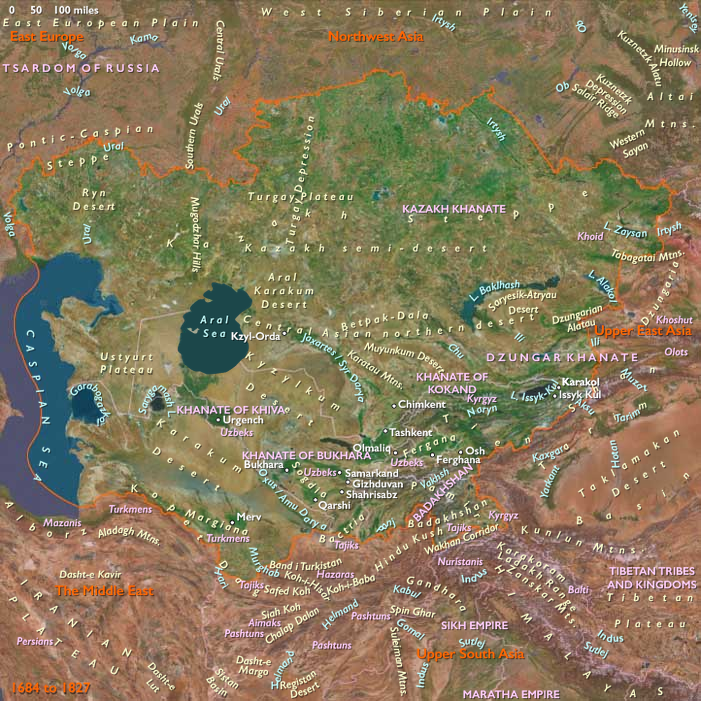
Mahmud, the young son and successor of Mir Wais Hotak, is not content to hold only Qandahar.
He leads some twenty thousand men against Isfahan in 1722; the Safavid government surrenders after a six-month siege.
Mahmud is not content with holding Qandahar.
He had already launched an expedition against Kerman in 1719 and in 1721 he besieged the city again.
Failing in this attempt and in another siege on Yazd, in early 1722, Mahmud had turned his attention to the shah's capital Isfahan.
Rather than biding his time within the city and resisting a siege in which the small Afghan army is unlikely to succeed, Sultan Husayn marches out to meet Mahmud's force at Golnabad.
Here, on March 8, the Persian royal army is thoroughly routed and flees back to Isfahan in disarray.
The shah's advisors urge him to escape to the provinces to raise more troops, but he decides to remain in the capital, which the Afghans have now encircled.
Mahmud's siege of Isfahan lasts from March to October, 1722.
Lacking artillery, he is forced to resort to a long blockade in the hope of starving the Persians into submission.
Sultan Husayn's command during the siege displays his customary lack of decisiveness and the loyalty of his provincial governors wavers in the face of such incompetence.
Starvation and disease finally force Isfahan into submission (it is estimated that eighty thousand of its inhabitants had died during the siege).
Sultan Husayn abdicates on October 23, and acknowledges Mahmud as the new shah of Persia.
Mahmud sacks the city and destroys what is left of central authority.
The resulting confusion and civil strife opens Persian territory to attacks from the north and west.
Tahmasp, the son of Husayn, has fled to Tabriz, where he establishes a government.
He gains the support of the Sunni Muslims of the Caucasus, as well as several Qizilbash tribes (including the Afshars, under the control of Iran's future ruler, Nader Shah).
Mahmud displays benevolence in the early days of his rule, treating the captured royal family well and bringing in food supplies to the starving capital.
He is in November confronted with a rival claimant to the throne when Hosayn's son, Tahmasp, declares himself shah.
Mahmud sends an army against Tahmasp's base, Qazvin.
Tahmasp escapes and the Afghans take the city but the populace, shocked at the treatment they receive at the hands of the conquering army, rises up against them in January 1723.
The revolt is a success and ...