Manuel Boutoumites
East Roman (Byzantine) general and diplomat
Years: 1050 - 1112
Manuel Boutoumites or Butumites (, fl.
1086–1112) is a leading Byzantine general and diplomat during the reign of Emperor Alexios I Komnenos (r. 1081–1118), and one of the emperor's most trusted aides.
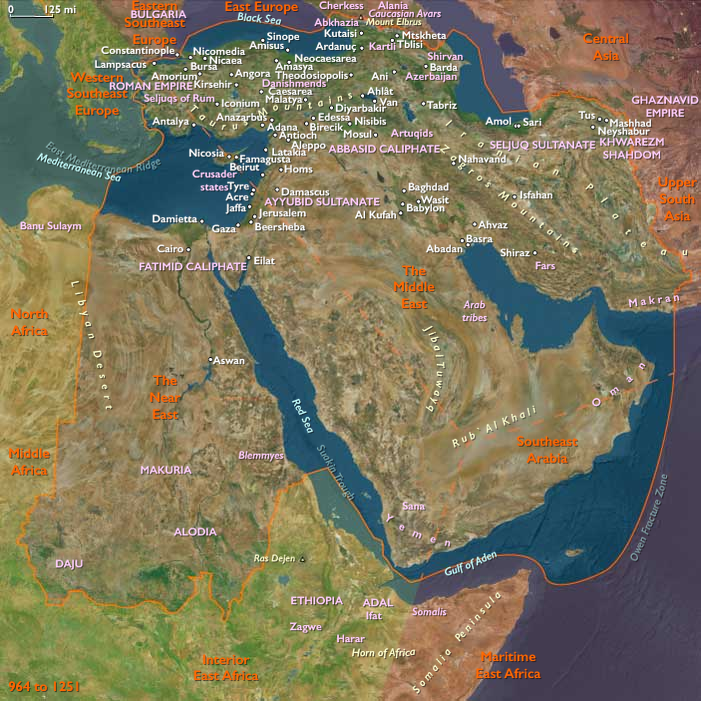
He is instrumental in the Byzantine recovery of Nicaea from the Seljuk Turks, in the reconquest of Cilicia, and acts as the emperor's envoy in several missions to Crusader princes.
Related Events
Filter results
Showing 10 events out of 96 total
…Euchaita and …
Peter the Hermit, according to Anna Komnena, had attempted to go on a pilgrimage to Jerusalem before 1096, but had been prevented by the Seljuqs from reaching his goal and was reportedly mistreated.
However, doubts remain that he ever made such a journey.
Sources differ as to whether he was present at Pope Urban II's famous Council of Clermont in 1095; but it is certain that he was one of the preachers of the crusade in France afterward, and his own experience may have helped to give fire to the Crusading cause.
He soon leapt into fame as an emotional revivalist; and the vast majority of sources and historians agree that thousands of peasants eagerly took the cross at his bidding.
This part of the crusade is also the crusade of the "paupers", a term which in the Middle Ages indicated a status as impoverished or mendicant wards of the Church.
Peter has organized and guided the paupers as a spiritually purified and holy group of pilgrims who would be protected by the Heavenly Host.
Peter had had difficulty in Germany, controlling his men, who in spring 1096 had gone on rampages killing Jews.
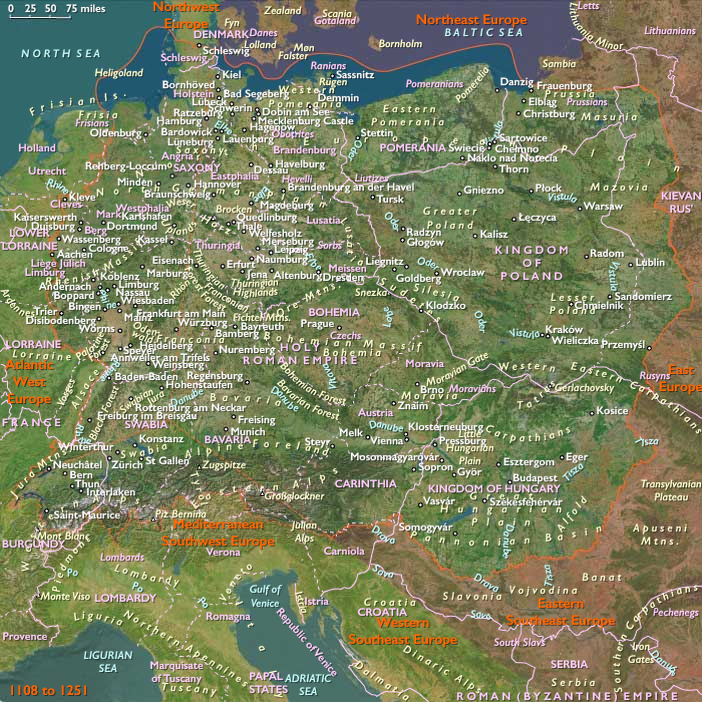
Leading the first of the five sections of the People's Crusade to the destination of their pilgrimage, the Church of the Holy Sepulcher, he had started (with forty thousand men and women) from Cologne in April, 1096, and arrived (with thirty thousand men and women) at Constantinople at the end of July.
The Eastern Roman Emperor Alexios I Komnenos is less than pleased with their arrival, for along with the head of the Eastern Orthodox Church, Patriarch Nicholas III of Constantinople, he is now required to provide for the care and sustenance of the vast host of paupers for the remainder of their journey.
Most of the paupers had failed to make their way out of Roman Catholic jurisdiction.
The majority were incapable of being provided for by the various lordships and dioceses along the way and either starved, returned home or were put into servitude.
Peter the Hermit had joined the only other section of the People’s Crusade that had succeeded in reaching Constantinople, that of the French Walter Sans Avoir, into a single group, encamping the still numerous pilgrims around Constantinople while he negotiated the shipping of the People's Crusade to the Holy Land.
The Emperor meanwhile had failed to provide for the pilgrims adequately and the camp had made itself a growing nuisance, as the increasingly hungry paupers turn to pilfering the imperial stores.
Alexios, worried at the growing disorder and fearful of his standing before the coming armed Crusader armies, had quickly concluded negotiations and ships them across the Bosporus to the Asiatic shore in the beginning of August, with promises of guards and passage through the Turkish lines.
He has warned the People's Crusade to await the arrival of the main body of crusaders, which is still on the way, but in spite of his warnings, the paupers enter Turkish territory, joined by number of bands of Italian crusaders who had arrived at the same time.
The army of the People's Crusade lands in Asia Minor on August 6, 1096, and camps at Helenopolis (Civetot/Civetote) to the northwest of Nicaea, capital of the Seljuq Sultanate of Rûm.
The young Sultan, Kilij Arslan I, is in the middle of a military campaign to the east, fighting the Danishmend emirate.
The motley European bands, once in Asia Minor, begin to pillage nearby towns, spurring each other on until finally the French reach the edge of Nicaea, where they pillage the suburbs.
The Norman raiding party returns unhindered many times with their booty, at some point even defeating the garrison of Nicaea when it tries to stop them.
An argument breaks out between the Germans and Italians on one side and the French on the other.
The Germans and Italians split off and elect a new leader, an Italian named Rainald, while for the French, Geoffrey Burel takes command.
Peter has effectively lost control of the crusade.
Reinald leads a host of Germans (Lombards and Alemanni), including two hundred knights, on similar raids.
Unsatisfied with the pillaging results near Nicaea, Reinald goes farther to Xerigordon, a hilltop fortress a few miles to the east, to set up a pillaging base, easily defeating the Xerigordon garrison on September 18, 1096.
Kilij Arslan orders his general, Elchanes, to deal with the crusader's raiding parties.
Elchanes arrives three days later with mostly mounted archers and besieges the crusaders tightly.
The speed of the Turkish mounted troops surprises the Germans; they had not expected to be besieged and are unprepared and without adequate supplies.
Moreover, there is no water system inside the fortress.
The defenders are forced to drink the blood of donkeys and their own urine during the siege, as their water supply is cut.
Relief forces never come.
For eight days, the Crusaders resist thirst and a rain of arrows and smoke from the Turks.
After, the leader of the Germans offers to surrender and to fight for the Turks.
The fort surrenders on September 29, 1096.
Some of the Crusaders who convert to Islam are enslaved and sent to Khorasan, while others who refuse to abandon their faith are killed.
There are various accounts on Reinald's fate.
Some mention that he was killed at the beginning of the siege while trying to ambush the Turks' own water source in front of the fortress, others that he died during the siege, and one that claims he converted to Islam.
Some accounts mention that Turks sent two spies to the Crusaders' camp at Civetot to make them think that Xerigordon was still safe, and even that Nicaea had been conquered by Reinald.
Other accounts mention that Crusader leaders on the field were forced by their troops to advance, but could not make the decision until news of the Xerigordon surrender arrived on October.
Two Turkish spies spread a rumor after the disastrous defeat for the Crusaders in the Siege of Xerigordon that the Germans who had taken Xerigordon had also taken Nicaea, which causes excitement to get there as soon as possible to share in the looting.
Of course, the Turks are waiting on the road to Nicaea.
Peter the Hermit had gone back to Constantinople to arrange for supplies and is due back soon, and most of the leaders argue to wait for him to return (which he never does).
However, Geoffrey Burel, who has taken command, argues that it is cowardly to wait, and they should move against the Turks right away.
His will prevails and, on the morning of October 21, the entire army marches out toward Nicaea, leaving women, children, the old, and the sick behind at the camp.
Three miles from the camp, where the road enters a narrow, wooded valley near the village of Dracon, the Turkish army is waiting.
When approaching the valley, the crusaders march noisily and are immediately subjected to a hail of arrows.
Panic sets in immediately and within minutes, the army is in full rout back to the camp.
Walter is killed, allegedly pierced by seven arrows.
Most of the crusaders are slaughtered; however, women, children, and those who surrender are spared.
Three thousand, including Geoffrey Burel, are able to obtain refuge in an abandoned castle.
Eventually, imperial troops under Constantine Katakalon sail over and raise the siege, and the survivors of the People’s Crusade return to Constantinople.
Left in Constantinople with the small number of surviving followers during the winter of 1096–1097, with little hope of securing imperial support, the People's Crusade awaits the coming of the armed crusaders as their sole source of protection to complete the pilgrimage.
Alexios I Komnenos, a well educated emperor, has reformed Constantinople’s monetary and taxation systems.
Alexios had undoubtedly solicited the help of mercenary troops from the West but not for the liberation of the Holy Land from the infidel.
The urgent need is the protection of Constantinople and the recovery of Anatolia.
The Greeks are more realistic about their Muslim neighbors than the distant popes and princes of the West.
The immediate threats to Constantinople had come from the Pechenegs to the north and the Normans to the west.
Alexios, who had doubtless anticipated some sort of auxiliary force, apparently soon realizes that he will have to provide for and police a much larger influx of warriors.
The main Crusading force, which had begun to move as Urban had directed in August 1096, consists of four major contingents, largely French and Norman knights under baronial leadership.
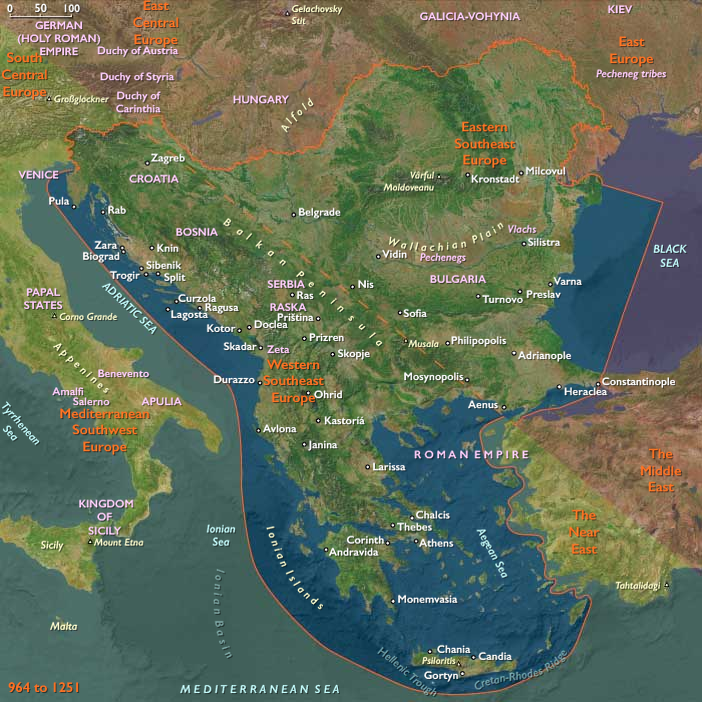
Hugh I of Vermandois, brother of King Philip I of France, had left first with a small following that had been reduced by shipwreck while crossing the Adriatic from Bari to Dyrrhachium.
Godfrey of Bouillon, duke of Lower Lorraine since 1089, is the only major prince from the German kingdom, though he and his associates largely speak French.
His brothers, Eustace and Baldwin of Boulogne, and a kinsman, Baldwin Du Bourcq, join him.
Taking the land route, Godfrey had crossed Hungary without incident, aided by that country's King Colomon, who had protected Hungary's Jewish communities from further mischief.
Markets and provisions had been supplied in imperial territory, and, except for some pillaging, the army reaches Constantinople without serious incident in late December.
Nikephoros Bryennios, a favorite of the emperor, who has given him the title of caesar, assists Alexios in dealing with Godfrey.
Bryennios marries Alexios's daughter Anna in 1097.
This time, Emperor Alexios is more prepared for the crusaders; there had been fewer incidents of violence along the way.
The motives of those who have taken the cross as crusaders ranges from religious enthusiasm to a mere spirit of adventure or a hope of gain; and it is no comfort to Alexios to learn that four of the eight leaders of the First Crusade are Normans, among them Bohemond, the son of Robert Guiscard.
Now forty years old, Bohemond is determined to come to profitable terms with his former enemy.
He arrives with his force, the second army to appear, at Constantinople on April 9, 1097.
The third and largest army to appear is that assembled by Raymond of Saint-Gilles, the count of Toulouse.
At fifty-five, he is the oldest and most prominent of the Crusading princes, and he aspires and perhaps expects to become the leader of the entire expedition.
Adhémar, bishop of Le Puy, whom the Pope had named as legate for the Crusade, accompanies him.
Raymond had led his followers, including a number of noncombatant pilgrims whom he supports at his own expense, across north Italy, around the head of the Adriatic, thence southward into imperial territory.
This large body had caused considerable trouble in Dalmatia and with imperial troops policing the area nearer the capital, where Raymond arrives on April 27.
The fourth army, under Robert of Flanders, had meanwhile crossed the Adriatic from Brindisi.
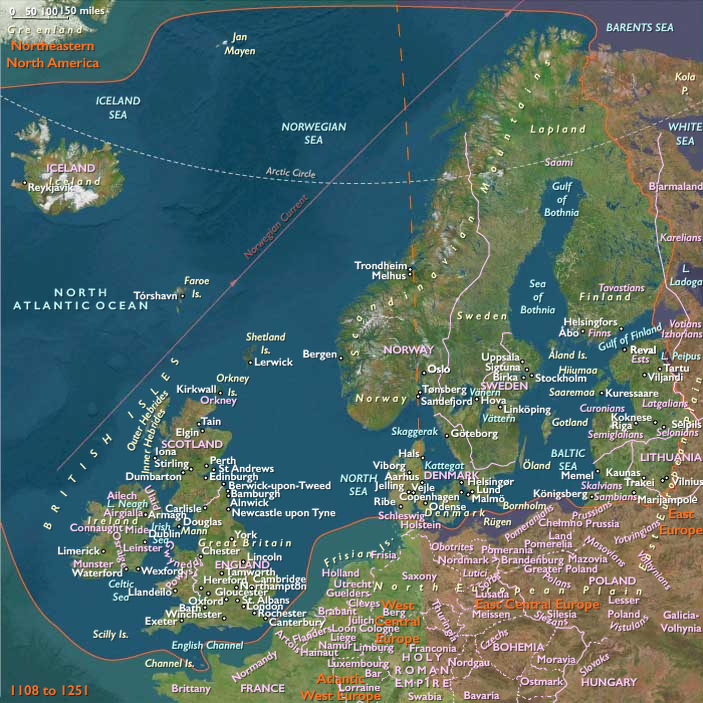
Accompanying Robert are his cousin Robert of Normandy (brother of King William II Rufus of England) and Stephen of Blois (the son-in-law of William I the Conqueror).
No king takes part in the First Crusade, and the predominantly French-speaking participants will come to be known as Franks.
The presence near Constantinople of massive military forces, numbering perhaps four thousand mounted knights and twenty-five thousand infantry, poses a serious problem for Alexios, and there is occasional disorder.
The size of the entire crusader army is difficult to estimate; various numbers are given by the eyewitnesses, and equally various estimates have been offered by modern historians.
Crusader military historian David Nicolle considers the armies to have consisted of about thirty thousand to thirty-five thousand crusaders, including five thousand cavalry.
Raymond has the largest contingent of about eighty-five hundred infantry and twelve hundred cavalry.
The princes have arrived in Constantinople with little food and expect provisions and help from Alexios.
Alexios is understandably suspicious after his experiences with the People's Crusade, and also because the knights include his old Norman enemy, Bohemond, who had invaded Imperial territory on numerous occasions with his father, Robert Guiscard, and may have even attempted to organize an attack on Constantinople while encamped outside the city.
The crusaders may have expected Alexios to become their leader, but he has no interest in joining them, and is mainly concerned with transporting them into Asia Minor as quickly as possible.
Since the crusade has to pass through Constantinople, however, the Emperor has some control over it.
Forced to consider the permanent imperial interests—which, it soon becomes evident, are different from the objective of the crusaders—the Emperor requires each Crusade leader to promise under oath to restore any conquered territory that had belonged to the empire before the Turkish invasions and to swear allegiance to him for any lands occupied beyond the former frontiers.
In return, he will give them guides and a military escort.
Still, the cost will be enormous, for the crusaders must be supplied with food or live off the land as they travel.
Godfrey is the first to take the oath, and almost all the other leaders follow him, although they do so only after warfare had almost broken out in the city between the citizens and the crusaders, who are eager to pillage for supplies.
Raymond alone avoids swearing the oath, instead pledging that he will simply cause no harm to the Empire, a modified form of oath common in southern France (and in the end he will remain of all the Crusade leaders the most loyal to Alexios).
Before ensuring that the various armies are shuttled across the Bosporus, Alexios advises the leaders on how best to deal with the Seljuq armies that they will soon encounter.
The main Crusader army, largely French and Norman knights under baronial leadership, had begun to cross over into Asia Minor from Constantinople at the end of April 1097.
Godfrey of Bouillon had been the first to arrive at Nicaea, with Bohemond of Taranto, Bohemond's nephew Tancred, Raymond IV of Toulouse, and Robert II of Flanders following him, along with Peter the Hermit and some of the survivors of the People's Crusade, and a small imperial force under Manuel Boutoumites and Tatikios.
They arrive on May 6, severely short on food, but Bohemond arranges for food to be brought by land and by sea.
They put the city to siege beginning on May 14, assigning their forces to different sections of the walls, which are well-defended with two hundred towers.
Bohemond camps on the north side of the city, Godfrey on the east, and Raymond and Adhemar of Le Puy on the south.
Arslan is away campaigning against the Danishmends in central Anatolia at the time, and has left behind his treasury and his family, underestimating the strength of these new crusaders.
On May 16, the Turkish defenders sally out to attack the crusaders, but the Turks are defeated in a skirmish with the loss of two hundred men.
The Turks send messages to Kilij Arslan begging him to return, and when he realizes the strength of the crusaders he quickly turns back.
An advance party is defeated by troops under Raymond and Robert of Flanders on May 20, and on May 21, the crusader army defeats Kilij in a pitched battle that lasts long into the night.
Losses are heavy on both sides but in the end the Sultan retreats, despite the pleas of the Nicaean Turks.
The rest of the crusaders arrive throughout the rest of May, with Robert Curthose (accompanied by Ralph de Guader) and Stephen of Blois arriving at the beginning of June.
Meanwhile Raymond and Adhemar build a large siege engine, which is rolled up to the Gonatas Tower in order to engage the defenders on the walls while miners mine the tower from below.
The tower is damaged but no further progress is made.
The siege continues, but the crusaders have little success as they find they cannot blockade the lake, upon which the city is situated, and from which it can be provisioned.
Emperor Alexios had chosen not to accompany the crusaders, but had marched out behind them and made his camp at nearby Pelecanum.
From there, he sends boats, rolled over the land, to help the crusaders blockade Lake Ascanius, which has up to this point been used by the Turks to supply Nicaea with food.
The boats arrive on June 17, under the command of Manuel Boutoumites.
The general Tatikios is also sent, with two thousand foot soldiers.
Alexios has instructed Boutoumites to secretly negotiate the surrender of the city without the crusaders' knowledge.
Tatikios has been instructed to join with the crusaders and make a direct assault on the walls, while Boutoumites will pretend to do the same to make it look as if the imperial forces had captured the city in battle.
This is done, and on June 19 the Turks surrender to Boutoumites.
The city is handed over to the imperial troops, which has often been depicted as a source of conflict between the Empire and the crusaders; imperial standards fly from the walls while Boutoumites is named dux of Nicaea and forbids the crusaders from entering in groups larger than ten men at a time.
Boutoumites also expels the Turkish generals, whom he considers just as untrustworthy (and indeed, these men try to take their Greek guides hostage on their way to meet with the emperor).
Kilij Arslan's family goes to Constantinople and will eventually be released without ransom.
Alexios gives the crusaders money, horses, and other gifts, but the crusaders are not pleased with this, believing they could have had even more if they had captured Nicaea themselves.
Boutoumites will not permit them to leave until they have all sworn an oath of vassalage to Alexios, if they had not yet done so in Constantinople.
As he had in Constantinople, Tancred at first refuses, but he eventually gives in.
The crusaders leave Nicaea on June 26, in two contingents, in order to simplify the problem of supplies.
Bohemond, Tancred, Robert of Flanders, and Tatikios are in the vanguard, and Godfrey, Baldwin of Boulogne, Stephen, and Hugh of Vermandois in the rear.
Tatikios has been instructed to ensure the return of captured cities to the empire.
Their spirits are high: Stephen, in a letter to his wife Adela of Blois, writes that he believes the journey will take five weeks; in reality, it will take two years.
The crusaders learn on June 29 that the Turks are planning an ambush near Dorylaeum (Bohemond had noticed that his army is being shadowed by Turkish scouts).
The Turkish force, consisting of Kilij Arslan I and his ally Hasan of Cappadocia, along with help from the Danishmendids, led by the Turkish prince Ghazi ibn Danishmend, the Persians, and the Caucasian Albanians.
Contemporary figures place this number between twenty-five thousand and thirty thousand, more recent estimates are between six thousand to eight thousand men.
In addition to large numbers of noncombatants, Bohemond's force probably numbers about ten thousand, the majority on foot.
Military figures of the time often imply perhaps several men-at-arms per knight (i.e., a stated force of five hundred knights is assumed to contain perhaps fifteen hundred men-at-arms in addition), so it seems reasonable that Bohemond had with him approximately eight thousand men-at-arms and two thousand cavalry.
On the evening of June 30, after a three-day march, Bohemond's army makes camp in a meadow on the north bank of the river Thymbres, near the ruined town of Dorylaeum (Many scholars believe that this is the site of the modern city of Eskişehir).