Maximilian III Joseph
Elector of Bavaria
Years: 1727 - 1777
Maximilian III Joseph (28 March 1727 – 30 December 1777) is Prince-elector of the Holy Roman Empire and Duke of Bavaria from 1745 to 1777.
Related Events
Filter results
Showing 10 events out of 11 total
The Austrians enjoy further military success following the death of the French puppet, Emperor Charles VII, in January 1745.
When his successor, Maximilian III Joseph, hesitates over peace proposals, the Austrians launch a rapid campaign, culminating in April with the Franco-Bavarian defeat at the decisive Battle of Pfaffenhofen.
Max Joseph sues for peace and gives his support for the candidacy of Maria Theresa's husband, Francis Stephen, in the coming Imperial election for the vacant throne.
The Austrians, with Bavaria out of the war, can now try to win back Silesia from Frederick II.
Bavarian repudiation of its French ties likewise means France is freed of its German involvement, and can now concentrate on its own military efforts in Italy and the Low Countries.
Saxe had prepared plans for a spring offensive in the Low Countries as early as December 1744.
He has made up his mind not only what he will do, but what he will compel his enemy to do, correctly calculating the operational and political difficulties that such a diverse opponent will face.
This opponent comprises Britain, the Dutch Republic, Austria, and Saxony, who conclude the defensive Treaty of Warsaw in January 1745—the Quadruple Alliance—by which all signatories commit themselves to uphold the Pragmatic Sanction and the House of Austria's claim to the Imperial crown.
To the Low Countries, the British send the son of King George II, the twenty-four-year old Duke of Cumberland, as the new Captain General of Britain's army, while Maria Theresa sends the experienced Count Königsegg to command Austrian forces.
The trio of generals is completed by Prince Waldeck, commander of the Dutch contingent in theater.
They hope to gain the initiative by the establishment of forward magazines and an early opening of the campaign season.
Major supply and ammunition depot magazines are set up for the British by General Ligonier at Ghent, Oudenarde and Tournai, while the Dutch General Vander—Duyn places theirs at Mons, Charleroi and Tournai.
The victory is followed by a rapid French advance.
Tournai surrenders to Saxe on 21 May and on June 20 the citadel of Tournai capitulates.
Ghent follows in mid-July after Moltke's repulse at Melle with an immense amount of supplies and material along with its garrison consisting of twenty-two hundred Dutch troops; and some seven hundred British troops.
The Allied field army, now reduced to thirty-five thousand men, is less than half the number of the French and they fall back to Diegem in the vicinity of Brussels.
Bruges and Oudenarde soon capitulate, and by the end of July the French stand on the threshold of Zeeland, the south-western corner of the Dutch Republic.
Additionally, the triumph of Saxe over the British inspires the second Jacobite rising, the Forty-Five, under the Young Pretender, Bonnie Prince Charlie.
Charles with a small contingent of troops returns to Scotland and invades England.
He has some reason to believe in his ultimate success as all but eight thousand British troops are away on the continent and recently defeated at Fontenoy.
Charles' return to Scotland combined with a stunning victory at the Battle of Prestonpans obliges Cumberland to pull his army back to England to deal with the Jacobite invasion.
The British government is greatly concerned with developments in Flanders but the military tide has turned in French favor.
Dendermonde and the vital port of Ostend, where a battalion of British Foot Guards and a garrison of four thousand falls to French forces in August, and Nieuport in early September.
The only good news for the British comes in North America when William Pepperrell captures the key French fortress of Louisbourg at Cape Breton in late June.
Saxe has in the space of three months achieved his grand design: he has established himself on the shores of the English Channel and the river Scheldt.
Britain is perilously near to exclusion from the mainland of Europe, and will find it hard to make contact with its continental allies.
With the capitulation of Ath in early October, France controls much of the Austrian Netherlands.
Saxe, now raised to heroic status in his adopted country, is soon threatening Brussels and Antwerp.
His initial aim is to take control of the upper Scheldt basin and thereby gain access to the heart of the Austrian Netherlands.
To these ends, he first besieges the fortress of Tournai, protecting the siege with his main force about five miles (nine kilometers) southeast of the town.
In order to relieve Tournai, the allies first decide to attack Saxe's position—a naturally strong feature, hinged on the village of Fontenoy and further strengthened by defensive works.
After failing to make progress on the flanks—the Dutch on the left, Brigadier Ingolsby's brigade on the right—Cumberland decided to smash his way through the center without securing the flanks of his main attack.
Despite devastating flanking fire the allied column, made up of British and Hanoverian infantry, bursts through the French lines to the point of victory.
Only when Saxe concentrates all available infantry, cavalry, and artillery is the column forced to yield.
The allies retreat in good order, conducting a fighting withdrawal.
The battle has shown, however, the strength of a defensive force relying on firepower and a strong reserve.
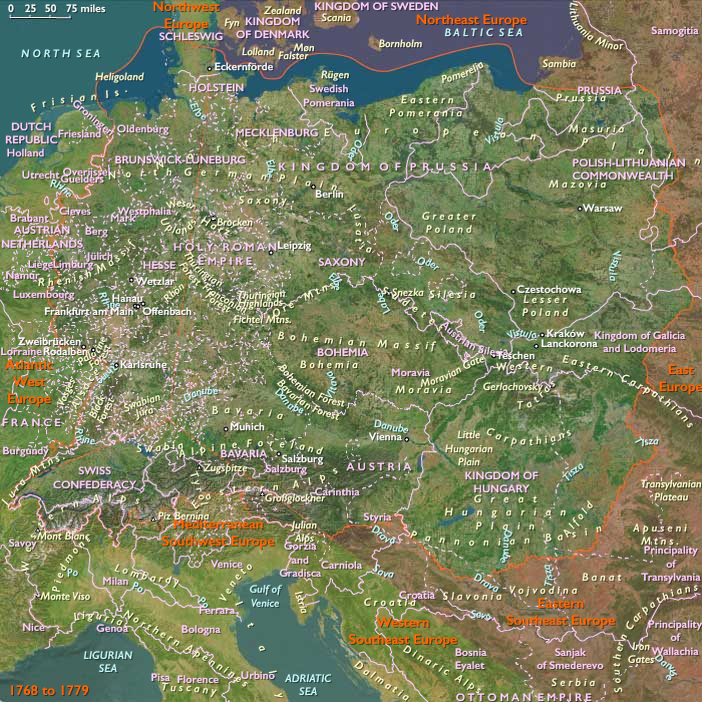
East Central Europe (1768–1779 CE): First Partition of Poland, Enlightened Absolutism, and Habsburg-Prussian Rivalry Intensified
Between 1768 and 1779 CE, East Central Europe—encompassing modern-day Poland, Czechia, Slovakia, Hungary, and the regions of eastern Germany and Austria east of 10°E and north of the defined boundary—experienced significant geopolitical realignments, highlighted by the First Partition of Poland (1772), intensified rivalry between Habsburg Austria and Prussia, and continuing Enlightenment-inspired reforms. These events reshaped political boundaries, social structures, and cultural dynamics, leaving enduring impacts on the region's historical trajectory.
Political and Military Developments
First Partition of Poland (1772)
-
In 1772, the First Partition of Poland profoundly altered regional politics, significantly reducing Polish sovereignty. Initiated by Prussia, Austria, and Russia, this partition divided substantial portions of Polish territory among these powers:
-
Prussia acquired West Prussia, establishing a direct territorial link between Brandenburg and East Prussia, significantly enhancing Prussian economic strength.
-
Austria annexed southern territories including parts of Galicia and Lodomeria, expanding its northeastern frontier and incorporating the important city of Lemberg (Lviv) into its domains.
-
Russia absorbed extensive eastern territories, greatly enhancing its western borderlands.
-
-
Poland’s territorial integrity was irreparably damaged, and the Polish-Lithuanian Commonwealth began a steady decline in autonomy and international standing.
War of the Bavarian Succession (1778–1779)
-
Following the death of Elector Maximilian Joseph III of Bavaria in 1777, Joseph II of Austria sought territorial expansion in Bavaria, sparking the War of the Bavarian Succession (1778–1779), also known as the Potato War.
-
Frederick the Great of Prussia swiftly opposed Austrian ambitions, reinforcing Prussian strength and challenging Habsburg influence in southern Germany.
-
Diplomatic interventions by France and Russia resulted in the Treaty of Teschen (1779), forcing Austria to abandon its ambitious territorial claims while retaining minor concessions, demonstrating the ongoing Austro-Prussian rivalry.
Economic and Technological Developments
Economic Gains from Partition
-
The First Partition of Poland substantially benefited Prussian and Austrian economies:
-
Prussia’s acquisition of West Prussia provided vital Baltic ports and fertile agricultural lands, significantly enhancing trade and agricultural production.
-
Austria’s new Galician territories provided productive agricultural resources, particularly grain and livestock, which strengthened the empire’s economic base.
-
Agricultural and Industrial Innovations
-
Enlightenment-influenced reforms continued, emphasizing agricultural modernization, industrial development, and infrastructure improvements in Austria and Prussia, including innovations in farming techniques, crop rotations, and livestock breeding.
Cultural and Artistic Developments
Enlightenment and Reforms in Austria and Prussia
-
Under Maria Theresa (1740–1780) and her son Joseph II (co-ruler from 1765), Austria pursued extensive Enlightenment-inspired reforms promoting centralized governance, educational enhancements, judicial improvements, and limited religious toleration.
-
Frederick the Great intensified Enlightenment-influenced governance, emphasizing education, scientific advancement, and cultural patronage, reinforcing Prussia’s intellectual prominence.
Cultural Flourishing and Artistic Patronage
-
Cultural vibrancy continued in key cities, including Vienna, Prague, and Berlin, marked by architectural developments, music, literature, and philosophical discourse. Notable figures like composer Christoph Willibald Gluck and dramatist Gotthold Ephraim Lessing enhanced regional cultural vitality.
Settlement and Urban Development
Urban and Infrastructural Expansion
-
Urban growth accelerated notably in Prussian-controlled West Prussia (notably Danzig/Gdańsk), Austrian Galicia (Lemberg/Lviv), and major cities such as Vienna, Prague, and Berlin, reflecting heightened administrative and economic integration of new territories.
-
Infrastructure improvements, including roads, canals, and civic architecture, accompanied this urban growth, boosting regional trade and connectivity.
Social and Religious Developments
Continued Enlightenment Reforms
-
Enlightenment-influenced monarchs implemented social reforms promoting centralized bureaucracy, meritocratic administration, legal rationalization, and educational advancement, profoundly reshaping social structures.
Religious Toleration and Diversity
-
Policies promoting religious tolerance persisted, notably under Frederick II in Prussia and Joseph II in Austria, fostering improved religious coexistence and integration within the increasingly diverse populations of their territories.
Long-Term Consequences and Historical Significance
The era 1768–1779 CE was critical for East Central Europe, significantly shaped by the First Partition of Poland and the intensified Habsburg-Prussian rivalry as exemplified by the War of the Bavarian Succession. The territorial division of Poland decisively altered regional geopolitical dynamics, strengthening Prussia and Austria economically and strategically while severely weakening Polish sovereignty. Enlightenment-inspired reforms and cultural flourishing continued to reshape governance, societal structures, and intellectual life across the region. These developments set crucial foundations for the further partitions of Poland, intensified Austro-Prussian competition, and transformative societal and political shifts into the late 18th and early 19th centuries.