Mehmed I
Sultan of the Ottoman Empire (Rûm)
Years: 1381 - 1421
Mehmed I Çelebi (1381, Bursa – May 26, 1421, Edirne, Ottoman Empire) is the sultan of the Ottoman Empire (Rûm) from 1413 to 1421.
He is one of the sons of Bayezid I and Devlet Hatun.
Related Events
Filter results
Showing 9 events out of 9 total
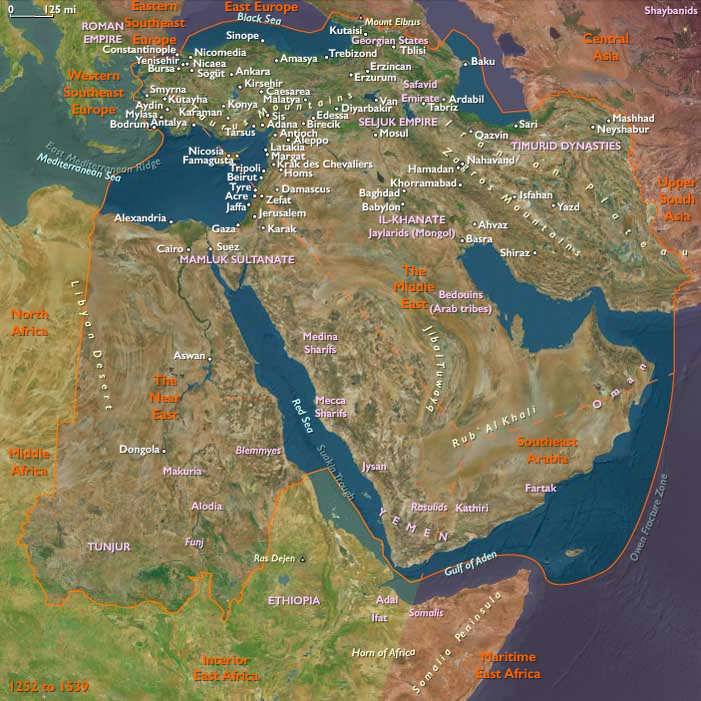
The descendants of the Turkmen notables who had assisted the early Ottoman conquests in Europe support the claims of Mehmed, who rules in Amasya.
With the additional support of the Anatolian Muslim religious orders and artisan guilds…
…Mehmed is able to defeat and strangle his brother Isa Bey of Balikesir in southwestern Anatolia, and seize Bursa.
He now sends another brother, Mûsa Bey, against Süleyman.
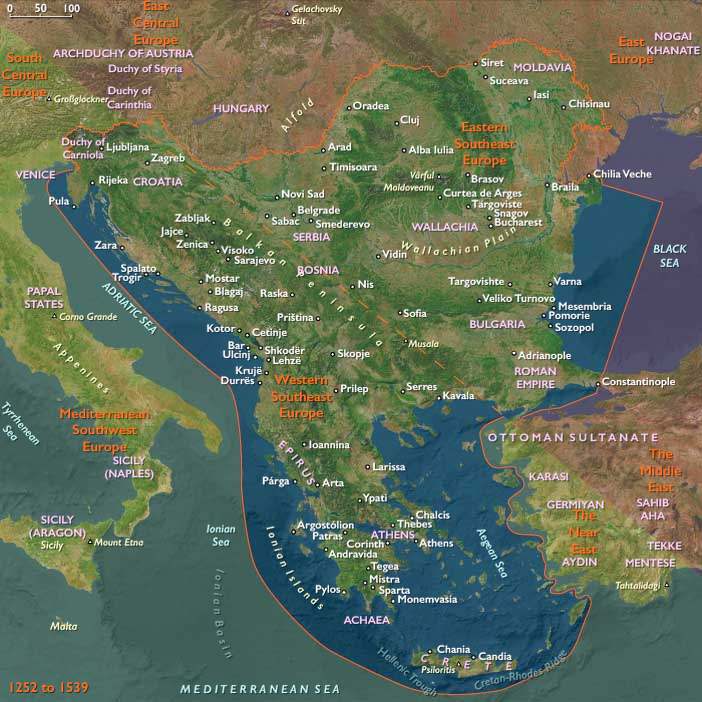
Eastern Southeast Europe (1408–1419 CE): Ottoman Interregnum and Regional Reassertion
Settlement and Migration Patterns
Ottoman Interregnum and Political Fragmentation
Following the defeat of Ottoman Sultan Bayezid I by Timur (Tamerlane) at the Battle of Ankara (1402), the Ottoman Empire entered a prolonged interregnum (1402–1413), known as the Ottoman Civil War. The resulting fragmentation temporarily weakened Ottoman control in Eastern Southeast Europe, as various Ottoman princes vied for power, causing instability and population displacement throughout Thrace and Macedonia.
Regional Powers Reassert Authority
The Ottoman interregnum enabled regional powers—including Serbia, Wallachia, and Hungarian-influenced Bulgaria—to regain a degree of autonomy. Serbian despot Stefan Lazarević notably expanded and solidified control over central and northern Serbia, revitalizing Belgrade as a prominent cultural and economic center. Wallachia under Mircea the Elder strengthened its autonomy, carefully balancing diplomatic relationships between Hungary and the fractured Ottoman domains.
Economic and Technological Developments
Renewed Economic Activity and Trade Revival
The temporary weakening of Ottoman dominance allowed regional trade and commerce, particularly along the Danube and through the Black Sea ports, to briefly flourish independent of centralized Ottoman control. Cities such as Belgrade, Smederevo, and Vidin experienced revived economic activities, becoming critical commercial hubs for regional trade between Central Europe and the Black Sea basin.
Fortification Efforts and Military Readiness
In response to the uncertain political landscape, regional leaders, particularly the Serbian despotate under Stefan Lazarević and Wallachian authorities, significantly enhanced military defenses. Belgrade, heavily fortified during this period, emerged as a key military stronghold and an influential economic center along the Hungarian frontier.
Cultural and Artistic Developments
Serbian Cultural Renaissance
Under Stefan Lazarević, the Serbian despotate experienced a remarkable cultural renaissance. Belgrade became a vibrant cultural and intellectual center, attracting scholars, artists, and architects from Byzantium and Western Europe. Lavish manuscripts, frescoes, and new church architecture demonstrated a sophisticated blending of Byzantine traditions with local Serbian innovations.
Preservation and Revival of Orthodox Traditions
Throughout the region, particularly in Serbia, Wallachia, and Bulgarian territories, Orthodox Christian traditions enjoyed a period of renewed vigor. Monastic centers and churches underwent renovation and expansion, producing illuminated manuscripts and religious artworks that helped reinforce regional identity amidst the shifting political dynamics.
Social and Religious Developments
Temporary Restoration of Local Autonomies
The Ottoman civil war significantly altered local governance structures, enabling the restoration and enhancement of local autonomies. Serbian, Wallachian, and Bulgarian rulers used this opportunity to assert authority, strengthening regional political cohesion and fostering greater cultural and religious autonomy under Orthodox Christian frameworks.
Increased Influence of Orthodox Christianity
Orthodox Christianity's social and cultural prominence grew significantly during this era, especially under Serbian despot Stefan Lazarević. Ecclesiastical centers flourished as religious institutions played pivotal roles in community life, governance, and education, solidifying the social cohesion of Orthodox populations.
Political Dynamics and Regional Rivalries
Reemergence of Hungarian Influence
Hungary, under King Sigismund of Luxembourg, capitalized on Ottoman fragmentation, strengthening political influence across Wallachia, Moldavia, and the northern Serbian territories. Hungarian diplomatic and military initiatives sought to counterbalance the Ottomans, actively promoting regional alliances aimed at containing future Ottoman resurgence.
Ottoman Reconsolidation under Mehmed I (1413–1421)
By the end of this era, Mehmed I successfully emerged as Ottoman Sultan, ending the Ottoman civil war by reuniting disparate Ottoman territories. His consolidation efforts began the reassertion of Ottoman authority in Eastern Southeast Europe, setting the stage for renewed Ottoman expansion in subsequent decades.
Long-Term Consequences and Historical Significance
The era from 1408 to 1419 CE represented a pivotal interlude during which regional powers temporarily regained autonomy amid Ottoman fragmentation. The period witnessed notable cultural flourishing, especially in Serbia, alongside revived regional trade networks and reinforced military fortifications. Ultimately, this period of relative independence and cultural revival laid important foundations for subsequent historical developments, significantly influencing Eastern Southeast Europe's socio-political and cultural resilience in the face of renewed Ottoman expansion.
The Ottoman Turks expand their empire from Anatolia to the Balkans in the fourteenth century.
They had crossed the Bosporus in 1352 and crushed the Serbs at Kosovo Polje, in the south of modern-day Kosovo, in 1389.
Tradition holds that Walachia' s Prince Mircea the Old (1386-1418) sent his forces to Kosovo to fight beside the Serbs; soon after the battle Sultan Bayezid marched on Walachia and imprisoned Mircea until he pledged to pay tribute.
After a failed attempt to break the sultan's grip, Mircea had fled to Transylvania and enlisted his forces in a crusade called by Hungary's King Sigismund.
The campaign ends miserably: the Turks rout Sigismund's forces in 1396 at Nicopolis in present-day Bulgaria, and Mircea and his men are lucky to escape across the Danube.
In 1402 Walachia gains a respite from Ottoman pressure as the Mongol leader Tamerlane attacks the Ottomans from the east, kills the sultan, and sparks a civil war.
When peace returns, the Ottomans renew their assault on the Balkans.
In 1417 Mircea capitulates to Sultan Mehmed I and agrees to pay an annual tribute and surrender territory; in return the sultan allows Walachia to remain a principality and to retain the Eastern Orthodox faith.
Eastern Southeast Europe (1420–1431 CE): Ottoman Reconsolidation and Regional Transformation
Settlement and Migration Patterns
Restoration and Expansion under Mehmed I and Murad II
From 1420 to 1431 CE, the Ottoman Empire, under the leadership of Mehmed I (1413–1421) and his son Murad II(1421–1451), experienced a significant restoration and subsequent territorial expansion. Following the turmoil of the Ottoman Interregnum (1402–1413), Mehmed I restored central authority, reestablished the Ottoman vassal system in Bulgaria and Serbia, and secured temporary peace in Europe by pledging to avoid further conquest. Upon his death, Murad II vigorously resumed Ottoman expansion, reasserting control over Thessaly, Macedonia, and significant portions of Anatolia.
Economic and Technological Developments
Revival of Trade and Tribute Systems
The restoration of Ottoman rule brought a renewed economic framework based on tribute from vassal states, notably the Byzantine Empire. Murad II's siege of Constantinople (1422), though unsuccessful militarily, secured substantial tribute, strengthening Ottoman economic leverage. Key trade cities such as Salonika, captured from Venice in 1430, were reincorporated into Ottoman economic networks, revitalizing regional commerce.
Military Reforms and the Establishment of the Janissary Corps
Murad II initiated profound military reforms to counterbalance the power of established Turkish nobility. Central to this was the expansion of the Janissary corps, an elite infantry force composed largely of converted Christians and slaves. Murad institutionalized the devshirme system, systematically drafting Christian youths from Balkan territories into imperial service. This provided the Ottoman military with a loyal, disciplined infantry, significantly enhancing military effectiveness and shifting the empire's internal power dynamics.
Cultural and Artistic Developments
Byzantine Cultural Resistance and Resilience
Despite increasing Ottoman pressure, Byzantine cultural and intellectual life persisted, particularly within Constantinople, which continued as a focal point of artistic and scholarly activity. Though increasingly isolated and economically strained, the Byzantine capital sustained significant cultural productivity, especially in religious and philosophical literature, preserving classical and Orthodox traditions.
Ottoman Architectural and Cultural Patronage
Under Murad II, Ottoman cultural patronage flourished. The empire invested in mosque construction, theological colleges (medreses), and urban infrastructure within newly consolidated territories. The incorporation of Salonika (1430) into Ottoman domains facilitated architectural and cultural synthesis, exemplified by new Ottoman-style public buildings and mosques in former Byzantine urban centers.
Social and Religious Developments
Strengthening of Islamic Institutions
Murad II significantly advanced Islamic institutions within Ottoman territories, building mosques, medreses, and caravansaries, and further integrating Islamic religious authority into state administration. This enhanced Islamic presence solidified Ottoman rule and encouraged conversions, integrating previously Christian-majority regions into an expanding Islamic socio-political framework.
Increasing Orthodox Christian Pressures
Orthodox Christian communities faced heightened pressures under Ottoman reconsolidation. The devshirme system, which forcibly drafted Balkan Christian youths, caused considerable societal strain and resentment. Nevertheless, the Orthodox Church continued to serve as a vital institution for preserving regional cultural identity, maintaining continuity and resilience amid escalating Ottoman dominance.
Political Dynamics and Regional Rivalries
Byzantine Political Intrigue and Ottoman Reprisal
The Byzantine Empire under Emperor John VIII Palaiologos attempted to exploit Ottoman instability at Mehmed I's death (1421) by supporting rival claimants to prevent Murad II's accession. This intervention backfired severely; Murad II swiftly neutralized opposition, revoked Byzantine privileges, and placed Constantinople under siege in 1422. Although the siege failed militarily, it reinforced Ottoman dominance politically and economically, forcing Constantinople into increased subservience.
Expansion and Consolidation of Ottoman Authority
By the late 1420s, Murad II had effectively quelled internal revolts and reasserted Ottoman control across Anatolia and the Balkans, culminating in the conquest of Salonika from Venice in 1430. His strategic combination of military force, administrative reorganization, and economic leverage decisively consolidated Ottoman hegemony in the region.
Long-Term Consequences and Historical Significance
The period from 1420 to 1431 CE marked a decisive turning point, characterized by significant Ottoman reconsolidation, territorial expansion, and profound internal transformations, including military and administrative reforms. These developments established enduring Ottoman dominance, reshaped regional political landscapes, and significantly influenced Eastern Southeast Europe's cultural and religious trajectories. The strengthened Ottoman state set the stage for future imperial expansion, eventually leading to the fall of Constantinople in 1453.
A new period of expansion, in which Sultan Bayezid's empire is restored and new territories are added, occurs under Bayezid's son Mehmed I, and Mehmed's son Murad II.
Mehmed restores the vassal system in Bulgaria and Serbia, promising that he will not undertake new European adventures.
Murad II is also compelled to devote most of the early years of his reign to internal problems, particularly to the efforts of the ghazi commanders and Balkan vassal princes in Europe, as well as the Turkmen vassals and princes in Anatolia, to retain the autonomy and—in some areas—independence that had been gained during the Ottoman Interregnum from 1402 to 1413.
Murad suppresses the Balkan resistance in 1422-23 and puts Constantinople under a new siege that ends only after the Empire provides him with huge amounts of tribute.
He then restores Ottoman rule in Anatolia and eliminates all Turkmen principalities left by Timur, with the exceptions of Karaman and Candar, which he leaves autonomous though tributary so as not to excite the renewed fears of Timur's successors in the East.
Placed on the throne by Turkish notables who had joined the Ottoman state during the first century of its existence, Murad soon begins to resent the power they have gained in return; the power of these notables is also enhanced by the great new estates they have built up in the conquered areas of Europe and Anatolia.
To counteract their power, he begins to build up the power of various non-Turkish groups in his service, particularly those composed of Christian slaves and converts to Islam, whose military arm is organized into a new infantry organization called the Janissary corps.
To strengthen this group Murad begins to distribute most of his new conquests to its members, and to add new supporters of this sort he develops the famous devshirme system, by which Christian youths are drafted from the Balkan provinces for conversion to Islam and life service to the sultan.
Emperor John VIII Palaiologos encourages a Turkish pretender at the death of Ottoman sultan Mehmed I in 1421 in hopes of preventing the ascent of eighteen-year-old Murad II and thereby causing disruption within the ranks and leadership of the Ottoman Empire.
Murad crushes the plot, then revokes all the privileges that the Turks had granted the Greeks after lifting their siege of Constantinople in 1399.
The Ottomans besiege Constantinople again in 1422, but the combination of stiff resistance by the defenders and the city’s nearly impregnable walls force the attackers to retire. (Another factor prompting the Turkish withdrawal may have been Murad’s necessary return to the Ottoman capital to prevent another pretender, also possibly encouraged by Constantinople, from usurping power.)
Murad, called the Restorer, has by 1430 reestablished Ottoman control of Thessaly and Macedonia, occupied Anatolia's Aegean coast, and won Salonika in a war with Venice.
Emperor Manuel II Palaiologos withdraws from state affairs to pursue his religious and literary interests.
His son John VIII, crowned co-emperor in 1421, ignores the tenuous bond with the Ottomans that has been established and in this year supports the pretender Mustafa against the rightful heir to the Turkish throne, Murad II, in hope of causing disruption within the ranks and leadership of the Ottoman Empire.
However, …
Peaceful relations persist between Constantinople and the Ottoman Empire until May 26, 1421, when Mehmed dies.
The reign of Mehmed I as sultan of the reunited empire had lasted only eight years before his death, but he had also been the most powerful brother contending for the throne and de facto ruler of most of the empire for nearly the whole preceding period of elevenyears of the Ottoman Interregnum that passed between his father's captivity at Ankara and his own final victory over his brother Musa Çelebi at the Battle of Çamurlu.
Mehmed is buried in Bursa, in a mausoleum erected by himself near the celebrated mosque which he built there, and which, because of its decorations of green porcelain, is called the Green Mosque.
Mehmed I also completed another mosque in Bursa, which his grandfather Murad I had commenced but which had been neglected during the reign of Bayezid.
Mehmed had founded in the vicinity of his own Green Mosque and mausoleum two other characteristic institutions, one a school and one a refectory for the poor, both of which he has endowed with royal munificence.